Used School Locker Collections: 7 Smart Buying Secrets for Budget-Conscious Facilities and Unique Interiors
Educational institutions, athletic departments, commercial manufacturing plants, and creative commercial businesses face escalating equipment procurement costs that strain capital expenditure budgets. Sourcing used school locker collections provides a cost-effective, environmentally responsible alternative to purchasing brand-new commercial steel storage units, slashing equipment acquisition costs by forty to seventy percent without sacrificing structural security or physical longevity. Heavy-gauge prime steel lockers engineered for K-12 corridors and university athletic facilities were originally fabricated to withstand decades of rigorous daily abuse. When commercial facilities, charter academies, and adaptive re-use developers purchase surplus or factory-reconditioned locker banks, they acquire time-tested industrial hardware that outperforms lightweight modern retail cabinetry while diverting hundreds of pounds of structural steel from regional landfills.
The Economics and Durability Standards of Commercial Steel Lockers
Institutional steel lockers are constructed according to stringent industrial fabrication standards that far surpass the material specifications of civilian flat-pack furniture. Understanding the metallurgical composition, gauge thicknesses, and structural welding standards of legacy locker banks helps facility managers evaluate the long-term value proposition of surplus equipment.
Structural Metallurgy and Steel Gauge Engineering
In commercial metal fabrication, steel thickness is measured inversely by gauge number: a lower gauge number designates a thicker, stronger steel sheet. Commercial-grade locker banks utilize sixteen-gauge or fourteen-gauge cold-rolled steel for operational door leaves and structural perimeter door frames, while twenty-gauge or twenty-four-gauge steel forms the internal shelving, side panels, and back enclosures.
Resistance to Mechanical Impact and Forced Entry
Thin retail storage units buckle under concentrated impacts, causing door alignment failure, latch binding, and compromised locking security. In contrast, institutional used school locker collections feature perimeter flange folds, continuous piano hinges, and channel-formed vertical door edges that resist pry-bar tampering, forceful kicks, and repetitive slam cycles across decades of continuous student and employee traffic.
Sustainable Procurement and Circular Economy Benefits
Specifying refurbished or surplus locker banks aligns directly with corporate sustainability goals and institutional LEED building certifications. Steel manufacturing remains one of the most energy-intensive industrial processes on the planet. By extending the operational lifecycle of existing steel assemblies through surface cleaning, dent straightening, and electrostatic powder coating, organizations reduce the carbon footprint associated with virgin steel smelting, industrial roll-forming, and long-distance freight distribution.
Standard Configurations Found in Surplus Locker Inventories
Surplus locker distributors and institutional liquidators organize inventories into standardized tier configurations designed for distinct storage capacities and room footprints.
Single-Tier Lockers (Full-Length Wardrobe Units)
Single-tier units measure sixty or seventy-two inches in clear vertical height. Each individual compartment features a full-height swinging door, an upper hat shelf, and multiple interior coat hooks or wardrobe rods. These units are ideal for secondary high schools, corporate employee change rooms, fire stations, and police locker bays where personnel must hang full-length winter coats, tactical uniforms, or full backpacks without folding or crumpling garments.
Double-Tier Lockers (Two-Tier Split Units)
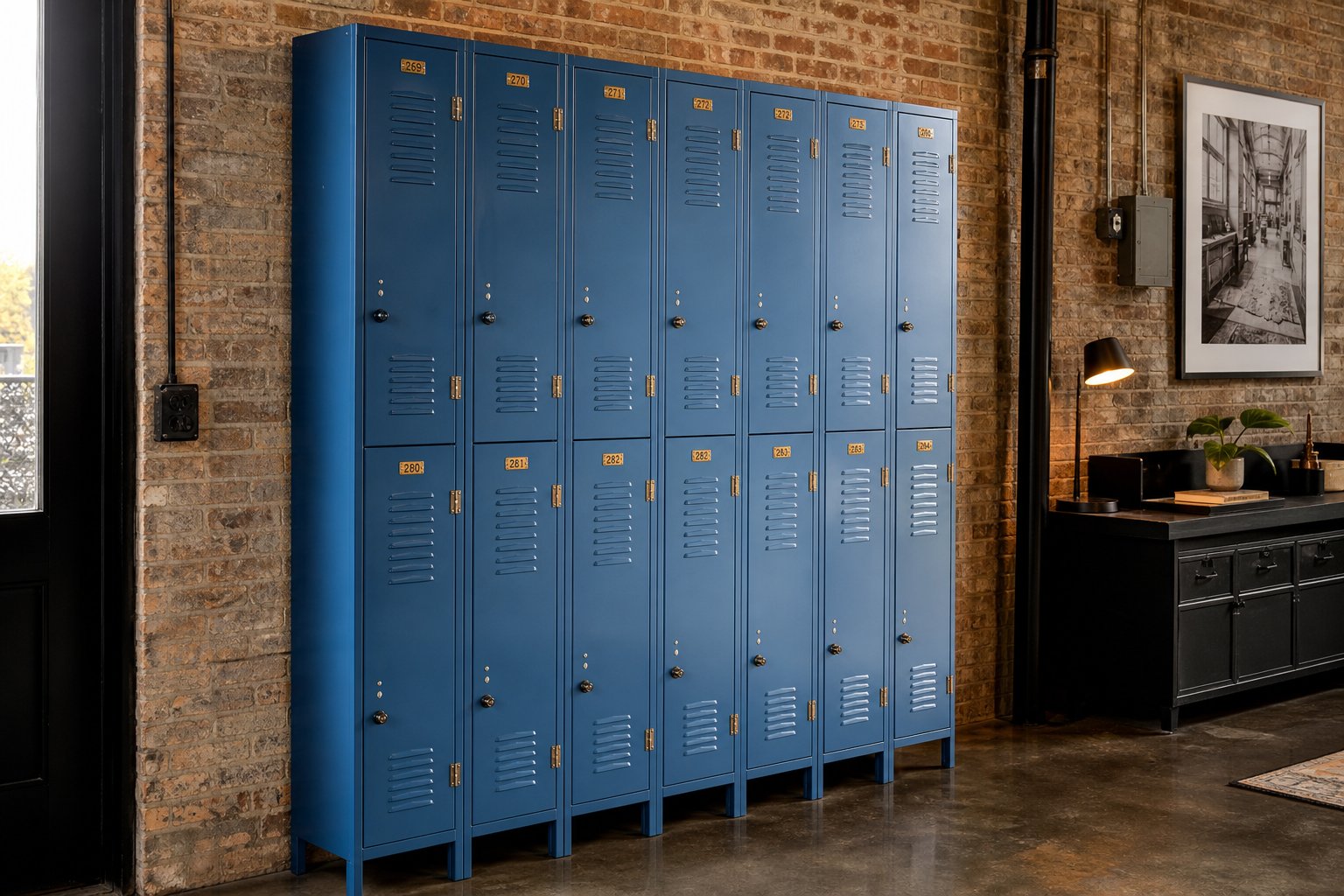
Double-tier assemblies stack two operational compartments within a single vertical locker frame, providing individual thirty-inch or thirty-six-inch high storage compartments. This configuration doubles storage capacity within the same horizontal wall footprint, making it the preferred standard for middle schools, fitness centers, and commercial production facilities balancing personal item security with tight hallway clearances.
Triple-Tier and Multi-Tier Box Lockers
Multi-tier box configurations divide a standard locker frame into three, five, or six stacked compartments, often referred to as gym box lockers. Measuring twelve to eighteen inches square, these compact compartments are engineered for secure daily storage of athletic sneakers, personal gym gear, wallets, textbooks, and mobile phones during athletic training sessions or work shifts.
Heavy-Duty Welded Athletic and Open-Front Team Lockers
Unlike standard corridor lockers, varsity athletic lockers often feature perforated or heavy-gauge expanded metal mesh side panels that facilitate unrestricted convective airflow, accelerating the drying of sweaty uniforms, pads, and athletic footwear. Open-front varsity locker stations eliminate front doors entirely, incorporating lockable security footlockers below and lockable upper helmet cubbies above.
Configuration and Dimensional Matrix
| Locker Classification | Typical Tier Height | Compartment Depth Range | Primary Locking Mechanism | Ideal Application Environment |
|---|---|---|---|---|
| Single-Tier Standard | 60″ or 72″ Clear | 12″, 15″, or 18″ Depth | Multi-point gravity latch / recessed cup | High schools, corporate uniform rooms, police bays |
| Double-Tier Split | 30″ or 36″ Clear | 12″, 15″, or 18″ Depth | Two-point spring latch / padlock eye | Middle schools, staff change rooms, gyms |
| Triple-Tier / 3-Door | 20″ to 24″ Clear | 12″ or 15″ Depth | Single-point friction catch / padlock eye | Community centers, day-use student storage |
| Six-Tier Box Lockers | 12″ Clear per Box | 12″, 15″, or 18″ Depth | Cam lock, hasp, or built-in combination | Health clubs, athletic locker rooms, cell phone storage |
| Heavy-Duty Welded Mesh | 72″ Total Height | 18″, 21″, or 24″ Depth | Heavy three-point latch with padlock hasp | Team locker rooms, varsity sports facilities, firehouses |
| Rustic Vintage Banks | Varied (48″ – 72″) | 12″ or 15″ Depth | Vintage latch or key-turn mechanical lock | Retail boutiques, creative agency offices, loft homes |
Quality Assessment and Inspection Protocols for Used Lockers
Before purchasing surplus inventory from equipment liquidators, public school auctions, or refurbishment dealers, facility managers must conduct a rigorous physical inspection to verify mechanical functionality and structural alignment.
Evaluating Door Geometry and Hinge Alignment
The single most critical mechanical failure in second-hand metal lockers is racked or twisted door leaves caused by students hanging on open doors or rough handling during building decommissioning.
Checking Hinge Pins and Welded Knuckles
Inspect whether the doors utilize continuous full-length piano hinges or staked leaf hinges. Ensure hinge pins are straight, free of severe rust, and securely fastened to the vertical frame. Swing each door open to ninety degrees and release it; properly aligned doors should travel freely without scraping against adjacent frame headers or sill rebates.
Inspecting Latching Systems and Lock Integrity
Industrial lockers utilize three primary latching styles: single-point friction catches, two-point spring latches, and heavy-duty three-point gravity lift systems.
- Check the vertical latch bars housed inside the door channel to ensure they slide freely without sticking or binding.
- Inspect the nylon or rubber quiet-close glides; missing rubber silencers cause noisy metal-on-metal clanging during door closure.
- Verify whether the locker doors feature standard padlock eyes, built-in master-keyed combination locks, or electronic keypad provisions.
Assessing Metal Corrosion, Dents, and Base Integrity
Surface scuffs and minor graffiti are superficial and easily addressed, but deep oxidation compromises structural integrity. Inspect the bottom two to four inches of the locker legs and sill channels. Lockers situated in wet gym environments frequently suffer rust corrosion along the bottom base where mop water and floor chemicals pool over time. Surface rust can be wire-brushed and sealed, but through-metal rust holes require structural base replacement or custom steel channel shoe caps.
Refurbishment, Color Customization, and Modern Upgrades
Refurbishing used lockers allows buyers to achieve custom aesthetics, match corporate branding, and upgrade security hardware at a fraction of the cost of new custom-ordered equipment.
Electrostatic Powder Coating and Professional Spray Painting
Applying new paint to metal lockers cannot be accomplished effectively with standard roller or brush techniques. Professional refurbishers employ electrostatic spray painting or baked powder coating:
- Electrostatic spraying charges atomized paint particles with high-voltage negative electricity while grounding the locker frames to positive polarity.
- The charged paint particles are magnetically drawn directly to the steel substrate, wrapping around curved edges, louvers, and interior crevices with zero overspray or dripping.
- Baked powder coating applies a dry polymer powder that cures in industrial ovens, creating a scratch-resistant, chemical-resistant enamel finish that withstands heavy daily usage.
Upgrading to Contemporary Digital Access and RFID Locks
Modern commercial facilities increasingly phase out physical keys and combination dials in favor of modern access control. Used locker doors can easily be retrofitted with battery-powered digital keypads, RFID proximity fobs, or smartphone-activated Bluetooth smart locks. This upgrade transforms cost-effective surplus steel banks into high-tech, modern secure storage systems suitable for tech offices and modern universities.
Creative Commercial and Residential Adaptive Re-Use
Beyond traditional school hallways and athletic facilities, vintage and restored used school locker collections have emerged as sought-after architectural centerpieces in contemporary interior design.
Industrial Chic Retail and Hospitality Interiors
Boutique fitness studios, coffee roasters, brewery taprooms, and creative agency offices frequently incorporate distressed or polished steel lockers as functional coat check stations, retail display shelving, and decorative acoustic room dividers. Stripping industrial paint down to bare burnished steel and applying a protective clear coat highlights authentic industrial welds, manufacturing stamps, and historic patina.
Residential Mudrooms, Entryways, and Garage Organization
Homeowners renovating mudrooms and entry foyers frequently install restored two-tier or three-tier locker banks to manage family footwear, backpacks, sporting gear, and outerwear. Metal lockers provide dedicated individual cubbies for each family member while preventing wet raincoats and muddy athletic cleats from coming into direct contact with wood cabinetry or finished drywall.
Frequently Asked Questions About Used School Locker Collections
How much can a facility save by purchasing used school locker collections instead of new lockers?
Organizations typically save between forty and seventy percent on equipment acquisition costs compared to purchasing brand-new commercial locker assemblies.
What steel gauge should buyers look for when selecting used metal lockers?
Look for lockers constructed with fourteen-gauge or sixteen-gauge steel door leaves and frames, as these gauges provide maximum resistance to impact, warping, and forced entry.
Can used school lockers be repainted to match custom school or corporate colors?
Yes, used lockers can be refinished using electrostatic spray painting or high-durability powder coating to match any custom RAL color palette or school mascot theme.
Are replacement parts readily available for older surplus locker brands?
Yes, standard components such as number plates, coat hooks, handles, latch springs, and master-keyed locks remain widely interchangeable across leading industrial steel locker manufacturers.
How are multi-compartment locker banks anchored to ensure seismic and anti-tip safety?
Locker banks should be bolted side-by-side through pre-drilled frame holes and secured into structural wall studs or anchored directly into concrete floors using concrete expansion anchors.
What is the typical service life of a refurbished heavy-gauge steel locker bank?
A properly maintained and repainted commercial steel locker bank can easily deliver an additional twenty to thirty years of daily institutional or commercial service.
Conclusion
Procuring used school locker collections delivers a balanced combination of financial prudence, environmental stewardship, and proven industrial durability. Rather than depleting capital budgets on lightweight consumer storage alternatives, facility directors and interior designers gain access to heavy-gauge cold-rolled steel structures designed to withstand decades of heavy operational use. Methodical inspection of door hinges, internal gravity latch channels, and base sill corrosion ensures that surplus acquisitions perform reliably from day one. Whether fully restored through modern electrostatic powder coating for an expanding educational academy or clear-coated as a bold industrial architectural statement in a commercial loft, surplus metal locker collections provide exceptional structural security and long-term utility across every storage application.