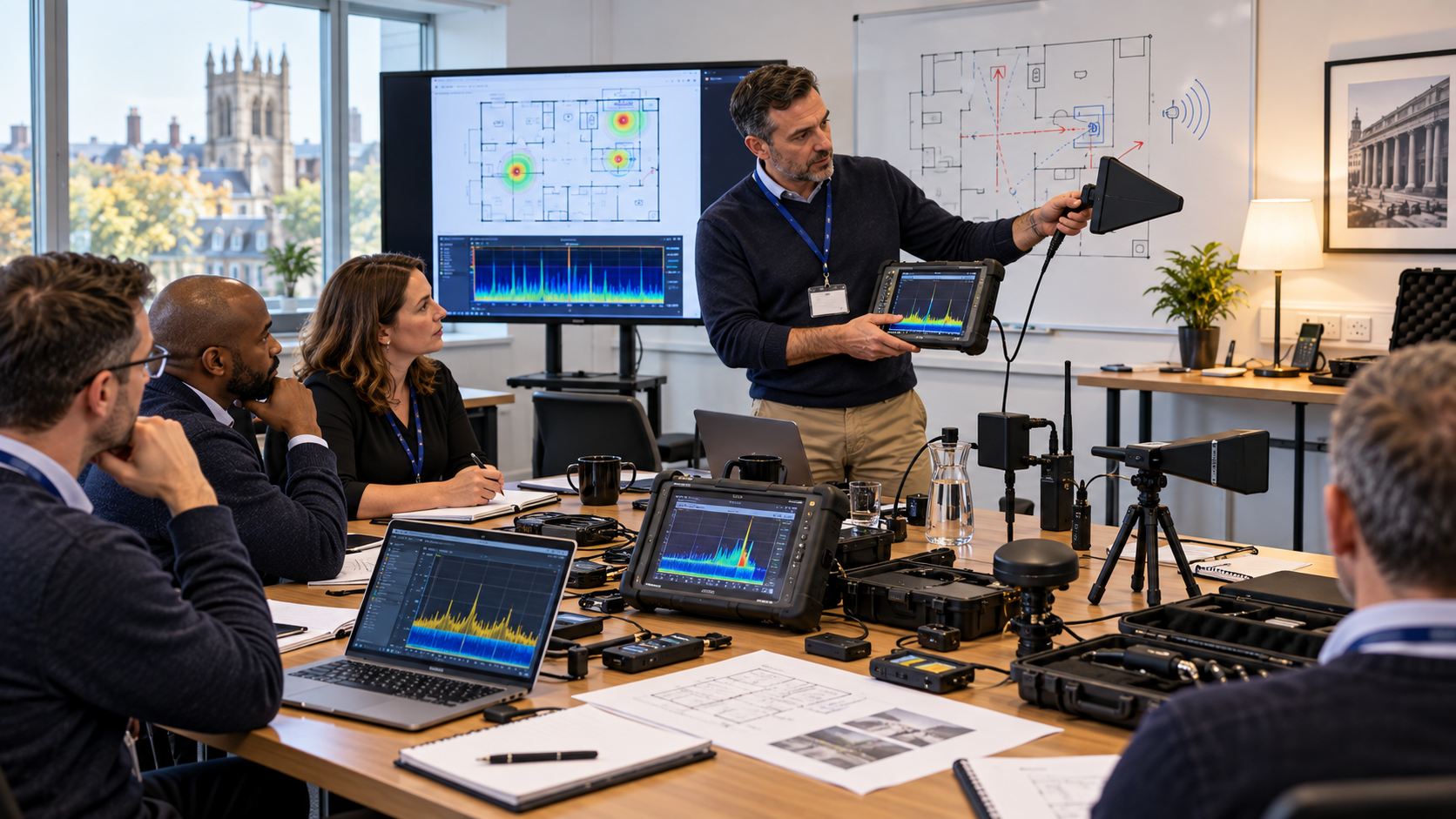
TSCM Training Course UK: How to Choose Professional Technical Surveillance Countermeasures Training
A TSCM training course UK programme teaches security professionals how to recognise, assess and respond to technical surveillance risks that could compromise confidential conversations, sensitive information or secure environments. Technical Surveillance Countermeasures, commonly shortened to TSCM, is a specialist security discipline involving structured threat assessment, physical inspection, technical examination and professional reporting. UK training currently ranges from short awareness courses and commercial classroom programmes to advanced government-focused practitioner training with strict eligibility requirements.
Demand for these skills extends beyond traditional government intelligence environments.
Corporate security teams, consultants, investigators, close protection professionals and organisations handling commercially sensitive information may all need a better understanding of technical surveillance risks.
However, course quality varies significantly.
Some programmes focus on general awareness, while others provide hands-on experience with professional equipment and structured search procedures.
Choosing the right course therefore requires understanding your current experience, intended role, certification requirements and whether you need introductory knowledge or practitioner-level capability.
What Is a TSCM Training Course?
TSCM stands for Technical Surveillance Countermeasures.
UK NACE, part of FCDO Services and the UK’s technical authority for technical security, describes TSCM inspections as measures used to identify technical security weaknesses and protect conversations and data from interception, overhearing or observation. Its work combines physical security, user behaviour, physical examination, technical examination and reporting.
A professional training course typically introduces students to the same broader defensive principles.
Depending on the level, subjects can include:
- Understanding technical surveillance threats
- Security risk assessment
- Physical inspection
- Technical search principles
- Radio-frequency awareness
- Equipment familiarisation
- Search planning
- Documentation
- Reporting findings
- Recommending security improvements
The objective should not simply be learning how to operate one piece of equipment.
A competent practitioner needs to understand why a search is being performed, what assets require protection and how findings fit into a wider security assessment.
Who Takes TSCM Training in the UK?
Participants can come from several professional backgrounds.
Potential students include:
- Corporate security professionals
- Technical security specialists
- Security consultants
- Government personnel
- Law-enforcement personnel
- Close protection professionals
- Investigators
- Telecommunications specialists
- Electronics professionals
- Risk managers
Different courses have different entry requirements.
Some commercial programmes are designed for security professionals with limited technical experience.
Advanced government courses can require existing technical qualifications, professional experience, citizenship restrictions and security clearance.
7 Powerful Tips for Choosing a TSCM Training Course UK Programme
The right course should match the level at which you expect to use the skills.
The following seven checks can help compare programmes.
1. Decide Whether You Need Awareness or Practitioner Training
The first distinction is between awareness training and operational practitioner development.
Awareness-Level TSCM Training
Awareness courses are useful for professionals who need to understand the threat without becoming full-time technical operators.
UK NACE currently offers a one-day TSCM Awareness course at Hanslope Park in Milton Keynes for eligible government-related personnel. It covers the threat from eavesdropping, technical attack methods, risk assessment and the role of technical countermeasures.
UK NACE also provides an aided physical search programme lasting four days plus preliminary e-learning for qualifying personnel working in environments at risk from technical compromise.
These programmes have strict eligibility requirements and are not open public courses.
Practitioner-Level Training
Practitioner courses go considerably deeper.
UK NACE states that its practitioner-level training is intended for technically qualified personnel who regularly perform TSCM work. Applicants are expected to have electronics, telecommunications or similar qualifications alongside practical radio experience.
Commercial providers also offer practitioner-focused programmes with hands-on exercises.
Before booking, ask whether a course is designed to provide awareness, introductory operational knowledge or advanced practitioner development.
The words advanced or professional in a course title do not automatically prove the level.
2. Look for Practical Training, Not Theory Alone
TSCM is a practical security discipline.
Classroom theory is important, but students also benefit from structured practical exercises performed in controlled training environments.
TAVCOM’s current UK TSCM programme, for example, includes assessed risk exercises, technical case-study work, survey and reporting requirements and practical room-search exercises. Its next listed Birmingham course at the time of checking is scheduled for 29–30 October 2026.
Other UK commercial providers advertise longer programmes involving practical use of specialist technical-security equipment and structured search exercises.
What Should Practical Training Develop?
A useful practical component should teach students how to work systematically.
Training may address:
- Preparing for an assessment
- Understanding the environment
- Identifying assets requiring protection
- Conducting an organised inspection
- Recording observations
- Interpreting findings
- Producing professional reports
The emphasis should be on lawful defensive security rather than simply demonstrating interesting equipment.
Equipment Should Support Methodology
A training course with expensive hardware may look impressive, but equipment alone does not create a competent operator.
Students should learn how different tools contribute to an overall process and where their limitations exist.
A single detector should never be presented as capable of identifying every possible technical threat.
3. Check the Instructor’s Operational Background
TSCM training is most valuable when instructors understand real security environments.
Before enrolling, review instructor information.
Useful questions include:
- Have they conducted professional TSCM work?
- Do they have technical-security experience?
- Have they worked in government, corporate or specialist security environments?
- Do they continue working within the field?
- Is their professional background explained clearly?
Operational experience can help instructors explain why disciplined procedures matter.
Avoid Relying Only on Job Titles
Terms such as surveillance expert or counter-surveillance specialist are not enough on their own.
Look for verifiable professional experience and specific technical-security competence.
Training organisations should be able to explain who delivers the course and why those instructors are qualified.
4. Understand What Certification Actually Means
Certification is one of the most confusing areas when comparing UK TSCM courses.
Different providers issue different qualifications.
For example, TAVCOM currently offers its own certification with its two-day TSCM course and advertises an optional additional SRF BTEC Level 3 Certificate for an extra fee. Its current listed classroom price is £1,495 excluding VAT, with the optional BTEC certificate priced at £120 plus VAT.
The Security Academy currently advertises a three-day commercial TSCM programme in London and states that successful candidates receive a Vanquish diploma in Technical Surveillance Countermeasures. Its current listed London course fee is £2,500, with a future session scheduled for 1–3 November 2026.
Ask Who Awards the Qualification
Before booking, determine whether the certificate is:
- Provider-issued
- Awarding-body certified
- Professionally recognised
- Required for a particular employer
- Intended mainly as evidence of course completion
A provider’s own diploma can still demonstrate completed training, but it should not automatically be treated as equivalent to an externally regulated qualification.
Certification Does Not Replace Experience
A short course does not instantly create an experienced TSCM practitioner.
Practical competence develops through ongoing training, supervised work, technical education and repeated experience in controlled environments.
Employers should evaluate the complete professional profile rather than one certificate alone.
5. Compare Current UK TSCM Course Providers Carefully
The UK currently has several types of TSCM training.
UK NACE Academy
UK NACE Academy is part of FCDO Services and provides government technical-security education from awareness through specialist practitioner levels.
Its training is primarily aimed at government, law-enforcement and qualifying contracted personnel rather than the general commercial market.
Eligibility can include nationality, employer status, relevant technical qualifications and security-clearance requirements depending on the course.
TAVCOM Training
TAVCOM currently offers a two-day classroom Technical Surveillance Countermeasures course in Birmingham.
The programme is positioned as an introduction to the principles and basic practical application of TSCM and includes assessed exercises and practical survey work.
This may suit security professionals looking for structured commercial training without the government eligibility requirements associated with UK NACE.
The Security Academy
The Security Academy currently advertises a three-day programme covering TSCM and bug-sweeping concepts, with courses offered internationally as well as in London.
Its next London date listed after October 2026 is 1–3 November 2026.
SIASS
SIASS announced a new Commercial Technical Surveillance and Commercial TSCM programme beginning in January 2026, developed in collaboration with Verrimus for commercial and public-sector audiences.
Verrimus continues to focus its operational programmes on established military, police and government customers, while SIASS handles broader commercial training.
Other Specialist Providers
Other UK organisations also advertise multi-day TSCM courses, including programmes focused on commercial security professionals and bespoke organisational training.
Course availability and specifications change, so always confirm the current syllabus before paying.
6. Compare Course Cost With What Is Actually Included
TSCM training can be expensive because practical courses require specialist instructors, controlled training environments and technical equipment.
Current advertised examples demonstrate the range.
TAVCOM currently lists its two-day course at £1,495 excluding VAT.
The Security Academy currently lists its three-day UK programme at £2,500.
Longer specialist programmes may cost more, particularly when training is packaged with equipment.
Do Not Compare Course Fees Alone
Check whether the price includes:
- Certification
- Training materials
- Practical exercises
- Equipment use
- Accommodation
- Meals
- Examination fees
- Follow-up support
TAVCOM, for example, currently lists accommodation separately at £110 per person per night plus VAT for its Birmingham course.
A slightly more expensive course may provide greater value if it includes considerably more practical training.
Equipment Packages Need Careful Evaluation
Some courses combine training with the purchase of TSCM equipment.
This can be convenient, but buyers should understand exactly which tools are included, warranty terms, software requirements and whether the equipment genuinely suits their expected work.
Do not buy equipment simply because it is bundled with training.
7. Check Eligibility Before Planning Your Career Around a Course
Some TSCM training has strict eligibility restrictions.
UK NACE practitioner training currently requires eligible nationality and employment status, along with technical qualifications and practical radio experience.
Its bespoke programmes can additionally require security clearance such as UK Security Check, NATO Secret or EU Secret depending on the participant.
Commercial courses are generally more accessible.
Technical Background Can Be Valuable
Even when not mandatory, knowledge of subjects such as electronics, radio systems, networking and telecommunications can help students understand technical-security concepts more deeply.
Someone entering TSCM from a security background may therefore benefit from complementary technical education.
Security Experience Also Matters
Technical ability alone is not enough.
Professional TSCM work requires understanding:
- Risk
- Confidentiality
- Client communication
- Evidence handling
- Reporting
- Professional ethics
A strong career path combines technical competence with disciplined security practice.
What Skills Should a Good TSCM Course Cover?
Course content varies, but a professional curriculum should normally combine technical understanding with risk management.
Threat Awareness
Students need to understand why technical surveillance risks exist and which environments may require additional protection.
Risk Assessment
A search should be based on the assets, threats and vulnerabilities relevant to the organisation.
TAVCOM specifically includes assessed work covering risks, assets, threats and vulnerabilities in its current programme.
Physical Inspection
Physical inspection remains an important part of technical security.
UK NACE describes physical search as examining an environment for suspicious items, unusual concealment opportunities and signs that furnishings or equipment have been disturbed.
Technical Awareness
Students may be introduced to professional categories of technical search equipment.
The purpose is to understand how different forms of analysis contribute to an overall assessment rather than rely on one tool.
Reporting
A TSCM assignment should produce useful findings.
Professional reports may document:
- Scope
- Areas examined
- Relevant observations
- Identified vulnerabilities
- Recommended improvements
Both UK NACE and commercial training providers include reporting within their training or operational methodology.
UK NACE Training vs Commercial TSCM Training
These routes serve different audiences.
UK NACE
UK NACE provides highly specialised technical-security training for eligible government and related personnel.
Its Academy identifies itself as part of the UK’s Technical Authority for technical security.
Access is controlled because some courses relate to protected government environments and policy standards.
Commercial Training
Commercial courses are more suitable for private security professionals who do not meet UK NACE eligibility requirements.
They can provide:
- Awareness
- Foundational practical training
- Commercial security context
- Professional development
- Equipment familiarisation
When comparing commercial programmes, focus on instructor quality and course depth rather than assuming that a privately issued certificate creates government-level credentials.
How Long Does a TSCM Training Course UK Programme Take?
There is no single standard duration.
Current UK examples range from one-day awareness courses to multi-day practical programmes.
Examples include:
- UK NACE TSCM Awareness: 1 day for eligible personnel
- UK NACE aided physical search: 4 days plus preliminary e-learning
- TAVCOM: 2 days
- The Security Academy: 3 days
- Some commercial specialist programmes: approximately 4–5 days
Longer does not automatically mean better.
The quality of instruction, practical time and intended competence level matter more than duration alone.
Classroom vs Online TSCM Training
Some providers offer online material, but practical TSCM skills are difficult to develop entirely through remote learning.
Online Learning Works Well for Theory
Remote modules can introduce:
- Terminology
- Threat awareness
- Risk concepts
- Reporting principles
- Equipment theory
Classroom Training Adds Practical Experience
Face-to-face programmes allow students to work within controlled scenarios and receive immediate instructor feedback.
For someone intending to perform TSCM work professionally, practical training is usually an important part of development.
A blended approach can therefore work well: theory online followed by supervised practical training.
Is There an Official UK TSCM Licence?
People sometimes assume that completing a private course creates a universal government TSCM licence.
That is not how the training landscape is structured.
UK NACE provides specialist government training with specific eligibility requirements, while commercial providers issue their own or awarding-body-associated qualifications.
A prospective student should therefore avoid interpreting the word accredited as meaning government-authorised unless the provider clearly identifies the awarding or regulatory body involved.
For employment, the qualification required will depend on the organisation and role.
What Careers Can TSCM Training Support?
TSCM knowledge may complement careers in:
- Corporate security
- Technical security
- Security consultancy
- Protective security
- Investigation
- Government security
- Specialist telecommunications
- Risk management
Some professionals offer TSCM as one service within a wider security consultancy.
Others work within dedicated technical-security teams.
Experience Matters More Over Time
A foundation course can provide an entry point, but professional development should continue.
That may involve:
- Further technical education
- Advanced courses
- Equipment training
- Mentoring
- Supervised exercises
- Regular professional development
Technical threats evolve, so practitioner knowledge also needs to develop.
Questions to Ask Before Booking a TSCM Course
Before paying a deposit, ask the provider:
- Who teaches the course?
- What operational experience do instructors have?
- How much practical training is included?
- What equipment categories are demonstrated?
- Is there an assessment?
- Who issues the certificate?
- Is the qualification externally recognised?
- Are there prerequisites?
- What is included in the fee?
- Is ongoing support available?
Clear answers make providers easier to compare.
Common Mistakes When Choosing TSCM Training
Choosing Only by Price
The cheapest programme may provide little practical training.
Assuming Every Certificate Is Equivalent
Certificates can have very different status.
Check the awarding organisation.
Buying Advanced Equipment Too Early
Training and methodology should come before expensive equipment purchases.
Expecting a Three-Day Course to Create an Expert
Competence develops through continued practice and education.
Ignoring Reporting Skills
Finding an anomaly is only part of the job.
Clients need clear, defensible conclusions and appropriate risk recommendations.
Frequently Asked Questions
What is a TSCM training course UK programme?
It is professional training in Technical Surveillance Countermeasures, covering defensive technical-security awareness, risk assessment, structured inspection and reporting for environments where sensitive information needs protection.
How much does TSCM training cost in the UK?
Costs vary by provider and course depth. TAVCOM currently lists a two-day Birmingham course at £1,495 excluding VAT, while The Security Academy currently lists a three-day UK course at £2,500.
Where can I take a TSCM course in the UK?
Current options include commercial training in Birmingham and London, while eligible government-related personnel may have access to UK NACE training at Hanslope Park in Milton Keynes.
Do I need technical experience before taking a TSCM course?
Entry-level commercial courses may accept students without advanced technical qualifications, but UK NACE practitioner-level training requires relevant technical qualifications and practical radio experience.
How long does TSCM training take?
Courses range from one-day awareness programmes to two-, three- and five-day practical courses, while advanced practitioner development can involve additional prerequisites and specialised modules.
Is practical training important for TSCM?
Yes. Professional TSCM requires more than theoretical knowledge. Practical exercises help students understand structured assessment, physical inspection, technical-security concepts and professional reporting.
Conclusion
A TSCM training course UK programme can provide valuable specialist skills for security professionals responsible for protecting confidential information and sensitive environments. The best course depends on whether you need general awareness, commercial practitioner training or restricted government-level development. Comparing practical training time, instructor experience, certification, eligibility and total cost can help you choose a programme that provides meaningful professional development rather than simply another certificate.