Marldon: 7 Proven Secrets for Flawless Timber Flooring, Acoustic Insulation, and Subfloor Mastery
Installing premium solid hardwood, luxury parquet, or wide-plank engineered timber represents a significant architectural investment that permanently elevates residential and commercial interiors. However, specifying high-performance Marldon installation products, acoustic underlays, damp-proof membranes, and subfloor adhesives is the critical technical foundation that prevents floor failure. While architects and homeowners frequently fixate on surface wood aesthetics—such as oak grain grades, UV-cured oil finishes, and custom stains—the long-term structural integrity of any timber floor is dictated entirely by what lies concealed beneath the planks. Failing to mitigate subfloor moisture vapor emissions, ignoring impact acoustic sound transmission standards, or utilizing cheap, low-density foam underlays causes catastrophic floor cupping, hollow footstep drumming, joint separation, and adhesive debonding. By incorporating trade-tested professional flooring systems, contractors and property owners achieve whisper-quiet acoustic dampening, total moisture defense, and flawless walking comfort across decades of heavy use.
The Physical Dynamics of Hardwood Flooring and Subfloor Interaction
Hardwood is an organic, hygroscopic building material that continuously expands and contracts in response to ambient relative humidity and subfloor moisture gradients. Understanding the structural interaction between the rigid subfloor substrate and the overlying timber wear layer reveals why high-grade underlays are essential to structural longevity.
Subfloor Moisture Vapor Emissions and Capillary Rise
Concrete screeds, sand-cement bases, and anhydrite screeds naturally retain vast volumes of water following initial placement. Even mature concrete slabs situated on grade experience continuous capillary moisture vapor drive:
- Relative Humidity Thresholds: British and European flooring installation standards (BS 8201) mandate that concrete subfloors must maintain a relative humidity (RH) below seventy-five percent before installing moisture-sensitive timber. In modern fast-track construction, slabs frequently hold eighty to ninety percent RH.
- The Mechanics of Moisture Damage: Without a continuous, vapor-impermeable damp-proof membrane (DPM), rising water vapor penetrates the bottom face of wooden planks. The bottom of the board swells while the climate-controlled top surface dries out, creating severe upward cupping, structural crowning, edge splintering, and permanent plank buckling.
Integrated Damp-Proof Membranes (DPM) and Vapor Barriers
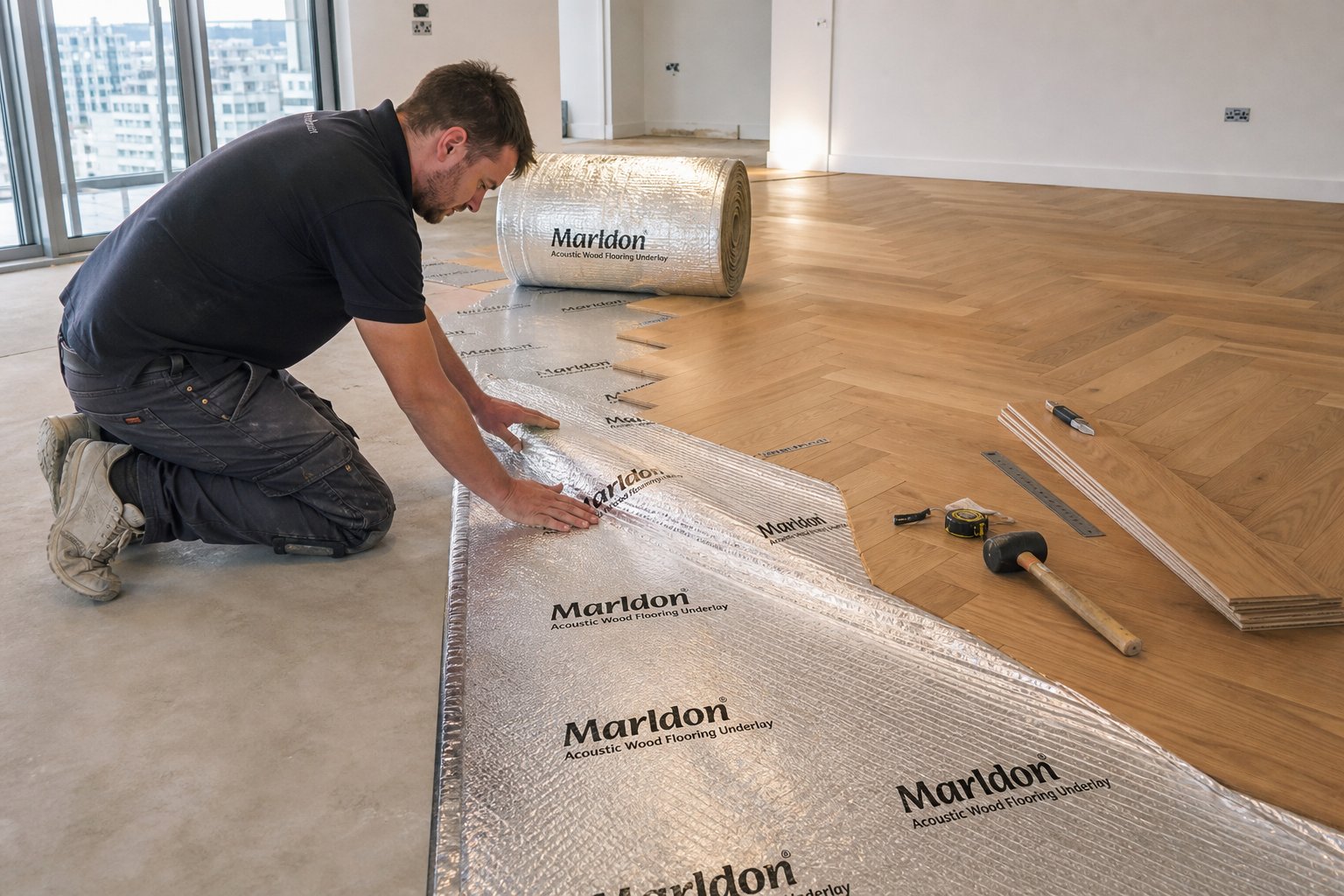
High-performance underlay formulations integrate heavy-gauge, puncture-resistant polyethylene films or vapor-tight metallized aluminum foil backings directly to the underside of the acoustic core. When installed with overlapping, taped vapor seams, these systems establish a hermetic barrier that stops subfloor moisture emissions from contacting timber planks, eliminating the need for messy liquid-applied epoxies on standard subfloors.
Acoustic Energy Infiltration: Impact Sound vs. Airborne Noise
In multi-storey residential apartment developments, luxury penthouses, and commercial hospitality venues, noise transmission through intermediate floor slabs represents a primary source of tenant complaints and legal disputes.
Impact Sound Pressure Levels (ΔLw)
Impact noise occurs when physical vibrational kinetic energy directly impacts the floor—such as hard-heeled footwear walking across timber, dragging furniture legs, or dropped objects:
- Mechanical Structural Bridging: Hardwood planks laid directly over concrete or standard thin foam transmit vibrational waves directly through the concrete slab, radiating loud footstep thuds into the ceiling cavities of neighbors below.
- Decoupling via High-Density Cellular Cores: Premium acoustic underlays utilize dense crumb rubber, cross-linked cellular polyolefin foams, or heavy mineral-loaded polymer composites. These resilient materials act as a mechanical spring that absorbs kinetic footfall energy, decoupling the floating timber floor from the structural subfloor and cutting impact noise transmission by twenty to over twenty-eight decibels (ΔLw).
Drumming Sound and In-Room Acoustic Resonance
Beyond sound traveling downward into neighboring rooms, walking across a poorly cushioned floating floor produces a hollow, cheap “clacking” or “drumming” sound inside the room itself. Utilizing high-mass, high-density acoustic underlays dampens reflected walking sound, giving floating engineered planks the solid, substantial feel and deep acoustic resonance of traditional solid hardwood nailed into joists.
Core Underlay and Installation Product Formulations
Different architectural environments, subfloor constructions, and heating configurations demand specialized subfloor engineering solutions.
High-Density Crumb Rubber and Heavy Mineral Underlays
Engineered from recycled automotive tires and vulcanized elastomeric granules, crumb rubber underlays represent the benchmark for heavy-duty commercial and luxury residential acoustic isolation:
- Unmatched Compression Resistance: Standard cheap polyethylene foam underlays quickly flatten under heavy dining tables, piano legs, and continuous foot traffic, permanently losing their cushioning and sound dampening. High-density rubber maintains dynamic elasticity under intense static loads without compressive fatigue.
- Exceptional Mass Damping: The heavy physical mass of crumb rubber provides superior acoustic attenuation across low-frequency thuds and footsteps, easily satisfying stringent Building Regulations Part E sound compliance standards.
Metallized Foil-Backed Acoustic Underlays for Underfloor Heating (UFH)
The widespread adoption of hydronic and electric underfloor heating systems requires underlays that balance thermal conductivity with moisture protection:
- Thermal Resistance (Tog Ratings): To allow underfloor heating systems to warm rooms efficiently, the total combined thermal resistance of the underlay and wood plank should not exceed 2.5 Tog (0.25 m²K/W). Specialized underfloor heating underlays feature ultra-low Tog ratings (often 0.35 to 0.60 Tog), permitting heat to radiate upward into the room without thermal blockage.
- Integrated Vapor Barrier: The metallized foil backing deflects radiant heat upward into the timber floor while protecting against subfloor condensation caused by temperature differentials.
Silane and Polyurethane Elastic Wood Flooring Adhesives
For direct-stick parquet installations (such as herringbone, chevron, or wide solid oak planks) where floating underlays cannot be used, specialized modified silane polymer adhesives provide elastic bonding:
- Permanently Elastic Polymer Matrix: Unlike brittle legacy PVA glues, modified silane adhesives cure into a tough, permanently flexible rubber bond that allows natural timber seasonal expansion and contraction without snapping the bond line or shearing the subfloor screed.
- Zero Isocyanates and Low VOCs: Modern eco-certified adhesives contain zero solvents, zero water, and zero hazardous isocyanates, protecting indoor air quality while eliminating the risk of adhesive moisture warping newly laid wood blocks.
Technical Performance Matrix by Product Category
| Product Classification | Core Composition | Acoustic Impact Reduction (ΔLw) | Thermal Resistance (Tog Rating) | Primary Architectural Application |
|---|---|---|---|---|
| Heavy-Duty Crumb Rubber | Vulcanized recycled rubber granules | 24 dB to 28 dB | 1.0 to 1.5 Tog | Luxury apartments, hotel guest rooms, commercial offices |
| Low-Tog UFH Acoustic Underlay | High-density perforated polyolefin | 18 dB to 21 dB | 0.35 to 0.55 Tog | Underfloor heated timber installations, low-energy homes |
| Foil-Backed Cellular Foam | Cross-linked PE foam + Alu-foil | 20 dB to 23 dB | 0.8 to 1.2 Tog | General residential floating floors on concrete screeds |
| Elastic Silane Adhesive | Modified silane polymer matrix | N/A (Direct bonded) | N/A (Direct thermal transfer) | Herringbone parquet, solid hardwood, chevron blocks |
| Liquid Epoxy Damp Proof Membrane | Two-part solvent-free epoxy resin | N/A (Subfloor barrier) | N/A (Direct substrate seal) | Green concrete screeds with up to 98% relative humidity |
Step-by-Step Subfloor Preparation and Installation Methodology
A flawless timber installation requires disciplined subfloor preparation before a single roll of underlay is laid out:
- Step 1: Subfloor Moisture Testing: Measure concrete relative humidity using calibrated hygrometer surface boxes according to BS 8201 standards. If readings exceed seventy-five percent RH, install an approved liquid DPM or specify a high-performance underlay with an integrated, taped vapor barrier.
- Step 2: Surface Leveling and Flatness Audits: Check the subfloor using a two-meter straightedge. Any deviation exceeding three millimeters over a two-meter span must be ground down or filled using a fiber-reinforced, rapid-drying self-leveling compound; laying underlay over uneven subfloors causes bouncy, squeaking planks.
- Step 3: Vacuuming and Debris Decontamination: Thoroughly vacuum the subfloor to extract all drywall dust, plaster lumps, and grit; loose debris beneath an underlay causes crunching sounds underfoot when walked upon.
- Step 4: Laying Underlay with Vapor Sealing: Roll out underlay rolls perpendicular to the intended direction of the timber floor planks. When using foil-backed or DPM underlays, face the vapor barrier down toward the concrete subfloor, overlap the factory foil margins by at least fifty millimeters, and seal every joint continuously using heavy-duty moisture-resistant vapor tape.
- Step 5: Acclimatization and Perimeter Expansion Gaps: Allow timber flooring planks to acclimatize in the conditioned installation room for forty-eight to seventy-two hours. Leave an uninterrupted ten-to-fifteen-millimeter expansion gap around all walls, door thresholds, and radiator pipes, concealed beneath skirting boards or matching perimeter scotia moldings.
Frequently Asked Questions About Marldon Installation Products
Why is an acoustic underlay required beneath floating engineered wood floors?
A high-density acoustic underlay absorbs the impact of footsteps, eliminates hollow clacking sounds inside the room, and reduces the transmission of impact noise to rooms below, satisfying building acoustic regulations.
Can I install timber flooring over a damp concrete subfloor?
Only if you first apply a certified liquid-applied damp-proof membrane (DPM) or use a high-performance underlay with an integrated, vapor-sealed foil barrier to protect the wood from capillary moisture damage.
What is the maximum Tog rating allowed for wood flooring underlays over underfloor heating?
The combined Tog rating of the underlay and the wood flooring should ideally not exceed 2.5 Tog; underlays designed specifically for underfloor heating typically have low Tog ratings between 0.35 and 0.60 Tog.
How do I prevent hollow drumming sounds when walking across a floating wood floor?
Use a high-density, heavy-mass underlay (such as crumb rubber or mineral-loaded acoustic underlay) rather than cheap, lightweight, low-density polyethylene foam rolls.
When should I use elastic wood floor adhesive instead of a floating underlay?
Direct-stick adhesive is required for traditional solid wood planks, parquet herringbone blocks, chevron designs, and wide engineered planks spanning large open commercial areas where floating floors would buckle.
How thick should an underlay be for engineered timber flooring?
Underlays for engineered timber typically measure between two and five millimeters; overly thick, soft underlays (such as carpet underlay) allow excessive flex that breaks the tongue-and-groove locking joints of wood planks.
Conclusion
The enduring beauty, acoustic refinement, and structural performance of a luxury hardwood floor are inextricably linked to the quality of the installation products concealed beneath the surface. Sourcing professional Marldon acoustic underlays, damp-proof membranes, and elastic polymer adhesives provides the engineering protection necessary to prevent floor failure. By isolating timber planks from destructive subfloor moisture emissions, eliminating annoying hollow drumming sounds, and drastically reducing impact noise transmission to satisfy strict building regulations, specialized underlay systems turn floating timber floors into solid, whisper-quiet architectural masterpieces. Whether outfitting a modern apartment development with high-density crumb rubber acoustic insulation or laying wide-plank engineered oak over a heated subfloor screed, investing in professional subfloor preparation products guarantees flawless walking comfort, structural stability, and lasting elegance across every room in your home.