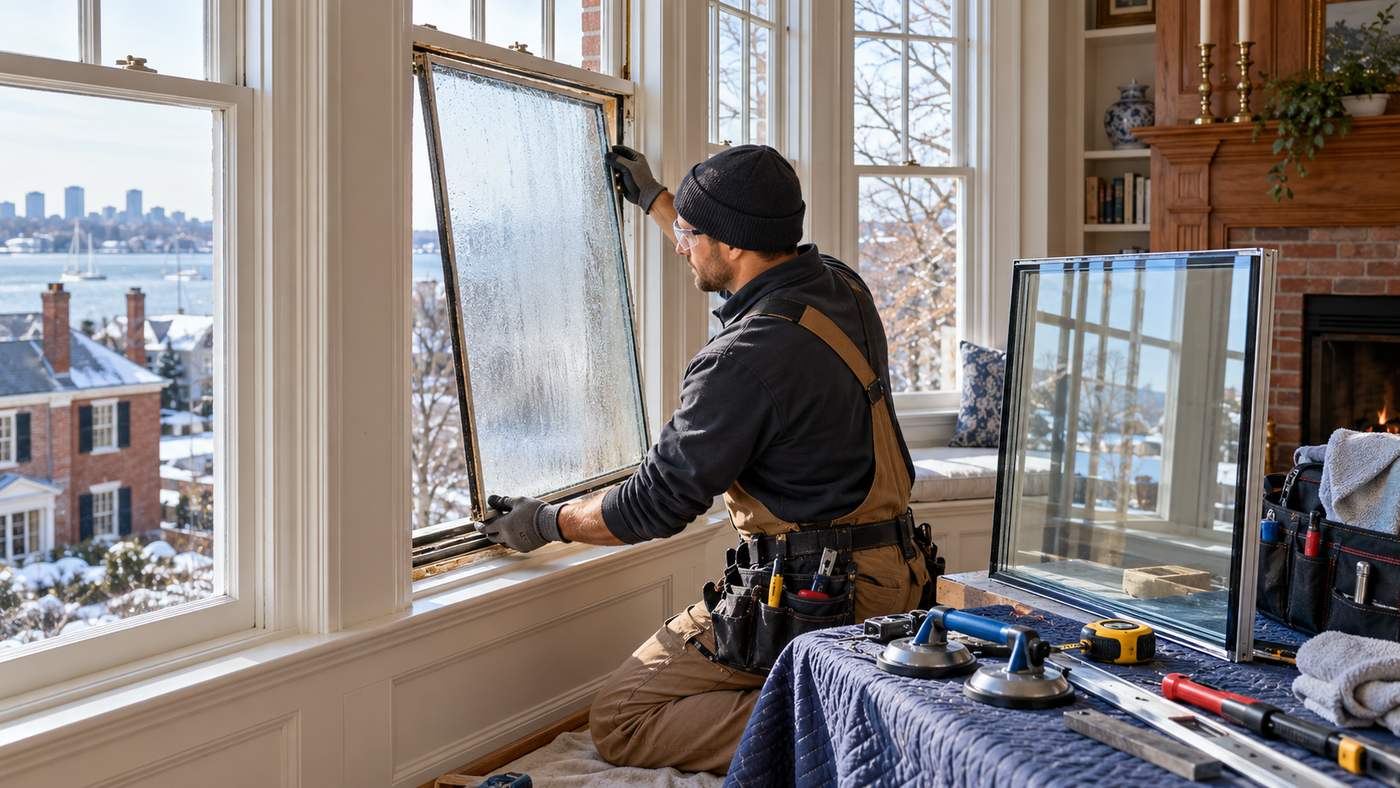
Fogged Glass Window Repair in Boston: What Homeowners Should Know Before Replacing a Window
fogged glass window repair in Boston is often needed when moisture, haze or condensation becomes trapped between the panes of a double or triple-pane window. Unlike normal condensation that forms temporarily on the room-facing or exterior surface of glass, moisture that appears inside an insulated glass unit commonly indicates that the sealed space between the panes has failed.
Pella’s current window guidance explains that condensation between pieces of insulating glass usually develops when the seal holding the insulated glass unit together fails and allows moisture to enter. Once that seal has failed, the affected window or insulated glass unit generally needs replacement rather than a simple humidity adjustment.
For Boston homeowners, this problem can be especially noticeable because windows experience substantial seasonal changes in temperature and moisture.
A fogged window does not always mean that the entire frame needs to be removed.
Depending on the condition of the:
- Frame
- Sash
- Hardware
- Weatherstripping
- Insulated glass unit
a professional may be able to replace only the failed glass assembly.
Understanding that distinction can prevent homeowners from paying for a complete replacement when only the insulated glass has failed.
Here are seven important things to understand before scheduling window repair.
1. Determine Where the Window Condensation Is Located
Not all window condensation indicates a failed window.
The first step is determining where the moisture actually appears.
Condensation on the Inside Surface
If water forms on the surface you can touch from inside the room, the problem may involve indoor humidity rather than glass failure.
Warm humid indoor air can condense when it comes into contact with a sufficiently cold window surface.
Pella recommends measures such as:
- Using bathroom exhaust fans
- Running kitchen ventilation
- Monitoring humidifiers
- Improving household ventilation
when interior moisture becomes excessive.
Condensation on the Exterior Surface
Exterior condensation can occur under ordinary weather conditions.
It may actually indicate that the insulating window is keeping interior heat from warming the exterior pane.
Andersen notes that exterior condensation can occur on energy-efficient windows and is not necessarily a defect.
Condensation Between the Panes
This is the important distinction.
If the haze or droplets appear:
inside the sealed space between two panes of glass,
the insulated-glass seal has probably failed.
Pella’s current FAQ states that condensation between dual or triple panes is usually an indication of glass-seal failure.
Because homeowners cannot simply wipe that moisture away, the window gradually develops the familiar:
- Foggy
- Cloudy
- Milky
appearance.
2. Understand Why Double-Pane Windows Become Foggy
Modern insulated windows commonly contain two or more pieces of glass separated by a sealed spacer system.
The space between the panes may also contain an insulating gas such as argon.
Many modern windows additionally use low-emissivity glass coatings to improve thermal performance.
Pella explains that insulating glass uses sealed construction, desiccant materials and, in many systems, inert gases and low-E coatings to improve energy performance. Over time, environmental exposure and material aging can eventually allow the seal to deteriorate.
What Happens After Seal Failure?
Once outside air and moisture begin entering the sealed cavity:
- The internal desiccant absorbs moisture.
- The desiccant eventually reaches capacity.
- Condensation begins appearing between panes.
- The glass may become increasingly cloudy.
This explains why a window may appear clear one day and foggy during another combination of:
- Sunlight
- Temperature
- Humidity
What Can Cause Seal Failure?
Potential contributors include:
- Age
- Long-term temperature cycling
- Sun exposure
- Installation conditions
- Movement of the frame
- Manufacturing defects
Pella notes that exact seal life depends on environmental conditions, glass construction, sealing materials and overall window design.
A failed seal therefore does not necessarily mean someone installed the window incorrectly.
Sometimes the insulated-glass unit has simply reached the point where its sealed system no longer performs as intended.
3. Decide Between IGU Replacement and Full Window Replacement
One of the most important decisions in fogged glass window repair in Boston is determining exactly what needs to be replaced.
What Is an IGU?
IGU stands for:
Insulated Glass Unit.
It is the sealed glass assembly containing the multiple panes.
In many window designs, the IGU can be replaced while retaining other parts of the window.
That may allow a homeowner to preserve:
- Existing frame
- Interior trim
- Exterior trim
- Overall window style
When Glass-Only Replacement May Make Sense
Replacing the insulated glass may be practical when:
- Frame is structurally sound
- Sash is usable
- Hardware still works
- Problem is limited to failed glass
A technician will generally need to determine the:
- Glass dimensions
- Thickness
- Spacer configuration
- Glass type
before ordering the replacement unit.
When Full Window Replacement May Make More Sense
A complete window replacement may be worth considering if there are multiple problems, such as:
- Rotten wood
- Warped frame
- Significant drafts
- Water leakage
- Poor operation
- Broken hardware
- Multiple failed glass units
Pella’s current homeowner guidance similarly states that minor issues may sometimes be repairable, while seal failure combined with broader window deterioration can make full replacement more economical.
The key is not to assume every fogged window requires an entirely new window.
Ask the contractor to explain:
Which component failed and why the proposed scope is necessary.
4. Be Careful With “Defogging” as a Substitute for IGU Replacement
Some services advertise window “defogging.”
The terminology can be confusing.
A failed insulated glass seal means the original sealed cavity has been compromised.
Pella states that once the seal holding an insulated glass unit together has failed, it cannot simply be restored through ordinary repair; the glass unit or window typically needs replacement.
A cosmetic process that reduces visible moisture is therefore different from replacing the failed insulated glass assembly.
Ask the Contractor What the Procedure Actually Does
Before approving a treatment, ask:
- Is the failed IGU being replaced?
- Is the original sealed cavity being restored?
- Is new Low-E glass being installed?
- Is insulating gas included?
- What warranty covers future fogging?
A service should not be evaluated only by whether the visible haze disappears immediately.
You also want to understand what happens to the window’s intended insulating performance.
Warranty Can Affect the Decision
Before paying for any repair, check whether the original window is still covered by:
- Manufacturer warranty
- Glass warranty
- Installation warranty
Some manufacturers provide specific coverage for permanent visual obstruction caused by premature insulating-glass seal failure.
Finding the original:
- Invoice
- Serial number
- Installation paperwork
may therefore save money.
5. Consider Boston Energy Efficiency When Choosing Replacement Glass
A window is part of the home’s thermal envelope.
Replacing failed glass provides an opportunity to consider whether the replacement IGU should match or improve the original energy performance.
Important characteristics can include:
- Double-pane or triple-pane construction
- Low-E coating
- Gas fill
- Spacer system
Why Low-E Glass Matters
Low-E coatings are designed to control heat transfer through glazing.
Pella describes modern Low-E coatings as a component that can help improve comfort and reduce heating and cooling demand.
For Boston’s heating-dominated climate, glass selection can influence winter comfort around large window areas.
Match the Existing Appearance
If only one IGU is being replaced in a group of visible windows, discuss appearance with the glass contractor.
Different glazing packages may have slightly different:
- Tint
- Reflectivity
- Color
This is especially important for:
- Bay windows
- Picture windows
- Groups of matching windows
A technically efficient replacement can still look odd if it visibly differs from adjacent glass.
6. Know When Boston Permitting May Become Relevant
A glass repair and a full structural window project are not necessarily the same type of work.
If the job expands into replacing the entire window, Boston currently provides specific permitting guidance.
The City states that replacing an existing window without structural changes, such as enlarging the opening, generally uses a Short-Form Permit.
Creating a new window or making structural changes such as enlarging the opening generally requires a Long-Form Permit.
Multi-Unit Properties Have Additional Considerations
Boston currently says homeowners may perform certain work themselves on a one or two-unit owner-occupied home.
For properties with three or more dwelling units, such as:
- Three-family buildings
- Larger apartment buildings
- Some multi-unit condos
the City states that a contractor must perform the window work.
Boston’s current Short-Form Permit fee is listed as:
$20 plus $10 per $1,000 of estimated project cost.
Permit requirements can depend on project scope, so homeowners should verify the specific work with Boston Inspectional Services instead of assuming that a glass repair and complete window alteration are treated identically.
7. Choose a Window Repair Contractor Based on Diagnosis, Not Sales Pressure
A good window professional should identify the problem before recommending the most expensive solution.
If only one double-pane unit is fogged, ask why the contractor recommends:
- Glass replacement
- Sash replacement
- Full window replacement
A clear diagnosis should explain the difference.
Ask for a Written Scope
The estimate should identify:
- Window location
- Glass dimensions
- Number of panes
- Glass type
- Low-E specification
- Gas fill if applicable
- Installation labor
- Warranty
Ask Whether the Frame Will Be Reused
This is important when comparing quotes.
One contractor may be quoting only an IGU.
Another may be quoting:
- New sash
- New frame
- Interior trim work
The prices cannot be compared fairly unless the scopes are equivalent.
Ask About Warranty
A strong warranty should explain coverage for:
- Glass defects
- Seal failure
- Installation workmanship
Also ask whether labor is covered if the new IGU fogs again.
Check Experience With Existing Window Types
Boston contains a wide variety of housing, including older properties with:
- Wood windows
- Double-hung windows
- Historic-style trim
A contractor experienced with the specific window system may be better able to preserve existing materials.
Fogged Windows vs Drafty Windows
These problems are related to window performance but are not identical.
Fogged Window
Fogging between panes generally indicates:
IGU seal failure.
Drafty Window
A draft may result from:
- Failed weatherstripping
- Poor frame sealing
- Installation gaps
- Damaged sash
Pella’s current guidance recommends checking around the frame if a window feels drafty.
A window can therefore be:
- Fogged but not obviously drafty
- Drafty without fogging
- Both fogged and drafty
Diagnosis should separate those issues.
Can a Fogged Window Still Be Used?
A fogged window may continue to open and close normally.
However, the visible condensation indicates that the insulating glass is no longer functioning exactly as designed.
The appearance may also worsen.
Signs can include:
- Persistent haze
- Droplets
- Mineral residue
- Streaking
Waiting does not normally restore a failed sealed unit.
Does Indoor Humidity Cause Fog Between Window Panes?
Normal indoor humidity can create condensation on the interior surface.
It does not normally create moisture between properly sealed panes.
When condensation appears inside the insulated cavity, Pella and Andersen both identify broken or failed glazing seals as the likely issue.
That distinction prevents homeowners from wasting time running a dehumidifier for a problem that is physically located inside the sealed glass assembly.
Should Every Fogged Window Be Replaced at the Same Time?
Not necessarily.
If:
- One IGU failed
- Other windows remain clear
- Frames are in good condition
repairing only the affected unit may be reasonable.
However, if several windows of similar age are showing:
- Seal failure
- Drafts
- Frame deterioration
a broader replacement project may deserve consideration.
Energy Upgrade Opportunities
Mass Save currently offers Massachusetts customers a $75-per-window incentive for eligible ENERGY STAR Most Efficient windows replacing verified single-pane windows, subject to program requirements.
For 2026, Mass Save states that eligible windows must be:
- ENERGY STAR Most Efficient
- Certified for the Northern Region
- Replacing qualifying single-pane windows
and must be verified through a Home Energy Assessment.
That particular incentive is aimed at qualifying full replacements rather than ordinary fogged IGU repairs, but it may be relevant if an older Boston property still has inefficient single-pane windows.
Window Repair vs Replacement Cost Factors
There is no single accurate price for fogged window repair across Boston.
The price depends on factors such as:
- Glass size
- Number of panes
- Tempered glass requirements
- Low-E coating
- Shape
- Accessibility
- Frame condition
- Labor
Large Glass Costs More
A large picture-window IGU typically requires more material than a small sash.
Special Shapes Increase Complexity
Arched, triangular or custom glass may require custom fabrication.
Tempered Glass Can Affect Price
Safety-glazing requirements may apply in particular locations.
Access Matters
A second or third-story window may require additional equipment and labor.
Instead of relying on a generic online price, ask several contractors to quote the same specification.
Can Fogged Glass Reduce Energy Efficiency?
The more precise answer is:
A failed sealed-glass system no longer performs exactly as originally designed.
Modern insulating windows depend on:
- Sealed air spaces
- Gas fills in some designs
- Low-E coatings
to reduce heat transfer.
Fogging demonstrates that the sealed assembly has been compromised.
The exact change in whole-window energy performance will depend on the specific window system and severity of the failure.
How to Prevent Future Window Problems
Seal failure cannot always be prevented, but general window maintenance can help identify other problems early.
Inspect Caulking
Exterior perimeter sealant should remain intact where appropriate.
Keep Drainage Paths Clear
Windows may contain designed drainage channels.
Avoid blocking them with:
- Paint
- Dirt
- Debris
Control Indoor Humidity
This will not fix failed insulated glass, but it can reduce room-side winter condensation.
Repair Water Intrusion
Water leaking through:
- Flashing
- Siding
- Exterior trim
should be corrected before it damages the surrounding frame.
Inspect Windows Each Fall
Andersen recommends inspecting windows before winter for:
- Moisture
- Weatherstripping problems
- Rot
- Between-pane condensation
so problems can be addressed before colder weather arrives.
When Full Window Replacement Is the Better Investment
Glass-only repair is attractive when the rest of the window is healthy.
Complete replacement becomes more compelling when there are multiple failures.
Examples include:
- Rotten wood
- Broken sash
- Major air leakage
- Poor operation
- Repeated seal failures
- Very old single-pane windows
Mass Save currently emphasizes air sealing and insulation as important first steps in Massachusetts home efficiency projects and offers no-cost Home Energy Assessments that can identify where improvements may provide the greatest benefit.
This can help homeowners avoid replacing windows solely because a room feels cold when the larger problem may involve:
- Attic leakage
- Wall insulation
- Basement air leakage
Questions to Ask a Boston Window Repair Company
Before approving the work, ask:
- Is the condensation definitely between the panes?
- Has the IGU seal failed?
- Can only the glass unit be replaced?
- Is the sash still structurally sound?
- What Low-E glass will be used?
- Is the replacement gas-filled?
- Will the new glass visually match surrounding windows?
- What warranty covers future seal failure?
- Does the project require a Boston permit?
- What is included in the written price?
A contractor who can answer these questions clearly makes it easier to understand what you are actually buying.
Common Fogged Window Repair Mistakes
Assuming Every Condensation Problem Is Seal Failure
Surface condensation and between-pane condensation are different.
Replacing the Entire Window Without Checking the Frame
A sound frame may allow IGU-only replacement.
Choosing the Cheapest Glass Without Matching Existing Performance
Check:
- Low-E coating
- Pane configuration
- Appearance
Ignoring Manufacturer Warranty
Some failed glass units may still have coverage.
Treating Cosmetic Defogging as Equivalent to a New Sealed IGU
Ask exactly what performance is being restored.
Ignoring Structural Problems
If the frame is rotten or leaking, changing the glass alone may not solve the larger issue.
Frequently Asked Questions
What causes fogged double-pane windows?
Fogging between panes usually occurs when the seal around the insulated glass unit fails and allows moisture to enter the cavity.
Can fogged glass windows be repaired without replacing the entire window?
Often, yes. If the frame and sash remain in good condition, a contractor may be able to replace only the failed insulated glass unit rather than the entire window.
Can I wipe condensation from between window panes?
No. The moisture is trapped inside the sealed glass cavity, so it cannot be reached from the normal interior or exterior surfaces.
Does fog between panes mean the window seal has failed?
Usually, yes. Both Pella and Andersen identify condensation between insulated panes as a common indication of a broken or failed glass seal.
Do I need a permit to replace windows in Boston?
Boston currently says replacing an existing window without structural changes generally uses a Short-Form Permit, while creating or enlarging an opening generally requires a Long-Form Permit. Confirm the requirements for the exact project with Inspectional Services.
Should I replace all my windows because one is fogged?
Not automatically. If only one IGU has failed and the remaining windows are structurally sound, repairing that unit may be sufficient. Broader replacement makes more sense when multiple windows have serious performance or structural problems.
Conclusion
Fogged glass window repair in Boston begins with identifying whether moisture is actually trapped between insulated panes or simply forming on a glass surface. Between-pane condensation typically points to IGU seal failure, and a structurally sound window may need only a replacement glass unit rather than an entirely new frame. Homeowners should compare repair and replacement scopes carefully, check warranties and consider Boston permitting requirements if the project expands into complete window replacement. A clear diagnosis can restore visibility and performance without paying for unnecessary work