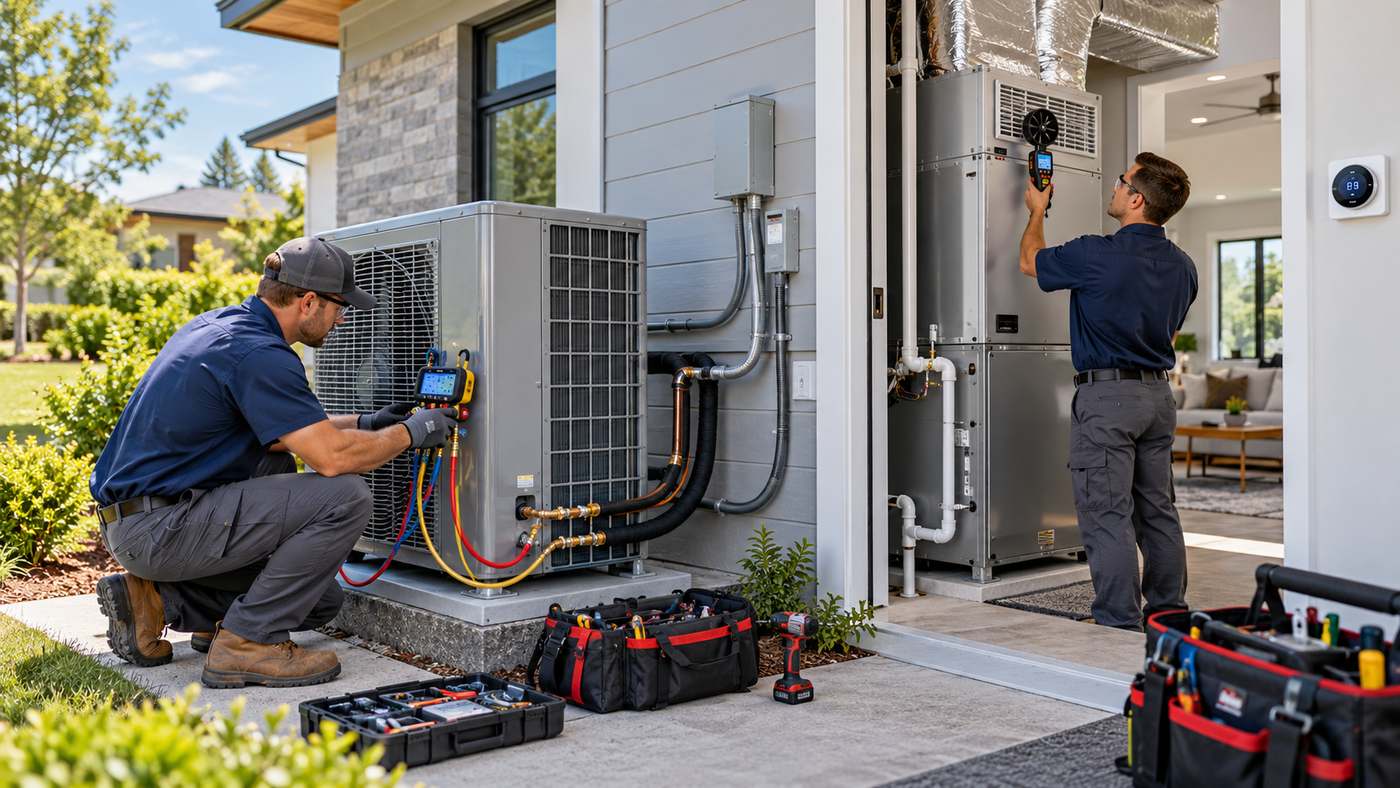
HVAC Installation Contractor: 9 Smart Ways to Choose the Right Professional
Choosing an hvac installation contractor is one of the most important decisions involved in replacing a furnace, central air conditioner or heat pump. Equipment efficiency matters, but even an expensive high-efficiency system can deliver disappointing comfort, excessive energy use and premature component wear if it is oversized, poorly charged, connected to inadequate ductwork or installed without proper airflow testing.
ENERGY STAR specifically emphasizes that HVAC performance depends on installation quality. It recommends that contractors properly size equipment using the home’s actual characteristics, optimize airflow, verify refrigerant charge and evaluate duct leakage rather than simply installing equipment according to a rule of thumb.
The technical environment has also changed substantially in recent years.
Modern systems are rated using newer efficiency metrics such as:
- SEER2
- EER2
- HSPF2
and the U.S. refrigerant transition now affects many new residential and light-commercial systems. EPA rules generally limit new residential and light-commercial air-conditioning and heat-pump systems to refrigerants with a global warming potential of 700 or less beginning with the applicable 2025 transition requirements.
That makes contractor competence more important than simply comparing equipment prices.
Here are nine areas homeowners should evaluate before signing an HVAC installation contract.
1. Choose an HVAC Installation Contractor Who Performs a Real Load Calculation
One of the clearest signs of a professional installation process is proper system sizing.
The contractor should not automatically replace an old:
- 3-ton air conditioner
- 80,000-Btu furnace
- 4-ton heat pump
with another unit of exactly the same capacity simply because that is what is already installed.
The existing system may have been oversized from the beginning.
What Is a Manual J Load Calculation?
ACCA Manual J is the nationally recognized residential load-calculation standard for determining heating and cooling requirements in houses and many individual dwelling units. ACCA notes that proper Manual J calculations are required by national building codes and by many state and local jurisdictions.
A proper calculation evaluates characteristics such as:
- Home size
- Insulation
- Windows
- Orientation
- Air leakage
- Local design weather
- Duct loads
- Internal loads
The result estimates how much heating and cooling the home actually requires.
Why Oversizing Is a Problem
Many homeowners assume that larger equipment will provide better comfort.
That is not necessarily true.
ENERGY STAR warns that oversized equipment can cycle too frequently, reduce comfort and shorten equipment life.
During cooling season, short cycles can also make humidity control more difficult because the air conditioner may shut off before operating long enough to remove adequate moisture.
Undersizing Can Also Be a Problem
A system that is too small may struggle during extreme weather.
The goal is not:
biggest equipment available.
The goal is:
correctly sized equipment for the actual building load.
Ask the contractor whether the proposal includes a Manual J calculation and request an explanation of the results.
2. Make Sure Equipment Selection Follows the Load Calculation
Calculating the load is only the first step.
The equipment still needs to be selected correctly.
ACCA uses several related residential design standards:
- Manual J for load calculations
- Manual S for equipment selection
- Manual D for duct design
ACCA’s residential system-review guidance explains that Manual S selection should use the calculated heating and cooling loads along with manufacturer performance data rather than relying only on nominal equipment size.
Nominal Capacity Is Not the Whole Story
A unit marketed as a:
3-ton air conditioner
does not necessarily deliver exactly the same performance under every combination of:
- Outdoor temperature
- Indoor temperature
- Humidity
- Airflow
Manufacturer performance data matters.
A good installer should confirm that the chosen indoor and outdoor components form a compatible system and can handle the calculated load under local design conditions.
Matched Systems Matter
Split HVAC equipment commonly combines:
- Outdoor condenser or heat pump
- Indoor evaporator coil
- Furnace or air handler
These components should be properly matched.
Do not assume that combining unrelated equipment will produce the efficiency rating advertised for one individual component.
The contractor should be able to provide the model numbers and the efficiency rating for the actual matched combination being installed.
3. Understand SEER2, EER2 and HSPF2 Before Comparing Quotes
Efficiency ratings can make HVAC proposals confusing.
Since January 1, 2023, DOE’s updated test procedures and standards have used newer metrics including SEER2 and HSPF2 for central air-conditioning and heat-pump equipment.
SEER2
SEER2 measures seasonal cooling efficiency.
A higher value generally means greater cooling efficiency under the standardized test procedure.
EER2
EER2 measures cooling performance under a specified operating condition.
It can be especially relevant in regions with very hot climates.
HSPF2
HSPF2 measures seasonal heating efficiency for heat pumps.
Higher ratings generally indicate greater heating efficiency under the standardized test conditions.
Minimum Efficiency Depends on Equipment and Region
DOE standards vary according to:
- Equipment type
- Capacity
- Region
For example, the nationwide baseline for many split-system heat pumps manufactured under the current standard is 14.3 SEER2 and 7.5 HSPF2. Regional air-conditioning requirements can differ between the North, Southeast and Southwest.
This is why homeowners should not compare proposals only by seeing which one has the largest SEER2 number.
Ask about:
- Installed cost
- Expected operating efficiency
- Climate
- Equipment features
- Warranty
- Quality of installation
An extremely efficient unit installed poorly may perform worse than a more modest system installed correctly.
4. Have the Contractor Inspect the Existing Ductwork
Replacing heating and cooling equipment without evaluating the duct system can leave major comfort problems unresolved.
ENERGY STAR recommends that HVAC contractors inspect ducts, perform leakage testing where appropriate and make necessary repairs because duct leakage and poor airflow can reduce comfort and efficiency.
Problems Commonly Found in Duct Systems
Existing ducts may have:
- Leaks
- Disconnected sections
- Poor insulation
- Restricted returns
- Undersized branches
- Crushed flexible duct
- Poorly designed transitions
A new variable-speed heat pump cannot fix a supply duct that is severely undersized.
Manual D
ACCA Manual D is the residential duct-design standard.
ACCA explains that duct sizing should consider:
- Equipment airflow
- Duct geometry
- Fittings
- Materials
rather than relying only on generic duct sizes.
Ask for Static Pressure Testing
One useful commissioning measurement is total external static pressure.
This helps technicians understand the resistance the blower experiences as it moves air through the system.
Excessive static pressure can indicate problems such as:
- Restrictive filter
- Undersized return
- Small ductwork
- Poor fittings
Ask the installer what airflow and static-pressure measurements will be performed after installation.
5. Verify That the Contractor Understands the Refrigerant Transition
HVAC refrigerants are undergoing an important transition in the United States.
EPA’s Technology Transitions rules generally set a 700 GWP limit for new residential and light-commercial air-conditioning and heat-pump systems under the applicable requirements beginning in 2025.
As a result, many newer systems use lower-GWP refrigerants such as refrigerants in the A2L safety classification.
Why This Matters for Installation
New refrigerant systems can involve updated requirements involving:
- Equipment compatibility
- Installation procedures
- Service tools
- Handling practices
- Building-code provisions
A contractor installing newer equipment should be trained for the exact refrigerant and manufacturer system being used.
Do Not Mix Refrigerant Components
An outdoor unit designed for one refrigerant cannot simply be treated as interchangeable with coils, controls or accessories designed for another refrigerant.
The complete system needs to be compatible.
Ask Which Refrigerant the New System Uses
Before signing the proposal, ask:
- What refrigerant is used?
- Is the equipment part of the current product generation?
- Are your installers trained for it?
- Are additional safety components required?
A professional contractor should be able to explain the transition without turning the conversation into confusing technical jargon.
6. Compare Installation Scope, Not Just Equipment Price
Two HVAC quotes can show the same equipment brand and still represent very different installations.
One contractor may include:
- New equipment
- Basic hookup
Another may include:
- Load calculation
- Duct modifications
- New refrigerant lines
- Condensate upgrades
- Electrical work
- Permit
- Startup testing
The second proposal may cost more because it includes substantially more work.
A Good Proposal Should Identify Model Numbers
Look for the specific model numbers of:
- Outdoor unit
- Furnace
- Air handler
- Coil
- Thermostat
Avoid approving a vague estimate that says only:
“Install 3-ton high-efficiency AC.”
Refrigerant Line Work
Ask whether the contractor will:
- Reuse existing lines
- Clean them according to applicable manufacturer procedures
- Install new lines
The correct choice depends on equipment type, condition and manufacturer requirements.
Condensate Drainage
Cooling systems remove moisture from indoor air.
That water needs reliable drainage.
The installation should address:
- Primary drain
- Secondary protection where required
- Proper slope
- Drain termination
Poor condensate installation can lead to:
- Water damage
- Ceiling damage
- System shutdowns
Electrical Requirements
A new system may require changes to:
- Breakers
- Disconnects
- Wiring
- Service capacity
These items should be identified before the project begins whenever possible.
7. Verify Licensing, Permits and Insurance
HVAC contractor licensing requirements vary by state and local jurisdiction.
Before hiring a company, verify what credentials are required where the property is located.
Ask for the Contractor License
Where licensing applies, verify it through the official state or local licensing authority rather than relying only on a number printed on the contractor’s website.
Insurance Matters
Ask whether the business carries appropriate:
- General liability insurance
- Workers’ compensation
according to applicable requirements.
HVAC installation can involve:
- Electrical systems
- Refrigerant
- Ladders
- Attic work
- Heavy equipment
Hiring a properly established company helps reduce unnecessary risk.
Permits
Many full HVAC replacements require permits and inspections.
Permit requirements vary by jurisdiction, but a contractor should know whether a permit is required for the exact installation.
Be cautious when someone says:
“We never pull permits because nobody checks.”
Avoiding required inspections can cause problems involving:
- Code compliance
- Home resale
- Insurance
- Future service
The contractor should explain what permits and inspections are included in the proposal.
8. Demand Proper Startup and Commissioning
Installation is not finished when the equipment turns on.
A professional startup verifies that the system actually operates according to manufacturer and design requirements.
ENERGY STAR identifies several critical installation checks:
- Correct airflow
- Correct refrigerant charge
- Appropriate system sizing
- Duct performance
Refrigerant Charge
Too much or too little refrigerant can reduce:
- Efficiency
- Capacity
- Reliability
ENERGY STAR specifically recommends testing and adjusting the refrigerant charge for correct system performance.
Airflow
The technician should confirm that airflow meets the equipment requirements.
Poor airflow can cause:
- Reduced efficiency
- Poor comfort
- Coil problems
- Excessive equipment stress
Temperature Measurements
Startup may include checking temperature differences across the indoor coil and verifying system operation in the appropriate modes.
Thermostat Configuration
Modern thermostats may need configuration for:
- Heat pump stages
- Auxiliary heat
- Variable-speed equipment
- Humidity control
Installing an advanced system with incorrect control settings can prevent the equipment from operating as intended.
Documentation
Ask for commissioning records where available.
A professional installer should be comfortable documenting what was measured rather than saying:
“It feels cold, so everything is fine.”
9. Evaluate Warranties and Long-Term Service Support
The installation relationship may continue long after the truck leaves the driveway.
Before choosing a contractor, understand both:
- Manufacturer warranty
- Contractor workmanship warranty
Manufacturer Warranty
Coverage may vary for:
- Compressor
- Heat exchanger
- Parts
Some manufacturers require product registration within a particular period to receive extended coverage.
Ask who handles registration.
Labor Warranty
A parts warranty does not necessarily cover the labor required to replace a failed part.
Ask whether the contractor provides:
- Labor warranty
- Workmanship warranty
and how long that coverage lasts.
Maintenance Requirements
Some warranty terms may require normal maintenance.
Ask the contractor what maintenance schedule the manufacturer recommends.
Service Availability
Consider who will help if the system stops working during:
- Extreme heat
- Winter weather
A low installation price is less attractive if the installer becomes impossible to reach afterward.
Why HVAC Installation Quality Matters So Much
Heating and cooling equipment is unusual because its real-world performance depends heavily on the surrounding building and installation.
A furnace or heat pump does not operate independently.
It interacts with:
- Ductwork
- Thermostat
- Electrical system
- Insulation
- Air leakage
- Outdoor climate
That explains why simply shopping by equipment brand can be misleading.
ACCA’s ANSI-recognized Quality Installation framework establishes minimum installation criteria for residential and commercial HVAC systems.
A strong contractor should therefore talk about the system, not only the box being installed.
Heat Pump vs Traditional Furnace and Air Conditioner
More homeowners are considering heat pumps when replacing HVAC systems.
An air-source heat pump can provide:
- Cooling
- Heating
using the refrigeration cycle.
Heat Pump Efficiency
DOE currently uses SEER2 for cooling and HSPF2 for seasonal heat-pump heating efficiency.
For many residential split-system heat pumps, the federal baseline under the current efficiency standard is 14.3 SEER2 and 7.5 HSPF2.
Higher-efficiency equipment can reduce energy consumption under appropriate conditions, although actual operating costs depend on:
- Climate
- Electricity rates
- Building efficiency
- Installation
Cold Climate Considerations
In colder regions, equipment selection becomes particularly important.
Heat-pump performance changes as outdoor temperature falls.
The contractor should evaluate manufacturer performance data rather than selecting a system only from its nominal tonnage.
HVAC Contractor Red Flags
Certain behaviors should make homeowners cautious.
No Load Calculation
Be cautious if sizing is based only on:
- Square footage
- Existing equipment size
without evaluating the home.
Extremely Low Bid
A low price may leave out important work such as:
- Permits
- Duct modifications
- Startup testing
Ask why the price differs from competing proposals.
Large Upfront Cash Requirement
Payment practices vary, but unexplained pressure for substantial cash before work begins should be examined carefully.
No Written Scope
Verbal promises are difficult to verify later.
Use a written agreement.
Refuses to Provide Model Numbers
You should know exactly what equipment you are buying.
Says Bigger Is Always Better
Proper HVAC design aims for correct sizing, not maximum capacity.
Questions to Ask an HVAC Installation Contractor
Before accepting a proposal, ask:
- Will you perform a Manual J load calculation?
- How was this equipment size selected?
- Will you inspect the ductwork?
- What SEER2 and HSPF2 ratings does the matched system have?
- Which refrigerant does it use?
- Are permits included?
- Will you test airflow?
- Will you verify refrigerant charge?
- What warranties are included?
- Who services the system after installation?
The contractor’s willingness to answer these questions clearly is itself useful information.
HVAC Installation Cost Factors
There is no reliable universal price for a complete HVAC installation.
Cost can depend on:
- Equipment type
- Capacity
- Efficiency
- Ductwork
- Electrical upgrades
- Refrigerant-line work
- Accessibility
- Local labor
- Permits
High Efficiency Costs More Upfront
A higher-efficiency system may cost more initially.
DOE’s federal purchasing guidance illustrates how higher SEER2 equipment can reduce modeled lifetime energy consumption compared with minimum-efficiency units, although actual residential savings vary with climate, electricity rates and usage.
The homeowner should evaluate:
purchase price + expected operating cost + installation quality
rather than comparing equipment cost alone.
Replacing Ductwork During HVAC Installation
Complete duct replacement is not automatically necessary.
However, existing ductwork should be assessed.
Replacement or modification may be appropriate when the system has:
- Severe leakage
- Major sizing problems
- Damaged ducts
- Poor return-air design
A professional contractor should explain which portions need work and why.
Do not accept a recommendation to replace every duct without evidence, but do not assume decades-old ductwork is automatically suitable for a completely different system.
Indoor Air Quality Add-Ons
HVAC proposals often include optional products such as:
- Higher-efficiency filters
- Humidifiers
- Dehumidifiers
- Ventilation systems
- Air cleaners
These can be useful when they solve a real problem.
However, every accessory affects system design.
A high-resistance filter, for example, must be considered in the airflow design.
Avoid adding products simply because they sound advanced.
Start by identifying the actual indoor-air-quality issue.
Frequently Asked Questions
What should an HVAC installation contractor do before replacing a system?
A quality contractor should evaluate the home, perform appropriate load calculations, inspect ductwork, select matched equipment, review electrical and drainage requirements and provide a detailed written proposal.
What is a Manual J HVAC calculation?
Manual J is ACCA’s ANSI-recognized residential load-calculation method used to estimate how much heating and cooling a home needs based on its actual construction and local design conditions.
Is a higher SEER2 rating always better?
A higher SEER2 rating indicates greater standardized cooling efficiency, but cost, climate, equipment features and installation quality should also be considered. Correct sizing and commissioning remain essential.
Should an HVAC contractor inspect my ducts?
Yes. ENERGY STAR recommends evaluating duct leakage and airflow because duct problems can reduce comfort, efficiency and equipment performance.
What refrigerant do new HVAC systems use?
The answer depends on the equipment. EPA’s HFC transition generally limits many new residential and light-commercial systems to refrigerants with a GWP of 700 or less under the current transition requirements, so newer equipment may use lower-GWP refrigerants.
Should HVAC installers test a new system after installation?
Yes. Startup should include appropriate checks of airflow, refrigerant charge, controls and overall system operation. ENERGY STAR identifies correct airflow and refrigerant charge as key elements of quality HVAC installation.
Conclusion
Choosing an HVAC installation contractor should be based on system-design competence rather than equipment brand or lowest price alone. Proper load calculations, matched equipment, sound duct design, correct refrigerant handling, permits and thorough commissioning all influence how well the new system performs. Current efficiency standards and the transition toward lower-GWP refrigerants make professional installation knowledge even more important. A contractor who can document sizing, airflow, charge and startup performance gives homeowners a much stronger foundation for long-term comfort, efficiency and reliability.