Power Bank Portable Charger: How to Choose Reliable Backup Power for Everyday Devices
A power bank portable charger provides convenient backup electricity for smartphones, tablets, wireless earbuds, cameras, handheld gaming devices, smartwatches, and even compatible laptops when access to a wall outlet is limited. Modern portable batteries have developed far beyond basic emergency phone chargers, with many models now offering USB-C fast charging, multiple device support, digital battery displays, wireless charging, higher output power, and intelligent power management. However, choosing the right model requires more than buying the highest advertised capacity. Battery size, usable energy, charging output, device compatibility, safety protection, physical weight, recharge speed, cable quality, and travel requirements all affect how useful a power bank becomes in everyday life.
Smartphones have become essential tools for communication, navigation, payments, photography, entertainment, work, and emergency contact.
That makes battery life increasingly important.
A phone running out of power during a normal day is inconvenient.
During travel, work, navigation, or an emergency, it can become a much bigger problem.
Portable chargers solve this issue by allowing users to carry stored energy wherever they go.
The challenge is choosing the right balance between capacity and portability.
A small battery may fit easily into a pocket but provide limited charging.
A very large power bank may offer more energy but become too heavy for everyday use.
The ideal model depends on what needs charging and how long the user expects to remain away from mains electricity.
What Is a Power Bank Portable Charger?
A power bank is a rechargeable external battery designed to provide electricity to compatible electronic devices.
Most models contain:
• Rechargeable lithium battery cells
• Charging controller
• USB ports
• Protection circuitry
• Battery level indicator
• External enclosure
Some models may also include:
• USB-C Power Delivery
• Wireless charging
• Built-in cables
• Digital displays
• Multiple output ports
• Integrated stands
• Flashlights
• Low-power charging modes
The power bank itself must first be charged.
Once energy is stored, it can later be transferred to other devices.
How Portable Charging Works
The basic process is simple.
Energy from a wall charger enters the power bank.
The internal battery stores that energy.
When another device is connected, the power bank converts and controls the output so the device can charge.
Actual performance depends on both devices.
A power bank capable of high output cannot force an incompatible smartphone to charge faster than the phone supports.
Likewise, a high-performance laptop may charge slowly or not at all from a low-output power bank.
Compatibility matters.
7 Powerful Tips for Choosing a Power Bank Portable Charger
The best portable charger should match real device requirements instead of relying purely on marketing numbers.
1. Power Bank Portable Charger Capacity Should Match Your Daily Needs
Battery capacity is commonly advertised in milliamp-hours, usually written as mAh.
Common capacities include:
• 5,000 mAh
• 10,000 mAh
• 20,000 mAh
• 25,000 mAh
• Larger high-capacity models
Higher numbers generally indicate greater stored energy.
However, the number printed on a power bank should not be interpreted as a direct guarantee of how many times it will recharge a phone.
Why Advertised Capacity and Usable Capacity Differ
Energy is lost during charging.
Losses can occur through:
• Voltage conversion
• Battery chemistry
• Cable resistance
• Heat
• Power management electronics
A 10,000 mAh power bank therefore does not usually deliver every advertised milliamp-hour directly into a phone battery.
5,000 mAh for Light Emergency Use
A compact 5,000 mAh model may suit people who want:
• Emergency phone charging
• Small size
• Low weight
• Pocket portability
It can be useful for short days when only a partial or approximately single phone recharge is needed, depending on the phone and efficiency.
10,000 mAh for Everyday Carry
This is a popular balance between:
• Capacity
• Size
• Weight
• Portability
It can be suitable for commuting, office work, day trips, and general daily use.
20,000 mAh for Travel and Multiple Devices
A larger capacity is useful for:
• Long journeys
• Multiple phone charges
• Tablets
• Several users
• Cameras
• Gaming devices
• Longer periods without wall power
The tradeoff is additional weight.
Larger Capacity for Laptop Users
People charging laptops may need significantly more stored energy.
Instead of looking only at mAh, laptop users should also examine watt-hours and output power.
2. Check USB-C Power Delivery and Charging Output
Modern portable charging increasingly revolves around USB-C.
USB-C is only the connector shape.
The charging capability depends on the power standard supported by the charger, cable, power bank, and receiving device.
USB Power Delivery
USB Power Delivery allows compatible devices to negotiate appropriate charging power.
Depending on the equipment, USB-C PD can support:
• Smartphones
• Tablets
• Portable gaming devices
• Cameras
• Laptops
• Other USB-C electronics
Higher output does not automatically mean every device will use the maximum available power.
The receiving device controls what it accepts.
Understand Watts
Charging output is commonly listed in watts.
Examples may include:
• 18W
• 20W
• 30W
• 45W
• 65W
• 100W
• Higher output models
A phone may need relatively modest fast-charging power.
A laptop may require much more.
Match Output to Your Laptop
Before purchasing for laptop charging, check the normal charging requirement of the laptop.
A small phone-oriented battery may contain enough energy to provide some power but lack the output required for effective laptop charging.
A laptop-compatible power bank should support the required USB-C charging profile and sufficient output.
3. Power Bank Portable Charger Recharge Speed Matters Too
Buyers frequently focus on how quickly the power bank charges other devices.
They sometimes forget how long the power bank itself takes to recharge.
This becomes particularly important with larger capacities.
High-Capacity Batteries Need Strong Input Charging
A large power bank charged from a weak adapter may take many hours to refill.
USB-C fast input can reduce waiting time substantially when used with a suitable wall charger.
Check both:
• Maximum output
• Maximum input
They may not be identical.
Use a Suitable Wall Charger
A high-speed power bank needs a charger capable of supplying appropriate input power.
Using an old low-power USB adapter can limit charging speed even if the power bank supports faster input.
Cable Capability Also Matters
Not every USB-C cable supports the same power level.
High-power charging can require an appropriately rated cable.
Quality cables also reduce the risk of unreliable connections and unnecessary power loss.
4. Choose the Right Number and Type of Ports
A portable charger can contain combinations of:
• USB-C ports
• USB-A ports
• Wireless charging surfaces
• Built-in cables
The right layout depends on the devices being carried.
USB-C
USB-C is increasingly useful because it can often handle both input and output.
One port may be able to:
• Recharge the power bank
• Charge a smartphone
• Charge a tablet
• Charge compatible laptops
This can reduce the number of different cables required.
USB-A
USB-A remains useful for older devices and accessories.
Many users still own:
• Older charging cables
• Small electronics
• Cameras
• Accessories
A combination of USB-C and USB-A can therefore provide flexibility.
Multiple Device Charging
If several ports are used simultaneously, total power may be shared between them.
For example, a power bank advertised with high maximum output may reduce the available wattage per port when two or three devices are connected.
Check the multi-port output specification when simultaneous fast charging is important.
5. Safety Should Be a Priority With Any Power Bank Portable Charger
Power banks store significant electrical energy in compact lithium batteries.
Safety should therefore be treated as an important buying factor.
Well-designed models may include protection against:
• Overcharging
• Excessive current
• Overvoltage
• Short circuits
• Excessive temperature
• Deep discharge
Avoid Damaged Power Banks
Stop using a portable battery if it develops signs such as:
• Swelling
• Cracked housing
• Unusual heat
• Burning smell
• Smoke
• Liquid leakage
• Damaged charging ports
A swollen lithium battery should not be squeezed, punctured, or casually thrown into household waste.
Follow appropriate local battery disposal guidance.
Avoid Extreme Heat
Do not leave a power bank unnecessarily in:
• Hot vehicles
• Direct intense sunlight
• Near heaters
• Other high-temperature locations
Heat can accelerate battery degradation and may create safety concerns.
Buy From Reputable Sources
Extremely cheap, poorly documented batteries may use lower-quality cells or protection systems.
Look for clear specifications and credible safety documentation rather than judging only by capacity claims.
6. Consider Size and Weight Before Buying
Capacity creates a physical tradeoff.
More stored energy generally requires more battery material.
This means high-capacity models are often:
• Larger
• Thicker
• Heavier
A power bank that stays at home because it is inconvenient to carry provides little everyday value.
Pocket-Friendly Models
Smaller chargers are useful for:
• Commuting
• Short trips
• Daily phone backup
• Minimalist bags
Backpack Models
Larger power banks suit:
• Travel
• Remote work
• Long flights
• Photography
• Gaming
• Laptop charging
Think about where the charger will normally be carried.
A business traveler with a laptop bag may tolerate more weight than someone who wants a charger in a trouser pocket.
7. Check Travel Requirements Before Flying
Power banks contain lithium batteries, which means airline rules can apply.
Travelers should check the requirements of the airline and relevant aviation authority before flying.
Important information may include:
• Battery watt-hour rating
• Whether it must remain in cabin baggage
• Capacity limits
• Quantity limits
• Restrictions on damaged batteries
Watt-Hours Are Important for Air Travel
Large portable batteries may display both:
• mAh
• Wh
Watt-hours provide a clearer measure of total stored energy for transportation rules.
Before travel, make sure the rating is clearly visible on the product.
Check the Airline Before Departure
Individual airlines can apply additional restrictions.
Do not assume that because a power bank was accepted on one flight, every airline will treat it identically.
Rules can also change.
Checking before departure can prevent problems at the airport.
Power Bank Portable Charger for Smartphones
Smartphone users should usually prioritize:
• Comfortable capacity
• Fast charging
• USB-C output
• Low weight
• Good safety protection
• Compact design
A 10,000 mAh class model can provide a practical balance for many everyday users.
However, users who travel heavily or use phones intensively may prefer larger capacities.
Fast Charging Compatibility
Different phone manufacturers can use different fast-charging technologies.
A charger may support standard USB-C PD but not every proprietary charging system at its highest speed.
Check the phone and power bank specifications together.
Power Banks for iPhone and Android Devices
Both iPhone and Android devices can use portable chargers, but connector and protocol requirements vary by device generation.
Modern USB-C devices make cable compatibility easier.
Older devices may require different cables.
Wireless Charging
Some portable chargers include wireless charging.
Potential benefits include:
• No cable required for the phone
• Convenient desk use
• Useful travel backup
Potential disadvantages can include:
• Lower efficiency
• More heat
• Slower charging in some situations
• Precise placement requirements
Cable charging is generally more energy-efficient when maximizing usable battery capacity matters.
Magnetic Wireless Power Banks
Magnetic power banks can attach directly to compatible phones or cases.
They are particularly convenient for:
• Travel
• Commuting
• Short top-ups
• Cable-free everyday use
Their compact size may mean lower capacity than larger traditional power banks.
Alignment also matters for efficient wireless charging.
Power Bank Portable Charger for Laptops
Laptop charging requires more attention to specifications.
Check:
• USB-C PD support
• Output wattage
• Battery watt-hours
• Compatible charging profiles
• Cable rating
A portable charger suitable for a phone may not provide enough output for a computer.
High-Power Laptops
Some performance laptops require more power than common power banks can provide.
Even when USB-C charging is supported, the computer may charge slowly during heavy workloads.
For travel and office work, a compatible high-output power bank can still provide valuable extra runtime.
Power Banks for Tablets
Tablets generally have larger batteries than phones.
A small portable charger may provide only a partial recharge.
Users who regularly charge tablets should consider:
• Greater capacity
• USB-C PD
• Faster output
A larger capacity model may provide a better overall experience.
Power Banks for Wireless Earbuds and Smartwatches
Small accessories require relatively little energy.
Even a modest power bank can recharge:
• Earbud cases
• Smartwatches
• Fitness trackers
• Small speakers
• Other accessories
Some power banks include low-current modes designed for small electronics.
Power Bank Portable Charger for Travel
Travelers often depend heavily on electronics.
Typical devices may include:
• Smartphone
• Tablet
• Camera
• Earbuds
• Laptop
• Smartwatch
• Portable router
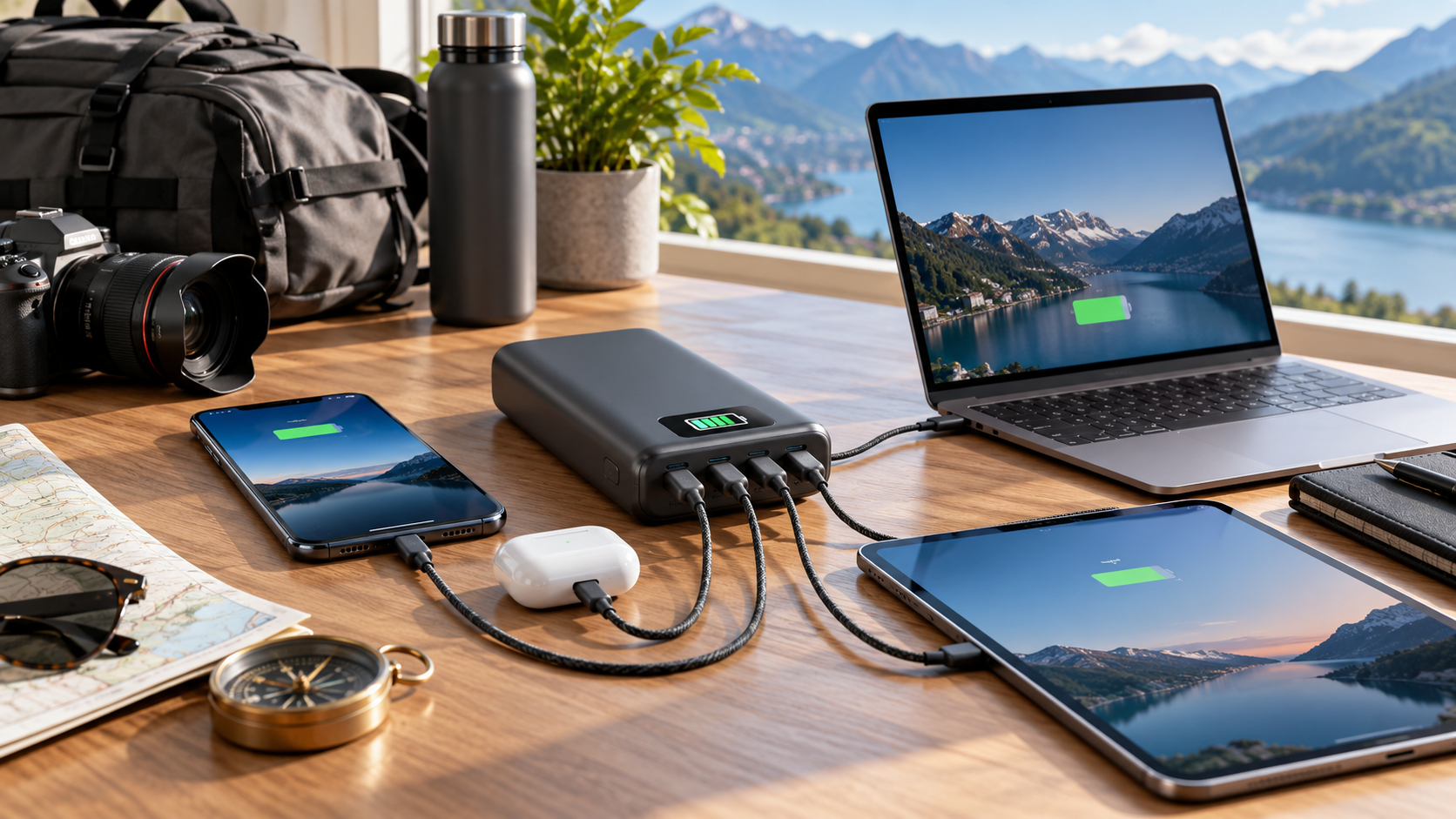
A single multi-port power bank can reduce dependence on airport and hotel outlets.
Travel-Friendly Features
Useful features can include:
• Compact design
• Clear Wh rating
• Multiple USB-C ports
• Fast recharge
• Built-in cable
• Digital battery display
• Durable casing
The ideal travel charger balances energy capacity with luggage weight.
Digital Battery Displays
Basic power banks often use four LEDs to indicate approximate remaining charge.
A digital display can provide more precise information.
Some advanced models show:
• Battery percentage
• Input wattage
• Output wattage
• Estimated charging time
This can be particularly useful for larger power banks and laptop users.
Built-In Cables
Some portable chargers include integrated cables.
Advantages include:
• Fewer accessories to carry
• Reduced chance of forgetting a cable
• Convenient daily use
The disadvantage is that a damaged built-in cable may be harder to replace.
A model with standard ports plus a built-in cable can offer more flexibility.
Pass-Through Charging
Some power banks support charging themselves while simultaneously powering another device.
This is known as pass-through charging.
It can be convenient, but implementation varies.
Heat and power management may affect long-term use.
Follow manufacturer instructions rather than assuming every model safely supports this feature.
Solar Power Banks
Some portable chargers include small solar panels.
These can appear attractive for outdoor use, but the limited panel area means solar charging can be slow.
They should generally not be assumed to replace a proper dedicated solar charging setup.
For extended outdoor trips, a larger folding solar panel connected to a compatible battery system may provide more practical energy generation.
Power Banks for Camping
Camping users may prioritize:
• High capacity
• Durability
• Multiple ports
• Lighting features
• Weather-resistant construction
• Solar charging compatibility
For multi-day camping, calculate expected energy use before choosing a battery.
Phones, cameras, lights, GPS devices, and communication equipment can collectively consume substantial energy.
Charging Multiple Devices
A multi-port power bank can be useful for families, teams, photographers, and travelers.
However, always check total combined output.
Suppose a charger supports high power through a single USB-C port.
Connecting several devices may divide the available power.
This can slow laptop or phone charging.
How Long Does a Power Bank Last?
There are two different meanings of battery life.
Runtime Per Charge
This describes how much energy the power bank provides before needing to be recharged.
Long-Term Battery Lifespan
Lithium batteries gradually lose capacity through charge cycles and age.
Long-term lifespan depends on:
• Battery quality
• Temperature
• Charging habits
• Usage frequency
• Storage conditions
A battery that once delivered several device charges may provide less capacity after years of regular use.
This is normal battery aging.
How to Store a Power Bank
For normal storage:
• Keep it in a cool, dry environment
• Avoid extreme heat
• Protect it from physical damage
• Keep ports clean
• Follow manufacturer recommendations for long-term storage charge levels
Do not leave a damaged power bank connected to charging equipment unattended.
Common Power Bank Portable Charger Mistakes
Buying Only by mAh
Capacity is important, but output power and efficiency matter too.
Ignoring USB-C PD
Laptop and fast-charging users should check charging protocols.
Buying Too Large
A massive charger may become inconvenient to carry.
Buying Too Small
Low capacity may not provide enough backup energy.
Using Poor Cables
A cable can limit charging speed.
Ignoring Airline Requirements
Travel restrictions should be checked before flying.
Continuing to Use a Swollen Battery
Damaged lithium batteries can create serious safety risks.
Assuming Every Port Delivers Maximum Power Simultaneously
Combined power can be shared.
How to Choose the Right Power Bank Portable Charger
Start by listing the devices you need to charge.
Then check their charging requirements.
For Emergency Phone Backup
Prioritize:
• Small size
• Low weight
• Moderate capacity
For Everyday Use
Consider:
• Approximately medium capacity
• USB-C fast charging
• Compact design
• Clear battery indicator
For Travel
Look for:
• Larger usable capacity
• Travel-compliant battery rating
• Multiple ports
• Fast power bank recharging
For Laptop Use
Prioritize:
• High USB-C output
• Appropriate PD support
• Large energy capacity
• High-rated USB-C cable
For Several Devices
Check:
• Port count
• Combined output
• Battery capacity
• Charging distribution
Choosing around actual use is more effective than automatically buying the largest specification.
Frequently Asked Questions
What is a power bank portable charger?
A power bank portable charger is a rechargeable external battery that stores electricity and later supplies power to compatible smartphones, tablets, earbuds, cameras, laptops, and other electronics.
What capacity power bank portable charger should I buy?
Light users may prefer compact capacities, while everyday users often benefit from medium-capacity models. Travelers, laptop users, and people charging several devices may need larger batteries.
Can a power bank portable charger charge a laptop?
Yes, if both the power bank and laptop support compatible USB-C charging and the power bank provides sufficient output wattage.
Is USB-C better for a power bank portable charger?
USB-C can support convenient two-way charging and modern fast-charging standards such as USB Power Delivery, making it useful for phones, tablets, and compatible laptops.
Can I take a power bank portable charger on an airplane?
Lithium battery travel restrictions apply to power banks. Requirements depend on battery watt-hours and airline rules, so travelers should verify current requirements before departure.
How can I safely use a power bank portable charger?
Use compatible chargers and cables, protect the battery from heat and physical damage, follow manufacturer guidance, and stop using any unit that becomes swollen, damaged, unusually hot, or otherwise abnormal.
Conclusion
A power bank portable charger can provide dependable backup energy for everything from everyday smartphone use to travel, remote work, photography, and laptop charging. Choosing the right model requires balancing battery capacity, USB-C output, recharge speed, port selection, physical size, safety features, and device compatibility. Larger capacity is useful only when the added weight matches the user’s needs, while high charging speeds depend on the complete combination of device, cable, and charger. With the right specifications and safe handling, a quality portable charger can become one of the most useful accessories in a modern mobile technology setup.