75% of HVAC Failures: 7 Critical Prevention Tips
Air conditioners and heating systems often seem to fail at the worst possible moment: during the first extreme heat wave, a freezing winter night, or just as guests arrive. You may have seen claims suggesting that 75% of HVAC failures could be avoided with routine maintenance. The precise percentage should be treated cautiously unless it is linked to a specific, credible study with a clearly defined population and methodology. What is well established is that neglected filters, dirty components, drainage problems, electrical wear, airflow restrictions, and other maintenance-related issues can contribute to poor performance and certain preventable breakdowns.
HVAC equipment is mechanical, so no maintenance plan can eliminate every failure. Compressors, motors, capacitors, control boards, heat exchangers, sensors, and other components can eventually fail because of age, manufacturing defects, operating conditions, or ordinary wear. Preventive maintenance is valuable because it can identify developing problems early, help equipment operate under appropriate conditions, and reduce avoidable strain.
Understanding the difference between a catchy statistic and evidence-based maintenance advice matters. Instead of assuming three out of every four HVAC breakdowns have one simple cause, homeowners and facility managers should focus on the specific conditions they can control. This guide covers seven major areas that can influence system reliability and explains when professional service is appropriate.
Is the 75% of HVAC Failures Claim Accurate?
The statement that 75% of HVAC failures are preventable is frequently used in marketing and maintenance discussions, but a universal figure is difficult to support.
Failure rates vary according to:
- Equipment type.
- System age.
- Installation quality.
- Climate.
- Maintenance history.
- Operating hours.
- Building conditions.
- Failure definition.
A residential heat pump in a mild climate, for example, operates under different conditions from a commercial rooftop unit running continuously during extreme temperatures.
Without a source defining exactly what counts as a “failure” and which systems were studied, the 75% figure should not be presented as an established industry-wide fact.
The more useful conclusion is that regular maintenance can reduce certain preventable problems and help identify others before they become major breakdowns.
Why HVAC Systems Fail
Heating, ventilation, and air-conditioning systems contain numerous components working together.
A problem in one area can create additional stress elsewhere.
Common contributors include:
- Restricted airflow.
- Electrical failures.
- Dirty coils.
- Refrigerant problems.
- Blocked condensate drainage.
- Mechanical wear.
- Poor installation.
- Control-system faults.
Some issues are maintenance-related; others are not.
1. Dirty Air Filters and Restricted Airflow
Air filters are among the simplest HVAC components to maintain, yet they can significantly influence system performance.
As a filter collects dust and debris, airflow resistance may increase.
Restricted airflow can contribute to:
Longer Run Times
The system may operate longer to reach the thermostat setting.
Reduced Comfort
Rooms may receive less conditioned air.
Coil Problems
In cooling systems, insufficient airflow across an evaporator coil can contribute to abnormal operating conditions, including coil freezing in some circumstances.
Additional System Stress
Components may work under less favorable conditions when airflow is significantly restricted.
The correct filter replacement schedule depends on filter type, household conditions, system use, pets, dust levels, and manufacturer recommendations.
2. Dirty Condenser and Evaporator Coils
HVAC systems rely on heat transfer.
The evaporator coil absorbs heat during cooling, while the outdoor condenser releases heat.
Dirt on coil surfaces can interfere with this process.
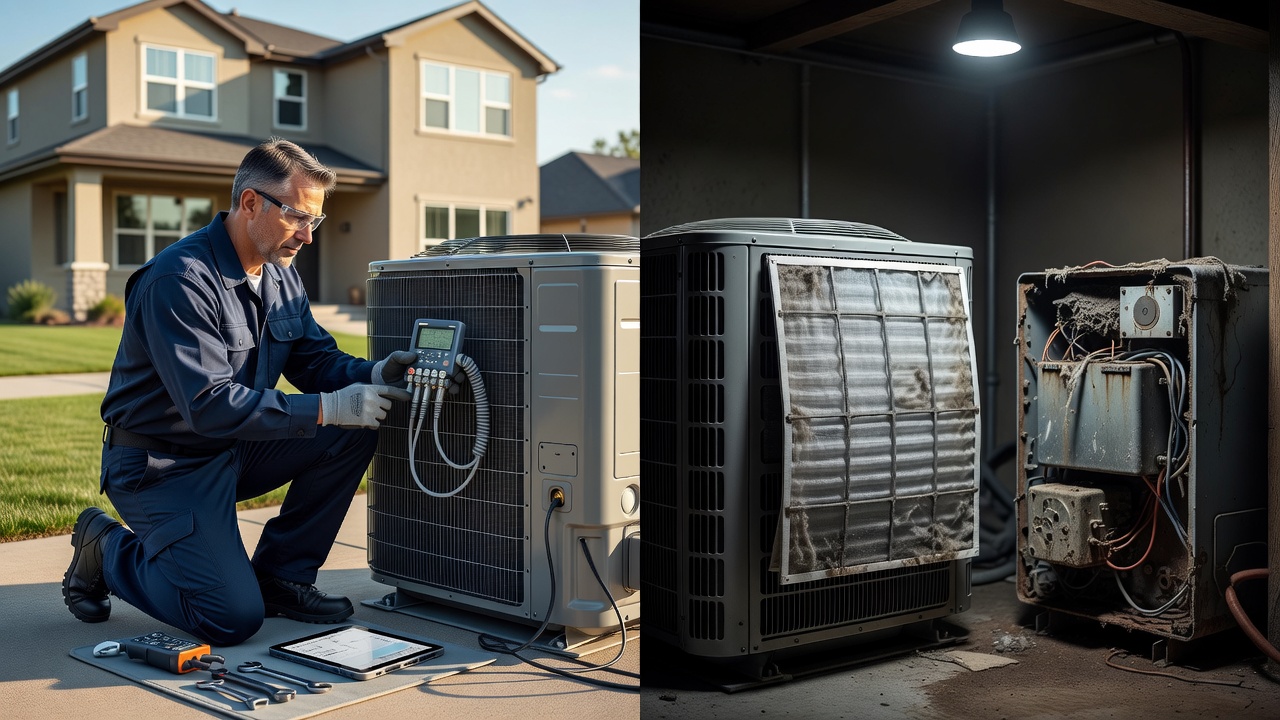
Outdoor units may accumulate:
- Dust.
- Leaves.
- Grass clippings.
- Pollen.
- Other debris.
Keep the area around outdoor equipment clear according to manufacturer recommendations.
Internal coil cleaning should generally be performed using appropriate methods because incorrect chemicals or techniques can damage components.
3. Electrical Component Wear
Electrical components experience repeated operating cycles.
Common HVAC electrical components include:
- Capacitors.
- Contactors.
- Relays.
- Wiring.
- Disconnects.
- Control boards.
Heat, vibration, corrosion, age, and electrical conditions can contribute to deterioration.
Warning signs may include:
- Intermittent operation.
- Failure to start.
- Unusual buzzing.
- Repeated breaker trips.
- Burning odors.
Electrical problems can create shock and fire hazards. Turn equipment off when appropriate and contact a qualified professional rather than opening electrical compartments without proper training.
4. Condensate Drain Problems
Air-conditioning systems remove moisture from indoor air, producing condensate that must drain properly.
Blocked or damaged condensate lines may cause:
- Water leakage.
- Ceiling or wall damage.
- System shutdowns where safety switches are installed.
- Excess moisture near equipment.
Drainage systems should be checked during routine maintenance.
If water is appearing around indoor HVAC equipment, investigate promptly rather than assuming it is harmless condensation.
5. Refrigerant Problems
Refrigerant circulates through a closed system and plays a central role in heat transfer.
Low refrigerant does not normally mean the system simply “used it up.” It can indicate leakage or another service issue.
Possible symptoms include:
- Poor cooling.
- Long operating cycles.
- Ice formation.
- Unusual system performance.
Refrigerant work requires specialized knowledge and may be subject to legal certification requirements depending on jurisdiction.
A technician should diagnose the underlying issue rather than merely adding refrigerant without determining why the charge is incorrect.
6. Mechanical Wear and Aging Components
Even well-maintained systems experience normal wear.
Motors, bearings, compressors, fans, and other moving components operate for thousands of hours throughout equipment life.
Potential warning signs include:
- Grinding.
- Rattling.
- Vibration.
- Difficulty starting.
- Reduced airflow.
- Declining performance.
Preventive service may identify deterioration early, but it cannot guarantee that an aging component will never fail.
7. Poor Installation and System Sizing
Maintenance receives considerable attention when discussing the claim that 75% of HVAC failures might be preventable, but the quality of the original installation also matters.
A system can experience persistent problems if:
- Equipment is incorrectly sized.
- Ductwork is poorly designed.
- Refrigerant charge is incorrect.
- Drainage is improperly installed.
- Airflow is inadequate.
- Controls are configured incorrectly.
Proper installation establishes the operating conditions equipment will experience for years.
For major replacements, choose qualified contractors who perform appropriate sizing and installation procedures.
Warning Signs Before an HVAC Breakdown
Some failures occur suddenly, but others produce warning signs.
Watch for:
- Longer heating or cooling cycles.
- Unusual noises.
- Uneven temperatures.
- Weak airflow.
- Unexpected energy-use increases.
- Water around equipment.
- Frequent cycling.
- New odors.
These symptoms do not identify a specific fault by themselves, but they can justify inspection.
Why Extreme Weather Exposes HVAC Problems
Breakdowns frequently appear during exceptionally hot or cold weather because equipment operates for longer periods and under greater loads.
A component that was already deteriorating may continue functioning during moderate conditions but fail during sustained operation.
This explains why HVAC service companies often become busiest during temperature extremes.
Pre-season maintenance may identify some developing issues before peak demand arrives.
A Practical Preventive HVAC Maintenance Schedule
Maintenance needs vary by manufacturer and system type, so always follow equipment documentation.
A general homeowner routine can include:
Regularly
Check the filter and replace or clean it when appropriate.
Seasonally
Inspect outdoor-unit clearance, visible drainage, thermostat operation, and obvious equipment changes.
Periodically
Arrange professional service according to manufacturer guidance, equipment condition, climate, and usage.
Commercial systems may require more frequent maintenance because of higher operating hours or regulatory requirements.
What Professional HVAC Maintenance Includes
A professional service visit can vary by system and contractor.
Potential tasks include:
- Inspecting electrical components.
- Checking airflow.
- Examining coils.
- Reviewing condensate drainage.
- Testing system operation.
- Evaluating temperature performance.
- Inspecting safety controls.
Refrigerant measurements and other technical diagnostics may be performed where appropriate.
Ask the contractor what is included rather than assuming every maintenance plan provides identical service.
Can Maintenance Prevent Compressor Failure?
Compressors are important and expensive components.
They can fail for multiple reasons, including:
- Electrical problems.
- Refrigerant-related conditions.
- Contamination.
- Excessive heat.
- Mechanical wear.
- Age.
Good maintenance can help create appropriate operating conditions and may identify some problems that contribute to compressor stress.
However, it would be inaccurate to claim that routine maintenance prevents every compressor failure.
The Hidden Cost of Skipping Maintenance
The cost of neglect is not limited to emergency repair bills.
Poorly maintained systems can experience:
- Reduced efficiency.
- Inconsistent comfort.
- Longer operating times.
- Water damage.
- Premature component wear.
Even when equipment continues operating, declining performance can increase energy consumption.
Repair or Replace?
When major failure occurs, homeowners sometimes need to decide between repair and replacement.
Consider:
- Equipment age.
- Repair cost.
- Overall condition.
- Previous breakdowns.
- Energy efficiency.
- Parts availability.
- Warranty status.
An expensive repair on relatively new equipment may make sense, while repeated major repairs on an old and inefficient system may make replacement worth considering.
Request clear estimates before deciding.
HVAC Warranties and Maintenance
Equipment warranties differ between manufacturers.
Some warranty terms may require specific installation, registration, or maintenance conditions.
Keep:
- Purchase documentation.
- Installation records.
- Maintenance invoices.
- Warranty information.
Do not assume a particular failure is covered until the manufacturer or authorized provider confirms it.
Choosing an HVAC Contractor
Qualified service is important for both performance and safety.
Consider:
- Required licensing.
- Relevant certifications.
- Insurance.
- Local experience.
- Written estimates.
- Manufacturer familiarity.
- Customer feedback.
Be cautious of contractors who guarantee that maintenance will eliminate all future failures or who rely heavily on unsupported statistics such as 75% of HVAC failures without providing the underlying evidence.
Smart HVAC Monitoring
Modern equipment increasingly uses connected technology to identify unusual operating patterns.
Smart thermostats and monitoring systems may track:
- Run times.
- Temperature changes.
- Energy patterns.
- Equipment alerts.
Some systems can notify homeowners when performance appears unusual.
These tools can provide early warning, but they cannot independently diagnose every mechanical problem.
AI and Predictive HVAC Maintenance
Artificial intelligence is increasingly used in commercial building management and advanced HVAC monitoring.
AI systems can analyze:
- Historical operating data.
- Temperature patterns.
- Equipment vibration.
- Energy consumption.
- Maintenance history.
Predictive analytics may help identify patterns associated with developing faults.
However, algorithms depend on data quality and should complement rather than replace qualified technicians.
How Homeowners Can Reduce HVAC Stress
Simple habits can support normal system operation.
Keep supply and return vents appropriately unobstructed.
Use thermostat settings that balance comfort and energy use.
Keep exterior equipment clear of vegetation and debris.
Maintain filters according to the manufacturer’s guidance.
Address unusual operation before it becomes severe.
Building improvements such as insulation, shading, and air sealing can also reduce heating and cooling demand.
Separating HVAC Facts from Marketing Claims
Statistics can make maintenance advice sound more persuasive, but precise numbers deserve verification.
When you encounter statements such as “75% of HVAC failures are preventable,” ask:
- Who produced the data?
- How many systems were studied?
- What types of HVAC equipment were included?
- What counted as a failure?
- Was the research independently reviewed?
- Does the figure apply to residential and commercial equipment equally?
Without those details, the number is better treated as a marketing claim than an established universal statistic.
The value of maintenance does not depend on exaggerating its benefits.
Conclusion
The claim that 75% of HVAC failures can be prevented is difficult to treat as a universal fact without reliable evidence defining how the figure was calculated. What homeowners can confidently take away is that many common HVAC problems are influenced by conditions that routine maintenance can address, including dirty filters, restricted airflow, contaminated coils, blocked drains, and developing electrical or mechanical issues. Preventive maintenance cannot eliminate failures caused by age, defects, extreme operating conditions, or unpredictable component breakdowns, but it can help equipment operate properly and reveal warning signs earlier. Following manufacturer guidance, monitoring system performance, and using qualified HVAC professionals provides a more useful reliability strategy than relying on an unsupported percentage.
FAQs
Is it true that 75% of HVAC failures are preventable?
There is no single universal failure rate that applies to every HVAC system. Unless a specific credible study supports the figure, the 75% claim should be treated cautiously.
What is the most common preventable HVAC problem?
Dirty filters and restricted airflow are common maintenance issues, although actual failure patterns vary according to equipment, environment, age, and usage.
How often should HVAC filters be changed?
There is no universal schedule. Follow the equipment and filter manufacturer’s guidance and inspect filters more frequently under dusty conditions, heavy usage, or in homes with pets.
Can regular maintenance stop all HVAC breakdowns?
No. Maintenance can reduce certain risks and identify developing problems, but components can still fail because of age, defects, wear, or other causes.
What are the warning signs of HVAC failure?
Weak airflow, unusual noises, frequent cycling, water leakage, declining comfort, unusual odors, and unexpectedly high energy use can indicate a problem requiring evaluation.
Should HVAC systems be professionally inspected every year?
Service frequency depends on equipment type, manufacturer recommendations, operating conditions, and usage. Many systems benefit from periodic professional maintenance, but owners should follow guidance applicable to their particular equipment.