AI Music Generator: Complete Guide to AI Composition & Text-to-Music
An AI music generator is transforming how we create, produce, and interact with audio. Whether you are a content creator needing royalty-free background tracks or a professional producer seeking rapid inspiration, an AI music generator puts the power of a full recording studio at your fingertips. By leveraging advanced machine learning and text-to-music technology, these platforms can compose complete songs in seconds. They synthesize melodies, harmonies, and beats based on simple text prompts. This comprehensive guide explores how artificial intelligence in music works, the best use cases for generative audio, and how to navigate the legal landscape of AI song making.
What is an AI Music Generator and How Does It Work?
An AI music generator is a software platform that uses artificial intelligence to compose original music. It does not simply stitch together pre-existing loops. Instead, it learns from vast datasets of musical theory, audio stems, and completed tracks to generate entirely new compositions from scratch.
The Technology Behind Generative Audio
At its core, generative audio relies on deep learning neural networks. These models are trained on thousands of hours of music across various genres. They analyze patterns in rhythm, chord progressions, tempo, and instrumentation.
When you input a command, the AI predicts which musical elements should come next to create a cohesive track. Modern platforms use diffusion models and transformer architectures. These advanced systems allow the AI to generate high-fidelity audio that sounds like it was recorded by human musicians with real instruments, rather than sounding like a basic MIDI file.
From Text-to-Music to Full AI Composition
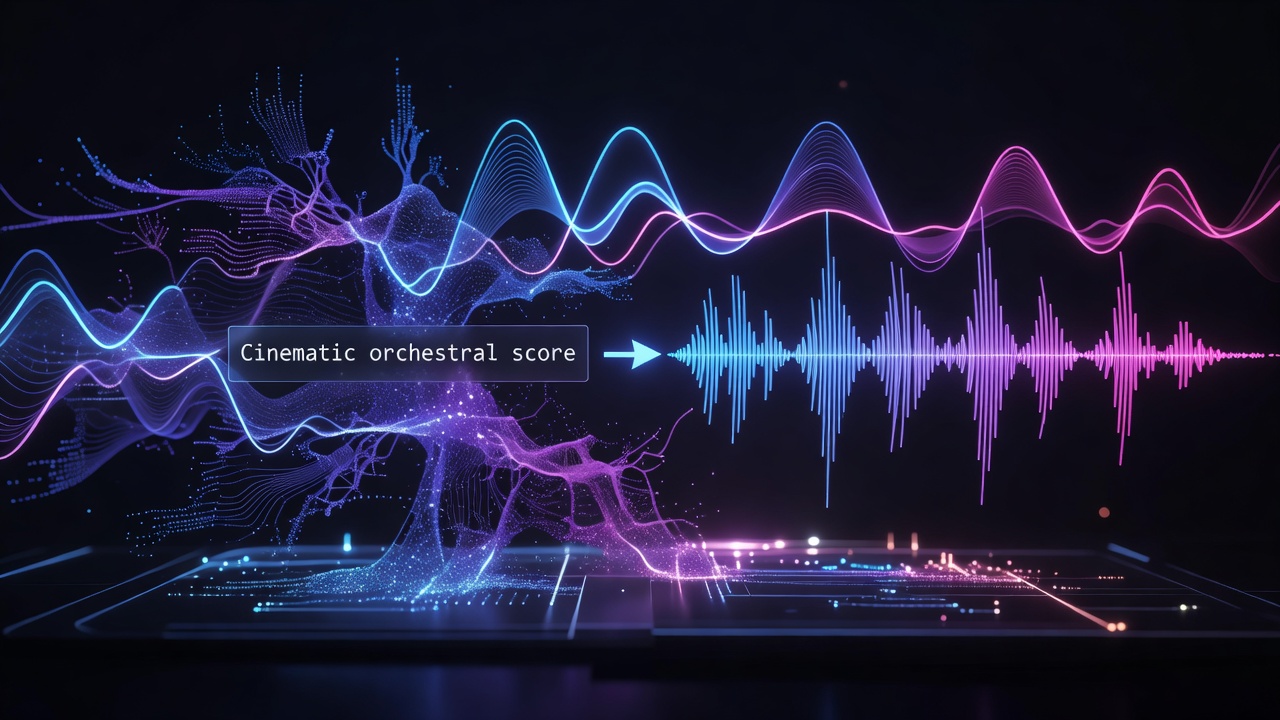
The most revolutionary advancement in this space is text-to-music generation. Instead of tweaking endless knobs and sliders, you simply type a descriptive prompt. For example, you might type: “A melancholic lo-fi hip hop track with a mellow saxophone and vinyl crackle.”
The AI parses your language. It identifies the mood (melancholic), genre (lo-fi hip hop), and instrumentation (saxophone, vinyl crackle). Within moments, the AI composition engine outputs a fully formed track. This intuitive process democratizes music production. You no longer need to understand complex digital audio workstations (DAWs) to bring your sonic ideas to life.
Top Use Cases for an AI Song Maker
The accessibility of AI song makers has opened the floodgates for creative applications across multiple industries.
Background Music for Content Creators
YouTubers, podcasters, and Twitch streamers constantly need fresh background music. Copyright strikes are a massive threat to content creators. Using mainstream music will quickly get a video demonetized or taken down. An AI music generator provides a endless supply of original, royalty-free AI music. Creators can generate tracks that perfectly match the pacing and mood of their videos without fearing copyright claims.
Prototyping and Music Production
Professional musicians are also embracing artificial intelligence in music. AI is not replacing the artist. It is acting as a collaborator. Producers use AI to quickly prototype song ideas, overcome writer’s block, or generate unique sample loops. Instead of starting from a blank project, a producer can generate a basic AI composition, export the stems, and manually refine the track in their DAW. This accelerates the creative workflow significantly.
Royalty-Free AI Music for Commercial Use
Businesses need music for advertisements, corporate videos, video games, and apps. Licensing commercial music is expensive and complicated. AI generators allow marketing teams and game developers to create custom soundscapes on demand. If a game developer needs a 10-minute ambient looping track for a sci-fi level, they can generate it instantly. This drastically reduces production budgets.
Key Features to Look for in an AI Music Generator
Not all AI audio synthesis platforms are created equally. When choosing a tool, look for these critical features to ensure it meets your creative and commercial needs.
Customization and Genre Versatility
A good AI song maker should offer a wide range of genres. From orchestral cinematic scores to aggressive EDM and smooth jazz, the platform must be versatile. Look for tools that allow you to adjust specific parameters. Being able to set the exact beats per minute (BPM), key signature, and song structure (intro, verse, chorus) gives you essential control over the final output.
Stem Extraction and Editing Capabilities
The ability to separate a generated track into individual stems is vital for professional use. Stem extraction allows you to isolate the drums, bass, vocals, and synths. Once isolated, you can import these stems into a traditional DAW. You can mix, master, and rearrange them to fit your project perfectly. Without stems, you are stuck with a flat, uneditable stereo file.
Commercial Licensing and Copyright
This is the most critical feature. If you plan to monetize your content, you must own the rights to the audio. Top-tier platforms offer clear, commercial licensing agreements. They guarantee that the AI-generated track is royalty-free and that you will not face future copyright infringement claims. Always read the terms of service. Understand whether you own the copyright outright or if the platform retains ownership of the generated audio.
The Impact of Artificial Intelligence in Music on the Industry
The rise of artificial intelligence in music is sparking intense debate. It is fundamentally shifting the economics and workflow of the audio industry.
Democratizing Music Creation
For decades, music production was locked behind expensive gear and years of training. AI music generators tear down these barriers. Anyone with an imagination can now produce high-quality music. This democratization empowers a new wave of creators. Indie filmmakers can afford custom scores. Hobbyists can express themselves musically without learning an instrument.
The Debate: AI vs. Human Artistry
Despite its benefits, AI music generation faces valid criticism. Many argue that AI lacks the emotional depth and lived experience that human artists pour into their work. A machine does not feel heartbreak or joy. It only simulates the sonic markers of those emotions based on data.
Furthermore, there are serious concerns about training data. Many AI models are trained on copyrighted human music without the original artists’ consent or compensation. As the technology evolves, the industry must find ethical ways to source training data and ensure human artistry is valued and protected.
How to Get the Best Results from Text-to-Music Prompts
Writing effective prompts is an art form. If your AI music generator outputs generic results, your prompt likely needs refinement. Here is how to write better prompts for generative audio.
Be Highly Specific and Descriptive
Avoid vague prompts like “a happy song.” Instead, use vivid, specific language. Describe the instruments, the era, and the vibe. A better prompt would be: “An upbeat 1980s synth-pop track with a driving bassline, bright analog synths, and a four-on-the-floor drum beat.”
Use Musical Terminology
If you know musical terms, use them. Words like legato, staccato, crescendo, arpeggio, and polyrhythm give the AI precise instructions. Even if you are not a musician, borrowing descriptive adjectives from music reviews helps guide the algorithm.
Iterate and Combine Styles
The magic of AI lies in its ability to blend influences seamlessly. Try combining genres that rarely mix in the real world. Prompt the AI with “A blend of traditional Celtic folk music and modern trap beats with heavy 808s.” These hybrid prompts often yield the most unique and inspiring AI compositions.
The Future of AI Audio Synthesis
The capabilities of AI music generators will only expand. We are rapidly moving toward real-time generative audio. In the near future, video games and virtual reality environments will use AI to generate dynamic soundtracks. The music will shift and change based on the player’s actions and emotional state, creating a deeply immersive experience.
We will also see improvements in vocal synthesis. AI is getting better at generating realistic, expressive singing voices from text. As ethical guidelines and licensing frameworks mature, AI will become a standard, trusted tool in every modern producer’s arsenal.
Conclusion: Embracing the AI Music Generator Revolution
The AI music generator is not a passing trend. It is a fundamental shift in how audio is conceived and produced. By turning simple text prompts into complex, high-fidelity tracks, text-to-music technology makes audio creation accessible to everyone. Whether you need royalty-free AI music for a YouTube channel, or generative audio to inspire your next hit record, these tools offer unprecedented speed and creative potential. By understanding how to prompt effectively, utilizing stem extraction, and respecting commercial licensing, you can harness the power of artificial intelligence in music safely and effectively. Explore an AI music generator today and discover how technology is amplifying human creativity.
Frequently Asked Questions (FAQs)
1. What is an AI music generator?
It is a software tool that uses artificial intelligence and deep learning models to compose and produce original music from text prompts or user parameters.
2. Can I use AI-generated music commercially?
Yes, many platforms offer commercial licensing, but you must check the specific terms of service of the tool you use to ensure you own the rights to monetize the track.
3. What is text-to-music generation?
Text-to-music is a technology where users type descriptive prompts (like “upbeat electronic dance track”), and the AI synthesizes a complete audio track matching that description.
4. Do AI music generators create MIDI or audio files?
Most modern AI generators output high-fidelity audio files (like MP3 or WAV), though some also provide MIDI files or separated stems for further editing in a DAW.
5. Is AI music generation a threat to human musicians?
AI is primarily a tool for rapid prototyping and background music; while it automates composition, many believe it lacks the emotional depth of human artistry and serves best as a creative assistant rather than a replacement.
6. How do AI music models learn to compose?
They are trained on massive datasets of existing music, analyzing patterns in rhythm, melody, and harmony to predict and generate new musical sequences that align with those patterns.