Buy Barrel Sauna for Home: How to Choose the buy barrel sauna for home Sauna
If you want to buy barrel sauna for home use, the most important decision is not simply which model looks best in backyard photos. A home sauna needs the right size, foundation, heater capacity, electrical supply, ventilation and weather protection to work safely and comfortably for years. Barrel saunas are popular because their curved construction creates a compact interior, uses outdoor space efficiently and allows heated air to circulate around the rounded ceiling with relatively little unused room.
Current outdoor sauna models range from compact two-person designs to larger six- and eight-person units. Manufacturers also offer electric heaters, Wi-Fi controls, thermally modified wood, traditional cedar and upgraded weather-protection systems. For example, Redwood Outdoors currently lists outdoor sauna capacities ranging from two to eight users and recommends allowing additional clearance around the structure for airflow, maintenance and heater access.
The buying process therefore should begin with your property and intended use rather than with a specific sauna model.
This guide explains seven major things homeowners should evaluate before ordering a barrel sauna.
What Is a Barrel Sauna?
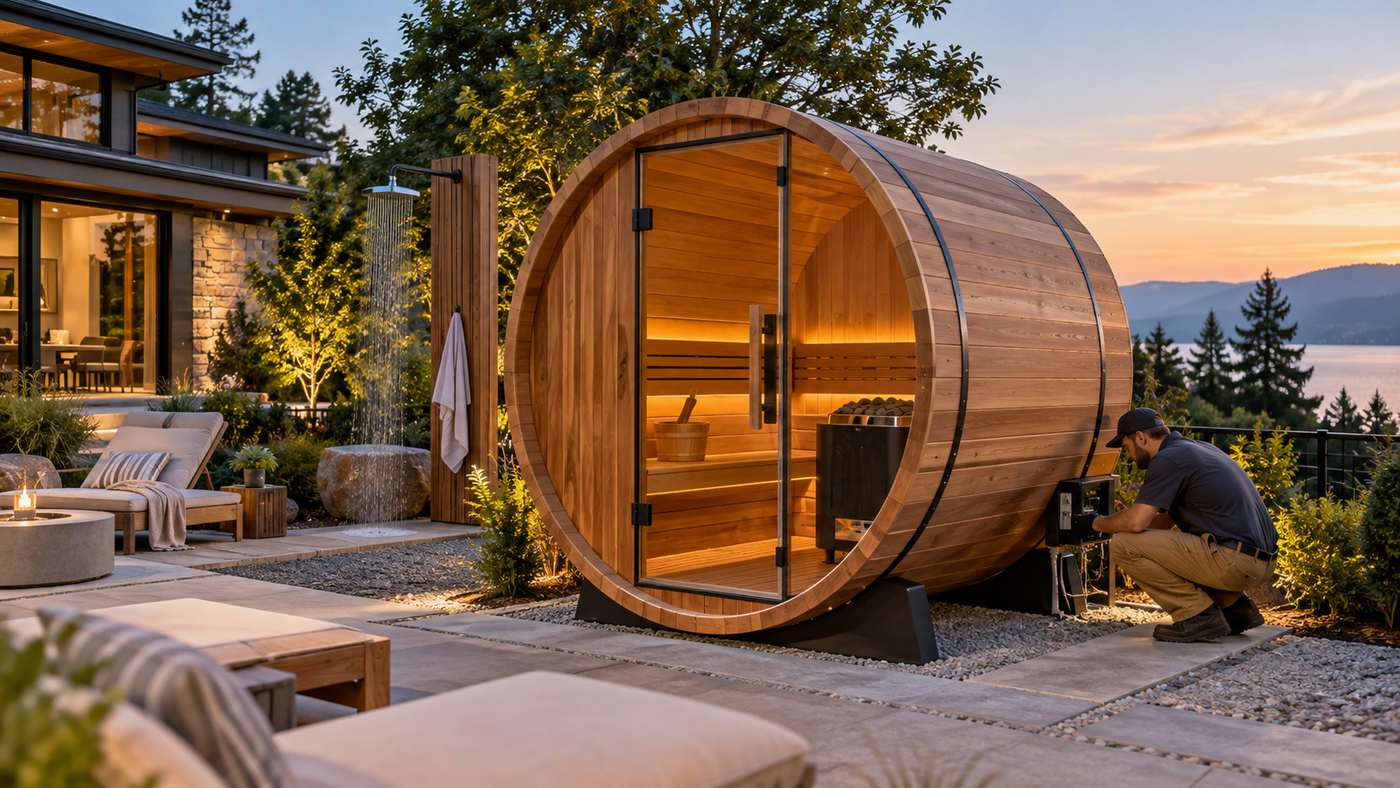
A barrel sauna is a freestanding sauna with a rounded cylindrical shape similar to a wooden barrel positioned horizontally.
Instead of conventional framed walls and a peaked roof, the structure usually uses curved wooden staves held together by metal bands.
Typical components include:
- Wooden barrel structure
- Benches
- Sauna heater
- Sauna stones
- Tempered glass or wooden door
- Ventilation openings
- Lighting
- Exterior cradle supports
- Weather protection or roof covering
Barrel saunas are most commonly installed outdoors.
Popular locations include:
- Backyard patios
- Garden areas
- Poolside spaces
- Decks
- Vacation properties
- Rural homes
Some manufacturers also produce compact barrel-style units suitable for special indoor installations, but most homeowners searching for a barrel sauna are considering an outdoor structure.
Why Buy a Barrel Sauna for Home?
A home barrel sauna combines wellness space with relatively compact outdoor construction.
Compared with building a permanent framed sauna room, a kit can simplify much of the construction process.
Potential advantages include:
- Compact footprint
- Distinctive appearance
- Efficient interior volume
- Prefabricated components
- Multiple seating capacities
- Electric or wood-burning heat options
- Backyard installation possibilities
Many barrel kits can be assembled on an existing suitable foundation rather than requiring construction of an entirely new room inside the home.
However, electrical work, local permits and site preparation can still require professionals.
1. Choose the Right Barrel Sauna Size
The first question should be:
How many people will realistically use the sauna at the same time?
Do not buy an eight-person sauna simply because eight seats sound better.
A larger sauna generally means:
- More yard space
- Larger heater requirements
- More electrical demand
- Higher purchase cost
- Longer heating time
Two-Person Sauna
A compact two-person barrel sauna can work well for:
- Couples
- Small patios
- Regular personal use
- Limited backyard space
This size is often ideal if most sessions involve only one or two people.
Four-Person Sauna
A four-person design provides more flexibility without becoming excessively large.
It can work well for:
- Couples who want more bench room
- Small families
- Occasional guests
Six-Person Sauna
Six-person barrels are among the more common full-size backyard options.
They offer enough bench length for several adults while remaining manageable in many residential yards.
Eight-Person Sauna
Larger barrel saunas are better suited to:
- Larger families
- Entertaining
- Vacation properties
- Group wellness use
Redwood Outdoors currently lists its eight-person barrel at approximately 92.5 inches long by 72.75 inches wide and weighing around 1,150 pounds.
This illustrates why checking dimensions and foundation requirements before delivery is essential.
Measure More Than the Sauna Footprint
The sauna needs more space than its published exterior dimensions.
Allow room for:
- Door opening
- Heater service
- Ventilation
- Exterior maintenance
- Electrical access
- Walking paths
Redwood Outdoors recommends roughly 12 inches of clearance around its outdoor sauna structures for airflow and maintenance access.
Always follow the specific manufacturer instructions for the model you purchase.
2. Compare Electric and Wood-Burning Sauna Heaters
The heater is one of the most important components of the sauna.
Most residential barrel saunas use either:
- Electric sauna heater
- Wood-burning sauna stove
Each option offers a different experience.
Electric Sauna Heater
Electric heaters are usually the simplest choice for suburban homes.
Advantages include:
- Easy temperature control
- No firewood storage
- No chimney
- Cleaner operation
- Timer controls
- Optional Wi-Fi systems
Many residential barrel sauna heaters use 240-volt power.
For example, Redwood Outdoors specifies 240V power for the heater in its larger barrel sauna systems and states that heaters should be installed by a certified electrician.
Harvia also offers 240V heaters specifically recommended for family and barrel saunas, with different heater sizes matched to different sauna-room volumes.
Electric Heater Size Matters
Do not choose heater power based only on price.
The heater should be sized according to:
- Sauna volume
- Glass area
- Insulation
- Climate
- Manufacturer recommendations
A heater that is too small may struggle to reach or maintain the intended temperature.
A heater that is unnecessarily large may increase cost and create installation complications.
Wood-Burning Sauna Stove
Wood-burning systems provide a more traditional experience.
They may be especially attractive for:
- Cabins
- Rural properties
- Off-grid locations
- Traditional sauna enthusiasts
Potential advantages include:
- Traditional atmosphere
- No high-amperage electrical heater circuit
- Strong heat output
- Firewood experience
However, installation can become more complex.
You may need to consider:
- Chimney
- Fire clearances
- Floor protection
- Local fire codes
- Smoke
- Wood storage
- Insurance requirements
For many suburban homeowners, an electric system is simpler.
3. Choose the Right Wood
The wood affects:
- Appearance
- Stability
- Maintenance
- Weather resistance
- Interior comfort
Common barrel-sauna materials include:
- Western red cedar
- Hemlock
- Nordic spruce
- Thermally modified wood
- Fir
Cedar
Western red cedar is widely associated with North American outdoor saunas.
It offers:
- Distinctive aroma
- Natural appearance
- Good outdoor durability
- Resistance to decay
However, cedar can be relatively expensive.
Some users also prefer a lower-aroma wood.
Hemlock
Hemlock provides a lighter, cleaner appearance.
It is commonly used in sauna construction because it remains relatively comfortable under high temperatures.
Some manufacturers offer standard hemlock or thermally modified hemlock.
Thermowood
Thermowood is wood that has been modified through controlled heat treatment.
The process is intended to improve dimensional stability and resistance to environmental conditions without relying primarily on chemical treatment.
Redwood Outdoors currently uses thermally modified hemlock in many of its outdoor sauna models and describes the treatment as improving stability and rot resistance.
Which Wood Is Best?
There is no universally best option.
Choose based on:
- Climate
- Budget
- Appearance
- Aroma preference
- Maintenance expectations
A properly designed sauna made from suitable wood can perform well even if it is not cedar.
4. Prepare a Firm, Level Foundation
One of the most common mistakes is planning the sauna before planning the base.
Barrel saunas are heavy.
Once people, heater equipment and sauna stones are added, the total load increases.
The structure therefore needs a stable foundation.
Suitable bases may include:
- Concrete pad
- Pavers
- Compacted gravel
- Suitable deck
Almost Heaven advises that outdoor barrel saunas should be installed on a firm, flat surface and lists concrete, pavers, decks and pressed gravel among possible options.
Redwood Outdoors similarly recommends a flat, level base and identifies concrete, pavers and compacted gravel as possible foundation solutions.
Avoid Bare Soft Ground
Installing directly on unstable soil can create problems.
The sauna may:
- Settle unevenly
- Shift
- Put stress on the structure
- Develop door alignment problems
Drainage also matters.
Water should not consistently pool beneath the sauna.
Consider the Delivery Route
Before ordering, measure:
- Gate width
- Side-yard clearance
- Stairs
- Fences
- Overhead obstructions
- Distance from delivery area
Some sauna kits arrive on large pallets.
If the delivery truck cannot access the final location, components may need to be moved manually.
Planning this beforehand can prevent an unpleasant delivery-day surprise.
5. Check Electrical Requirements Before Ordering
Homeowners frequently underestimate this part of the project.
Many electric barrel sauna heaters cannot simply be plugged into an ordinary household outlet.
Larger units commonly require:
- 240V circuit
- Dedicated breaker
- Correct conductor sizing
- Hardwired connection
- Professional electrician
Redwood Outdoors specifies 240V heater power on its eight-person barrel sauna and explicitly recommends certified electrician installation.
Harvia offers North American sauna heaters in capacities such as 4.5 kW and 6 kW operating at 240V, with UL-certified models available.
Get an Electrical Quote Before Buying
Ask an electrician to inspect:
- Main electrical panel
- Available breaker capacity
- Distance to sauna
- Underground wiring requirements
- Outdoor disconnect requirements
- Lighting circuits
- Local code requirements
The electrical installation can be a meaningful portion of total project cost.
If your electrical panel requires upgrading, that can change the economics of the project substantially.
Buy a Properly Certified Heater
For North American installations, look for heaters with appropriate third-party safety certification for the market.
Harvia lists several home sauna heaters with UL certification or certification to relevant electric dry-bath heater requirements.
Certification does not replace correct installation.
Both matter.
6. Consider Ventilation and Heat Circulation
A sauna needs ventilation.
Fresh air helps maintain:
- Comfort
- Air quality
- Heater performance
- Moisture management
Barrel saunas often include pre-designed intake and exhaust vents.
Do not permanently block them because the room seems to heat more quickly when they are closed.
The sauna was designed to operate with controlled airflow.
Barrel Shape Helps Heat Circulation
One appeal of the barrel design is the curved interior.
A conventional rectangular room has more ceiling volume and corners.
A barrel’s rounded ceiling reduces some unused space and encourages rising warm air to circulate through the compact room.
However, good heater sizing and ventilation are still necessary.
Bench Height Matters
Heat rises.
The upper portion of a sauna is usually warmer than the floor.
Bench position therefore influences the bathing experience.
Some barrel saunas have relatively low benches because of the curved walls.
Before buying, examine interior photos and dimensions carefully.
If you are tall, consider:
- Bench height
- Headroom
- Legroom
- Door height
Extra-wide barrels can provide more usable vertical space than compact traditional barrels.
7. Evaluate Weather Protection and Maintenance
An outdoor sauna is exposed to:
- Rain
- Snow
- UV radiation
- Temperature changes
- Wind
- Humidity
The structure needs to manage these conditions.
Some barrel sauna packages include:
- Shingles
- Rain jackets
- Roof systems
- Exterior stains
Redwood Outdoors includes asphalt shingles with some barrel models to provide additional weather protection.
Almost Heaven notes that untreated outdoor sauna wood can naturally weather over time and that exterior stain or sealant can be used when owners want to preserve the wood’s original appearance.
Do Not Treat the Sauna Interior Like Exterior Wood
Exterior protection and interior treatment are different issues.
Almost Heaven specifically advises against treating the sauna-room interior with exterior wood treatment.
Sauna interiors reach high temperatures.
Always follow the manufacturer’s instructions regarding approved interior products.
Barrel Sauna vs Cabin Sauna
Some homeowners begin wanting a barrel sauna but eventually choose a cabin.
Understanding the trade-offs helps.
Barrel Sauna Advantages
- Distinctive appearance
- Compact design
- Efficient interior volume
- Usually simpler kit construction
- Excellent backyard visual appeal
Barrel Sauna Limitations
- Curved walls reduce vertical usable space
- Bench height may be lower
- Interior layout is less flexible
- Weatherproofing may require attention
Cabin Sauna Advantages
- More headroom
- Flexible bench layouts
- Conventional walls
- Easier shelving or accessory mounting
Cabin Sauna Limitations
- Larger volume to heat
- Larger footprint
- Typically higher cost
Redwood Outdoors notes that barrels generally provide efficient space per person, while cube and cabin designs offer greater headroom.
Indoor vs Outdoor Barrel Sauna
Most barrels are designed for outdoor installation.
Before placing any sauna indoors, confirm that the specific model is intended for indoor use.
Indoor installations raise additional concerns involving:
- Moisture
- Ventilation
- Flooring
- Ceiling clearances
- Electrical installation
Harvia recommends appropriate clearance, solid flooring and proper ventilation for indoor sauna installations, with electrical work completed by a licensed professional.
Never assume an outdoor kit can automatically be placed inside a bedroom or basement.
How Many People Should Your Home Barrel Sauna Hold?
Manufacturers often describe seating capacity under ideal conditions.
An advertised six-person sauna may feel comfortable for:
- Four larger adults
- Six smaller adults sitting closely
- Two or three people wanting more room
Redwood Outdoors even notes that its eight-person barrel may practically seat six to eight people depending on body size and seating arrangement.
If comfort matters more than maximum capacity, consider buying one size larger than your usual group.
Glass Door vs Wooden Door
Modern barrel saunas frequently use tempered glass doors.
Glass Door Advantages
- More natural light
- Contemporary appearance
- Less enclosed feeling
Wooden Door Advantages
- More privacy
- Traditional appearance
- Reduced glass heat loss
Large panoramic glass sections look impressive but can increase heat loss.
That may influence heater sizing.
Always follow the manufacturer’s heater recommendation for the exact model and glazing configuration.
Should You Choose Wi-Fi Sauna Controls?
Premium heaters increasingly offer remote controls and smartphone connectivity.
Possible features include:
- Temperature adjustment
- Timers
- Scheduling
- Status monitoring
Wi-Fi control can be convenient if you want the sauna warm before you go outside.
However, remotely controlled heaters must use approved safety features and be installed according to the manufacturer requirements.
Harvia’s Spirit heater family includes integrated safety functions and compatibility with external control systems.
Convenience should never override heater safety.
Questions to Ask Before You Buy Barrel Sauna for Home
Before ordering, ask the seller:
- What is the actual exterior footprint?
- How many adults comfortably fit?
- What heater is included?
- What voltage does it require?
- Is the heater appropriately safety certified?
- Are sauna stones included?
- Does the sauna include shingles or other roof protection?
- What foundation is required?
- How long is the structural warranty?
- What maintenance is required?
- Is professional assembly available?
- What is the total shipping weight?
- Can replacement parts be ordered?
- What happens if wooden components arrive damaged?
A low advertised price can become expensive if important components must be purchased separately.
Calculate Total Ownership Cost
Do not look only at the sauna-kit price.
Your project budget may also include:
- Delivery
- Foundation
- Electrician
- Electrical trenching
- Heater upgrade
- Assembly
- Roof covering
- Exterior stain
- Lighting
- Landscaping
For example, a sauna that requires a new 240V circuit located far from the house may cost substantially more to install than one located near the electrical panel.
Get quotes before purchase when possible.
Do You Need a Permit for a Backyard Barrel Sauna?
Permit requirements vary widely.
Depending on your location, requirements may involve:
- Accessory structure rules
- Electrical permit
- Building permit
- Setback requirements
- HOA approval
- Fire restrictions
A small prefabricated sauna may be exempt from some structural permits in one jurisdiction while requiring approval in another.
Do not rely solely on the sauna seller.
Check with:
- City
- County
- Electrical authority
- HOA where applicable
before finalizing the location.
Barrel Sauna Maintenance
Routine care can help extend the life of the structure.
Keep the Interior Dry
After use:
- Allow ventilation
- Leave the door open when appropriate
- Let benches dry
Persistent moisture can encourage odor and staining.
Clean Benches Gently
Use cleaning products recommended by the manufacturer.
Avoid aggressive chemicals that can damage untreated sauna wood.
Check Metal Bands
Barrel structures rely on exterior bands.
Wood naturally expands and contracts with humidity.
Check the manufacturer’s instructions regarding band adjustment.
Inspect the Exterior
Periodically examine:
- Roof covering
- Door
- Foundation
- Wood finish
- Drainage
Early maintenance is usually easier than repairing significant weather damage later.
Common Barrel Sauna Buying Mistakes
Buying Too Small
A small sauna can feel crowded once people are seated.
Ignoring Electrical Cost
A 240V heater may require substantial electrical work.
Installing on Uneven Ground
An unstable foundation can create structural alignment problems.
Choosing a Heater Without Checking Room Volume
Heater capacity needs to match the sauna.
Forgetting Weather Protection
Outdoor wood needs proper design and maintenance.
Ignoring Local Rules
Electrical and structural requirements differ by location.
Choosing Only by Appearance
Panoramic glass and expensive wood are attractive, but heater quality, ventilation and construction matter more to daily use.
Frequently Asked Questions
What should I check before I buy barrel sauna for home use?
Check seating capacity, exterior dimensions, heater size, electrical requirements, foundation, ventilation, wood type, weather protection and local permit requirements before ordering.
Do barrel saunas need 240V electricity?
Many full-size electric barrel saunas do. For example, several current North American Harvia heaters operate on 240V, and large outdoor barrel kits commonly specify 240V heater connections.
What is the best base for a barrel sauna?
A firm, level concrete pad, pavers or compacted gravel can work depending on the manufacturer. Suitable decks may also be used if structurally capable of supporting the load.
Is cedar the best wood for a barrel sauna?
Cedar is popular, but it is not the only good option. Hemlock, spruce and thermally modified woods are also widely used. Thermowood is valued for improved dimensional stability and outdoor durability.
Can I install a barrel sauna myself?
Some kits are designed for homeowner assembly, but heater wiring should generally be completed by a qualified electrician when required by the manufacturer and local code. Redwood Outdoors, for example, specifies certified electrician installation for its electric heaters.
How many people fit comfortably in a barrel sauna?
Capacity varies by model and body size. An advertised six- or eight-person sauna may feel more comfortable with fewer users if people prefer extra bench space. Always review interior measurements rather than relying only on the capacity label.
Conclusion
When you buy barrel sauna for home use, the best choice is the model that fits your property, electrical system and real household needs rather than simply the biggest or most visually impressive option. Start with seating capacity and site measurements, then confirm heater sizing, 240V electrical requirements, foundation, ventilation and weather protection. A well-planned barrel sauna can create a comfortable backyard wellness space, but proper installation and realistic maintenance expectations are just as important as the sauna itself