Droplet-based microfluidics: Advancing Single-Cell Analysis and Diagnostics
The manipulation of fluids at the micron scale has revolutionized modern biology and chemistry. At the forefront of this innovation is droplet-based microfluidics, a technology that generates highly uniform, nanoliter-sized droplets to serve as isolated micro-reactors. By encapsulating individual cells or molecules within these aqueous droplets suspended in an immiscible carrier oil, researchers can perform massive numbers of parallel experiments without cross-contamination. This high-throughput approach significantly accelerates single-cell analysis, enzyme engineering, and diagnostic workflows, marking a paradigm shift in how biological data is captured and processed.
The Mechanics of droplet-based microfluidics
The core principle of this technology relies on the precise control of multiphase fluid flow within microfabricated channels. Typically, an aqueous sample phase is introduced into a stream of fluorinated oil containing surfactants. At a junction—often designed as a T-junction or a flow-focusing geometry—the shear forces and interfacial tension cause the aqueous phase to pinch off into monodisperse droplets. The size and generation frequency of these droplets are dictated by the channel geometry, fluid viscosity, and flow rates. Consequently, researchers can tune these parameters to produce millions of identical droplets per hour. Thus, the technology provides an unparalleled level of precision in fluid manipulation.
Device Architecture and Lab-on-a-Chip Integration
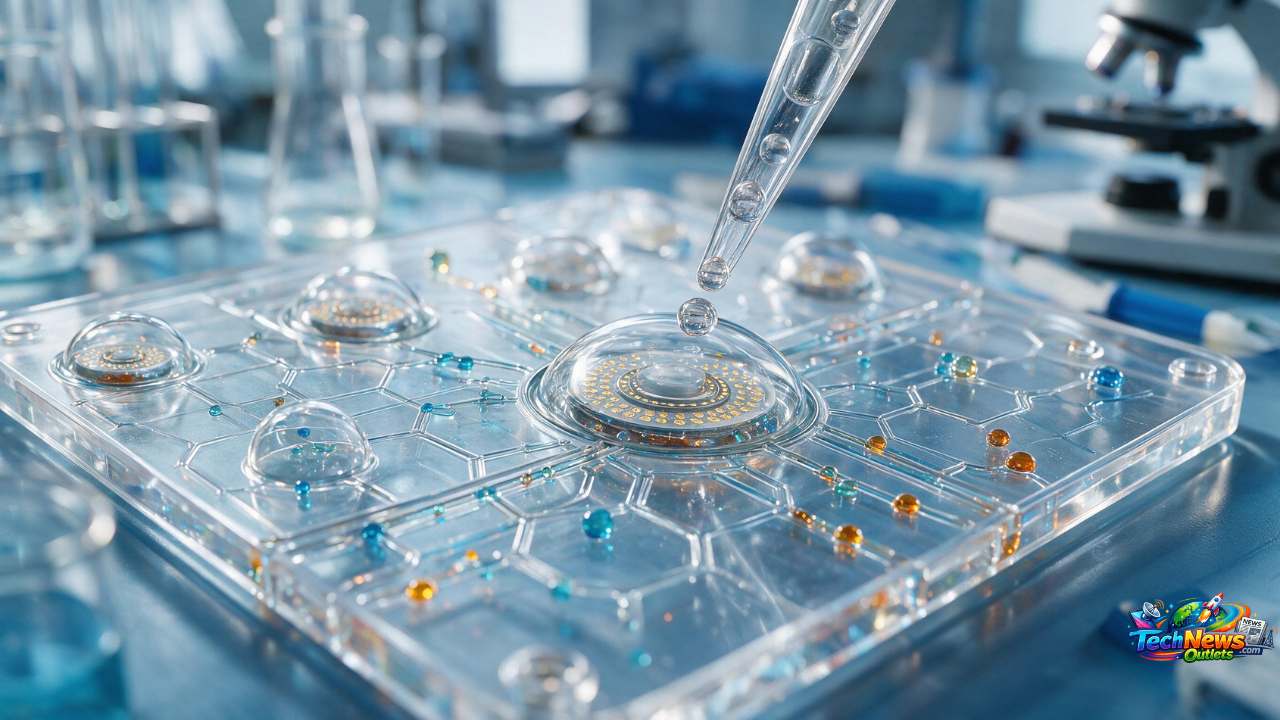
The physical devices used for this process are typically manufactured using soft lithography, with polydimethylsiloxane (PDMS) being the most common material due to its optical transparency and biocompatibility. These lab-on-a-chip devices integrate multiple laboratory functions onto a single substrate. Beyond droplet generation, these chips can incorporate channels for droplet merging, splitting, incubation, and optical sorting. By integrating these steps, researchers create continuous, automated workflows that eliminate the need for manual pipetting. Therefore, the risk of human error drops significantly, and experimental reproducibility increases dramatically.
High-Throughput Screening via droplet-based microfluidics
Traditional microplate screening limits throughput due to volume constraints and robotic handling times. Conversely, droplet-based microfluidics overcomes these limitations by using droplets as individual test tubes that are several orders of magnitude smaller than a standard well. This miniaturization allows for the screening of millions of variants in a single afternoon. The technology is heavily utilized in directed evolution experiments, where libraries of mutant enzymes are screened for improved catalytic activity. Each droplet encapsulates a single variant, and fluorescence-activated droplet sorting (FADS) is used to isolate the droplets containing the most active enzymes. Consequently, biochemical engineering advances at a pace previously considered impossible.
Single-Cell Analysis and Genomics
One of the most impactful applications of this technology lies in single-cell genomics and transcriptomics. In bulk tissue analysis, cellular heterogeneity is masked, obscuring rare cell populations and distinct gene expression profiles. Droplet-based microfluidics solves this by isolating single cells along with a barcoded bead in individual droplets. Within this micro-reactor, the cell is lysed, and its messenger RNA hybridizes to the barcoded primers on the bead. This is the foundational technology behind widely adopted platforms like the 10x Genomics Chromium system. Therefore, researchers can map complex tissues, track developmental trajectories, and identify novel cell states with unprecedented resolution. Thus, droplet microfluidics has become the bedrock of modern spatial and single-cell biology.
Diagnostic Applications of droplet-based microfluidics
The clinical diagnostics field has embraced this technology to achieve unprecedented sensitivity in molecular detection. Digital polymerase chain reaction (dPCR) relies heavily on droplet partitioning. In droplet digital PCR (ddPCR), a bulk sample containing target DNA is fractionated into tens of thousands of droplets. The PCR amplification occurs within each droplet individually. After amplification, a fluorescence reader counts the number of positive and negative droplets. This binary counting mechanism allows for the absolute quantification of nucleic acids without the need for standard curves. Consequently, ddPCR offers superior precision and sensitivity compared to quantitative PCR, especially for detecting rare mutations in a high background of wild-type DNA.
Point-of-Care and Clinical Translation
While ddPCR is well-established in central laboratories, the miniaturization inherent in droplet-based microfluidics also paves the way for point-of-care diagnostics. Portable microfluidic devices can rapidly process clinical samples—such as blood or saliva—on-site, delivering results in minutes rather than days. For infectious disease monitoring, this rapid turnaround allows for immediate clinical intervention. Furthermore, the minimal reagent consumption makes diagnostic testing highly affordable, a critical factor for deployment in resource-limited settings. Therefore, translating lab-on-a-chip technologies into clinical diagnostics democratizes access to advanced molecular testing.
Drug Discovery and Biochemical Assays
Pharmaceutical development is a notoriously expensive and time-consuming process. Droplet microfluidics streamlines the drug discovery pipeline by enabling ultra-high-throughput compound screening. Drug candidates can be encapsulated alongside target cells, allowing researchers to monitor cellular responses at the individual level. This approach is particularly valuable for assessing drug cytotoxicity and efficacy against heterogeneous cancer cell populations. Furthermore, droplet microfluidics facilitates the screening of antibody libraries. Hybridoma cells secreting target antibodies can be isolated in droplets, and the secreted antibodies can be assayed for antigen binding within the same droplet. Thus, the technology compresses months of iterative screening into a few days of continuous flow processing.
Overcoming Technical Challenges in droplet-based microfluidics
Despite its immense potential, the technology faces several technical hurdles. Droplet coalescence during incubation can ruin experimental outcomes by mixing distinct biological reactions. Biofouling, where biomolecules adsorb to the channel walls, can disrupt flow patterns and cause cross-contamination. To mitigate these issues, researchers continuously develop novel surfactant chemistries and surface passivation techniques. Additionally, maintaining cell viability within the confined, oxygen-limited environment of a droplet poses a significant challenge, particularly for long-term assays. Engineers address this by using oxygen-permeable PDMS devices and fluorinated oils that can dissolve and transport respiratory gases. Consequently, solving these engineering challenges is vital for expanding the biological applications of the platform.
Future Trends in droplet-based microfluidics
The field continues to evolve rapidly, driven by interdisciplinary collaborations between engineers, biologists, and data scientists. The integration of artificial intelligence and machine learning is poised to revolutionize droplet analysis. High-speed cameras and fluorescence detectors generate massive datasets during droplet generation and sorting. Machine learning algorithms can analyze this data in real-time to optimize sorting gates, identify subtle phenotypic variations, and predict experimental outcomes. Furthermore, the development of stimuli-responsive surfactants allows for on-demand droplet merging and breaking, adding temporal control to the spatial isolation provided by the droplets. Therefore, the next generation of microfluidic devices will be highly dynamic and computationally driven.
Automation and Synthetic Biology Integration
In synthetic biology, researchers design and build novel biological systems. Testing these engineered circuits requires massive parallelization. Droplet-based microfluidics provides the perfect testing ground, allowing synthetic biologists to screen thousands of genetic circuit variants rapidly. By integrating microfluidic platforms with automated liquid handlers and robotic incubators, entirely autonomous biofoundries can be established. These systems can run iterative design-build-test-learn cycles continuously, drastically accelerating the pace of synthetic biology innovation. Consequently, the convergence of automation, droplet microfluidics, and synthetic biology will drive the production of next-generation biotherapeutics and sustainable biomaterials.
FAQs
1. What is droplet-based microfluidics?
It is a technology that generates uniform, nanoliter-sized aqueous droplets in oil to serve as isolated micro-reactors for high-throughput biological and chemical experiments.
2. How does droplet-based microfluidics benefit single-cell analysis?
It isolates individual cells with barcoded beads, allowing researchers to capture distinct gene expression profiles and map cellular heterogeneity in complex tissues.
3. What is droplet digital PCR (ddPCR)?
ddPCR fractionates a sample into thousands of droplets for individual PCR amplification, allowing absolute quantification of target DNA without standard curves.
4. How are droplets sorted in microfluidic devices?
Droplets are typically sorted using fluorescence-activated droplet sorting (FADS), where dielectric forces deflect fluorescent droplets containing target molecules or cells.
5. What materials are used to manufacture microfluidic chips?
Polydimethylsiloxane (PDMS) is the most common material due to its optical transparency, biocompatibility, and oxygen permeability, though glass and thermoplastics are also used.
6. What are the main challenges of droplet microfluidics?
Key challenges include preventing droplet coalescence during incubation, avoiding biofouling of channel walls, and maintaining long-term cell viability in oxygen-limited environments.
Conclusion
The ability to compartmentalize biological and chemical reactions into microscopic droplets has fundamentally transformed the life sciences landscape. droplet-based microfluidics provides an unparalleled platform for high-throughput screening, precise single-cell genomics, and ultra-sensitive clinical diagnostics. By shrinking the laboratory to the micron scale, this technology reduces reagent costs, accelerates experimental timelines, and reveals biological heterogeneity that bulk analysis obscures. While engineering challenges like biofouling and cell viability persist, continuous advancements in material science and artificial intelligence integration are rapidly overcoming these barriers. Ultimately, droplet-based microfluidics stands as a cornerstone technology that will continue to drive innovation across biotechnology, pharmaceuticals, and clinical diagnostics for decades to come.