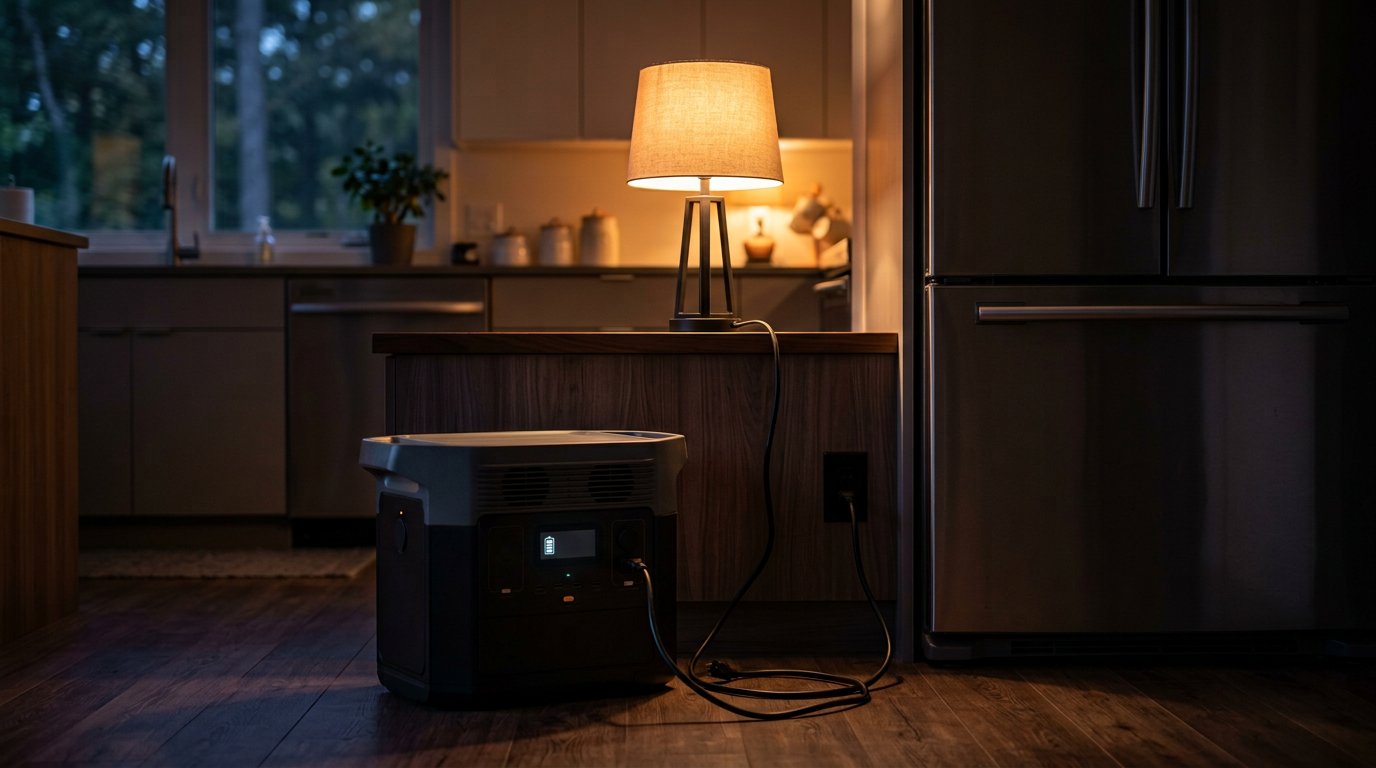
Home Battery Backup: A Complete Guide to Keeping Your Power On
Power outages have a way of arriving at the worst possible moment: during a storm, on the hottest day of the year, or right when the freezer is full and the family is home. For years, the default answer was a fuel-powered generator, with its noise, fumes, and endless refuelling. A home battery backup system offers a different approach, one that is quieter, cleaner, and increasingly practical for a wide range of households. This guide explains what home battery backup actually means, the difference between portable power stations and whole-home systems, how to size a unit for your needs, and what to look for when choosing one, with reference to the backup systems offered by Oukitel Power.
What Home Battery Backup Actually Means
The term “home battery backup” covers several different products, and understanding the distinctions is the first step to buying the right one.
At one end of the spectrum is the permanent whole-home battery, typically installed by an electrician and wired into the home’s electrical panel. These systems power the entire house or a dedicated set of circuits, and they usually pair with solar panels. They are powerful, but they are also expensive and require professional installation.
At the other end is the portable power station, a self-contained battery with an inverter and AC outlets that can be carried, moved, and recharged from a wall outlet, a car, or a solar panel. Portable power stations have grown enormously in capability, and larger models with expansion batteries now overlap with what was once the territory of installed systems. This category is the most relevant for most households, because it delivers real backup capability without installation, permits, or permanent modification to the home.
Between the two sits the expandable home backup system: a portable power station that accepts additional battery modules to scale its capacity, paired with solar panels for recharging. This is the fastest-growing segment, and it is the approach Oukitel Power has built its home backup line around.
Why the Portable Power Station Changed the Category
For a long time, portable power was small: enough for a phone, a laptop, maybe a small appliance. That limitation kept battery backup in the realm of camping and emergencies rather than whole-home use. Two developments changed that.
The first is battery technology. Modern lithium-iron-phosphate and related chemistries pack far more energy into a manageable package, and they survive thousands of charge cycles, which makes a backup system a durable investment rather than a disposable one.
The second is inverter technology. A pure sine wave inverter delivers the clean, grid-like power that sensitive electronics expect, which means the same unit can run a refrigerator, a medical device, a router, or a workstation without worry.
The result is that a single portable unit, or a unit paired with an expansion battery, can now cover a meaningful portion of a home’s critical loads during an outage: the refrigerator and freezer, lights, phones, internet, a sump pump, or a CPAP machine. For most outages, which are measured in hours rather than days, that is exactly what matters.
How to Size a Home Battery Backup
The most common question in battery backup is also the most important: how much capacity do you actually need? The answer comes from looking at what you plan to power and for how long.
Capacity is measured in watt-hours, usually written as Wh. A refrigerator, for example, might draw 100 to 200 watts while running and cycle on and off, consuming roughly 1,000 to 2,000 watt-hours over a full day. A phone charges in a few tens of watt-hours, a laptop in a few hundred, and a CPAP machine overnight in a few hundred. The exercise is simple: list the essential devices, estimate their consumption, and multiply by the hours you expect to run them.
Output power is measured in watts, and it must be high enough to start and run everything at once. Appliances with motors, such as refrigerators and sump pumps, draw a brief surge when they start, so the inverter needs headroom above the running wattage. A unit rated at 3,600 watts, for instance, will comfortably run a refrigerator, lights, electronics, and a microwave in sequence without tripping.
Expansion is the third consideration. Some households buy a single unit first and add battery modules later as budget allows. A system built around expansion, such as Oukitel’s BP2000 paired with B2000 expansion batteries, lets capacity grow from a base level to something substantially larger, which is a practical way to spread the cost while still ending up with real backup depth.
Types of Home Battery Backup Systems
Understanding the product categories makes the buying decision clearer.
Single-Unit Portable Power Stations
A standalone unit contains the battery, inverter, and outlets in one chassis. Smaller units handle a handful of devices; larger units, such as the Oukitel P5000 Pro with 5,120 watt-hours and 3,600 watts of output, can carry substantial household loads on their own. Single units are the easiest entry point and remain fully portable.
Expandable Systems With Battery Modules
An expandable system starts with a core station and adds one or more expansion batteries to increase total capacity. Oukitel’s BP2000, for example, can be paired with B2000 expansion batteries of 2,048 watt-hours each, allowing a home backup configuration to scale without replacing the original purchase. This modularity is the defining advantage of the category.
Solar Generator Kits
A solar generator is a power station bundled with one or more solar panels, turning the system into a renewable source rather than just a battery. During an extended outage, a 400-watt panel can meaningfully recharge a large station each day, which stretches a finite battery far beyond its stored capacity. Oukitel pairs its P5000 Pro with one or two 400-watt portable solar panels for this purpose.
What to Look for When Buying
Several technical factors separate a good home battery backup from a disappointing one.
Battery chemistry matters first. Lithium-iron-phosphate (LiFePO4) batteries are the standard for serious backup because they offer thousands of charge cycles and stable performance over years of use. The cycle life of the battery is effectively the lifespan of the product, so it deserves attention.
The inverter’s waveform matters second. A pure sine wave inverter is essential for anything with a motor or sensitive electronics; a modified sine wave can cause buzzing, overheating, or outright failure in some devices. This is a specification worth confirming before purchase.
Output ports matter third. A good unit offers a mix of AC outlets, USB ports, and higher-power outputs for appliances, and the total output wattage should exceed your anticipated simultaneous load with room for surge.
Recharging flexibility matters fourth. The best systems can be recharged from a wall outlet, a vehicle, and solar panels, which gives you options during an extended outage when the grid is down and the car is the only other source.
Finally, consider the warranty and support. A home battery backup is a multi-year purchase, and the company behind it should offer a defined warranty and reachable support. Oukitel Power publishes its warranty and returns policies on its site, and it maintains an active review base that buyers can consult before committing.
A Practical Look at Oukitel Power’s Home Backup Line
Oukitel Power is a brand focused on portable power stations, home battery backup systems, and solar generator kits. Its home backup collection centres on two approaches: large single units and expandable systems with solar options.
The P5000 Pro is the flagship single unit, rated at 5,120 watt-hours of capacity and 3,600 watts of output, and listed at a sale price of $1,599 at the time of writing. It can be bundled with one or two 400-watt portable solar panels as a solar generator kit. For buyers who want to scale capacity over time, the BP2000 pairs with B2000 expansion batteries of 2,048 watt-hours each, and the collection includes configurations with one or two expansion batteries, with or without solar panels, at price points from roughly $2,099 to $2,398 at the time of writing.
The company’s broader catalogue includes smaller power stations, a range of 100-watt to 400-watt portable solar panels, and accessories such as extension cables, and it maintains customer reviews that buyers can read directly. Customer feedback on the site frequently references reliability over years of ownership and performance during camping and backup use, though individual experiences vary. As with any purchase of this size, confirming current specifications, pricing, and warranty terms with the company is recommended.
Backup Power Without the Drawbacks of Fuel
It is worth addressing the comparison most buyers are implicitly making, because home battery backup has a few structural advantages over a fuel generator.
A battery system is silent, or nearly so, which matters during an overnight outage and in dense neighbourhoods. It produces no exhaust, so it can be operated indoors, which means no running extension cords through windows and no carbon monoxide risk. It requires no fuel storage, no carburettor maintenance, and no cold-start frustration months after the last storm. And it can be recharged by solar, which makes it sustainable during the kind of multi-day outage that drains a fuel can quickly.
The honest trade-off is total energy. A fuel generator can run indefinitely as long as fuel keeps coming, while a battery holds a finite charge until recharged. For the typical outage, the battery’s convenience and safety outweigh that limitation; for indefinite off-grid power, solar recharging narrows the gap considerably.
Conclusion
A home battery backup is no longer a niche alternative; it has become, for many households, the most practical way to ride out a power outage with dignity and safety. By understanding capacity in watt-hours, output in watts, and the value of expansion and solar recharging, you can choose a system that covers the loads that actually matter to you without overspending on power you will never use. Portable power stations with expansion batteries, such as those offered by Oukitel Power, have brought serious backup capability within reach of ordinary households, without installation, permits, or permanent modification to the home. The right time to think about backup power is before the lights go out, and the right place to start is a clear-eyed look at what you cannot afford to be without.
Frequently Asked Questions
1. What is a home battery backup?
A home battery backup stores electrical energy and supplies it to your essential devices during a power outage, either as a portable power station or an installed whole-home system.
2. How much battery capacity do I need for a power outage?
List your essential devices, estimate their consumption in watt-hours, and multiply by the hours you need to run them; a refrigerator uses roughly 1,000 to 2,000 watt-hours per day.
3. Can a portable power station run a refrigerator?
Yes, units with sufficient output wattage and surge headroom can run a refrigerator, but check the running and startup wattage against the station’s rated output.
4. How long does a home battery backup last?
Runtime depends on capacity and load; a 5,120Wh unit can run a few hundred watts of essential loads for many hours, and solar panels extend it during multi-day outages.
5. What is the difference between a power station and a solar generator?
A solar generator is a power station bundled with solar panels, so it can recharge from sunlight; the terms overlap when a station supports solar input.
6. How do expansion batteries work?
Expansion batteries, such as Oukitel’s B2000, connect to a compatible power station to increase its total watt-hour capacity without replacing the original unit.