Concrete Driveway Guide: Planning, Cost and What Makes One Last
A driveway is one of the few parts of a home that works every single day while also being the first thing anyone sees on arrival. It carries vehicles, endures weather, channels water, and sets the visual tone for the entire front of the property, yet it is often the last part of a build or renovation to be given real thought. A well-planned concrete driveway does more than look good on the day it is poured; it stays solid, safe, and attractive for decades. This guide explains what goes into a quality concrete driveway, the finishes available, how drainage and site conditions affect the outcome, what drives cost, and what to look for in a contractor, with reference to how Conker approaches driveways across Brisbane and the Gold Coast.
Why Concrete Remains the Default Choice
Concrete has been the dominant driveway material for generations, and the reasons are practical rather than fashionable.
Concrete is strong and long-lasting. A properly prepared and poured concrete driveway routinely serves for decades, far outlasting asphalt and requiring far less upkeep than loose-surface alternatives such as gravel. It carries heavy vehicles without rutting, resists the sun and rain that degrade other materials, and holds its shape through seasonal movement.
Concrete is also versatile. Through different finishes, colours, and treatments, the same material can read as sleek and modern, warm and textured, or classic and understated. That flexibility is why concrete suits everything from a coastal renovation to a rural acreage property, and why it remains the reference point against which other driveway materials are judged.
Understanding the Finishes
One of the first decisions in any concrete driveway project is the finish, and each option carries a different look and a different practical profile.
Plain or Broom-Finished Concrete
A broom finish is the classic, most economical option. The surface is textured with a broom while the concrete is still wet, creating a light grip that improves traction when wet. It is durable, low-maintenance, and widely used where function matters more than statement. For many homes, a well-executed broom finish with neat edges and good drainage is all the driveway ever needs.
Exposed Aggregate
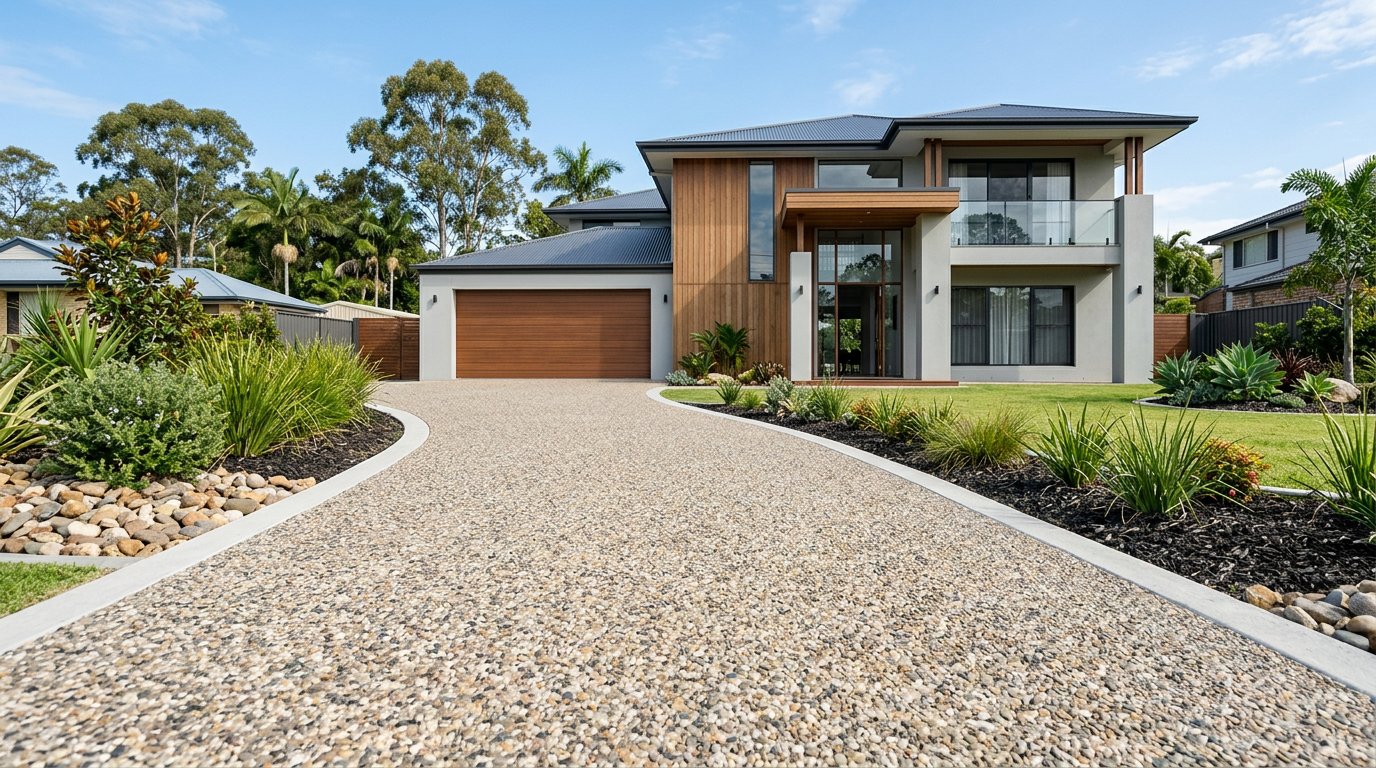
Exposed aggregate is one of the most popular premium finishes in South East Queensland. The top layer of cement paste is washed away during finishing to reveal the natural stone within, producing a textured, slip-resistant surface with genuine visual depth. It is prized for its appearance and its grip, and it hides tyre marks and general wear better than a smooth finish. The specific stones and colours in the mix can be selected to suit the home, which makes exposed aggregate a favourite for both modern and character properties.
Coloured and Decorative Concrete
Coloured concrete introduces pigment into the mix or applies a colour treatment to the surface, allowing the driveway to be matched to the home’s palette rather than left as a default grey. This can be combined with stencilling or saw-cut patterns to create the look of paving at a fraction of the labour cost. The key is that colour is permanent, so the choice deserves care: viewed in full sun, a colour can appear quite different from the small sample that was approved.
The Part You Cannot See: Subgrade, Drainage and Structure
The most important decisions in a concrete driveway are the ones hidden beneath the surface, and they are the reason two driveways that look identical can age very differently.
Site Preparation and the Subgrade
Concrete is only as good as what it sits on. The ground beneath the slab must be excavated, compacted, and prepared to a consistent level, because movement in the subgrade becomes cracking in the slab above. Queensland’s clay soils move with wet and dry cycles, which makes thorough compaction and appropriate reinforcement essential rather than optional.
Drainage and Water Flow
Water is the enemy of every driveway and the foundation around it. A well-designed driveway directs water away from the house rather than toward it, with falls, spoon drains, or strip drains where the land requires. In Brisbane and the Gold Coast, where heavy downpours are routine, drainage is not a finishing touch; it is a structural requirement. A contractor who plans overland flow and stormwater paths before setting out formwork is designing a driveway that will not quietly undermine the home it serves.
Reinforcement and Joints
Steel reinforcement and correctly placed expansion and control joints manage the natural expansion and contraction of concrete as temperatures change. Joints are deliberately placed so that when the slab does crack, it cracks neatly along a planned line rather than randomly across the surface. This is standard practice for any serious contractor, and its absence is a warning sign regardless of how good the finished surface looks.
What a Concrete Driveway Costs
Driveway pricing varies so widely that any single figure would mislead, but the factors that move the price are consistent and worth understanding.
The size and shape of the driveway is the starting point, since it determines material volume and formwork. A long driveway to a rear garage costs more than a short front apron. The site condition matters next: steep blocks, poor access, and difficult ground all add labour, and in Brisbane’s hilly suburbs this is a common reality rather than an exception.
The finish moves the price substantially, with plain broom finish at the economical end and exposed aggregate and decorative treatments at the premium end. Site preparation and drainage work, such as additional excavation, retaining, or stormwater connections, can add more to the total than the finish itself on difficult sites.
The honest way to budget is to obtain itemised quotes from licensed contractors who have inspected the site, and to be wary of quotes that are dramatically lower than others for the same stated scope. A driveway is a long-term structure, and the cheapest quote often simply prices out the preparation and drainage work that determines whether it lasts.
Choosing a Contractor: What to Look For
The contractor determines the outcome more than the material does, and a few checks separate the dependable from the rest.
Licensing is non-negotiable. In Queensland, concrete work should be delivered by a contractor who holds the appropriate licences and meets QBCC requirements and the National Construction Code. Proof of insurance should be available without hesitation, because both protect you if something goes wrong.
Accreditation signals standards. Industry bodies such as Master Concreters, Master Builders, and the Housing Industry Association indicate a contractor who operates within recognised professional frameworks. Supplier accreditations, such as Dulux Avista or Geostone approval, show that the contractor has met a product manufacturer’s standards for installation quality.
Local experience matters in ways that are easy to underestimate. A contractor who has built hundreds of driveways across Brisbane and the Gold Coast has already learned how the region’s clay soils, storms, and steep blocks behave, and has refined their approach accordingly. That local knowledge is worth more than any national brand name.
Finally, look at finished work and speak to past clients. A driveway is hard to evaluate from photographs alone, and the people who live with one for a few years know whether it drains, whether it cracks, and whether the contractor stood behind it.
A Brisbane and Gold Coast Option: Conker
For homeowners in South East Queensland, Conker is a licensed concreting and structural landscaping company that specialises in concrete driveways across Brisbane and the Gold Coast, from character homes in Ascot and Teneriffe to acreage properties in Pullenvale, Samford, and the Hinterland. The company describes its approach as designing every driveway around structure and drainage first, assessing overland flow, existing levels, retaining, and stormwater paths before any formwork is set.
Conker states that it delivers all work in line with QBCC requirements and the National Construction Code, and that it holds the necessary licences and insurance. The company is a member of Master Concreters, Master Builders, and the Housing Industry Association, and it is accredited by Dulux Avista and an approved Geostone installer, with a long-term partnership with Holcim Geostone for exposed aggregate and coloured concrete mixes developed for South East Queensland conditions. Homeowners can contact Conker directly through its website to discuss a project.
Getting the Driveway Right the First Time
A few practical habits will make the project smoother and the result better.
Think about how the driveway is actually used before finalising the design: where vehicles park, how they turn and reverse, where bins are collected, and how pedestrians reach the door. A driveway planned around real movement patterns is safer and easier to live with than one planned around a symmetrical sketch.
Consider the whole front of the property, not just the strip of concrete. The driveway should sit comfortably with the home’s architecture, the landscaping, and the street, because it is the largest hard surface on most frontages and it sets the visual tone for everything around it.
And insist on clarity. A professional contractor should be able to explain what happens at each stage, why it matters, and what the finished result will be, in plain language. If the explanation is vague, the work probably will be too.
Conclusion
A concrete driveway is a long-term investment that sits at the intersection of function and first impressions, and the difference between a good one and a poor one is almost always decided before the first pour. Preparation, drainage, reinforcement, and an appropriate finish determine whether a driveway looks good for a season or performs well for decades. In a climate like South East Queensland’s, where heavy rain and reactive soils are constant pressures, choosing a licensed contractor who plans for those realities is the single most important decision in the project. Companies such as Conker, with local experience across Brisbane and the Gold Coast and the accreditations to back it, represent the kind of contractor worth talking to. The driveway is the first and last thing you see every day; it is worth getting right the first time.
Frequently Asked Questions
1. How much does a concrete driveway cost in Australia?
Costs vary with size, finish, site conditions, and drainage work, so the reliable approach is itemised quotes from licensed contractors who have inspected the site.
2. How long does a concrete driveway last?
A properly prepared, reinforced, and drained concrete driveway commonly lasts for several decades, far longer than asphalt or loose-surface alternatives.
3. What is the best finish for a concrete driveway?
Exposed aggregate is popular for its grip and visual depth, while a broom finish is durable and economical; the right choice depends on budget and style.
4. Do concrete driveways crack?
Control joints are placed so that natural expansion and contraction cracks occur along planned lines; a well-built driveway should not crack randomly.
5. How thick should a concrete driveway be?
Thickness depends on vehicle loads and site conditions, and a licensed contractor will specify the appropriate slab and reinforcement for your situation.
6. Does a driveway need drainage?
Yes, effective drainage that moves water away from the house and foundations is essential, especially in Brisbane and the Gold Coast’s heavy-rainfall climate.