Make A Boxes: Complete Guide to Custom Packaging Solutions for Businesses
Packaging plays a crucial role in how customers perceive a product before they even open it. A well-designed box does more than protect its contents; it communicates brand identity, creates a memorable unboxing experience, and helps products stand out in a competitive marketplace. For businesses looking for personalized packaging solutions, Make A Boxes offers custom packaging options designed for industries ranging from cosmetics and fashion to food, retail, and e-commerce.
Whether you are launching a startup, expanding an online store, introducing a new product, or improving your existing packaging, selecting the right manufacturer can influence both presentation and operational efficiency. Custom packaging allows businesses to choose materials, sizes, printing styles, and finishing techniques that match their products and branding requirements.
This comprehensive guide explores the services, packaging styles, customization options, manufacturing process, and practical advantages associated with Make A Boxes. It also explains how businesses can select suitable custom boxes, compare packaging materials, and make better purchasing decisions.
What Is Make A Boxes?
Make A Boxes is a USA-based custom packaging solutions company specializing in personalized product boxes for businesses across different industries. The company focuses on creating packaging that balances product protection, visual presentation, material selection, and practical functionality.
According to its published company information, Make A Boxes has more than ten years of experience supporting small and medium-sized businesses. The company describes serving more than 2,500 brands and producing custom packaging using modern printing technologies and a variety of paperboard materials.
Its product range includes retail boxes, rigid boxes, corrugated packaging, mailer boxes, food packaging, cosmetic boxes, and several specialty designs.
One of the company’s main selling points is customization. Instead of requiring businesses to accept generic packaging dimensions and designs, it offers made-to-order options intended to accommodate different products and branding objectives.
Why Custom Packaging Matters for Modern Businesses
Packaging has become an important part of the customer experience, particularly as more businesses compete through online stores, subscription services, and direct-to-consumer sales.
Customers often interact with the packaging before seeing the product itself. Box structure, color, texture, and opening style can all influence their first impression.
Building Stronger Brand Recognition
Custom packaging provides an opportunity to display a company’s logo, brand colors, visual identity, and product information consistently.
When customers encounter recognizable packaging across retail shelves, deliveries, and promotional materials, it can reinforce brand familiarity.
Make A Boxes provides various customization options intended to help businesses develop packaging that reflects their branding preferences.
Improving Product Presentation
A thoughtfully designed package can make a product appear more organized and professionally presented.
For example, a luxury fragrance may benefit from a sturdy rigid box with a fitted insert, while a handmade candle may require a compact carton that protects the container and communicates its design aesthetic.
The most suitable approach depends on the product’s characteristics and the expectations of its intended customers.
Supporting Product Protection
Packaging should protect products during handling, storage, transportation, and delivery.
Appropriate box dimensions, structural materials, inserts, and cushioning can help reduce movement and exposure to ordinary shipping stresses.
However, attractive packaging alone does not guarantee product protection. Businesses should evaluate structural performance and test packages under realistic distribution conditions.
Popular Packaging Solutions Available
Different products require different packaging structures. A fragile cosmetic bottle has different needs from a clothing accessory or subscription package.
Make A Boxes offers multiple box styles intended to support a range of commercial applications.
1. Custom Rigid Boxes
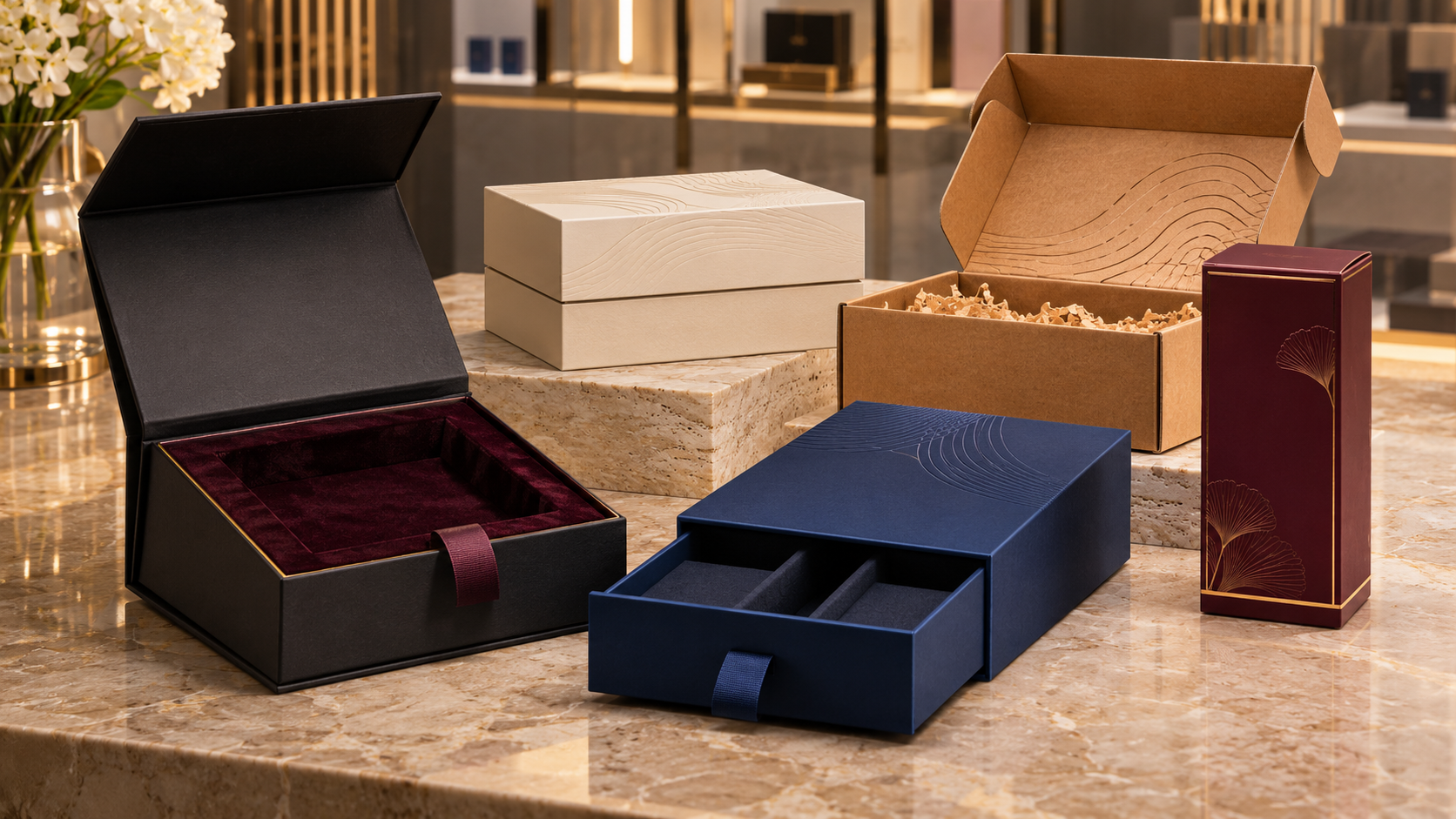
Rigid boxes are commonly associated with premium products, luxury gifts, jewelry, cosmetics, and specialty retail items.
They are generally constructed from substantial paperboard that maintains its shape rather than being folded flat during normal use.
Make A Boxes offers custom rigid packaging with options for dimensions, materials, decorative wrapping, inserts, and special finishes.
These boxes can create a more substantial presentation, although their cost and storage requirements may be greater than those of standard folding cartons.
2. Custom Tuck Boxes
Tuck boxes are folding cartons that use integrated flaps to close the package.
They are often suitable for lightweight retail goods, skincare products, small accessories, and other items that do not require unusually heavy structural protection.
Common configurations include straight tuck end and reverse tuck end designs.
These boxes can be shipped flat before assembly, making them practical for businesses that need efficient storage.
3. Custom Mailer Boxes
Mailer boxes are widely used for e-commerce deliveries, promotional kits, and subscription services.
They commonly feature corrugated construction and integrated closing panels that create a convenient packaging structure.
For online brands, custom mailer packaging can combine product protection with printed branding and an engaging opening experience.
Businesses should select the appropriate corrugated grade and internal cushioning based on their product weight and shipping conditions.
4. Custom Food Boxes
Food packaging must address product protection, handling convenience, and relevant food-contact requirements.
Make A Boxes lists custom food packaging among its available solutions for businesses selling food and beverage products.
Possible applications include bakery packaging, chocolate boxes, takeaway containers, and specialty food cartons.
When selecting food packaging, businesses should verify that the exact materials, coatings, inks, and intended contact conditions satisfy applicable regulatory requirements.
5. Custom Pillow Boxes
Pillow boxes feature curved edges and a distinctive folded structure that resembles a small pillow.
They are commonly used for lightweight gifts, promotional merchandise, jewelry accessories, and retail presentation.
Their compact shape can make them useful for products that do not require complex internal compartments.
6. Custom Drawer and Shoulder Boxes
Drawer boxes typically feature an exterior sleeve and an internal sliding tray.
Shoulder boxes use a raised inner section that connects the lid and base, creating a distinctive layered appearance.
These structures are often considered for premium gifts, accessories, jewelry, and carefully arranged product sets.
Make A Boxes includes drawer and shoulder packaging options within its custom product range.
7. Custom Mylar Bags
Mylar-style packaging is commonly used where flexible packaging and suitable barrier properties are important.
These bags may be used for certain dry goods, specialty retail products, and other applications depending on the selected material structure.
Businesses should confirm the required moisture, oxygen, light, and food-contact performance rather than assuming all flexible bags provide identical protection.
Industries Served by Make A Boxes
Custom packaging requirements vary across industries because products differ in size, weight, fragility, storage conditions, and customer expectations.
The company describes serving businesses in several major commercial sectors.
Beauty and Cosmetics
Beauty packaging often requires a combination of attractive branding and protection for products such as perfumes, skincare bottles, cosmetics, and beauty accessories.
Custom inserts, decorative finishes, and suitable carton structures can support presentation while helping keep delicate containers in place.
Retail and Fashion
Fashion businesses may require packaging for clothing, jewelry, footwear accessories, and specialty merchandise.
Custom printing and coordinated colors can help create a consistent retail identity across different product lines.
E-commerce and Subscription Businesses
Online businesses need packaging that performs during distribution while providing an appropriate customer experience.
Make A Boxes offers options for branded mailers and other packaging structures that can be adapted for e-commerce use.
Health and Wellness
Health and wellness businesses may need packaging for supplements, personal care items, and related products.
These applications require attention to labeling, product protection, and relevant regulatory requirements.
Home and Lifestyle Products
Candles, decorative accessories, and specialty household products often benefit from packaging designed around their exact shapes and fragility.
Well-fitted inserts and suitable structural materials can help reduce movement during storage and transportation.
Customization Options for Business Packaging
One of the main benefits of working with a custom packaging supplier is the ability to adjust packaging specifications rather than selecting only standard stock boxes.
Custom Dimensions and Shapes
Correct dimensions help products fit securely and reduce unnecessary empty space.
Make A Boxes offers made-to-order sizes and structural configurations suited to different product requirements.
Businesses should provide accurate measurements, product weight, and relevant information about internal inserts when requesting a quotation.
Custom Printing and Brand Colors
Printing allows businesses to incorporate logos, illustrations, product information, and other visual elements.
The company’s published capabilities include digital, offset, and flexographic printing, as well as CMYK and spot-color options.
The best printing method depends on the design complexity, quantity, material, budget, and production specifications.
Luxury Finishing Techniques
Specialty finishes can add texture, contrast, or visual emphasis to selected areas of a package.
Make A Boxes lists techniques such as foil stamping, embossing, debossing, UV coatings, and soft-touch finishes.
Foil Stamping
Foil stamping applies decorative metallic or colored foil to selected design elements. It is commonly used to emphasize logos or premium branding details.
Embossing and Debossing
Embossing creates a raised surface, while debossing presses selected elements into the material.
These techniques can add tactile detail without relying entirely on printed graphics.
Matte and Gloss Finishes
Matte finishes create a softer visual effect, while gloss finishes provide greater surface shine.
Material compatibility and durability should be considered when selecting a finish.
Packaging Materials and Their Benefits
Choosing suitable materials affects strength, appearance, cost, environmental characteristics, and handling performance.
Kraft Paperboard
Kraft paperboard offers a natural appearance and is commonly associated with understated or environmentally conscious branding.
It can be suitable for various cartons and retail packaging applications, depending on construction and product requirements.
Corrugated Fiberboard
Corrugated materials combine flat liners with a fluted structure that provides cushioning and structural performance.
They are commonly used for shipping cartons and mailer boxes.
Material grade and strength should be selected according to product weight, stacking conditions, and distribution requirements.
Solid Bleached Sulfate Board
Solid bleached sulfate, often abbreviated as SBS, provides a smooth printable surface commonly used for high-quality retail cartons.
It can be suitable for detailed printing and decorative finishes.
Chipboard and Greyboard
Thicker chipboard or greyboard materials are often used as the structural foundation of rigid packaging.
These boards may be covered with printed or decorative paper to create a finished presentation.
Make A Boxes lists these materials among its available packaging substrates.
Does Make A Boxes Offer Eco-Conscious Packaging?
Environmental considerations are increasingly relevant when businesses select packaging materials and suppliers.
Make A Boxes advertises eco-conscious options, including kraft-based and corrugated packaging solutions, along with certain biodegradable or compostable substrates.
However, environmental performance depends on the complete packaging design rather than the name of a single material.
Choosing Recyclable Materials
Some paper-based packaging can be accepted through established recycling systems, but coatings, adhesives, laminates, and mixed-material components may affect recyclability.
Businesses should verify local recycling requirements before making environmental claims.
Reducing Packaging Waste
Right-sized packaging can help reduce unnecessary material consumption and improve storage efficiency.
The company’s custom sizing and structural design services are intended to help businesses avoid using oversized boxes for smaller products.
Evaluating Material Certifications
Businesses making sustainability claims should request supporting documentation where appropriate.
Claims involving recycled content, compostability, biodegradability, and responsible sourcing should be specific and verifiable.
How the Custom Packaging Process Works
The company describes a six-stage process covering consultation, structural design, material selection, printing, quality inspection, and delivery.
Step 1: Discuss Packaging Requirements
The process begins with an assessment of the product, target market, branding expectations, and desired packaging structure.
Clear information helps the supplier recommend appropriate materials and dimensions.
Step 2: Develop the Box Design
Packaging designers prepare structural concepts and mockups based on the agreed specifications.
The company’s published services include CAD-based structural design intended to support product fit and practical box construction.
Step 3: Select Materials
Material selection considers strength, appearance, cost, and functional requirements.
For example, a fragile glass product may need a stronger outer structure and a fitted insert, while lightweight retail products may use simpler cartons.
Step 4: Apply Printing and Finishes
Once the artwork and structure are approved, the selected printing and finishing processes can be applied.
Businesses should review proofs carefully for color consistency, spelling, dimensions, and design placement.
Step 5: Inspect Production Quality
Quality inspection helps identify problems involving dimensions, printing, folding, wrapping, and construction.
Make A Boxes states that its process includes checks for strength, finishing, and accuracy before dispatch.
Step 6: Arrange Delivery
After production, completed packaging is prepared for shipment.
The company advertises nationwide U.S. delivery, although total delivery time depends on the production schedule, order specifications, destination, and shipping arrangements.
Minimum Order Quantities and Production Times
Minimum order quantity is an important consideration for startups and smaller businesses.
Make A Boxes advertises minimum orders starting at approximately 100 units for many custom packaging products.
This may appeal to businesses that want customized packaging without committing to exceptionally large quantities.
The company also publishes a standard production period of approximately 8–12 business days after final design approval.
These are advertised conditions rather than guarantees for every order. Complex construction, special materials, production demand, or shipping requirements may affect the final schedule.
Businesses should confirm quantities, pricing, production dates, and shipping expectations before placing an order.
How to Request a Custom Packaging Quote
A detailed quotation helps businesses compare costs and determine whether a packaging solution fits their budget.
When contacting Make A Boxes, provide enough information for an accurate assessment.
- Product dimensions: Specify length, width, and height using consistent measurement units.
- Product weight: Explain the weight of each item or complete product set.
- Box style: Identify whether you need rigid, folding, mailer, display, or other packaging.
- Order quantity: State the estimated number of boxes required.
- Material preference: Mention any specific board, paper, or structural requirements.
- Printing details: Provide logo files, artwork requirements, and preferred colors.
- Special finishes: Specify foil, embossing, coatings, inserts, or other features.
- Delivery information: Include the intended destination and required delivery period.
Request clarification about design charges, tooling fees, sampling costs, shipping expenses, and any additional services before approving production.
How Businesses Can Choose the Right Packaging Supplier
Selecting a packaging supplier should involve more than comparing the lowest quoted price.
Evaluate Product Compatibility
The supplier should understand the product’s dimensions, weight, fragility, and handling requirements.
Packaging must function effectively during storage, shipping, and ordinary customer use.
Review Samples Before Bulk Orders
Physical samples allow businesses to inspect material quality, structural strength, printing accuracy, and opening mechanisms.
Make A Boxes describes offering visual mockups and physical sampling as part of its capabilities.
Consider Total Costs
Compare complete costs, including unit pricing, setup charges, material upgrades, freight, and potential storage requirements.
A lower unit price may not represent better value if additional expenses or poor packaging performance increase overall costs.
Check Communication and Support
Clear communication is important when approving specifications and managing production deadlines.
Businesses should confirm how design changes, quality concerns, and delivery quest