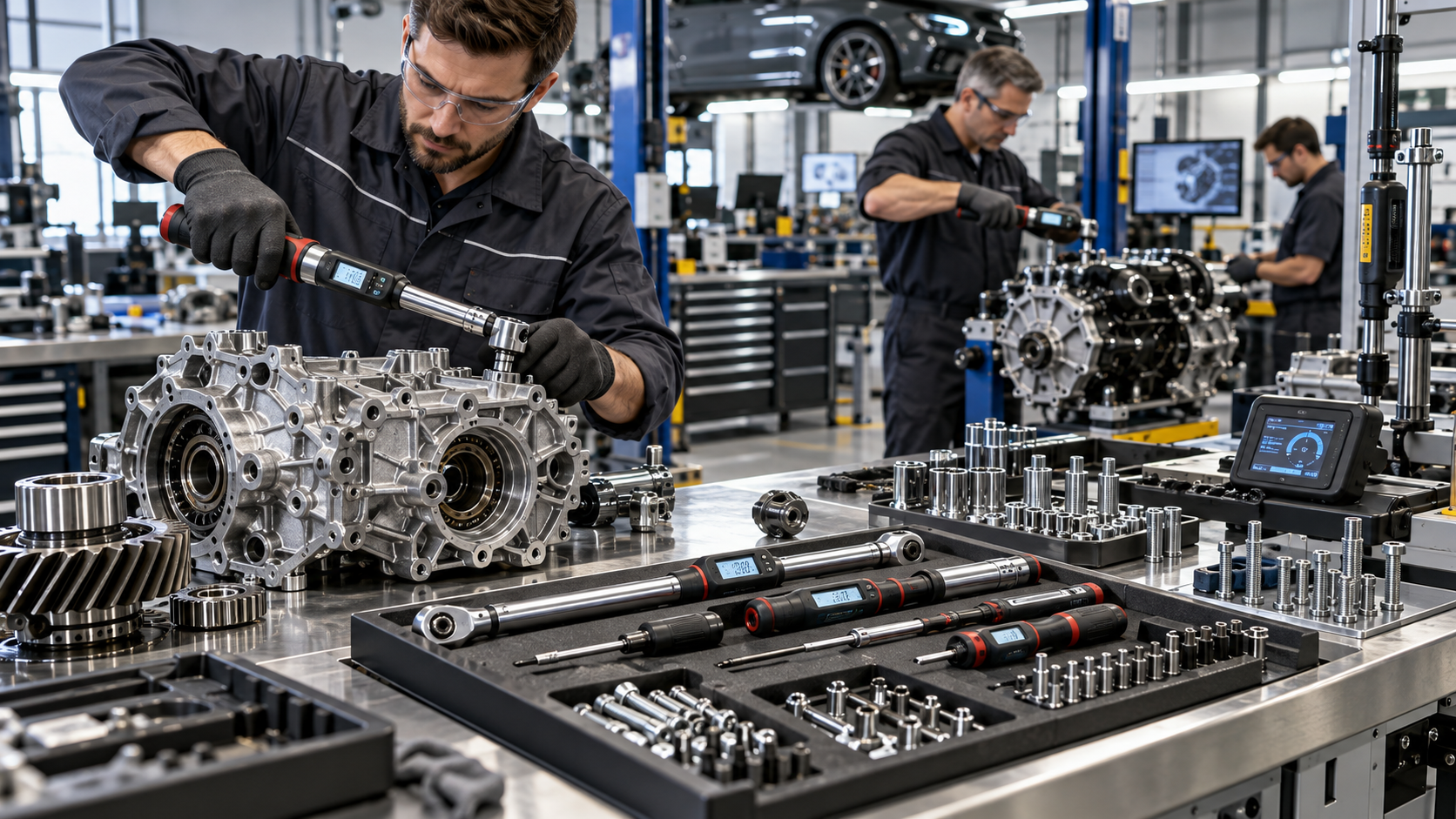
Torque Tools: How Precision Fastening Improves Safety, Accuracy, and Reliability
Torque Tools are essential whenever bolts, nuts, screws, and other threaded fasteners must be tightened to a defined level rather than simply made as tight as possible. Automotive technicians, manufacturing teams, engineers, maintenance professionals, construction crews, aerospace specialists, and equipment installers use torque controlled tools to achieve consistent fastening while reducing the risks associated with overtightening or undertightening. The right torque wrench, screwdriver, multiplier, tester, or digital system helps ensure that a fastener produces the required clamping force without damaging threads, components, seals, or surrounding materials.
Fasteners can look simple, but their performance affects entire machines and structures.
If a bolt is too loose, vibration may allow it to move.
If it is too tight, excessive stress can stretch the bolt, damage the thread, distort a component, or create premature failure.
This is why many manufacturers specify a particular tightening torque.
A technician needs both the correct specification and a suitable tool to apply it accurately.
What Are Torque Tools?
Torque Tools are instruments designed to apply, measure, control, or verify rotational force during fastening.
Common examples include:
• Torque wrenches
• Torque screwdrivers
• Digital torque wrenches
• Click torque wrenches
• Beam torque wrenches
• Dial torque wrenches
• Torque multipliers
• Hydraulic torque tools
• Pneumatic torque tools
• Electric torque tools
• Torque testers
• Calibration systems
Different tools serve different applications.
A technician tightening small electronic screws needs a very different tool from a maintenance team working on large industrial flange bolts.
Why Torque Matters
Torque describes the turning effect applied to a fastener.
The amount required depends on factors including:
• Fastener size
• Fastener material
• Thread condition
• Lubrication
• Joint design
• Required clamping force
• Manufacturer specification
Applying more torque than specified does not automatically create a safer joint.
Correct torque is the goal.
7 Powerful Tips for Using Torque Tools Correctly
Precision fastening depends on both equipment quality and correct technique.
1. Choose Torque Tools With the Correct Working Range
One of the most important decisions is selecting a tool that comfortably covers the required torque value.
A tool designed for very high torque may not provide the best control at extremely low settings.
Likewise, a small torque wrench should not be forced beyond its rated capacity.
Match the Tool to the Application
Before beginning work, identify:
• Required torque
• Fastener size
• Available space
• Drive size
• Required accuracy
• Frequency of use
• Environmental conditions
For example, wheel fasteners on a passenger vehicle may require a different torque wrench range from delicate bicycle components.
Avoid Using One Tool for Everything
Professional workshops often maintain several torque ranges.
This provides better control across applications involving:
• Small screws
• Engine components
• Wheel fasteners
• Industrial equipment
• Large structural bolts
Using the correct range also reduces unnecessary stress on the tool.
2. Understand Different Types of Torque Wrenches
Torque wrenches are available in several designs.
Each has advantages.
Click Type Torque Wrench
A click torque wrench is widely used in workshops.
The user selects the desired torque.
As the fastener reaches the setting, the wrench produces a noticeable click or release.
At that point, the technician should stop applying force.
Advantages can include:
• Simple operation
• Familiar design
• Broad availability
• Suitable for many workshop tasks
The user must still pay attention.
Continuing to pull after the click can apply additional torque.
Beam Torque Wrench
A beam wrench uses mechanical deflection and a scale.
The operator watches the indicator while tightening.
Benefits include:
• Simple mechanism
• No preset spring adjustment
• Useful visual feedback
However, reading the scale can be harder when access is awkward.
Dial Torque Wrench
Dial tools display applied torque through a gauge.
They can be useful for inspection and measurement work where the technician wants to observe torque throughout the operation.
Digital Torque Wrench
Digital tools use electronic measurement.
Depending on the model, they may provide:
• Digital readings
• Audible alerts
• Vibration alerts
• Visual indicators
• Multiple measurement units
• Memory
• Data recording
• Computer connectivity
Digital tools can be useful where traceability and detailed records matter.
3. Torque Tools Need Regular Calibration
A torque tool is a measuring instrument.
Like other measuring equipment, its accuracy can change over time.
Factors that can influence performance include:
• Heavy use
• Accidental drops
• Overloading
• Internal wear
• Poor storage
• Environmental exposure
• Long periods between inspections
Calibration compares the tool against a known reference.
Why Calibration Matters
Imagine a torque wrench set to 100 Nm but actually applying significantly more or less.
The technician may believe every fastener is correct while repeatedly producing incorrect joints.
Calibration reduces this risk.
How Often Should Torque Tools Be Calibrated?
There is no single interval suitable for every application.
The correct schedule may depend on:
• Manufacturer recommendations
• Frequency of use
• Quality requirements
• Industry standards
• Previous calibration results
• Criticality of the application
A tool used every day in production may require more frequent verification than one used occasionally.
Recalibrate After Significant Events
A torque tool that has been:
• Dropped
• Overloaded
• Damaged
• Repaired
may need to be checked before returning to critical service.
4. Use Proper Tightening Technique
Even an accurate tool can produce inconsistent results if used incorrectly.
Good technique helps improve repeatability.
Apply Force Smoothly
Do not jerk the wrench.
Apply slow, controlled pressure.
Sudden movement can make it harder to stop accurately at the target torque.
Hold the Correct Position
Many hand torque wrenches are designed to be operated from a particular grip area.
Holding the tool incorrectly can affect leverage and control.
Follow the manufacturer’s operating instructions.
Stop When the Tool Signals
With a click wrench, stop when the click is felt or heard.
Do not repeatedly click the same fastener unless the procedure specifically requires additional verification.
Keep the Tool Aligned
Side loading or awkward pulling can reduce control.
Where possible, keep the tool properly aligned with the fastener.
5. Consider Thread Condition and Lubrication
Torque alone does not directly measure clamp force.
A significant portion of applied torque is affected by friction.
This means the condition of the fastener and threads can strongly influence the final joint.
Factors include:
• Dry threads
• Lubricated threads
• Corrosion
• Dirt
• Damaged threads
• Thread locking compounds
• Coatings
Do Not Add Lubrication Without Checking the Procedure
A torque specification may be intended for dry threads.
Adding lubricant can reduce friction and change how much clamping force results from the same torque.
This can potentially overstress the fastener.
Always follow the applicable assembly specification.
Inspect Threads
Before tightening critical fasteners, check for:
• Cross threading
• Corrosion
• Damage
• Contamination
• Excessive wear
A torque wrench cannot correct a damaged thread.
6. Follow the Correct Tightening Sequence
Some assemblies require fasteners to be tightened in a particular order.
Examples include:
• Cylinder heads
• Wheels
• Flanges
• Covers
• Housings
• Large mechanical joints
The sequence helps distribute clamping force more evenly.
Tightening in Stages
Some procedures require multiple passes.
For example:
Initial low torque
Intermediate torque
Final specified torque
This gradual approach can reduce distortion and improve joint consistency.
Cross Patterns
Circular components may use a cross or star pattern rather than tightening adjacent fasteners one after another.
The correct pattern should come from the equipment or component manufacturer’s procedure.
7. Store Torque Tools Properly
Precision tools should be treated carefully.
Poor storage can shorten service life and affect accuracy.
Protect the Tool From Impact
Do not throw a torque wrench into a drawer with heavy tools.
Use a protective case where available.
Store Click Type Tools Correctly
Many adjustable click type torque wrenches should be returned to the manufacturer’s recommended low storage setting after use.
This can help reduce unnecessary load on the internal mechanism.
Do not automatically set the wrench below its permitted minimum.
Follow the tool manufacturer’s instructions.
Keep Tools Clean and Dry
Protect them from:
• Moisture
• Dirt
• Chemicals
• Excessive heat
• Corrosive environments
A clean and controlled storage area supports longer service life.
Torque Screwdrivers for Smaller Fasteners
Torque screwdrivers provide controlled torque for screws and smaller fasteners.
They are commonly used in:
• Electronics
• Electrical installations
• Manufacturing
• Medical equipment assembly
• Precision engineering
• Instrumentation
• Automotive interiors
Adjustable Torque Screwdrivers
Adjustable designs allow one tool to cover several torque values.
This makes them useful for technicians working on different components.
Preset Torque Screwdrivers
Preset tools are configured for a specific torque.
They are particularly useful in production settings where workers repeatedly tighten the same type of fastener.
Preset tools can reduce setup errors.
Digital Torque Tools
Digital technology has expanded what torque equipment can do.
Some tools can provide real time measurements and store results.
This can support industries where quality records are important.
Possible features include:
• Torque measurement
• Angle measurement
• Target alerts
• Pass and fail indication
• Data storage
• Wireless transfer
• User identification
• Job tracking
Digital functionality can support traceability, but electronic features do not remove the need for calibration and correct technique.
Torque Multipliers
Large fasteners may require more torque than a technician can safely or comfortably apply using a standard hand wrench.
Torque multipliers increase output torque through mechanical gearing.
They are useful in applications such as:
• Heavy equipment
• Industrial maintenance
• Energy infrastructure
• Large machinery
• Construction equipment
Reaction Force Must Be Managed
Torque multipliers create significant reaction forces.
The reaction arm or support system must be positioned according to the manufacturer’s safety instructions.
Incorrect use can create serious injury risks.
Operators should receive appropriate training.
Hydraulic Torque Tools
Hydraulic systems are commonly used for high torque industrial bolting.
They can be suitable for:
• Flanges
• Pipelines
• Power generation
• Oil and gas equipment
• Wind turbines
• Heavy industrial machinery
Hydraulic tools can produce substantial controlled torque in situations where manual tools would be impractical.
Hydraulic Equipment Requires Inspection
Operators should inspect:
• Hoses
• Couplings
• Pumps
• Tool body
• Reaction points
• Hydraulic fluid condition
Damaged high pressure components should not be used.
Pneumatic Torque Tools
Pneumatic torque equipment uses compressed air.
These tools can improve speed and reduce physical effort in repetitive industrial applications.
They may be useful for:
• Production lines
• Heavy vehicle maintenance
• Industrial assembly
• Large fasteners
Air pressure and tool settings must be controlled correctly.
Operators should not assume an impact wrench provides the same controlled output as a calibrated torque tool.
Electric Torque Tools
Electric torque systems are increasingly common in manufacturing and assembly.
Depending on the application, they can provide:
• Programmable torque
• Angle control
• Process monitoring
• Error detection
• Data recording
• Production traceability
These capabilities can be valuable where thousands of similar joints are produced and every fastening operation needs to meet a defined standard.
Torque Tools in Automotive Maintenance
Automotive work contains many torque sensitive fasteners.
Examples can include:
• Wheel nuts or bolts
• Spark plugs
• Engine components
• Suspension components
• Brake assemblies
• Bearing systems
• Transmission components
Manufacturer specifications should be followed.
Wheel Fastening
Wheel fasteners are one of the most familiar uses of torque wrenches.
Undertightening can allow movement.
Excessive tightening can damage studs, bolts, threads, or wheel components.
Using an impact wrench alone for final tightening may not provide controlled torque.
A calibrated torque wrench is commonly used for final verification according to the specified procedure.
Torque Tools in Manufacturing
Manufacturing environments depend on repeatability.
One worker should not tighten a component very differently from another worker.
Torque controlled tools can improve process consistency.
Production systems may record:
• Target torque
• Actual torque
• Angle
• Time
• Tool identification
• Operator information
• Assembly status
This data can support quality assurance and traceability.
Torque Tools in Aerospace
Aerospace fastening can involve strict procedures because joint reliability may be safety critical.
Tools may require:
• Documented calibration
• Controlled storage
• Identification numbers
• Traceability
• Operator training
• Scheduled inspection
The exact requirements depend on the organization and application.
Precision and documentation are equally important.
Torque Tools for Construction and Structural Work
Construction projects may use torque controlled fastening in:
• Steel structures
• Mechanical installations
• Heavy equipment
• Infrastructure
• Industrial facilities
Large fasteners may require hydraulic or powered torque equipment.
Workers need appropriate procedures and personal protective equipment.
Torque Tools for Wind Energy
Wind turbines contain large bolted joints exposed to significant mechanical loads.
Torque equipment may be used during:
• Installation
• Inspection
• Scheduled maintenance
• Component replacement
High torque hydraulic or electric systems can make this work more manageable.
Tool accuracy and documentation may be particularly important because access to turbine components can be difficult.
Torque Tools and Fastener Safety
Fastener safety starts before the tool touches the bolt.
Check:
• Correct fastener
• Correct specification
• Correct thread
• Correct condition
• Correct lubricant status
• Correct tightening sequence
• Correct torque setting
Torque equipment is only one part of the complete fastening process.
Torque Units
Common torque units include:
• Newton metres
• Pound feet
• Pound inches
• Kilogram force metres in some applications
Unit conversion mistakes can create serious errors.
Always confirm that the tool and specification use the same unit.
Digital tools may allow users to switch between units.
Check the display before beginning work.
Common Torque Tool Mistakes
Using a Torque Wrench as a Breaker Bar
Torque wrenches are designed primarily for controlled tightening.
Using them to loosen severely seized fasteners can place unnecessary stress on the mechanism.
Use an appropriate breaker bar or loosening tool unless the specific torque tool is designed for that function.
Exceeding the Rated Range
Do not force the tool beyond its specification.
Ignoring Calibration
An unverified tool can produce misleading results.
Continuing After the Click
This can apply additional torque.
Using the Wrong Units
Always confirm Nm, lb ft, lb in, or another required unit.
Using Damaged Extensions Incorrectly
Extensions and adapters can influence tool setup depending on their geometry.
Follow manufacturer guidance when using adapters that change effective lever length.
Applying Incorrect Lubrication
Thread condition affects the relationship between torque and clamp force.
Poor Storage
Dropping or neglecting precision tools can affect reliability.
How to Choose Torque Tools
Start by defining the application.
Torque Range
Choose a tool suited to the required values.
Accuracy
Critical work may require tighter accuracy specifications.
Tool Type
Decide between:
• Mechanical
• Digital
• Hydraulic
• Pneumatic
• Electric
Frequency of Use
Daily industrial use may justify a more robust system than occasional home maintenance.
Data Requirements
Some organizations need recorded fastening data.
Others only require reliable manual tightening.
Calibration Support
Consider whether calibration and service support are easily available.
Ergonomics
Technicians may use tools repeatedly throughout a shift.
Weight, handle design, and balance can affect comfort.
Buying Professional Torque Tools
Professional users should evaluate total value rather than purchase price alone.
Consider:
• Accuracy
• Build quality
• Certification
• Calibration availability
• Warranty
• Spare parts
• Service
• Range
• Durability
• Ease of adjustment
• Data features
A low cost tool may be adequate for occasional noncritical tasks, while industrial work may justify equipment designed for intensive repeated use.
Maintaining Torque Tools
Routine care supports accuracy and service life.
Good practices include:
• Clean after use
• Inspect for visible damage
• Store securely
• Follow calibration schedules
• Avoid overloading
• Protect digital tools from unsuitable conditions
• Replace damaged accessories
Maintenance records may also be important in regulated or quality controlled industries.
Frequently Asked Questions
What are Torque Tools?
Torque Tools are instruments used to apply, control, measure, or verify rotational force when tightening threaded fasteners such as bolts, nuts, and screws.
Why are Torque Tools important?
They help prevent undertightening and overtightening, improving fastening consistency, component protection, safety, and reliability.
How often should Torque Tools be calibrated?
Calibration frequency depends on manufacturer guidance, frequency of use, industry requirements, application criticality, and previous calibration results.
What is the difference between a torque wrench and torque screwdriver?
A torque wrench is generally used for larger nuts and bolts, while torque screwdrivers provide controlled torque for smaller screws and precision fastening applications.
Can Torque Tools be used to loosen bolts?
Some tools may allow this, but many torque wrenches are primarily intended for controlled tightening. A suitable breaker bar or loosening tool is often preferable for seized fasteners.
How do I choose the right Torque Tools?
Choose according to required torque range, accuracy, fastener size, working space, application, frequency of use, calibration needs, and whether manual or powered operation is required.
Conclusion
Torque Tools play an essential role wherever fasteners must be tightened accurately and consistently. Choosing the correct torque range, maintaining calibration, following the specified tightening sequence, and using controlled technique can reduce damaged components and unreliable joints. Professional users should also consider tool durability, service support, traceability, and the specific requirements of their industry. When used correctly, quality torque equipment supports safer assembly, dependable maintenance, and more consistent engineering results.