Las Vegas Tile and Grout Cleaning: 7 Powerful Secrets for Spotless Floors, Pristine Grout Lines, and Lasting Protection
The harsh Mojave Desert climate presents unique, aggressive environmental challenges that degrade residential and commercial flooring surfaces across Southern Nevada. Scheduling specialized Las Vegas tile and grout cleaning restores visual vibrancy, extracts deeply embedded mineral contaminants, and protects architectural masonry from permanent discoloration. From Summerlin and Henderson to Green Valley and Centennial Hills, homes and hospitality venues feature extensive ceramic, porcelain, travertine, and slate floorings designed to stay cool under blistering desert summer heat. However, porous cementitious grout lines act as microscopic dirt sponges, absorbing fine windblown silica dust, alkaline caliche mineral particulates, oily kitchen soils, and dissolved calcium salts from municipal tap water. Routine domestic mopping merely pushes contaminated water across floor surfaces, packing grime deeper into porous grout channels. Partnering with certified floor restoration technicians equipped with high-pressure enclosed extraction tools, heated water units, and penetrating chemical sealants permanently reverses this degradation, revitalizing your living spaces while extending the functional lifespan of high-end hard surface investments.
The Unique Environmental Chemistry of Southern Nevada Flooring
Residential flooring in the Las Vegas Valley experiences environmental stressors unlike almost any other geographical region in North America. Understanding the soil chemistry, water composition, and atmospheric dynamics of the Mojave Basin reveals why traditional household cleaning methods fail so quickly.
Combating Airborne Mojave Caliche Dust and Fine Silica Soils
The desert basin surrounding Las Vegas contains abundant caliche—a hardened natural sedimentary deposit composed of calcium carbonate, clays, and silica sands cemented into rock-like strata. Constant desert thermal updrafts, afternoon windstorms, and active suburban construction disperse microscopic caliche dust particles throughout the atmosphere. These abrasive mineral particulates settle indoors through doorways, sliding patio tracks, and HVAC returns. When walked upon, sharp silica particles act like microscopic sandpaper, scratching polished tile glaze finishes and embedding themselves into cementitious grout pores.
Severe Water Hardness and Calcium Carbonate Efflorescence
Las Vegas receives the majority of its municipal water supply from the Colorado River via Lake Mead, resulting in extremely hard municipal tap water ranging from 280 to over 420 parts per million (ppm) of dissolved minerals, or sixteen to twenty-five grains per gallon. When homeowners mop their tiled floors using standard tap water, the liquid evaporates rapidly under desert relative humidity (often below ten percent). This accelerated evaporation leaves behind pure calcium carbonate, magnesium scale, and alkaline salts on the grout surface. Over months of routine mopping, these mineral salts chemically bond with grout pores, creating a crusty, chalky white or murky grey discoloration known as efflorescence that resists standard household detergents.
The Downward Spiral of Traditional String Mopping
Traditional residential cleaning relies on string mops, sponge pads, and bucket cleaners. While effective at lifting superficial topical dust, this practice is counterproductive on textured tile and recessed grout lines:
- Liquid Slurry Redeposition: The mop bucket quickly becomes saturated with suspended soil, dissolved kitchen grease, and dirty water. Mopping spreads this dirty slurry across the floor, where gravitational runoff forces it into the lowest physical plane: the recessed grout joints.
- Chemical Soap Scum Accumulation: Over-the-counter floor cleaners frequently contain sticky synthetic surfactants, animal fats, and artificial fragrances. When allowed to air dry without clean hot water extraction, these surfactants leave a sticky, microscopic chemical film. This sticky residue acts as a magnet, trapping walking dust and pet dander, causing newly cleaned grout lines to turn black within days of cleaning.
Material Science: Matching Cleaning Protocols to Tile Substrates
Different flooring substrates exhibit vastly different chemical tolerances, porosity ratings, and hardness levels. Applying an incorrect chemical cleaner can cause irreversible etching or structural surface pitting.
Glazed Porcelain and Ceramic Tiles
Vitrified porcelain and ceramic tiles are fired at temperatures exceeding 1,200 degrees Celsius, producing a non-porous, glass-like vitrified surface layer with water absorption rates below 0.5 percent. While the porcelain surface itself is exceptionally stain-resistant and durable, the unglazed cement grout surrounding each tile remains porous. Cleaning porcelain floors requires targeted alkaline pre-treatments that dissolve surface grease, paired with localized mechanical agitation that lifts compacted soil out of the grout channels without abrading the tile’s factory glaze.
Natural Porous Stones: Travertine, Marble, and Limestone
Natural calcium carbonate-based stones are popular across luxury Las Vegas estates for their rich organic veining and cool underfoot texture. However, travertine and marble are sensitive to chemical attack:
- Acid Sensitivity and Chemical Etching: Contact with acidic solutions (including vinegar, lemon juice, acidic descalers, or citrus-based cleaners) triggers an immediate chemical reaction with the stone’s calcium carbonate matrix. This reaction dissolves the polished mineral surface, leaving dull, rough, discolored spots known as chemical etches that require mechanical diamond abrasive repolishing to restore.
- Professional Neutral-pH Emulsification: Technicians utilize specialized, buffered neutral-pH or mild alkaline stone emulsifiers paired with low-pressure heated extraction that flushes pores without causing surface cavitation or dissolving natural filler resins.
Porous Cementitious Grout vs. Epoxy Grout Formulations
- Traditional Sanded Cement Grout: Fabricated from Portland cement, graded silica sand, and water. Cementitious grout contains microscopic interconnected capillary pores that absorb water, oils, and bacteria like an open sponge, mandating penetrating sealers to prevent permanent staining.
- Non-Porous Epoxy Grout: Formulated with epoxy resins and hardener fillers. Epoxy grout is completely waterproof, chemical-resistant, and stain-proof; however, it requires specialized cleaning agents to remove topical grease films without clouding the epoxy binder.
Flooring Substrate and Cleaning Chemistry Matrix
| Flooring Material Type | Surface Porosity Rating | Acid Chemical Tolerance | Recommended Cleaning Chemistry | Optimal Heat & Pressure Settings |
|---|---|---|---|---|
| Vitrified Porcelain | Extremely Low (<0.5%) | High (Tolerates mild acids) | Heavy alkaline degreasers + rinse | 200°F – 220°F at 800 – 1000 PSI |
| Glazed Ceramic Tile | Very Low (1% to 3%) | Moderate to High | Concentrated alkaline emulsifier | 190°F – 210°F at 700 – 900 PSI |
| Honed / Polished Travertine | High (Porous natural stone) | ZERO (Acids cause severe etching) | pH-Neutral stone wash / oxygenated | 140°F – 160°F at 400 – 600 PSI |
| Natural Slate & Quartzite | Moderate to High (Clefted) | Moderate (Stone specific) | Chelating alkaline cleaner | 180°F – 200°F at 600 – 800 PSI |
| Sanded Cement Grout | Extremely High (Spongy) | Low (Acids break down cement) | Specialized oxygenated grout restorer | Deep steam flush + vacuum extraction |
| Commercial Epoxy Grout | Completely Non-Porous | High chemical resistance | Non-abrasive surfactant rinse | 160°F – 180°F at 500 – 700 PSI |
The Multi-Stage Industrial Deep Cleaning Methodology
Professional restorative cleaning employs an engineering approach combining the four pillars of cleaning science: chemical action, thermal energy, mechanical agitation, and dwell time.
Step 1: Pre-Inspection and Calibrated Chemical Pre-Treatment
Technicians test stone reactivity and apply an electrostatically charged alkaline pre-spray. This solution breaks surface tension, saponifies animal fats, and suspends deeply embedded soils during a ten-to-fifteen-minute chemical dwell cycle.
Step 2: Mechanical Counter-Rotating Brush Agitation
While the chemical solution dissolves grime, technicians utilize high-speed counter-rotating cylindrical brush machines (CRB) or orbital grout brushes. The stiff synthetic bristles penetrate deep into low-lying grout joints and textured tile clefts, mechanically dislodging compacted caliche dust and dried grime that water pressure alone cannot break loose.
Step 3: High-Pressure Enclosed Hydro-Thermal Vacuum Extraction
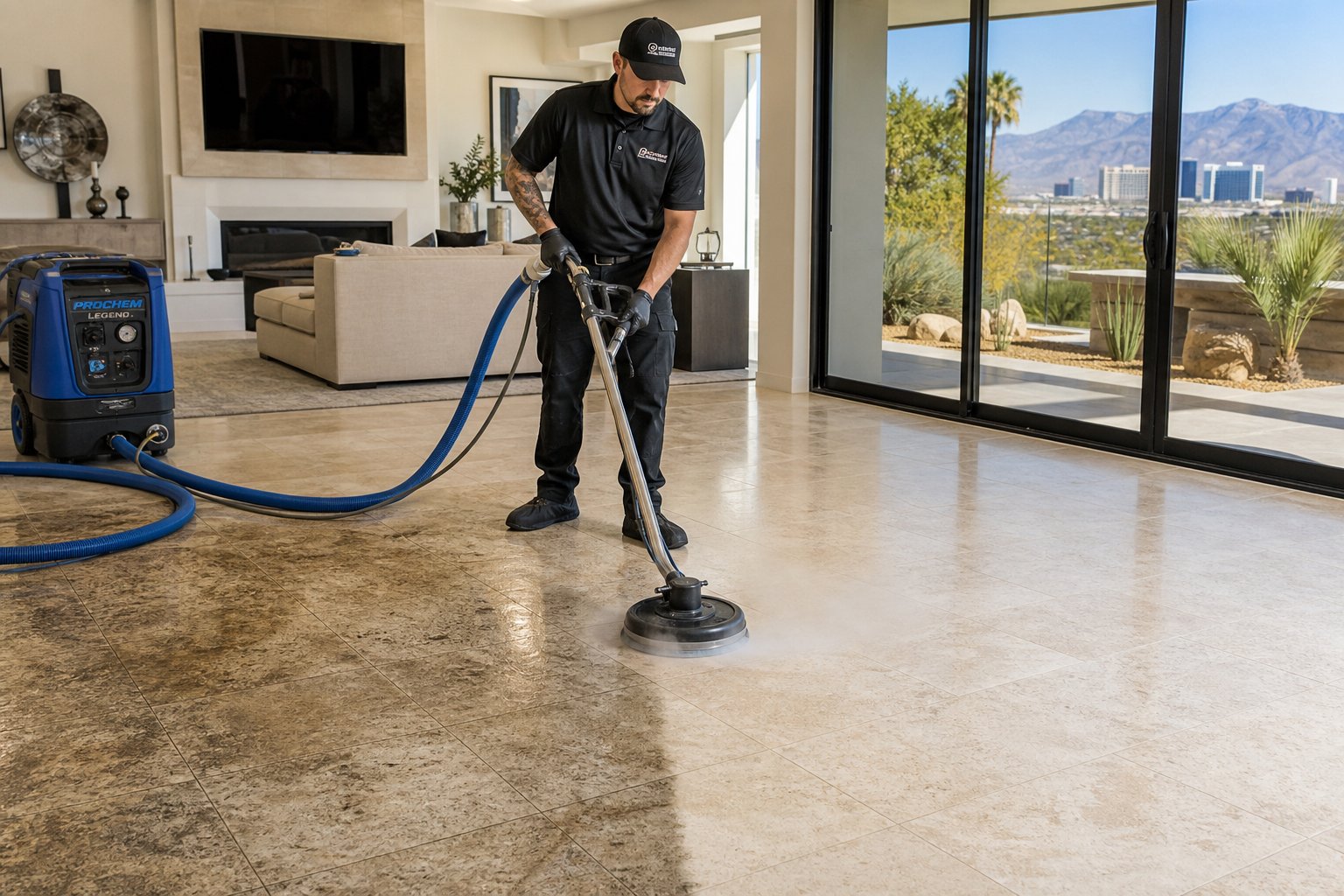
The heart of the professional restoration process is the enclosed rotary extraction tool (often referred to as a hard-surface spinner tool):
- Controlled Fluid Delivery: Truck-mounted heat exchangers deliver softened water heated to between two hundred and two hundred twenty degrees Fahrenheit (93°C to 104°C) at pressures between seven hundred and one thousand pounds per square inch (PSI).
- Dual High-Velocity Spray Jets: Twin spray nozzles spin inside an enclosed dome housing, blasting pressurized hot water into tile crevices to scour away suspended dirt.
- Zero-Overspray Vacuum Recovery: A high-cfm dual-vacuum recovery slot surrounds the spinning head, instantly capturing all wastewater, stripped grease, and suspended soils. Water is extracted directly through sealed vacuum hoses to a holding tank in the service truck, keeping baseboards, drywall, and furniture completely dry.
Advanced Protection: Penetrating Sealers vs. Color Sealing Restorations
Cleaning grout opens its microscopic capillary pores, leaving it vulnerable to rapid re-soiling unless protected with a high-performance sealant.
Fluorochemical Hydrophobic and Oleophobic Penetrating Sealers
Clear penetrating sealers contain microscopic fluorochemical polymers that absorb deep into the cementitious matrix:
- Invisible Protective Barrier: Penetrating sealers do not alter the natural color, texture, or slip resistance of the tile or grout.
- Repelling Liquids: The cured sealant dramatically increases surface tension, forcing spilled red wine, coffee, cooking grease, and pet accidents to bead up on top of the grout joint, allowing homeowners to wipe away spills before they soak in and stain.
Grout Color Sealing (Epoxy Barrier Restoration)
For older grout lines that suffer from permanent acid burns, bleached spots, or irreversible mineral staining, clear sealers are insufficient. Technicians apply a pigmented, urethane-acrylic topical color sealer:
- Restoring Uniform Aesthetics: The pigmented sealant covers color blotches, restoring grout lines to a uniform, brand-new appearance in your choice of custom colors.
- Hermetic Surface Seal: Color sealers cure into an impenetrable, hard plastic-like topical barrier that completely fills the grout pores, making the joints impervious to water, grease, and caliche dust for years to come.
Frequently Asked Questions About Las Vegas Tile and Grout Cleaning
How frequently should tile and grout be professionally deep cleaned in Las Vegas?
Due to high outdoor caliche dust levels and hard tap water minerals, residential floors should be professionally deep cleaned and sealed every twelve to eighteen months, while high-traffic commercial spaces require semi-annual service.
Will vinegar and water safely clean my tile and grout floors?
No, using vinegar (acetic acid) is dangerous on natural stone like travertine or marble because it chemically etches the surface, and repeated use on cement grout slowly dissolves the cement binder, causing crumbly joints.
How long does it take for newly applied grout sealer to cure completely?
Penetrating sealers are typically safe for light barefoot traffic within two to four hours, but require a full twenty-four to forty-eight hours to achieve complete fluorochemical stain-repellent curing.
Can professional cleaning eliminate pet urine odors trapped inside porous grout?
Yes, professional heated extraction combined with specialized oxidizing enzyme pre-treatments breaks down uric acid crystals and bacteria trapped deep within cement grout pores, eliminating odors at the source.
What is the difference between clear penetrating sealer and grout color sealing?
A clear penetrating sealer absorbs invisibly into porous grout to repel future liquid spills; a color sealer coats the grout joint in a durable, tinted epoxy-acrylic barrier that covers old stains and changes the grout color.
Why do my grout lines turn dark again so quickly after standard mopping?
Traditional mopping leaves behind sticky chemical soap residues from cleaning solutions, which act as a magnet for fine airborne desert dust, quickly turning newly mopped grout dark.
Conclusion
Preserving the beauty, hygienic safety, and structural integrity of tiled living surfaces in Southern Nevada requires specialized cleaning science tailored to our desert environment. Sourcing certified Las Vegas tile and grout cleaning replaces ineffective, labor-intensive mopping routines with powerful hydro-thermal extraction technology that extracts compacted caliche minerals, eliminates stubborn hard-water efflorescence, and flushes away deeply embedded contaminants. By following deep extraction with advanced fluorochemical penetrating sealers or restorative epoxy color sealing, homeowners safeguard their flooring against future staining, simplify routine maintenance, and revitalize their interior living spaces. Investing in expert hard-surface care transforms dull, discolored tile floors into stunning, hygienic centerpieces that elevate home equity and comfort across every room in your home.