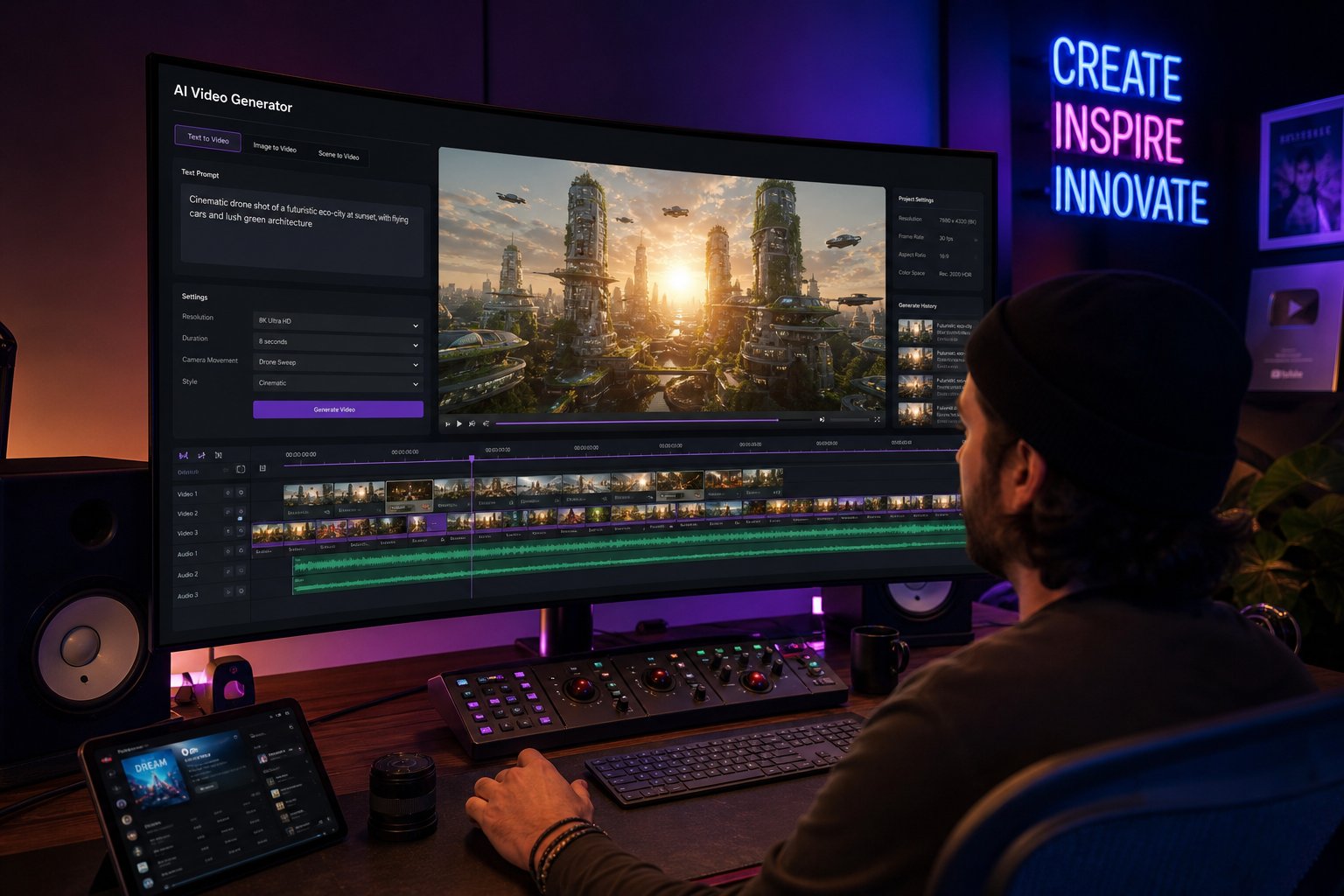
AI Video Generator: 7 Proven Secrets to Create Stunning Cinematic Video, Automate B-Roll, and Scale Content
The digital media landscape has entered an unprecedented era of visual transformation driven by generative artificial intelligence, spatial computing, and multi-modal diffusion modeling. Leveraging a high-performance AI video generator empowers digital creators, corporate marketing agencies, enterprise brands, educators, and indie filmmakers to produce broadcast-quality video content from simple text descriptions, reference images, or script outlines. While traditional video production demands tens of thousands of dollars in high-end cinema camera gear, location scouting, professional lighting crews, voice actors, and lengthy post-production editing schedules, generative AI video engines compress weeks of filming and rendering into seconds. By synthesizing temporal motion consistency, photorealistic lighting physics, fluid fluid dynamics, and expressive synthetic digital avatars, modern AI video tools democratize visual storytelling, enabling creators to scale engaging video campaigns, generate limitless B-roll assets, and dominate video-first platforms like YouTube, TikTok, and Instagram with breathtaking creative speed.
The Technological Architecture of Generative AI Video Modeling
Generating temporally coherent video frames is exponentially more computationally complex than generating static 2D images. An image model needs only to calculate spatial relationships across a two-dimensional grid of pixels, whereas a video model must calculate spatial and temporal dimensions simultaneously across thirty to sixty sequential frames every second.
Diffusion Models and Temporal Latent Transformer Networks
Early attempts at AI video synthesis suffered from severe morphing, frame flickering, and hallucinatory warping:
- Spatial Latent Diffusion: The AI compresses raw video footage into a compact mathematical latent space, learning the visual grammar of lighting, perspective, depth of field, and material textures across millions of video hours.
- Temporal Attention Mechanisms: Modern video transformers incorporate dedicated temporal attention layers that track how objects move through physical space over time. If a character turns their head or walks behind a tree, the temporal model remembers facial features, lighting reflections, and wardrobe details, preserving visual identity across the entire clip.
Physical World Simulation: Understanding Lighting, Inertia, and Gravity
State-of-the-art video generation engines (such as Sora, Runway Gen-2/Gen-3, Pika, and Stable Video Diffusion) do not merely splice together random pixels; they operate as intuitive physics simulators:
- Kinetic Momentum and Inertia: Water ripples outward with realistic hydrodynamic drag, fabrics flutter in response to directional wind vectors, and smoke disperses according to fluid dynamics.
- Photometric Light Interactions: Direct sunlight passing through a moving glass prism casts accurate chromatic refractions and shifting shadows across surrounding surfaces, producing cinematic imagery indistinguishable from physical camera capture.
Core Capabilities of Modern Generative Video Platforms
Generative video software has evolved beyond basic novelty animations into versatile production suites supporting multiple creative workflows.
Text-to-Video (T2V): Turning Words into Visual Motion
Text-to-video represents the most intuitive creative interface for visual worldbuilding:
- Natural Language Prompting: Creators write descriptive natural language prompts specifying camera lenses (e.g., 35mm anamorphic, f/1.8 aperture), lighting styles (golden hour, chiaroscuro, cybernetic neon), atmospheric conditions (rainy, foggy), and specific cinematic camera moves (dolly zoom, crane shot, pan left).
- Unrestricted Conceptual Visualization: Text prompts unlock imagery that would be physically impossible, prohibitively expensive, or dangerously hazardous to film in real life—such as flying through deep space nebulae, diving into boiling volcanic craters, or staging historical battles.
Image-to-Video (I2V): Breathing Life into Static Art
For artists, concept designers, and brands with established visual assets:
- Motion Priming: Upload a static concept painting, digital illustration, or high-resolution product photograph, and the AI animates the image based on text or motion brush inputs.
- Preserving Exact Brand Aesthetics: Because the initial video frame is anchored by an authentic photograph, character faces, product labels, and corporate color palettes remain 100% consistent throughout the generated video clip.
Motion Brush and Camera Direction Controls
Precise creative direction requires granular control over scene choreography:
- Motion Brushing: Creators highlight specific regions of an image with a digital brush (e.g., brushing only a character’s flowing hair or background waterfall) and assign directional motion vectors, ensuring the rest of the scene remains rock-solid while designated elements move organically.
- Directorial Camera Controls: Manually keyframe virtual camera parameters, including horizontal panning, vertical tilting, zooming, tracking speed, and camera roll to match the pacing of professional cinema.
Synthetic AI Talking Avatars and Multi-Lingual Dubbing
For corporate training, automated customer support, and educational course creation:
- Hyper-Realistic Digital Presenters: Platforms (such as HeyGen, Synthesia, and D-ID) generate photorealistic human avatars that speak any written script with natural lip synchronization, subtle head tilts, and micro-facial expressions.
- One-Click Global Localization: Automatically dub video presentations into over one hundred forty languages, cloning the original speaker’s authentic vocal timbre and synchronizing their mouth movements to match the translated phonemes.
Video Generation Platform Feature Matrix
| Generation Modality | Input Mechanism | Typical Clip Duration | Primary Output Resolution | Best Suited Production Role |
|---|---|---|---|---|
| Text-to-Video (T2V) | Descriptive text prompt | 4 to 16 Seconds | 1080p to 4K Upscaled | Concept ideation, dreamlike worlds, sci-fi B-roll |
| Image-to-Video (I2V) | Source image + motion prompt | 4 to 10 Seconds | Matches source image | Commercial product animations, bringing photos to life |
| Talking Head Avatars | Written text script + avatar | Unlimited (Multi-minute) | 1080p / 4K UHD | Corporate training, explainer videos, marketing reels |
| Video-to-Video (Styling) | Source video + style prompt | Matches input video | 1080p | Anime restyling, claymation, sci-fi rotoscoping |
| Real-Time Motion Tracking | Video + Skeletal Pose Model | Real-Time / Rendered | 1080p | VFX motion capture, virtual VTuber broadcasting |
Strategic Workflows for Scaling Content Production
Integrating generative video into commercial marketing pipelines requires structured production workflows that maximize output quality while minimizing rendering costs.
Assembling Unlimited Commercial B-Roll Libraries
Video creators and documentary filmmakers constantly need contextual filler footage (B-roll) to illustrate voiceover narration:
- Bypassing Expensive Stock Footage Subscriptions: Instead of spending hundreds of dollars per clip on generic, overused stock footage libraries, creators generate custom, brand-aligned B-roll clips on demand within minutes.
- Custom Aesthetic Matching: Adjust prompt parameters to ensure all generated B-roll shares identical color grading, film grain, and camera lens characteristics, creating a cohesive visual aesthetic across long-form video productions.
Scaling Short-Form Social Media Content (TikTok, Shorts, Reels)
High-velocity social media platforms reward creators who publish daily video content:
- Automated Script-to-Video Pipelines: Connecting large language models (like ChatGPT) with AI video engines via automated APIs allows creators to turn written blog posts into fully edited, voice-narrated short-form vertical video reels in minutes.
- Dynamic Animated Subtitles: Modern platforms automatically transcribe voiceovers, generating animated on-screen captions with highlighted keywords, sound effects, and background music that capture viewer attention.
Mastering the Craft of the Video Prompt: Directorial Techniques
Achieving cinematic results from an AI video generator requires adopting the mindset of a Hollywood director and director of photography (DP).
The Five Pillars of a Cinematic Prompt
- Subject & Action: Clearly define who or what is moving (e.g., “A lone astronaut in a reflective gold-visor spacesuit walking purposefully through red desert sands…”).
- Camera Motion & Angle: Specify camera movement explicitly (e.g., “Slow dynamic low-angle tracking shot, sweeping smoothly from left to right…”).
- Lighting & Atmosphere: Establish the emotional mood (e.g., “Diffused cinematic volumetric lighting, soft misty haze, dramatic golden hour backlight with warm lens flare…”).
- Lens & Technical Specs: Define the camera package (e.g., “Shot on 65mm IMAX camera, 50mm anamorphic prime lens, shallow depth of field, photorealistic 8K render…”).
- Color Palette & Style: Direct the visual finish (e.g., “Teal and orange cinematic color grade, subtle 35mm film grain, muted contrast…”).
Avoiding Negative Keywords and Over-Constrained Prompts
- Negative Prompting: Use negative prompt fields to eliminate common AI artifacts—such as “blurry, morphing limbs, extra fingers, cartoonish, oversaturated, low resolution, flickering.”
- Avoiding Over-Description: Trying to describe five complex actions happening simultaneously can confuse the temporal diffusion model; keep individual clips focused on a single, clean motion arc, combining multiple clips together inside traditional editing software (like DaVinci Resolve or Premiere Pro) to tell a larger story.
Frequently Asked Questions About AI Video Generators
Can an AI video generator create long, full-length movies automatically?
Currently, AI video generators produce short clips lasting between four and sixteen seconds; creators build long-form movies and commercials by generating multiple clips and editing them together with audio and dialogue in editing software.
Are videos created by an AI video generator safe for commercial use?
Most reputable AI video platforms grant full commercial usage rights for paid subscription tiers, allowing you to use generated videos in paid advertising, client projects, YouTube monetization, and broadcast media.
What is the difference between Text-to-Video and Image-to-Video?
Text-to-Video generates visual scenes from scratch using written words, while Image-to-Video uses an existing photograph or illustration as the foundational starting frame, animating movement from that exact visual reference.
Can AI video generators create realistic human lip-syncing for scripts?
Yes, dedicated AI avatar platforms (such as HeyGen and Synthesia) analyze written text or recorded audio tracks and generate photorealistic, synchronized mouth and facial movements that match the speech perfectly.
Do I need a powerful, expensive computer to generate AI videos?
No; video generation takes place in the cloud on high-performance GPU data center clusters, meaning you can generate high-definition video from any standard laptop, tablet, or smartphone browser.
How do I prevent AI-generated characters from looking different in every video clip?
Use Image-to-Video by uploading a consistent character reference portrait as the starting frame, or utilize platforms that feature consistent seed parameters and character face-lock tools.
Conclusion
The rise of the AI video generator marks a historic turning point in digital creative expression, fundamentally breaking down the technical and financial barriers that previously kept high-end filmmaking out of reach for independent creators. By harnessing temporal diffusion transformers, intuitive physics simulations, and natural language directorial prompts, anyone with an imaginative vision can produce breathtaking cinematic visuals in minutes. Whether generating bespoke B-roll for YouTube documentaries, scaling short-form advertising reels across social media, or deploying multilingual digital avatars for corporate training, generative video tools unlock unprecedented creative speed. Embracing AI video technology does not replace the human storyteller; rather, it amplifies human imagination, turning ideas into moving, cinematic reality with the touch of a button.