Tree and Brush Clearing: How to Clear Overgrown Land Safely and Responsibly
Professional tree and brush clearing can transform overgrown property into land suitable for construction, farming, fire risk management, access, landscaping, utility work, or routine property maintenance. Effective clearing involves far more than cutting vegetation to ground level. Tree size, root systems, terrain, soil conditions, drainage, wildlife, utilities, permits, erosion, debris management, and the property’s intended future use can determine which clearing method is appropriate. Planning these factors before equipment arrives can reduce unnecessary disturbance, protect vegetation worth keeping, and prevent expensive site problems later.
What Is Tree and Brush Clearing?
Tree and brush clearing is the selective or comprehensive removal of woody vegetation from a defined area.
The work can involve trees, saplings, shrubs, vines, brambles, invasive vegetation, stumps, and accumulated woody debris. Depending on project objectives, roots may be removed, ground below grade, left in place, or treated through another appropriate method.
Not every clearing project should remove every plant.
Selective clearing retains desirable vegetation while removing specified trees and undergrowth. Complete land clearing removes significantly more vegetation when required for construction or another planned land use.
The best method depends on what happens to the site afterwards.
A future building pad has different requirements from a woodland trail, pasture restoration project, defensible space around a home, or landscape renovation.
9 Powerful Benefits of Tree and Brush Clearing
Land clearing can provide practical advantages when it is justified and carried out with appropriate environmental and safety controls.
1. Restores Access to Overgrown Land
Dense brush can make areas of a property difficult to reach on foot or with vehicles.
Clearing designated routes can create access for surveying, maintenance, farming, construction, recreation, or emergency purposes.
The route should be planned before vegetation removal begins.
Unnecessary clearing can increase soil disturbance without improving usable access.
2. Prepares Property for Construction
Buildings, driveways, utility corridors, drainage systems, and other development can require vegetation removal.
Construction clearing should be based on an actual site plan.
Removing trees before building locations, grading, drainage, and protected areas have been established can destroy vegetation that could otherwise have been retained.
Tree and Brush Clearing Before Site Development
A preconstruction plan can identify:
• Building footprint
• Driveway
• Utility routes
• Drainage
• Grading limits
• Trees to preserve
• Staging areas
• Soil storage
• Erosion controls
Mark these areas visibly before heavy equipment starts work.
3. Helps Manage Certain Wildfire Fuels
In wildfire prone areas, managing vegetation around structures can be part of a broader defensible space or fuel management strategy.
However, indiscriminately removing all vegetation is not automatically the safest approach.
Vegetation type, spacing, dead material, terrain, climate, and local fire guidance all matter.
Property owners should follow recommendations from relevant fire authorities, forestry agencies, or qualified wildfire mitigation professionals.
4. Supports Invasive Vegetation Management
Some properties become dominated by invasive shrubs, vines, or trees.
Clearing may form part of a control program.
Cutting alone may not eradicate species that readily resprout from stumps or roots.
Effective management can require repeated follow up, appropriate herbicide treatment where lawful and justified, root removal, grazing, revegetation, or other methods depending on the species.
Accurate identification should come first.
5. Creates Space for Productive Land Uses
Clearing can restore land for pasture, orchards, gardens, agricultural fields, or other productive uses where site conditions permit.
Soil should be evaluated rather than assuming vegetation removal automatically produces usable agricultural land.
Compaction, rocks, drainage, fertility, slope, and erosion risks may require additional work.
6. Improves Visibility Across Selected Areas
Dense roadside or driveway vegetation can sometimes reduce sight lines.
Selective cutting can improve visibility where appropriate.
Work near public roads may be subject to right of way rules and transportation authority requirements.
Do not remove vegetation outside property boundaries without authorization.
7. Allows Access for Property Maintenance
Brush can obstruct fences, drainage structures, utility infrastructure, ponds, outbuildings, and boundary areas.
Strategic clearing can restore maintenance access.
The objective should be to create enough working space for the task while minimizing unnecessary disturbance.
8. Removes Certain Hazardous Vegetation
Dead, declining, storm damaged, or structurally compromised trees can present hazards in some locations.
Hazard evaluation is not the same as general clearing.
A qualified arborist can assess trees near buildings, roads, utility lines, or regularly occupied spaces.
9. Creates a Foundation for Landscape Restoration
Clearing can be the first stage of converting neglected land into a managed landscape.
The next stage matters just as much.
Tree and Brush Clearing Followed by Revegetation
Exposed soil should not necessarily be left bare.
Depending on the project, follow up may include:
• Native planting
• Grass establishment
• Mulching
• Erosion control blankets
• Pasture establishment
• Tree planting
• Invasive species monitoring
• Drainage stabilization
Prompt stabilization can reduce erosion and unwanted recolonization.
Tree and Brush Clearing Methods
Different vegetation and terrain require different approaches.
Contractors may combine several methods on the same site.
Manual Brush Clearing
Hand tools and smaller powered equipment can be useful for limited or highly selective work.
This approach can minimize disturbance around trees, structures, fences, or sensitive areas.
It is labor intensive and generally unsuitable for quickly clearing large areas of heavy woody vegetation.
Mechanical Land Clearing
Excavators, bulldozers, skid steers, compact track loaders, forestry machines, and other equipment can remove larger amounts of vegetation.
Machine selection should reflect soil, slope, vegetation size, access, and desired level of disturbance.
Heavy machines can compact soil, particularly when ground conditions are wet.
Forestry Mulching
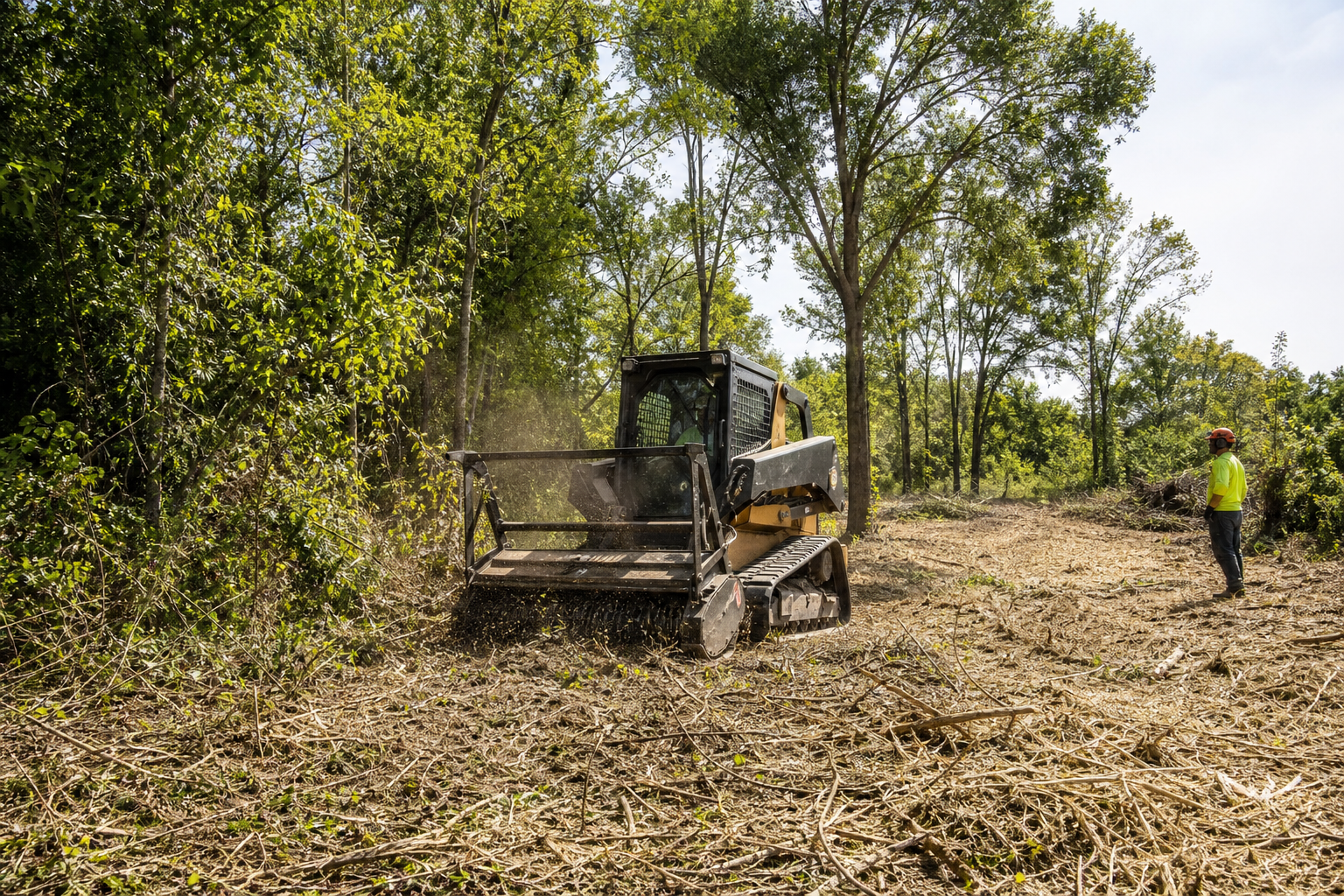
Forestry mulchers mechanically cut and process standing brush, saplings, and selected woody vegetation into smaller material.
The processed material is typically left on the ground.
Tree and Brush Clearing With Forestry Mulching
Forestry mulching can be useful when the project aims to control brush while limiting widespread soil excavation.
It does not produce the same result as grubbing roots and stumps from a construction area.
Some vegetation can resprout after mulching, making follow up management necessary.
Tree Removal vs Brush Clearing
Tree removal requires different skills and risks from mowing or mulching brush.
Small Tree Clearing
Small saplings may be handled mechanically as part of a brush management operation, depending on machine capability and site conditions.
Equipment operators should stay within manufacturer limitations.
Large Tree Removal
Large trees require careful assessment of lean, defects, nearby structures, utilities, rigging needs, and drop zones.
Professional tree removal becomes especially important in confined areas.
Tree and Brush Clearing Near Buildings
Trees located near houses, garages, roads, fences, or other structures may require sectional dismantling or specialized rigging rather than simple felling.
Qualified tree care professionals should handle hazardous or technically complex removals.
Brush Clearing for Overgrown Properties
An overgrown property can contain hidden obstacles that are difficult to see before vegetation is reduced.
Potential hazards include old fencing, wire, wells, debris, rocks, holes, drainage structures, and abandoned equipment.
Walk and Survey the Site
Where safe, inspect accessible areas before machine clearing.
Mark known hazards.
Historic aerial imagery, surveys, utility records, and discussions with previous owners can sometimes provide useful context for larger sites.
Clear in Stages
On heavily overgrown land, an initial reduction of light vegetation may reveal conditions that change the plan.
This can be more practical than immediately sending heavy equipment across the entire property.
Tree and Brush Clearing Around Existing Trees
If mature trees are being retained, protect their root zones from unnecessary excavation, grade changes, storage, and heavy traffic.
An arborist can help establish appropriate tree protection areas for valuable specimens.
Tree and Brush Clearing Equipment
Equipment selection influences productivity, cost, and site disturbance.
Compact Track Loaders
Compact track loaders can accept brush cutters, mulchers, grapples, and other attachments.
Tracks can distribute machine weight differently from wheeled equipment, but they can still compact or disturb soil.
Excavators
Excavators can remove trees, stumps, roots, and debris using appropriate attachments.
They are useful where excavation and handling are required.
Operator skill strongly influences the amount of unnecessary soil disturbance.
Bulldozers
Bulldozers can move substantial vegetation and soil.
They may be useful on larger projects involving broader site grading but can create extensive disturbance.
Choosing Equipment for Tree and Brush Clearing
Equipment choice should consider:
• Vegetation diameter
• Tree height
• Stump removal requirements
• Terrain
• Soil moisture
• Slope
• Access width
• Utilities
• Disposal method
• Future land use
The largest machine is not automatically the most efficient choice.
Stump Removal After Land Clearing
Stumps can be handled in several ways.
The right approach depends on what will happen to the land.
Stump Grinding
A stump grinder mechanically reduces the visible stump and some material below grade.
Depth varies by equipment and contract.
Roots generally remain in the soil and decompose over time.
Stump Excavation
Excavation removes more of the stump and root mass.
This can be useful where future construction or grading requires complete removal.
The process disturbs substantially more soil and leaves a hole requiring suitable backfill and compaction.
Tree and Brush Clearing Without Stump Removal
Stumps may sometimes be left when the area will remain woodland or another use where they do not create a problem.
They can interfere with mowing, building, roads, farming, or future excavation.
Decide how stumps will be handled before pricing the clearing project.
Tree and Brush Clearing Costs
There is no reliable universal clearing price per acre or square metre.
Site conditions can change production rates dramatically.
Factors Affecting Clearing Cost
Pricing can depend on:
• Property area
• Vegetation density
• Tree diameter
• Tree height
• Number of large trees
• Terrain
• Slope
• Soil conditions
• Access
• Stump requirements
• Debris handling
• Disposal fees
• Equipment transport
• Permits
• Utility constraints
Two equal sized properties can therefore have very different costs.
Hourly vs Project Pricing
Some contractors price work by machine and operator hour.
Others quote a fixed project price based on an agreed scope.
Both approaches can work.
Comparing Tree and Brush Clearing Quotes
Request quotations that identify:
• Area being cleared
• Vegetation being removed
• Trees being preserved
• Stump treatment
• Equipment
• Debris disposal
• Mulch handling
• Grading
• Erosion control
• Mobilization
• Permits
• Exclusions
A vague quote described only as clear the property creates room for disagreement.
Tree and Brush Clearing Permits
Vegetation removal can be regulated even on privately owned land.
Rules vary considerably by jurisdiction.
Tree Protection Ordinances
Some municipalities protect specified tree species, trees above certain dimensions, heritage trees, or vegetation in designated areas.
Permits or replacement planting may be required.
Wetlands and Waterways
Clearing close to streams, wetlands, shorelines, floodplains, or other sensitive areas can trigger additional environmental requirements.
Do not assume private ownership permits unrestricted clearing.
Protected Wildlife
Nesting birds, endangered species, or protected habitat can affect the timing and scope of work.
Checking Regulations Before Tree and Brush Clearing
Depending on location, consult relevant:
• Local planning authorities
• Forestry agencies
• Environmental regulators
• Public works departments
• Fire authorities
• Utility providers
• Homeowners associations
Obtain required approvals before work starts.
Utility Safety During Land Clearing
Underground and overhead utilities can make clearing dangerous.
Locate Underground Utilities
Contact the appropriate utility locating service before excavation.
In the United States, 811 provides a common route for requesting public utility marking before digging.
Private utility lines may require separate locating services.
Watch Overhead Lines
Trees and equipment operating near energized power lines create potentially fatal hazards.
Special clearance requirements can apply.
Tree and Brush Clearing Near Power Lines
Do not attempt tree removal near power lines without appropriate professional coordination.
Contact the utility or use contractors properly qualified for utility related vegetation work.
Electricity can arc across gaps under certain conditions, so direct contact is not required for a severe hazard.
Tree and Brush Clearing Safety
Land clearing combines sharp cutting equipment, falling trees, heavy machinery, uneven terrain, noise, dust, and hidden obstacles.
It is inherently hazardous work.
Establish Work Zones
Keep people who are not involved in the operation outside the active clearing area.
Machine operators need sufficient distance from bystanders.
Flying debris from forestry attachments can travel beyond the immediate machine.
Use Appropriate Protective Equipment
Required protective equipment depends on the task.
Professional operations can require helmets, eye and hearing protection, high visibility clothing, chainsaw protective equipment, and other PPE.
Never Work Beneath Unstable Trees
Dead or damaged trees can shed limbs without warning.
Professional Tree and Brush Clearing for Hazardous Sites
Steep slopes, large trees, unstable timber, utility corridors, roadside work, and confined spaces increase complexity.
These conditions should be handled by contractors with the necessary training, equipment, insurance, and relevant qualifications.
Erosion Control After Clearing
Vegetation protects soil from rainfall impact and helps stabilize ground through root systems.
Removing it can increase erosion.
Minimize Exposed Soil
Where possible, limit clearing to required areas.
Forestry mulching can leave processed material on the ground, although mulch alone is not a universal erosion control solution.
Stabilize Disturbed Areas
Seeding, mulch, erosion control blankets, sediment barriers, drainage features, or other measures may be appropriate.
Local regulations can specify required practices.
Tree and Brush Clearing on Slopes
Steeper land deserves particular attention because runoff velocity and erosion potential can increase.
Avoid large areas of unnecessary exposed soil and consider professional erosion control planning for substantial slopes.
Debris Management After Tree and Brush Clearing
Clearing generates logs, branches, stumps, chips, mulch, and other organic material.
Plan where it will go before work begins.
Chipping
Branches and smaller woody material can be chipped.
Wood chips may be reusable on site for appropriate landscape applications.
Fresh material should be used thoughtfully because excessive mulch can affect plants and drainage.
Mulching in Place
Forestry mulching distributes processed vegetation across the ground.
The resulting appearance depends on vegetation volume and machine operation.
Hauling Material Away
Offsite disposal creates loading, hauling, and tipping costs.
Burning Debris After Tree and Brush Clearing
Open burning is regulated or prohibited in many locations and can create wildfire, smoke, and safety hazards.
Never burn clearing debris without confirming legal requirements, weather restrictions, permits, and safe procedures with relevant authorities.
Tree and Brush Clearing for Wildfire Risk Reduction
Vegetation management can form one part of wildfire preparedness in fire prone regions.
The goal is not automatically to create bare ground.
Follow Local Defensible Space Guidance
Fire agencies can provide recommendations for vegetation spacing, dead material removal, pruning, and zones around structures.
Advice varies by ecosystem and region.
Maintain Cleared Areas
Vegetation regrows.
A one time clearing project will not provide permanent fuel management.
Ongoing Tree and Brush Clearing Maintenance
Maintenance can involve:
• Mowing
• Targeted brush cutting
• Pruning
• Removing dead material
• Managing invasive regrowth
• Maintaining access routes
• Monitoring newly established vegetation
Plan future maintenance before choosing an initial clearing method.
Tree and Brush Clearing for Construction Sites
Construction clearing should align closely with engineering and site plans.
Do Not Clear More Than Necessary
Retaining mature vegetation can provide shade, privacy, visual value, and ecological benefits.
Construction boundaries should be clearly marked.
Coordinate Clearing and Grading
If grading follows clearing, sequence work so soils are not unnecessarily disturbed multiple times.
Stockpiled topsoil should be managed according to the site plan.
Tree Protection During Tree and Brush Clearing
Protect retained trees before equipment mobilization.
Fencing should keep heavy machinery and stored materials away from critical root areas defined for the project.
Damage to roots can affect tree health long after construction is complete.
Selective Clearing vs Complete Land Clearing
Selective clearing removes targeted vegetation while retaining desirable trees and shrubs.
It can be appropriate for wooded residential properties, trails, views, habitat management, and understory control.
Complete clearing may be appropriate for certain building sites, fields, roads, or infrastructure.
The broader environmental and drainage effects should be considered.
Benefits of Selective Clearing
Selective work can preserve:
• Mature trees
• Shade
• Habitat
• Soil stability
• Privacy
• Landscape character
It also requires careful marking and skilled machine operation.
When Full Clearing Is Necessary
Some development footprints cannot retain vegetation in active construction zones.
Even then, clearing limits should be planned to prevent unnecessary expansion.
Invasive Species and Brush Regrowth
Many aggressive plants respond to cutting by producing new shoots.
Identification changes the control strategy.
Know What You Are Removing
Take photographs or obtain plant identification before large scale clearing.
A local Extension service, forestry professional, invasive species program, or qualified land manager may provide region specific information.
Plan Follow Up Control
The first clearing operation may simply reset vegetation height.
Tree and Brush Clearing Is Not Always Permanent
Seeds, roots, stumps, and adjacent vegetation can repopulate cleared land.
Follow up treatments and desirable vegetation establishment are often necessary for long term control.
This should be included in maintenance budgeting.
Environmental Considerations
Healthy woodland and brush can provide habitat, carbon storage, erosion control, water filtration, and other ecological functions.
Clearing should therefore have a defined purpose.
Preserve Valuable Vegetation
Identify mature healthy trees and native plant communities before clearing.
A forester, arborist, ecologist, or landscape professional can assist with more complex properties.
Protect Water Resources
Maintain legally required buffers and avoid sending sediment into streams, wetlands, drains, or neighboring properties.
Responsible Tree and Brush Clearing
Responsible work combines:
• Defined clearing boundaries
• Permit compliance
• Utility protection
• Erosion controls
• Selective vegetation retention
• Appropriate debris management
• Wildlife considerations
• Follow up stabilization
Efficiency should not come at the expense of avoidable site damage.
How to Choose a Tree and Brush Clearing Contractor
A qualified contractor should understand both equipment operation and land management consequences.
Check Relevant Experience
Ask about projects with similar vegetation, acreage, terrain, and objectives.
Forestry mulching, large tree removal, grading, and site preparation require overlapping but different capabilities.
Verify Insurance and Credentials
Licensing requirements vary by location and scope.
Tree removal, herbicide application, earthwork, transport, or other services may involve separate requirements.
Ask for appropriate insurance documentation.
Review Equipment
The contractor should use equipment suited to the site.
Oversized machinery can cause unnecessary disturbance, while undersized equipment can make projects inefficient.
Questions to Ask Tree and Brush Clearing Contractors
Ask:
• Which clearing method do you recommend?
• Why is it appropriate for this site?
• What vegetation will remain?
• How are large trees handled?
• Are stumps removed or ground?
• How will utilities be protected?
• Who obtains permits?
• What happens to debris?
• How is erosion controlled?
• What happens if hidden obstacles are found?
• Is grading included?
• What insurance do you carry?
Put major project assumptions in writing.
Common Tree and Brush Clearing Mistakes
Clearing first and planning later can create expensive problems.
Common mistakes include:
• Removing valuable trees unnecessarily
• Ignoring property boundaries
• Failing to locate utilities
• Clearing protected vegetation without permits
• Using equipment unsuited to wet soil
• Ignoring erosion
• Forgetting stump requirements
• Failing to budget for debris
• Leaving invasive plants without follow up
• Directing runoff toward neighboring property
• Allowing heavy equipment around retained tree roots
• Assuming all cleared land is immediately buildable
A good plan starts with the future land use and works backward.
Frequently Asked Questions
How much does tree and brush clearing cost?
Costs depend on acreage, vegetation density, tree size, terrain, equipment, access, stump removal, debris handling, permits, and local labor rates. Site specific quotes are most reliable.
What is the fastest method for tree and brush clearing?
The fastest suitable method depends on vegetation and the desired finished condition. Forestry mulching or heavy equipment can be efficient, but speed alone should not determine the approach.
Does forestry mulching remove tree stumps?
It can reduce some woody material near ground level, but it does not provide the same stump and root removal as excavation or dedicated stump grinding.
Do I need a permit for tree and brush clearing?
Possibly. Tree preservation, wetlands, waterways, wildlife habitat, grading, burning, and local development rules can require approvals depending on location.
Can tree and brush clearing help with wildfire safety?
Vegetation management can contribute to wildfire risk reduction in appropriate regions, but work should follow current local fire authority or forestry guidance.
How do I choose a tree and brush clearing company?
Compare relevant experience, clearing methods, equipment, insurance, permits, debris plans, erosion controls, written scope, and experience protecting vegetation you want to retain.
Conclusion
Tree and brush clearing can prepare overgrown property for construction, access, agriculture, wildfire mitigation, or landscape restoration when it is planned around the site’s future use. The right approach considers vegetation, terrain, utilities, permits, drainage, soil protection, debris, and trees worth preserving before machinery starts. Working with an experienced contractor and stabilizing disturbed ground afterward can produce usable land while reducing unnecessary damage and future maintenance problems.