Milwaukee M18HB6: Compatibility, Runtime, Charging, Care, and Buying Advice
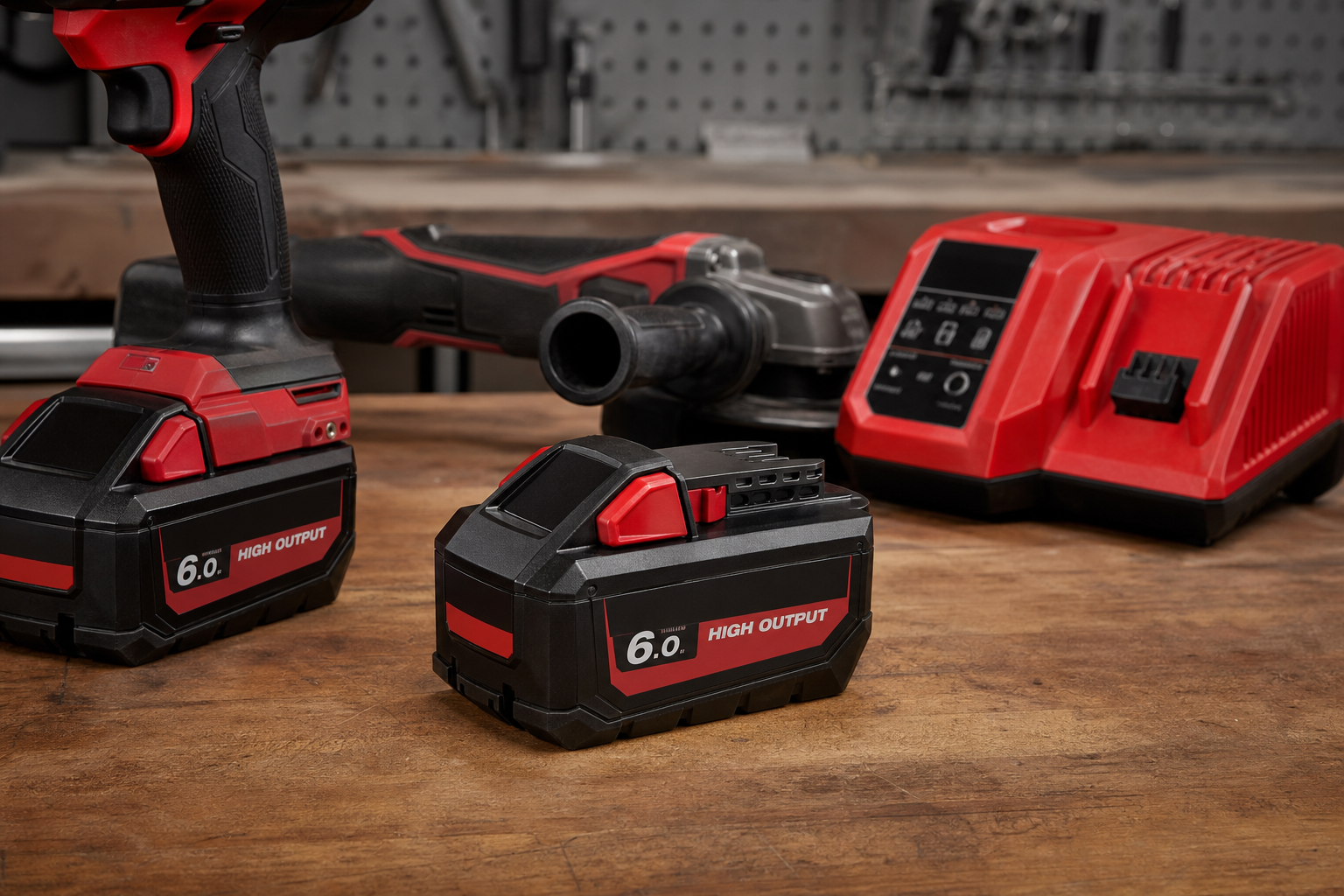
The Milwaukee M18HB6 is a 6.0 Ah M18 HIGH OUTPUT battery pack designed for compatible Milwaukee M18 cordless tools, giving professional and demanding users a higher capacity option within the 18 volt platform. Choosing a battery should involve more than comparing amp hour figures, however. Tool compatibility, workload, pack size and weight, charger compatibility, temperature management, storage, authenticity, and battery condition can all influence practical performance and service life. Understanding those factors makes it easier to determine whether the M18HB6 suits your existing tools and typical workload.
What Is the Milwaukee M18HB6?
The Milwaukee M18HB6 is part of Milwaukee Tool’s M18 battery platform. It is commonly identified as an M18 HIGH OUTPUT 6.0 Ah lithium ion battery pack, although exact product naming and packaging can differ by country and market.
The pack is intended to power compatible M18 cordless tools.
HIGH OUTPUT batteries are designed around Milwaukee’s battery and tool ecosystem, with electronics and thermal management intended to support demanding applications when paired with compatible equipment.
The 6.0 Ah capacity places the pack above compact lower capacity batteries while remaining below some of the largest capacity packs available within the broader M18 platform.
That creates a useful middle ground for many users.
A contractor running demanding saws, grinders, outdoor equipment, or other higher draw tools may prioritize runtime and power delivery. Someone using a lightweight drill overhead for extended periods may place greater emphasis on reduced weight.
The appropriate battery therefore depends on the tool and task.
9 Powerful Milwaukee M18HB6 Buying and Usage Tips
Battery specifications can appear straightforward, but practical performance depends on how the battery interacts with the tool, charger, environment, and workload.
1. Confirm M18 Tool Compatibility
The first requirement is platform compatibility.
Milwaukee’s M18 cordless system is designed around 18 volt battery packs and compatible M18 tools. However, buyers should still confirm compatibility with the exact tool and application, particularly when dealing with older equipment or specialist products.
Do not assume an M18 pack belongs on an M12 tool.
Milwaukee M12 and M18 are different battery platforms with different physical interfaces and voltage systems.
Always check the tool’s model information and official Milwaukee documentation where compatibility is uncertain.
2. Understand the 6.0 Ah Capacity
Amp hours, abbreviated Ah, describe battery charge capacity under specified conditions.
A 6.0 Ah pack provides greater nominal capacity than a lower amp hour pack of the same voltage class.
That generally creates the potential for more runtime under comparable loads.
However, amp hour rating alone does not provide a reliable prediction such as a specific number of cuts, holes, or minutes.
Actual runtime depends on:
• Tool type
• Workload
• Material
• Accessory condition
• Operating technique
• Temperature
• Battery condition
• Tool settings
Manufacturer tests can provide useful comparisons when the testing methodology is clearly stated.
3. Match Battery Size to the Tool
Higher capacity batteries contain additional battery cells or different cell configurations depending on the pack design, which can increase physical size and weight.
That tradeoff matters.
A larger pack can be well suited to a stationary or high draw tool but feel less convenient on a compact drill used above shoulder height.
Milwaukee M18HB6 Size and Work Balance
Before selecting the M18HB6 for every tool, consider ergonomics.
Think about:
• Tool weight
• Battery position
• Working height
• Duration of use
• Required runtime
• Available spare batteries
• Frequency of battery changes
The highest capacity available is not automatically the best ergonomic choice.
4. Use a Compatible Milwaukee Charger
Lithium ion batteries require controlled charging.
Use a charger specifically approved for the battery platform and follow Milwaukee’s instructions concerning compatible charger models.
A genuine compatible charger communicates with the battery and controls charging according to the system design.
Avoid makeshift charging arrangements or unverified adapters.
They can bypass intended electrical and mechanical safeguards.
5. Consider HIGH OUTPUT Benefits for Demanding Tools
Milwaukee markets HIGH OUTPUT packs for enhanced performance and cooler operation compared with certain standard M18 battery configurations when used under appropriate conditions.
The actual benefit depends on the tool.
A relatively low demand tool may not take advantage of the same performance characteristics as a high draw saw or grinder.
Buyers should therefore consider the complete tool and battery pairing rather than assuming every application will show an identical difference.
6. Protect the Battery From Extreme Conditions
Temperature affects lithium ion performance.
Very hot or cold conditions can alter available output, charging behaviour, and battery longevity.
Professional battery systems contain protective electronics, but users should still follow manufacturer temperature guidance.
Do not intentionally heat or cool a battery using unsafe methods.
7. Inspect the Pack Before Use
Power tool batteries experience impact, vibration, dust, moisture exposure, and frequent handling.
Inspect the battery periodically.
A damaged enclosure can expose components to conditions for which the pack was not designed.
Milwaukee M18HB6 Warning Signs
Stop using and appropriately isolate a battery when manufacturer guidance indicates concern, particularly if you observe serious physical damage, abnormal swelling, unusual heat, leakage, smoke, burning odor, or other abnormal behavior.
Do not dismantle a lithium ion battery pack.
Damaged lithium ion batteries can present fire and chemical hazards and require appropriate handling.
8. Buy From a Reliable Seller
Popular power tool batteries are frequently sold through marketplaces and third party retailers.
Counterfeit or misrepresented packs can differ internally from genuine products despite similar external appearance.
Purchase from established sellers and examine model information, packaging, warranty terms, and seller identity.
Extremely low pricing should prompt additional verification.
9. Consider Total Battery System Value
If you already own multiple M18 tools, a compatible battery can serve across the platform rather than being dedicated to one device.
This is one of the practical benefits of a cordless ecosystem.
However, buying batteries solely because they belong to the same platform can lead to unnecessary spending.
Choose a mix of capacities that reflects actual tools and usage.
Milwaukee M18HB6 Specifications Explained
Specifications help shoppers compare batteries, but each figure should be interpreted correctly.
18 Volt Battery Platform
M18 is Milwaukee’s 18 volt cordless tool platform.
Lithium ion battery cells operate across a range of voltages as they charge and discharge, so consumer platform voltage labeling should be interpreted according to the manufacturer’s system designation rather than as a fixed voltage at every moment of operation.
6.0 Ah Battery Capacity
The M18HB6 carries a nominal 6.0 Ah capacity rating.
Higher amp hour capacity generally means more stored energy potential within the same nominal voltage system, although usable energy under real loads depends on operating conditions and battery management.
Lithium Ion Cell Technology
Lithium ion chemistry is widely used in professional cordless tools because it provides a strong balance of energy density, power capability, and rechargeable operation.
Battery packs also require electronic management.
Milwaukee M18HB6 REDLINK Intelligence
Milwaukee describes its integrated electronics using REDLINK related terminology across its cordless ecosystem.
Battery, charger, and tool electronics can monitor operating conditions and provide system protection appropriate to compatible products.
These safeguards should not be treated as permission to misuse equipment or ignore operating instructions.
Milwaukee M18HB6 HIGH OUTPUT Technology
HIGH OUTPUT is Milwaukee’s designation for battery technology designed to improve performance characteristics within the M18 system.
Power Delivery
High demand cordless tools can require substantial current.
A battery’s ability to provide current without excessive voltage drop or heat can affect tool performance.
Cell selection, electrical connections, cooling characteristics, and electronic management all influence this behavior.
Thermal Management
Heat is an important consideration in high current battery systems.
Manufacturers design packs to manage heat through cell spacing, housing design, electronics, and other engineering methods.
Does the Milwaukee M18HB6 Make Every Tool More Powerful?
Not necessarily.
Performance improvement depends on whether the tool can make use of the battery’s capabilities and how the compared battery performs under the same workload.
A simple LED light or lower demand drill application may show less meaningful performance difference than a demanding cutting or grinding application.
Use tool specific manufacturer data when available.
Milwaukee M18HB6 Compatibility
Compatibility should be considered both mechanically and electronically.
Compatible M18 Tools
The battery is intended for Milwaukee M18 system tools, subject to specific product requirements.
This broad platform includes many categories such as:
• Drills
• Impact drivers
• Impact wrenches
• Circular saws
• Reciprocating saws
• Grinders
• Rotary hammers
• Lighting
• Outdoor power equipment
• Dust extraction equipment
Availability varies by region.
M18 FUEL Tools
Milwaukee’s M18 FUEL range typically combines brushless motors, electronics, and M18 battery technology in professional oriented tools.
The M18HB6 can be attractive for demanding compatible FUEL products where higher output and capacity are useful.
Milwaukee M18HB6 and Older M18 Tools
The M18 platform emphasizes battery compatibility across generations, but users should check official documentation for the exact tool, especially when equipment is old, modified, specialized, or from another market.
Physical fit should never be forced.
Milwaukee M18HB6 Runtime
A specific universal runtime cannot be accurately stated for the M18HB6.
A work light and circular saw consume energy at dramatically different rates.
Why Runtime Varies
Battery runtime can change with:
• Power demand
• Tool efficiency
• Material hardness
• Accessory sharpness
• Tool speed
• Ambient temperature
• Operator technique
• Battery age
• Duty cycle
Even two users operating the same tool can achieve different results.
Compare Runtime Under Identical Conditions
Meaningful comparisons require the same tool, accessory, material, and test procedure.
Marketing claims should be read alongside their test conditions.
Milwaukee M18HB6 Runtime for Professional Work
Professionals should estimate battery requirements based on their own workload.
Track how many packs are typically consumed over a working day and account for charging opportunities.
Often, multiple appropriately sized batteries provide better workflow than relying on one very large pack.
Charging the Milwaukee M18HB6
Correct charging protects the user and helps the battery operate as designed.
Use Approved Chargers
Check Milwaukee’s official compatibility information for chargers sold in your market.
Different charger models can provide different charge rates.
Fast charging can be convenient, but charging behavior is controlled by the complete battery and charger system.
Let the System Manage Charging
Modern battery systems monitor pack conditions and may delay or adjust charging based on temperature.
Do not attempt to override a charger indication when the battery is outside an acceptable condition.
Keep Charger Ventilation Clear
Chargers generate heat during operation.
Use them on appropriate surfaces in accordance with manufacturer instructions and keep ventilation openings unobstructed.
Milwaukee M18HB6 Charging Safety
Do not charge batteries that are severely damaged, wet beyond their rated conditions, leaking, swollen, or otherwise abnormal.
Keep charging equipment away from flammable clutter and environments prohibited by the manufacturer.
Follow the current battery and charger manuals.
Milwaukee M18HB6 Battery Care
Battery care does not require complicated rituals.
Manufacturer instructions should take priority over generalized lithium ion advice.
Keep Contacts Clean
Battery terminals need reliable electrical contact.
Avoid allowing conductive debris, liquids, or loose metal objects to contact exposed terminals.
Do not insert tools into battery connections.
Prevent Unnecessary Impact
Power tool batteries are designed for working environments, but repeated drops can damage housings or internal components.
A pack should not continue in service automatically after a severe impact.
Inspect it carefully.
Avoid Unapproved Modifications
Do not open the housing, replace cells independently, bypass electronics, or modify terminals.
Extending Milwaukee M18HB6 Service Life
Practical habits include:
• Use compatible equipment
• Avoid unnecessary heat exposure
• Follow charger instructions
• Keep terminals protected
• Inspect physical condition
• Store according to manufacturer guidance
• Avoid deep physical damage
• Keep batteries away from loose conductive objects
Battery aging is unavoidable, but appropriate use can reduce avoidable damage.
Storing Milwaukee M18HB6 Batteries
Storage conditions can influence lithium ion batteries.
Choose a Suitable Environment
Store batteries in a dry location within the temperature range recommended by Milwaukee.
Avoid leaving batteries for extended periods in excessively hot vehicles or direct sunlight.
Protect the Terminals
Loose screws, nails, coins, keys, and other metal objects can potentially create electrical contact across exposed terminals.
Store batteries so terminals cannot be accidentally short circuited.
Long Term Milwaukee M18HB6 Storage
For long periods without use, follow Milwaukee’s current instructions concerning charge state, temperature, and periodic inspection.
Do not rely on generic battery advice when manufacturer specific documentation is available.
Milwaukee M18HB6 for High Demand Tools
The 6.0 Ah HIGH OUTPUT pack can be attractive for tools that combine substantial power demands with the need for reasonable portability.
Circular and Reciprocating Saws
Cutting applications can place sustained or repeated high loads on batteries.
Blade condition matters too.
A dull or inappropriate blade increases workload and can reduce practical runtime.
Angle Grinders
Grinding and cutting can involve sustained high power demand.
Battery capacity should be balanced with tool weight and operator comfort.
Outdoor Power Equipment
M18 outdoor tools can consume significant energy depending on the product and workload.
Grass density, cutting conditions, and tool settings can materially affect runtime.
Milwaukee M18HB6 for Drills and Impact Drivers
The M18HB6 can power compatible drills and impact drivers, but its physical size may not be ideal for every task.
For short or overhead applications, some users may prefer a smaller pack for improved balance.
For sustained demanding work, additional capacity may be useful.
Milwaukee M18HB6 vs Smaller M18 Batteries
Smaller M18 batteries can make tools lighter and more compact.
This can be valuable for electricians, installers, technicians, and others who carry tools throughout the day.
The tradeoff is generally lower capacity.
When a Smaller Pack Makes Sense
Consider lower capacity options for:
• Tight spaces
• Short tasks
• Overhead work
• Lightweight tools
• Frequent battery access
• Lower power demands
When the M18HB6 Makes Sense
The 6.0 Ah pack may be more suitable where runtime and high load performance outweigh the benefit of minimum tool weight.
Building a Balanced Milwaukee M18 Battery Kit
Many professionals benefit from owning more than one battery size.
Smaller packs can support compact tools while HIGH OUTPUT batteries handle more demanding equipment.
This approach matches battery weight and performance to each task.
Milwaukee M18HB6 vs Higher Capacity Batteries
Larger packs can provide additional nominal capacity but typically add size, weight, and cost.
The best choice depends on whether continuous runtime is more important than handling.
Consider Battery Change Frequency
If stopping to change batteries creates significant downtime, higher capacity may be valuable.
If charged spare packs are always nearby, a moderately sized battery can provide a better ergonomic balance.
Consider Tool Design
Battery weight affects tools differently.
A heavier pack on a ground based outdoor tool feels different from the same pack on a handheld tool used at shoulder height.
Genuine vs Counterfeit Milwaukee M18HB6 Batteries
Counterfeit power tool batteries deserve particular caution because unseen cells, wiring, electronics, and protection components determine safety and performance.
Warning Signs When Shopping
Potential concerns can include:
• Unusually low pricing
• Poor packaging quality
• Inconsistent labeling
• Seller identity that cannot be verified
• Spelling errors
• Missing documentation
• Questionable warranty claims
No single sign proves that a battery is counterfeit.
Check Authorized Sales Channels
For maximum confidence, purchase through Milwaukee or established authorized sellers identified through official regional resources.
Why Genuine Milwaukee M18HB6 Packs Matter
A power tool battery is a high energy device.
Quality control involves more than exterior appearance.
Cells, internal conductors, temperature monitoring, protection electronics, and manufacturing consistency all matter under heavy loads and charging.
Buying a Used Milwaukee M18HB6
A used battery can have substantial hidden wear even when its housing looks clean.
Ask About Age and Usage
Charge cycles, heat exposure, storage, workload, and charging history can affect remaining capacity.
Sellers may not have accurate records.
Inspect Physical Condition
Avoid packs showing severe cracks, swelling, melted areas, corrosion, fluid leakage, damaged terminals, or obvious unauthorized repairs.
Is a Used Milwaukee M18HB6 Worth Buying?
It depends on price, condition, remaining performance, authenticity, and any available warranty.
Because internal condition is difficult to verify visually, used batteries involve more uncertainty than new packs from reputable sellers.
Milwaukee M18HB6 Safety
Lithium ion tool batteries store substantial energy.
Responsible handling is essential.
Stop Using Damaged Batteries
A battery that emits smoke, becomes abnormally hot, swells, leaks, or shows severe damage requires careful handling.
Move away from immediate danger and follow manufacturer and local emergency guidance.
Battery fires can require specific response procedures.
Do Not Dispose of Batteries in Household Waste
Rechargeable lithium ion batteries generally require dedicated recycling or hazardous waste handling according to local rules.
In the United States, resources such as the EPA and recognized battery recycling programs can help locate appropriate options.
Transporting Milwaukee M18HB6 Batteries
Lithium batteries are subject to transportation rules, especially during air shipping.
Individuals and businesses should follow carrier and regulatory requirements concerning packaging, terminals, battery condition, and watt hour classifications.
Damaged batteries can face stricter restrictions.
Milwaukee M18HB6 Warranty Considerations
Warranty terms can vary by country, product, seller, and purchase date.
Do not rely on a universal warranty period without checking the documentation applicable to your market.
Keep Proof of Purchase
Retain:
• Sales receipt
• Seller information
• Product packaging where useful
• Model details
• Serial or manufacturing information where applicable
These can simplify a legitimate warranty inquiry.
Avoid Unauthorized Repair
Opening or modifying the battery can create safety problems and may affect warranty coverage.
Use official or appropriately authorized service channels where repair or assessment is offered.
How to Choose the Right Milwaukee M18 Battery
Capacity should be one part of the decision.
Consider power demand, tool weight, balance, runtime, charging availability, purchase cost, and working environment.
Choose by Application
A tradesperson may use compact batteries for installation tools and higher capacity HIGH OUTPUT packs for cutting or grinding.
Outdoor equipment users may prioritize runtime more heavily.
Choose by Workflow
Two batteries and an appropriate charger can sometimes provide better continuous workflow than one large pack.
Charging speed and task duration determine whether this strategy works.
When the Milwaukee M18HB6 Is a Strong Choice
The M18HB6 can be a practical option for users who want a 6.0 Ah HIGH OUTPUT pack that balances substantial capacity with portability within the M18 system.
Its suitability remains tool and task dependent.
Common Milwaukee M18 Battery Mistakes
Battery misuse can reduce convenience, damage equipment, or create safety risks.
Avoid:
• Using incompatible chargers
• Forcing batteries onto other platforms
• Buying only by amp hour rating
• Ignoring tool balance
• Continuing to use physically damaged packs
• Charging abnormal batteries
• Modifying battery terminals
• Opening lithium ion packs
• Leaving terminals exposed around metal objects
• Assuming suspiciously cheap batteries are equivalent to genuine products
• Disposing of lithium batteries in ordinary household waste
Follow product specific manuals whenever their guidance differs from generalized advice.
Frequently Asked Questions
What is the Milwaukee M18HB6?
The Milwaukee M18HB6 is an M18 HIGH OUTPUT 6.0 Ah lithium ion battery pack intended for compatible Milwaukee M18 cordless tools.
Is the Milwaukee M18HB6 compatible with all M18 tools?
It is designed for Milwaukee’s M18 platform, but users should verify compatibility with the exact tool through current official Milwaukee documentation, especially for specialized equipment.
How long does a Milwaukee M18HB6 battery last per charge?
Runtime depends on the tool, workload, material, settings, temperature, battery condition, and operator technique, so there is no universal runtime figure.
Can I charge the Milwaukee M18HB6 on any M18 charger?
Use only Milwaukee chargers officially identified as compatible with the battery. Check current regional manufacturer documentation for specific charger models.
Is the Milwaukee M18HB6 suitable for high demand tools?
Its HIGH OUTPUT design and 6.0 Ah capacity can make it suitable for many demanding compatible M18 tools, although practical performance remains tool and workload dependent.
How should I store a Milwaukee M18HB6?
Store it dry, protected from extreme temperatures and conductive objects, following Milwaukee’s current instructions for storage conditions and long term battery care.
Conclusion
The Milwaukee M18HB6 offers 6.0 Ah capacity within Milwaukee’s M18 HIGH OUTPUT battery range and can be a useful match for demanding compatible cordless tools. Its real value depends on balancing runtime and power capability against weight, tool ergonomics, charger availability, and the specific work being performed. Buying through a reliable seller, following Milwaukee’s charging and storage instructions, and removing damaged batteries from service are equally important for dependable and safe long term use.