Cleopatra Enterprise: 7 Critical Strategies for Accurate Industrial Project Cost Estimation, Scope Management, and Turnaround Execution
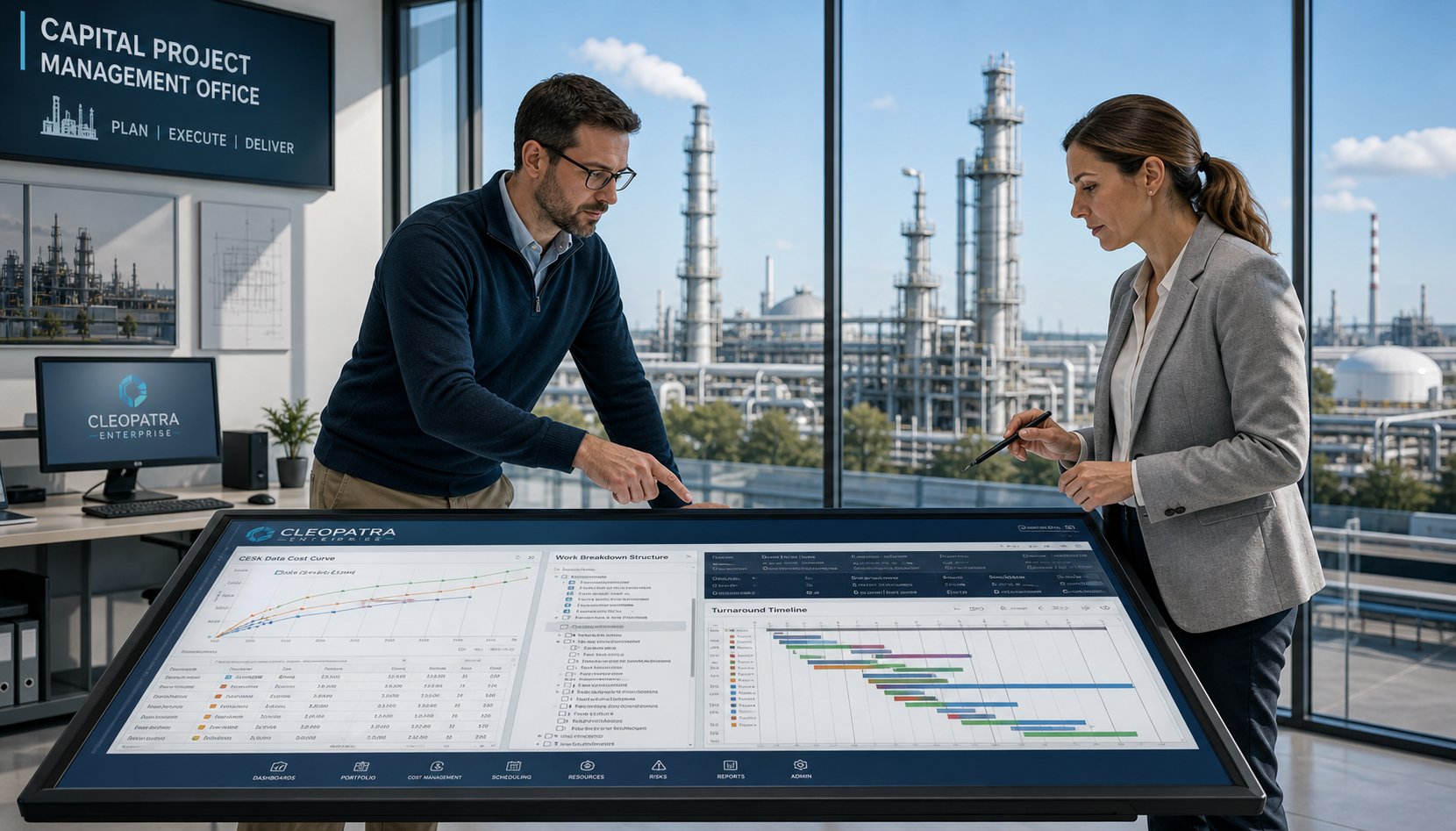
Industrial capital ventures—such as refinery modernizations, offshore wind turbine installations, pharmaceutical facilities, and chemical plant revamps—operate under extraordinary technical complexity, volatile commodity pricing, and unforgiving regulatory deadlines. Deploying Cleopatra Enterprise provides cost engineers, project controls directors, and turnaround managers with an integrated digital ecosystem that unifies precision cost estimating, detailed field execution tracking, and historical cost benchmarking. For decades, industrial asset owners and Engineering, Procurement, and Construction (EPC) contractors have struggled with disconnected legacy tools, juggling fragile Excel workbooks, manual ERP spreadsheets, and isolated scheduling files. This systemic fragmentation routinely triggers multi-million-dollar bidding variances, severe scope creep, and chaotic plant shutdowns. By combining advanced parametric cost modeling with an in-house database of over 1.5 million verified cost items, a modern total cost management platform bridges the gap between pre-sanction conceptual modeling and post-sanction field realities.
The Cost Engineering Crisis: Why Conventional Industrial Estimating Fails
To appreciate the disruptive value of an integrated project controls system, one must understand why traditional estimation techniques fail during large-scale industrial projects and plant outages.
1. Spreadsheet Fragility and the Loss of Institutional Knowledge
Despite advancements in enterprise software, many industrial firms still rely on manual spreadsheets:
- Calculation Vulnerabilities: Large capital projects involve tens of thousands of Work Breakdown Structure (WBS) line items. A single mistyped formula, broken cell link, or unverified macro in a complex workbook can distort multi-million-dollar labor projections without generating error alerts.
- Departmental Knowledge Silos: When veteran cost engineers transition out of an organization, their personal productivity rules, regional labor multipliers, and historical subcontractor assumptions disappear with them. Successor estimators are left without verified documentation, forcing them to guess baseline project metrics.
- Version Control Confusion: Distributing multiple versions of estimation files across engineering disciplines leads to conflicting equipment lists, misaligned piping specifications, and out-of-date currency exchange rates.
2. The Scope Volatility of Shutdowns, Turnarounds, and Outages (STO)
Plant turnarounds compress months of intensive maintenance and capital improvements into intense 20-to-40-day production shutdowns:
- High-Stakes Time Compression: Every single hour an oil refinery or petrochemical plant remains offline represents hundreds of thousands of dollars in lost operating revenues.
- Unplanned Discoveries: Opening pressurized vessels, cracking towers, and heat exchangers frequently reveals unforeseen corrosion, weld fatigue, and metal degradation. Without an agile estimating tool that links discovery work directly to approved work packs, unexpected scope additions rapidly inflate turnaround budgets beyond initial contingency reserves.
Powering Precision: The CESK Data Knowledge Base
At the heart of dependable cost estimation is verified, empirical data. A major competitive asset of Cleopatra Enterprise is its proprietary Cost Engineering Standard Knowledge Base (CESK).
Comprehensive Empirical Cost Architecture
A reliable estimation platform requires access to comprehensive, market-calibrated benchmark metrics:
- Over 1.5 Million Verified Cost Items: Drawn from more than 2,000 real-world global projects, CESK data provides validated material pricing, crew productivity ratios, and equipment rental rates across oil, gas, chemical, offshore wind, mining, and civil infrastructure domains.
- Parametric Cost Modeling: Rather than requiring detailed line-item design specs at project kickoff, parametric algorithms allow estimators to generate rapid, reliable conceptual Class 5 and Class 4 estimates using high-level design drivers—such as vessel capacities, pipe diameters, operating pressures, and foundation footprints.
- Location and Escalation Factoring: Regional tables account for localized labor productivity variations, union wage agreements, import tariffs, and material inflation across global fabrication hubs, ensuring bids reflect realistic regional market conditions.
Cleopatra Project Controls Architecture Comparison
| System Capability | Traditional Spreadsheet & Manual Methods | Point Estimating Software Tools | Cleopatra Enterprise Integrated Platform |
|---|---|---|---|
| Database Depth | Static, ad-hoc personal spreadsheets | Basic vendor catalogs | CESK Knowledgebase (1.5M+ verified items) |
| AACE Estimating Coverage | Inconsistent; prone to manual bias | Usually limited to Class 1 or 2 bids | Full Class 5 to Class 1 lifecycle support |
| Turnaround (STO) Tooling | Clunky; requires separate manual work packs | Missing dedicated shutdown logic | Fully integrated work pack & discovery management |
| Software Interfacing | High manual transcription error risk | Basic CSV imports and exports | Native bidirectional APIs (SAP, P6, Maximo) |
| Change Control Linking | Lagging monthly budget reconciliation | Disconnected from field execution | Real-time trend tracking & early forecast alerts |
| Historical Benchmarking | Dispersed files; lost project actuals | Manual post-mortem entries | Automated ingestion of completed project actuals |
End-to-End Lifecycle Alignment: From Scoping to Benchmarking
Total cost management is not a static calculation performed before contract signing; it is an active discipline that spans the entire project lifecycle.
1. Conceptual and Feasibility Estimation (AACE Classes 5 and 4)
In the early feasibility phases of a capital project, detailed engineering drawings do not exist:
- Capacity-Factored Estimating: Engineers utilize power-law capacity curves and six-tenths factoring rules to evaluate alternative plant designs, helping executive steering committees determine project viability before committing substantial capital.
- Investment Decision Support: Scenario modeling tools allow teams to evaluate trade-offs between capital expenditure (CAPEX) choices and ongoing operational maintenance expenditures (OPEX) over a 25-year plant lifecycle.
2. Definitive Bidding and Execution Baselines (AACE Classes 3 to 1)
As piping and instrumentation diagrams (P&IDs), 3D structural models, and vendor quotes mature:
- Bottom-Up Detailed Take-Offs: Estimators transition seamlessly into unit-rate estimating, linking individual work packages to discipline-specific labor crews, craneage requirements, non-destructive testing (NDT), and coating specifications.
- Instant Baseline Freezing: Once the definitive estimate receives board approval, the software converts estimation line items directly into field Cost Breakdown Structures (CBS), establishing clear operational budgets without manual data re-entry.
3. Integrated Dynamic Cost Control and Earned Value Analytics
During construction and turnaround execution, maintaining real-time financial transparency is critical:
- Earned Value Management (EVM): By ingesting actual field hours and installed physical quantities, the system automatically calculates Cost Performance Index (CPI) and Schedule Performance Index (SPI), alerting project directors to labor productivity drops long before scheduled completion dates.
- Trend and Change Order Management: Field-initiated scope deviations are categorized as pending, approved, or rejected trends, projecting their financial impact on the final Estimate at Completion (EAC) in real time.
Seamless Enterprise Digital Integration
To deliver maximum efficiency, modern project controls platforms must communicate effortlessly with existing enterprise systems.
Direct Bidirectional Interoperability
- Enterprise Resource Planning (ERP): Robust integrations with SAP S/4HANA, IBM Maximo, and Oracle ERP allow procurement purchase orders, contractor timesheets, and material invoices to sync directly with project cost accounts.
- Scheduling Synchronization: Bidirectional links with Oracle Primavera P6 and Microsoft Project connect resource loading and budget distribution directly to critical path milestones, ensuring delays are immediately quantified in financial terms.
- Engineering Design Interfaces: Direct connections with software like Honeywell UniSim enable estimators to extract process simulation data directly into parametric cost equations.
Frequently Asked Questions About Cleopatra Enterprise
What makes Cleopatra Enterprise unique in industrial cost management?
It is a comprehensive Total Cost Management platform that integrates precision cost estimating, dynamic field cost control, turnaround management, and historical benchmarking into a single database.
What is CESK data and how does it support cost engineers?
CESK is Cleopatra’s proprietary cost database featuring over 1.5 million verified cost items and models drawn from more than 2,000 real-world projects across energy, mining, chemical, and offshore sectors.
How does the platform assist with shutdowns, turnarounds, and outages (STO)?
It provides specialized tools to scope work packages, estimate discovery work quickly, model contractor shifts, and monitor real-time hourly progress during tight shutdown windows.
Does the software comply with international cost engineering standards?
Yes, Cleopatra Enterprise natively supports the cost classification frameworks and Total Cost Management principles established by AACE International.
Can Cleopatra Enterprise connect to existing ERP and scheduling platforms?
Yes, it features seamless bidirectional data integrations with leading enterprise software including SAP, IBM Maximo, Primavera P6, Honeywell UniSim, and Excel.
How does historical benchmarking improve future project bids?
The platform automatically captures actual field labor productivity, material expenditures, and equipment costs upon project completion, updating institutional databases to increase the accuracy of future estimates.
Conclusion
Successfully delivering complex mega-projects and mission-critical plant shutdowns requires absolute financial discipline, transparent data governance, and proven estimating accuracy. Utilizing Cleopatra Enterprise provides industrial asset owners and EPC contractors with the definitive digital infrastructure required to conquer project risks. By leveraging the expansive CESK knowledge base, streamlining work pack scoping, establishing dynamic cost control baselines, and integrating seamlessly with enterprise ERP and scheduling tools, organizations eliminate the costly blind spots of manual spreadsheets. Embracing a unified Total Cost Management platform protects capital investments, optimizes shutdown durations, and ensures that every project transitions smoothly from initial conceptual design to on-budget, on-time operational excellence.