Screen Dividers for Rooms: Smart Ways to Create Privacy, Style and Flexible Spaces
Screen dividers for rooms provide a practical way to divide open interiors, create privacy and define different functional zones without constructing a permanent wall. From folding panels and wooden slat screens to fabric partitions and freestanding shelving systems, room dividers can help transform bedrooms, living rooms, studios, home offices and open plan spaces. The right design can separate activities while still allowing light, air and visual connection to move through the room.
Modern homes are increasingly expected to support several activities within the same space. A living room may also function as a home office. A studio apartment may need separate sleeping and entertaining areas. A large bedroom may require a dressing space, while an open plan home may benefit from a subtle boundary between dining and relaxation zones.
A room divider can solve these challenges without the cost or disruption of major construction.
The most effective divider is one that balances privacy, proportions, light, stability and interior style rather than simply creating a visual barrier.
What Are Screen Dividers for Rooms?
Screen dividers for rooms are movable or fixed interior elements used to separate one area from another.
Unlike conventional walls, they generally do not form a fully enclosed structural partition.
Many designs are freestanding, which means they can be repositioned whenever the room layout changes.
Common types include:
- Folding screens
- Wood slat dividers
- Fabric screens
- Metal partitions
- Woven screens
- Decorative panels
- Shelving dividers
- Sliding screens
- Glass partitions
- Acoustic screens
The best type depends on how much privacy is required and whether the divider is primarily functional, decorative or both.
Why Room Screens Are Popular
A permanent wall can completely change a room.
That can be useful when full separation is required, but it may not make sense for renters, temporary layouts or flexible living spaces.
Screens offer several advantages.
They can:
- Define zones quickly
- Add visual privacy
- Hide clutter
- Create a decorative feature
- Support flexible furniture layouts
- Reduce the need for structural alterations
- Be moved or stored when not required
They also allow homeowners to experiment with room layouts before committing to permanent changes.
7 Smart Ways to Use Screen Dividers for Rooms
Room dividers can solve very different design problems.
The following seven approaches can help homeowners choose and position them more effectively.
1. Create Privacy Without Building a Wall
Privacy is one of the most common reasons people install a screen divider.
This can be especially useful in open plan homes, shared bedrooms and studio apartments.
A divider can create a visual barrier while keeping the overall room accessible.
Bedroom Privacy
A screen can separate:
- Bed from dressing area
- Sleeping area from workspace
- Shared children’s bedroom zones
- Bed from an entrance door
For greater privacy, choose a solid or tightly woven design.
If you only need a visual boundary, open timber slats or decorative metal panels may be sufficient.
Studio Apartment Privacy
Studio apartments benefit significantly from zoning.
Positioning a divider near the bed can create the impression of a separate sleeping area.
A folding screen works well because it can be closed when guests visit and folded away when more floor space is needed.
Screen Dividers for Rooms With Limited Floor Space
In a small room, avoid extremely deep or bulky partitions.
Slim folding panels, narrow slatted screens and sliding systems can create separation without occupying too much usable floor area.
Light coloured and partially open designs can also help prevent the space from feeling smaller.
2. Separate a Home Office From Living Areas
Working from home often requires a visual boundary between professional and personal space.
A divider can create that distinction even when a dedicated office room is unavailable.
Position a screen behind or beside the desk to separate the workstation from the rest of the room.
This can improve the visual background for video calls and reduce distractions.
Choose the Right Office Divider
For a home office, consider:
- Visual privacy
- Sound absorption
- Background appearance
- Natural light
- Cable access
- Stability
Fabric covered acoustic screens may provide some sound absorption while also creating separation.
They will not fully soundproof a room, but they may reduce reflections and make the workstation feel more contained.
Keep Daylight Available
Avoid placing a solid divider directly between the desk and the room’s primary window if natural light is important.
A slatted, translucent or open shelving divider may provide better results.
The objective is to define the office without turning it into a dark corner.
3. Use Screen Dividers for Rooms as Decorative Features
A room divider does not need to disappear into the background.
It can become one of the strongest design elements in the room.
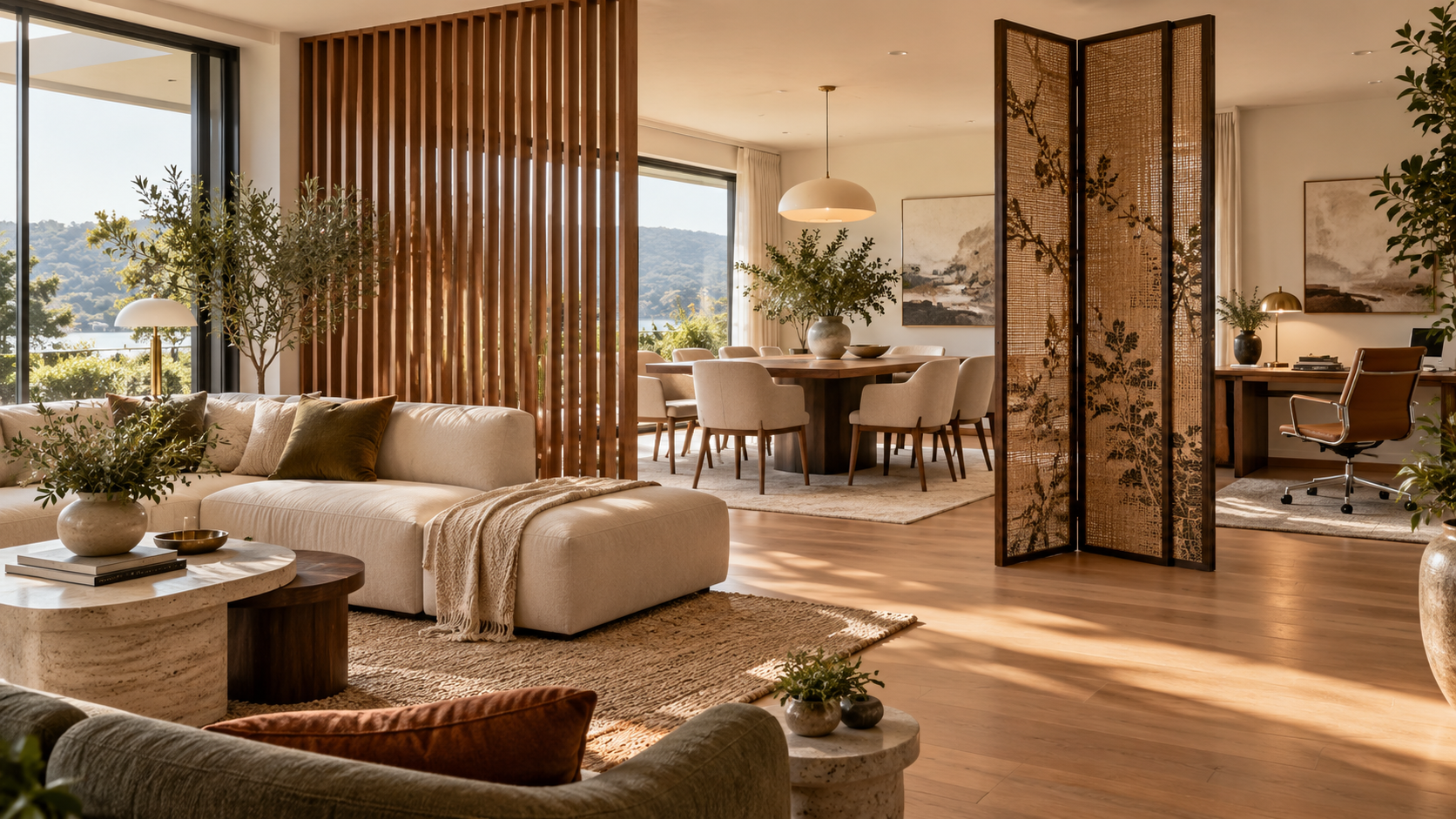
Decorative screens are available in many styles, including:
- Carved timber
- Cane
- Rattan
- Metal
- Geometric panels
- Upholstered fabric
- Japanese inspired screens
- Contemporary slatted timber
Choose a material that relates to existing furniture and finishes.
Match the Interior Style
A natural rattan divider works well in relaxed, coastal or bohemian interiors.
Dark timber can suit classic or sophisticated rooms.
Minimal wood slats complement Scandinavian and contemporary spaces.
Metal screens can work well in industrial interiors.
The goal is visual consistency rather than choosing a divider simply because it looks attractive by itself.
Use Repetition
If the room already contains timber furniture, repeating a similar wood tone in the screen can make the divider feel intentional.
The same principle applies to metal finishes.
A black metal screen can connect visually with black lighting, furniture legs or window frames.
4. Divide Open Plan Living and Dining Areas
Open plan layouts can feel spacious, but they sometimes lack definition.
A screen can create a subtle boundary between functions without blocking the entire room.
For example, a divider can sit between:
- Sofa and dining table
- Kitchen and living area
- Entrance and lounge
- Dining space and home office
Keep Circulation Clear
A divider should not interfere with natural walking routes.
Before purchasing, identify how people move through the room.
Leave enough space around the screen for comfortable circulation.
Avoid placing a freestanding divider where it creates a narrow or awkward passage.
Partial Separation Often Works Best
Full visual separation is not always necessary.
A divider that covers only part of the room can provide enough structure to define zones.
This can preserve the spacious feeling of open plan living while still making each area feel distinct.
5. Use Open Shelving as a Functional Divider
A freestanding shelving unit can perform two jobs at once.
It separates the room while also providing storage or display space.
Open shelving is particularly useful when daylight needs to travel through the divider.
What to Display
Shelves can hold:
- Books
- Plants
- Decorative objects
- Storage baskets
- Ceramics
- Framed photographs
Avoid filling every shelf completely if you want the room to remain visually connected.
Leaving some openings allows light and sightlines to pass through.
Secure Tall Shelving
Safety becomes important with tall freestanding units.
Furniture that could tip should be appropriately anchored or installed according to the manufacturer’s instructions, especially in homes with children or pets.
A decorative divider should never become a stability hazard.
6. Use Screen Dividers for Rooms to Hide Unattractive Areas
Not every room feature needs to remain visible.
Screens can hide functional or cluttered areas without requiring renovation.
They can conceal:
- Laundry zones
- Storage shelves
- Exercise equipment
- Clothing rails
- Utility equipment
- Work desks
- Children’s toys
A folding screen is especially useful because it can be opened and closed depending on the situation.
Hide Without Blocking Access
Place the divider far enough from the hidden area to allow practical access.
If you need to reach the area several times a day, a lightweight folding screen or sliding panel may be more convenient than a heavy fixed divider.
Do Not Cover Equipment That Needs Ventilation
Heating appliances, electrical equipment and other devices may require ventilation and minimum clearances.
Do not place fabric or other combustible room dividers close to equipment that becomes hot.
Follow the equipment manufacturer’s safety requirements.
7. Choose a Divider That Can Adapt Over Time
One of the biggest advantages of room screens is flexibility.
Your needs may change.
A divider used for a home office today may later separate a nursery, dressing area or reading corner.
Folding Screens Offer Maximum Flexibility
Folding screens normally consist of several hinged panels.
The panels can be opened to different angles, which helps the divider remain stable.
They can also be folded into a relatively compact shape for storage.
Modular Dividers
Some modern divider systems use interchangeable panels or sections.
This makes it possible to extend, shorten or reconfigure them.
Modular designs can be useful in rental properties and changing family spaces.
Best Materials for Screen Dividers for Rooms
Material affects appearance, weight, privacy and maintenance.
There is no single best option for every room.
Wooden Screen Dividers
Wood creates warmth and works with many decorating styles.
Options range from solid timber panels to lightweight slatted designs.
Advantages
Wood can provide:
- Natural appearance
- Strong decorative impact
- Good visual privacy
- Many finish choices
Considerations
Solid wood screens may be heavy.
They should be positioned on a stable surface and moved carefully.
Rattan and Cane Dividers
Rattan and cane have become popular because they create texture without making the room feel too heavy.
The woven structure can provide partial privacy while still allowing some light through.
They are particularly well suited to bedrooms, living rooms and relaxed interiors.
Fabric Room Dividers
Fabric screens are generally lightweight and available in many colours.
Some are stretched across frames, while others use curtain style hanging systems.
Fabric can help soften the appearance of a room.
Certain specialist acoustic fabrics can also help absorb some reflected sound.
However, ordinary fabric screens should not be described as full soundproofing.
Metal Screens
Metal dividers can create strong architectural definition.
Laser cut decorative panels are available with geometric, floral and abstract patterns.
Metal works particularly well in:
- Contemporary interiors
- Industrial rooms
- Commercial inspired spaces
Check edges, stability and overall weight before installation.
Glass Room Dividers
Glass provides separation while preserving daylight.
Clear glass creates minimal visual interruption, while frosted or textured glass offers more privacy.
Glass partitions may be fixed or sliding.
For safety, use glazing products designed and installed for the intended interior application.
How Tall Should a Room Divider Be?
Height depends on the purpose.
A low divider can define zones while preserving full visual connection.
A taller screen creates stronger privacy.
Before buying, measure:
- Ceiling height
- Desired privacy level
- Furniture height
- Divider location
A screen does not necessarily need to reach the ceiling.
In many homes, leaving space above the divider helps maintain light and airflow.
Width Is Equally Important
Measure the area to be divided rather than guessing.
Folding screens lose some total straight line width because the panels need to sit at angles for stability.
If the manufacturer lists the full panel width, the actual space covered may be slightly smaller once the divider is positioned correctly.
Screen Dividers for Small Rooms
Small rooms require careful selection.
Heavy, dark and completely solid dividers can make an already compact room feel crowded.
Consider:
- Light colours
- Open slats
- Cane
- Translucent materials
- Narrow frames
- Open shelving
Mirrored surfaces can also visually expand some interiors, although their placement should be carefully considered.
Avoid Visual Clutter
A highly decorative screen combined with patterned walls, busy furniture and many accessories can overwhelm a small room.
If the room already contains strong patterns, choose a simpler divider.
Screen Dividers for Large Rooms
Large rooms offer more freedom.
A substantial divider can make a spacious room feel more intimate and organised.
Large open plan homes may benefit from:
- Wide slatted partitions
- Architectural shelving
- Multiple folding screens
- Floor to ceiling systems
The divider should be proportionate to the room.
A small decorative panel can look lost within a very large open space.
Choosing Screen Dividers for Bedrooms
Bedroom dividers often need more privacy than living room screens.
Consider solid panels or tightly woven materials.
They can create:
- Dressing area
- Workspace
- Reading corner
- Sleeping zone
Soft finishes can help the bedroom remain comfortable and relaxing.
A screen placed near the bed should be stable and positioned where it is unlikely to be knocked over during the night.
Choosing a Divider for a Shared Children’s Room
Room dividers can help siblings feel that they each have their own zone.
However, safety is especially important.
Avoid unstable screens that children can easily pull over.
Secure suitable dividers where necessary and avoid designs with dangerous gaps, sharp components or heavy unsupported sections.
The screen should not block access to doors, windows or essential circulation routes.
Can Screen Dividers Reduce Noise?
A divider may reduce direct sound transmission slightly, but ordinary folding screens do not provide true soundproofing.
Sound travels around the top, sides and bottom of a freestanding screen.
For better acoustic performance, consider specialist acoustic panels or partitions.
Soft materials can help reduce echo and reflected sound within the room.
This may make conversations or video calls feel more comfortable without fully isolating noise.
Lighting Around Screen Dividers for Rooms
Lighting should be reviewed after installing a room divider.
A solid screen may create shadows or reduce light within one area.
Consider using:
- Floor lamps
- Table lamps
- Wall lights
- Pendant lighting
- LED accent lighting
A decorative slatted divider can also create attractive shadows when positioned near indirect lighting.
Avoid running electrical cables where people could trip over them.
How to Style a Room Divider
Treat the screen as part of the furniture scheme.
Repeat colours and materials found elsewhere in the room.
Plants can soften the edges of a divider.
A rug can reinforce the zone created by the screen.
For example, a room divider behind a sofa combined with a large rug beneath the seating area clearly defines the living zone.
Keep Both Sides Attractive
A divider is often visible from two directions.
Consider how both faces look.
Shelving dividers are particularly effective because objects can be arranged to look attractive from either side.
Cleaning and Maintaining Screen Dividers
Maintenance depends on the material.
Wood
Dust regularly with a soft cloth.
Use cleaning products suitable for the particular finish.
Fabric
Vacuum gently with an upholstery attachment where appropriate.
Check the manufacturer’s cleaning instructions before using water or stain treatments.
Rattan
Use a soft brush or vacuum attachment to remove dust from woven surfaces.
Avoid excessive moisture.
Metal
Dust regularly and follow the finish manufacturer’s guidance for cleaning.
Glass
Use an appropriate glass cleaner and soft cloth.
Clean both sides so fingerprints and dust do not affect transparency.
Common Mistakes When Choosing Screen Dividers for Rooms
One common mistake is purchasing a divider without measuring the space.
Other problems include:
- Choosing an unstable screen
- Blocking natural light
- Selecting the wrong height
- Ignoring walking routes
- Expecting full soundproofing
- Using a divider that clashes with the room
- Overcrowding a small space
- Ignoring child or pet safety
Planning the position before purchasing usually prevents many of these issues.
How to Choose the Best Screen Divider
Start with the purpose.
Ask whether you primarily need:
- Privacy
- Decoration
- Storage
- Workspace separation
- Light filtering
- Temporary zoning
Then consider dimensions and material.
A lightweight folding screen may be perfect for temporary privacy.
A substantial timber slat installation may be more appropriate for a permanent architectural feature.
There is no need to choose the most elaborate design.
The best divider is one that solves the room’s practical problem while improving its overall appearance.
Frequently Asked Questions
What are Screen dividers for rooms used for?
Screen dividers for rooms create privacy, separate functional zones, hide storage or work areas and add decorative interest without requiring a permanent wall.
Are Screen dividers for rooms suitable for small spaces?
Yes. Slim folding screens, open slats, cane and translucent designs can divide compact rooms while helping preserve light and a sense of openness.
Can room dividers provide complete privacy?
Solid screens can provide strong visual privacy, but most freestanding dividers do not completely block light, noise or visibility around their edges.
Can screen dividers reduce noise?
Fabric and acoustic dividers may reduce reflected sound, but ordinary room screens do not provide complete soundproofing because sound can travel around them.
What material is best for a room divider?
The best material depends on the room. Wood provides warmth, cane feels lighter, fabric offers softness, metal adds architectural style and glass preserves daylight.
How do I choose the correct size screen divider?
Measure the desired width and height, consider walking routes and remember that folding screens usually need angled panels for stability, reducing their effective straight line width.
Conclusion
Screen dividers for rooms offer a flexible way to introduce privacy, define functional areas and improve interior style without constructing permanent walls. The best results come from choosing the right dimensions, material, privacy level and placement for the way the room is actually used. Whether separating a bedroom, creating a home office or organising an open plan living area, a thoughtfully selected divider can make the space more practical while maintaining comfort, light and visual balance.