Multifamily Cabinets for Durable, Efficient, and Attractive Apartment Interiors
Choosing multifamily cabinets is an important decision for apartment developers, property managers, general contractors, architects, and renovation teams because cabinetry has to balance appearance, durability, storage, installation speed, budget control, and long term maintenance. Unlike cabinets selected for a single custom home, cabinetry used across multifamily properties must often perform consistently across dozens or even hundreds of units. Materials, dimensions, hardware, finishes, and replacement availability can all influence the total cost of ownership.
A cabinet package that looks attractive on installation day but begins showing wear after frequent tenant turnover can create unnecessary maintenance costs.
At the same time, choosing only the cheapest available option can reduce perceived quality and make renovated units feel less competitive.
The strongest cabinet strategy considers the full life of the property.
That includes procurement, transport, installation, daily use, repairs, unit turnover, replacement parts, and future renovations.
When these factors are considered together, cabinetry can become one of the most predictable and manageable components of a multifamily interior program.
What Are Multifamily Cabinets?
Multifamily cabinets are cabinetry systems selected or produced for apartment buildings, condominiums, student housing, senior living communities, build to rent developments, and other properties containing multiple residential units.
They are commonly installed in:
• Kitchens
• Bathrooms
• Laundry areas
• Utility spaces
• Community rooms
• Leasing offices
• Amenity spaces
The main difference between multifamily cabinetry and custom residential cabinetry is scale.
A single family homeowner may choose highly personalised cabinet dimensions, colours, and accessories.
A multifamily project usually benefits from greater standardisation.
This makes ordering, installation, repair, and replacement easier.
Why Standardisation Matters
Using a consistent cabinet program across multiple units can simplify:
• Purchasing
• Inventory
• Installation
• Replacement doors
• Hardware replacement
• Touch up work
• Renovation planning
• Maintenance training
If every unit uses completely different cabinets, future repairs can become more difficult.
Standardisation does not mean every apartment has to look identical.
Different finish packages can still be created while maintaining compatible cabinet construction and dimensions.
Why Multifamily Cabinets Need Different Priorities
Rental housing places unique demands on interior materials.
Cabinets may be opened and closed thousands of times.
Different residents use the space differently.
Moisture, cleaning products, impact, heavy cookware, and daily wear can all affect cabinet surfaces and hardware.
For this reason, multifamily cabinet selection should prioritise more than visual design.
Important considerations include:
• Durability
• Ease of cleaning
• Hardware quality
• Finish consistency
• Moisture resistance
• Replacement availability
• Lead times
• Installation speed
• Unit cost
• Long term maintenance
A successful project balances all of these requirements.
7 Smart Ways Multifamily Cabinets Improve a Property
The right cabinet program can support both resident experience and property operations.
1. Multifamily Cabinets Create Consistent Unit Quality
Consistency is valuable in apartment development.
When cabinet construction and finishes remain uniform across similar units, property teams can maintain a predictable visual standard.
This can help during:
• Leasing
• Marketing photography
• Model unit preparation
• Turnovers
• Maintenance
• Renovation phases
Consistent cabinetry also makes it easier for management teams to describe unit finishes accurately.
A resident touring one apartment can understand what to expect in another unit with the same finish package.
2. Durable Construction Can Reduce Maintenance
Rental cabinets should be selected for regular use.
Durability depends on the complete cabinet system rather than one material alone.
Important areas include:
• Door construction
• Drawer boxes
• Hinges
• Drawer slides
• Cabinet boxes
• Edge treatment
• Finish quality
• Fasteners
• Shelf support
A weak hinge can create problems even when the cabinet door itself remains in good condition.
Likewise, a durable cabinet box can still become frustrating if drawer slides fail repeatedly.
Multifamily Cabinets Need Strong Hardware
Hardware receives constant movement.
Soft close hinges and drawer slides are often considered because they reduce slamming and create a more refined user experience.
However, hardware quality still matters.
A soft close feature does not automatically mean the mechanism is durable.
Property teams should consider:
• Cycle performance
• Adjustment options
• Replacement availability
• Weight capacity
• Ease of installation
• Manufacturer support
Hardware should be easy for maintenance teams to service.
3. Standard Sizes Can Improve Installation Efficiency
Large projects depend on schedule control.
Cabinet installation can delay countertops, plumbing fixtures, appliances, backsplashes, and final inspections when deliveries or dimensions are incorrect.
Standard cabinet sizing can make installation more predictable.
Common planning benefits include:
• Easier measurement verification
• Faster installer training
• Repeatable layouts
• Simplified replacement ordering
• Reduced custom fabrication
• Better coordination with appliances
Standardisation can also help during renovation projects where multiple units are completed in phases.
4. Better Storage Can Improve Resident Experience
Storage is one of the most important functional features in an apartment.
Residents need space for:
• Cookware
• Food
• Small appliances
• Cleaning supplies
• Dishes
• Bathroom products
• Laundry items
Good cabinet design uses available space efficiently.
The most expensive cabinet is not necessarily the most useful.
A practical layout should consider how residents actually use the room.
5. Multifamily Cabinets Can Support Faster Unit Turnovers
Apartment turnover time affects operations.
When a resident moves out, property teams may need to repair, clean, paint, and prepare the unit quickly.
Cabinets that are easy to clean and repair can support a faster process.
Useful characteristics include:
• Washable surfaces
• Replaceable doors
• Standard hinges
• Consistent finish colours
• Readily available drawer components
• Simple hardware
If one damaged door can be replaced instead of replacing an entire cabinet, repair costs may be easier to control.
6. Attractive Cabinets Can Improve Perceived Interior Quality
Kitchens and bathrooms strongly influence how residents perceive an apartment.
Cabinetry occupies a large visual area.
Even modest kitchens can feel polished when cabinets are well proportioned, aligned, and coordinated with other finishes.
Popular multifamily design directions often include:
• Shaker style doors
• Flat panel doors
• Neutral colours
• Wood tone finishes
• Simple contemporary hardware
• Clean cabinet lines
The goal should be a design that feels current without becoming difficult to maintain.
7. Predictable Cabinet Programs Can Simplify Future Renovations
Multifamily properties are rarely renovated only once.
Over time, owners may upgrade units in stages.
Using a cabinet program with reliable dimensions and replacement parts can simplify later work.
Property teams can keep records of:
• Cabinet sizes
• Finish names
• Door styles
• Hardware models
• Drawer components
• Supplier information
• Installation details
Good documentation makes future repairs and renovations more efficient.
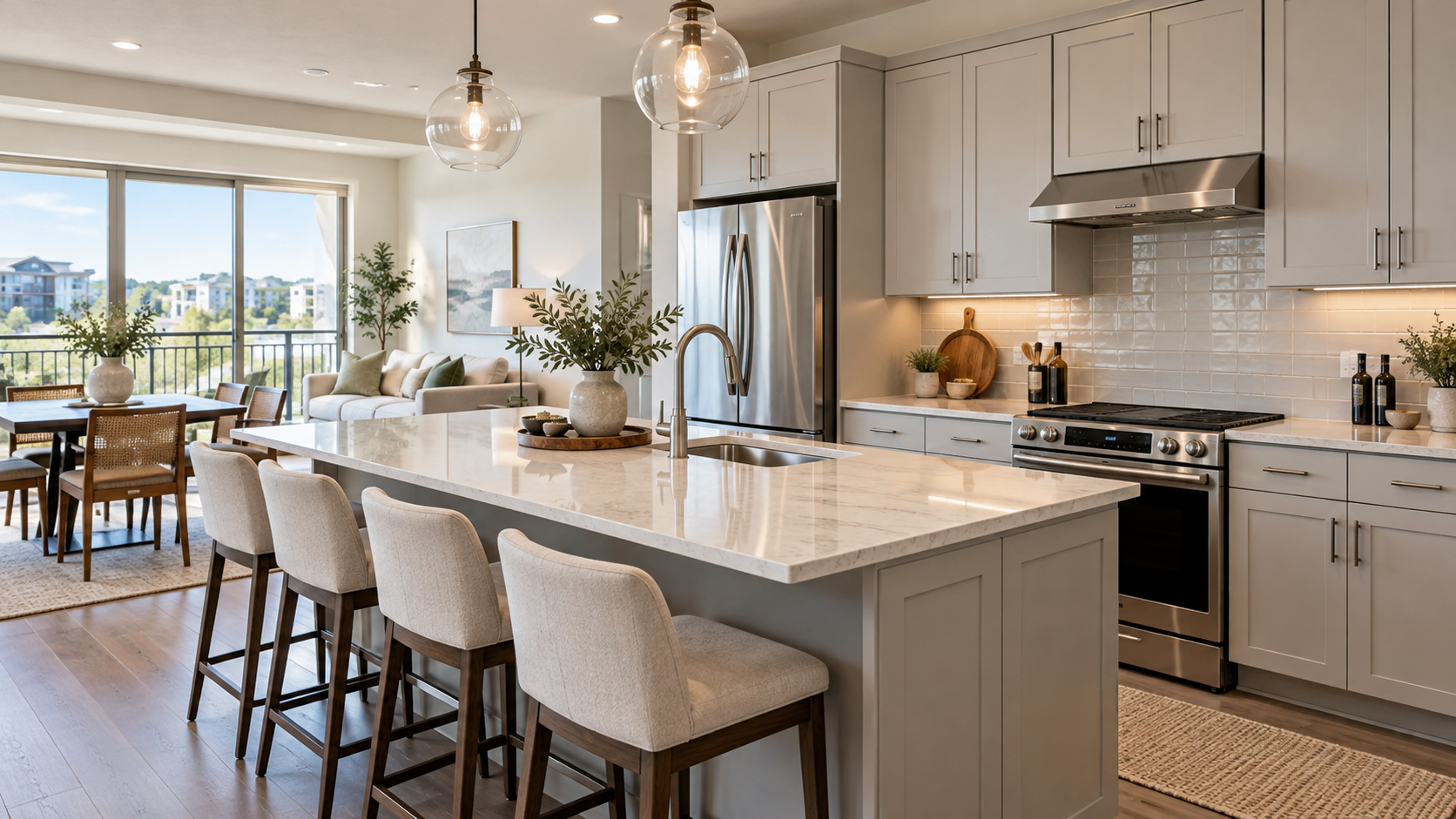
Multifamily Cabinets for Apartment Kitchens
Kitchen cabinetry usually represents the largest cabinet package in an apartment.
The layout must balance storage with appliances, plumbing, countertops, and circulation.
Base Cabinets
Base cabinets support countertops and provide lower storage.
They may contain:
• Drawers
• Doors
• Pull out storage
• Sink bases
• Trash storage
• Appliance spaces
Drawer based storage can improve accessibility for frequently used items.
However, drawer hardware should be selected for regular use.
Wall Cabinets
Wall cabinets provide storage without using additional floor area.
Important design factors include:
• Height
• Depth
• Door swing
• Shelf adjustment
• Clearance around appliances
• Accessibility
Very tall cabinets can increase storage but may place upper shelves beyond comfortable reach for some residents.
Pantry Cabinets
A pantry can provide valuable vertical storage.
Even a narrow pantry cabinet may improve functionality in a compact apartment.
Pantries can be especially useful in units with limited wall cabinet space.
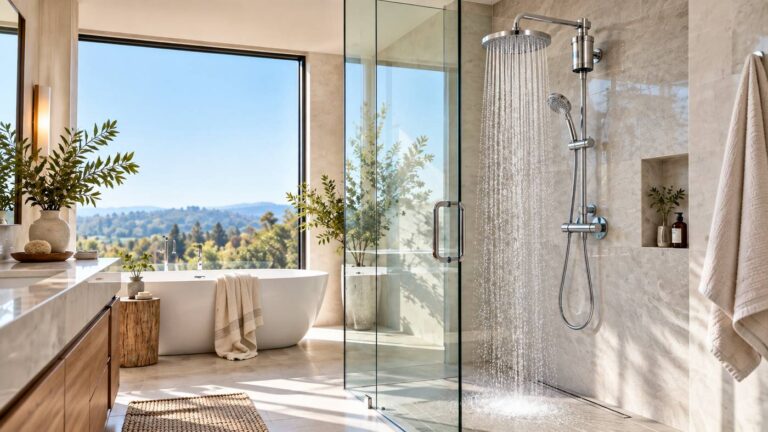
Multifamily Cabinets for Bathrooms
Bathroom cabinets face different conditions from kitchen cabinets.
Humidity and water exposure are greater concerns.
Vanity cabinets should be selected and installed to tolerate normal bathroom conditions.
Bathroom Cabinet Considerations
Look at:
• Moisture resistant finishes
• Durable edges
• Sink plumbing access
• Easy cleaning
• Drawer clearance
• Hardware corrosion resistance
• Countertop compatibility
Water leaks should still be repaired quickly.
No ordinary cabinet material should be expected to tolerate prolonged water exposure without damage.
Choosing Materials for Multifamily Cabinets
Cabinet construction can use several material types.
There is no single best material for every project.
Selection depends on budget, design, performance requirements, and supplier capabilities.
Plywood
Plywood uses layers of wood veneer bonded together.
It is often selected for cabinet boxes when buyers want strong construction and good fastener holding.
Cost varies depending on grade and specification.
Medium Density Fibreboard
Medium density fibreboard can provide a smooth surface that works well with painted finishes.
It is commonly used for cabinet doors and other components.
Moisture exposure should be controlled because prolonged water can damage many fibre based products.
Particleboard
Particleboard is widely used in manufactured cabinetry.
Quality varies.
Higher density engineered panels can perform well when correctly finished and protected from water.
The edge treatment and hardware connection are especially important.
Thermally Fused Surfaces
Factory applied decorative surfaces can provide consistent colour and easy cleaning.
These materials are commonly used for cabinet interiors and modern flat panel designs.
Painted Cabinets
Painted cabinetry can create a premium appearance.
However, paint finish quality matters.
Rental properties may require regular touch up work, so owners should consider how easily matching colours can be obtained.
Multifamily Cabinets and Door Styles
Door style changes the appearance of the entire kitchen.
Shaker Style
Shaker cabinets remain popular because they can work with both traditional and contemporary interiors.
The recessed panel design adds detail without excessive decoration.
Flat Panel
Flat panel doors create a cleaner modern appearance.
They are often easier to wipe because the surface contains fewer grooves.
Slab Wood Look
Wood look slab doors can add warmth while keeping a modern design.
This can work well in urban apartment developments and newer multifamily projects.
Selecting Cabinet Colours
Colour decisions should consider both appearance and maintenance.
White
White cabinetry creates a bright appearance.
It works well with many countertop and flooring options.
However, marks may be more visible.
Grey
Grey can provide a neutral modern look.
Different undertones can make grey feel warm or cool.
Wood Tones
Wood colours can create warmth and may hide minor everyday marks more effectively than some solid colours.
Dark Cabinets
Dark finishes can create a sophisticated look.
However, fingerprints, dust, and surface marks may become more noticeable depending on the finish.
Multifamily Cabinets and Countertop Coordination
Cabinets and countertops should be selected together.
The combination affects the entire kitchen design.
Consider:
• Colour contrast
• Edge details
• Cabinet strength
• Sink type
• Appliance colours
• Backsplash
• Flooring
• Wall paint
A visually balanced package can make a relatively simple kitchen feel more complete.
How Multifamily Cabinets Affect Construction Scheduling
Cabinet installation sits in the middle of several construction activities.
The schedule may depend on:
• Wall completion
• Flooring sequence
• Electrical work
• Plumbing rough in
• Appliance specifications
• Countertop templating
• Final plumbing
• Backsplash installation
Incorrect cabinet dimensions can delay several trades at once.
Verify Measurements Before Production
Field dimensions should be confirmed before final cabinet ordering when the project requires it.
Plans and actual construction can differ.
Verify:
• Wall lengths
• Ceiling height
• Appliance openings
• Plumbing locations
• Electrical outlets
• Door clearances
• Window positions
• Soffits
• Structural columns
Small errors can create large installation problems when repeated across many units.
Procurement Strategies for Multifamily Cabinets
Large cabinet orders require careful coordination.
Confirm Lead Times
Do not assume that standard cabinets are always immediately available.
Production schedules can change.
Plan Delivery by Building or Floor
Large projects may be easier to manage when cabinet deliveries are grouped by installation sequence.
This reduces onsite storage pressure.
Label Units Clearly
Cabinet packages should be easy to identify.
Labels can include:
• Building
• Floor
• Unit number
• Room
• Cabinet code
Clear identification reduces installation mistakes.
Keep Spare Components
Property owners may benefit from storing a limited number of commonly damaged items.
Possible spares include:
• Hinges
• Drawer slides
• Handles
• Doors
• Drawer fronts
• Shelf clips
The appropriate inventory depends on the project size.
Multifamily Cabinets and Accessibility
Some multifamily projects include accessible units.
These may require different cabinet layouts to support residents with mobility needs.
Design teams should coordinate cabinet dimensions with applicable accessibility requirements for the project.
Potential considerations include:
• Counter height
• Knee clearance
• Reach range
• Sink access
• Hardware usability
• Work surface access
Accessible cabinetry should be planned early rather than modified after installation.
Installing Multifamily Cabinets Correctly
Even high quality cabinets can perform poorly when installation is inaccurate.
Installers should verify:
• Level
• Plumb
• Secure wall fastening
• Door alignment
• Drawer alignment
• Appliance openings
• Countertop support
• Finished panel placement
• Hardware operation
A row of cabinets that is slightly out of level can create problems when countertops are installed.
Quality Control for Multifamily Cabinets
Large projects benefit from a repeatable inspection process.
Before accepting each unit, check:
• Cabinet finish
• Scratches
• Door alignment
• Drawer operation
• Hardware
• Shelf placement
• Fasteners
• Gaps
• End panels
• Countertop support
• Cleaning
Problems should be documented consistently.
Digital punch lists can make correction tracking easier.
Multifamily Cabinets During Unit Turnover
Cabinet maintenance should be part of turnover inspection.
Look for:
• Loose hinges
• Damaged doors
• Drawer problems
• Water damage
• Missing hardware
• Shelf damage
• Finish wear
• Sink leaks
• Cabinet movement
Small repairs completed during turnover can help prevent larger issues.
How to Extend the Life of Multifamily Cabinets
Property teams can protect cabinet investments with basic maintenance.
Fix Water Leaks Quickly
Water is one of the most common causes of cabinet damage.
Inspect under sinks during maintenance visits.
Adjust Hinges
Loose or misaligned doors can place additional stress on hardware.
Replace Damaged Hardware
A failing hinge or slide should be addressed before it damages the cabinet.
Use Compatible Cleaning Products
Harsh chemicals can affect some cabinet finishes.
Follow manufacturer care instructions.
Keep Replacement Records
Document part numbers and supplier details.
This makes future repairs easier.
Common Multifamily Cabinet Mistakes
Choosing Only by Initial Price
Low purchase cost can be attractive, but frequent repairs can increase long term expense.
Using Too Many Unique Sizes
Excessive customisation can complicate production and replacement.
Ignoring Hardware Quality
Cabinet boxes can remain intact while hinges and drawer slides fail.
Ordering Before Final Verification
Incorrect measurements can delay an entire installation sequence.
Selecting Trendy Finishes With Limited Availability
A highly specific colour may become difficult to match years later.
Forgetting Maintenance Needs
Property management teams should be able to obtain replacement parts easily.
How Multifamily Cabinets Can Support Property Value
Cabinetry does not determine property value by itself, but it contributes significantly to the appearance and usability of apartments.
Updated kitchens and bathrooms can influence:
• Leasing impressions
• Resident satisfaction
• Renovation quality
• Unit positioning
• Marketing photography
• Overall interior consistency
The most successful cabinet program supports both aesthetics and operations.
A visually attractive design that is difficult to repair may create unnecessary challenges.
Likewise, an extremely durable cabinet that feels outdated may reduce the appeal of renovated units.
Balance is essential.
Frequently Asked Questions
What are multifamily cabinets?
Multifamily cabinets are cabinetry systems designed or selected for apartment buildings, condominiums, student housing, build to rent communities, and other properties with multiple residential units.
What materials are best for multifamily cabinets?
Common options include plywood, engineered wood panels, medium density fibreboard, particleboard, and factory finished decorative surfaces. The best choice depends on budget, moisture exposure, hardware, construction quality, and expected use.
Why is standardisation important for multifamily cabinets?
Standard dimensions, finishes, and hardware can simplify installation, replacement parts, maintenance, unit turnovers, and future renovation planning.
Are shaker cabinets good for multifamily properties?
Shaker style doors can work well because their simple design suits many interiors. Flat panel doors may also be attractive where easier cleaning and a more contemporary appearance are priorities.
How long should multifamily cabinets last?
There is no universal lifespan. Durability depends on cabinet construction, hardware, installation, moisture exposure, resident use, cleaning, maintenance, and the quality of the original materials.
What should property managers inspect during cabinet turnover?
Inspect hinges, drawer slides, doors, shelves, finishes, water damage, sink areas, handles, alignment, and any signs that the cabinet box has become loose or damaged.
Conclusion
Multifamily cabinets should be selected as long term building components rather than simple decorative finishes. Durable construction, standard dimensions, reliable hardware, efficient storage, careful installation, and readily available replacement parts can make cabinetry easier to manage throughout the life of an apartment property. By balancing appearance with maintenance, procurement, and turnover needs, developers and property managers can create kitchens and bathrooms that remain attractive, functional, and practical across many residential units.