Computer vision development company: 3 Incredible Solutions for Unmatched Success
Visual data holds immense operational value for modern enterprises. However, extracting actionable insights from images and videos requires specialized artificial intelligence infrastructure. Partnering with a computer vision development company provides organizations with the custom algorithms and deep learning models necessary to automate visual tasks. Furthermore, these specialized firms bridge the gap between raw pixel data and intelligent business automation. Therefore, understanding the capabilities of these development partners helps enterprises deploy scalable, accurate visual recognition systems.
The Strategic Value of a computer vision development company
Off-the-shelf vision APIs offer basic functionality but fail to address complex, industry-specific visual challenges. A dedicated computer vision development company builds bespoke models trained on proprietary datasets tailored to the client exact operational environment. This custom approach ensures significantly higher accuracy and reliability. Furthermore, relying on generic APIs often creates data privacy risks, as sensitive visual data must be sent to third-party clouds. By developing custom, localized solutions, organizations maintain strict control over their proprietary visual data. Consequently, bespoke development provides both a competitive advantage and enhanced security posture.
Tailored Machine Learning Models in a computer vision development company
Building a production-ready vision model involves far more than training a basic neural network. It requires extensive data annotation, augmentation, and hyperparameter tuning. A computer vision development company employs specialized data scientists who understand the nuances of different architectures, such as Convolutional Neural Networks and Vision Transformers. They select the optimal architecture based on the specific use case, balancing accuracy with inference speed. Therefore, organizations receive models that perform reliably under real-world conditions, including varying lighting and complex backgrounds. Thus, tailored machine learning development ensures operational robustness.
Core Services Offered by a computer vision development company
A specialized development firm offers a comprehensive suite of services spanning the entire model lifecycle. From initial data pipeline architecture to final edge deployment, these firms handle the complex technical overhead required for AI implementation. By centralizing these services, a computer vision development company eliminates the need for enterprises to build expensive, in-house AI teams. Consequently, businesses can accelerate their time-to-market for intelligent visual applications.
Object Detection and Image Segmentation via a computer vision development company
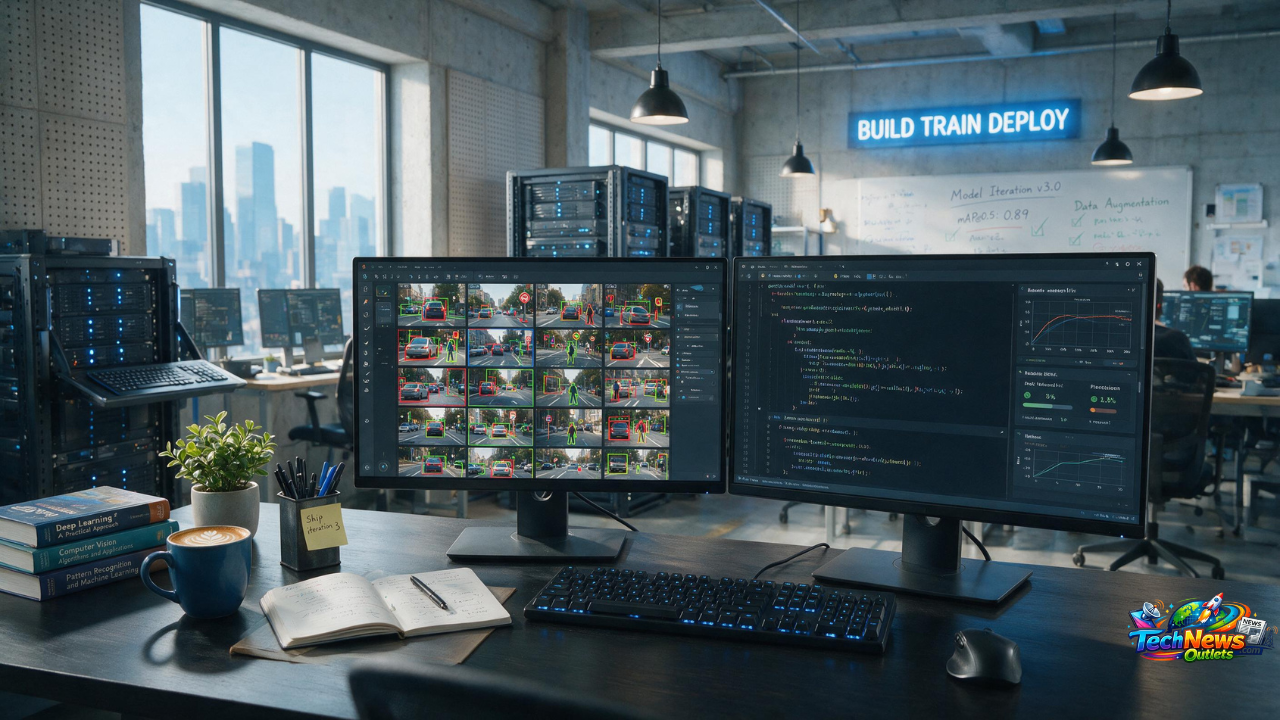
Object detection and image segmentation represent the most common services requested by enterprise clients. Object detection identifies and classifies multiple items within a single frame, drawing bounding boxes around them. This is crucial for retail inventory tracking or autonomous driving systems. Image segmentation takes this a step further by classifying every pixel in an image, outlining the exact shape of an object. A computer vision development company utilizes advanced frameworks like YOLO or Mask R-CNN to build these systems. Therefore, automated quality control can identify microscopic defects on a manufacturing line with pinpoint accuracy. Consequently, precise pixel-level analysis unlocks highly automated visual workflows.
Industry Applications for a computer vision development company
The versatility of visual AI allows it to be deployed across virtually every sector. From healthcare diagnostics to agricultural yield prediction, visual data is ubiquitous. A computer vision development company adapts its technical approach to meet the regulatory and operational demands of the specific industry. Therefore, an AI model deployed in a hospital must meet strict HIPAA compliance, while a model in a factory must withstand harsh industrial environments. Consequently, industry-specific expertise is a critical differentiator when selecting a development partner.
Manufacturing Quality Control and Defect Detection in a computer vision development company
Manufacturing relies heavily on visual inspection to ensure product quality. Human inspectors suffer from fatigue and inconsistency. A computer vision development company automates this process by installing high-resolution cameras along the production line paired with edge AI devices. The system analyzes every product in milliseconds, flagging anomalies like scratches, dents, or missing components. This automated defect detection drastically reduces waste and ensures only flawless products reach the market. Furthermore, the system collects data on defect types, providing valuable feedback to upstream manufacturing processes to correct the root cause. Thus, AI-driven quality control transforms manufacturing economics.
Overcoming Implementation Challenges in a computer vision development company
Deploying computer vision in the physical world presents unique engineering challenges. Lighting conditions change throughout the day, camera lenses get dirty, and network connectivity in remote areas can be unreliable. A professional computer vision development company anticipates these physical world variables during the architecture phase. They build resilient systems that function even when ideal conditions are not met. Therefore, successful deployment requires a deep understanding of both software engineering and physical hardware integration.
Edge AI and Real-Time Processing for a computer vision development company
Streaming high-definition video to the cloud for inference introduces unacceptable latency and consumes massive bandwidth. To solve this, a computer vision development company specializes in Edge AI. They optimize and compress deep learning models so they can run directly on small, low-power devices at the network edge. This localized processing ensures real-time decision making, which is critical for applications like autonomous robotics or security surveillance. Furthermore, edge processing keeps visual data on the local device, enhancing privacy and reducing cloud computing costs. Consequently, edge deployment is the standard for modern, scalable vision systems.
Choosing the Right computer vision development company
Selecting a technology partner for AI initiatives is a high-stakes decision. An ineffective model wastes capital and disrupts operations. Enterprises must look beyond marketing materials and rigorously evaluate the technical depth of potential partners. The right computer vision development company will have a proven track record of moving models from the laboratory into production environments. Therefore, buyers must scrutinize the vendor portfolio and ask for demonstrated case studies. Consequently, thorough due diligence secures a reliable long-term technology partnership.
Evaluating MLOps and Deployment Capabilities in a computer vision development company
Training an accurate model is only half the battle. Maintaining that accuracy over time requires robust Machine Learning Operations (MLOps). Real-world data drifts; a model trained on summer imagery will fail when winter lighting arrives. A reputable computer vision development company implements MLOps pipelines that monitor model performance in production and trigger automatic retraining when accuracy drops. Furthermore, they establish clear metrics for model lifecycle management, ensuring seamless updates without system downtime. Therefore, strong MLOps capabilities guarantee the AI system remains accurate and relevant years after initial deployment. Thus, operational maintenance is the true test of a competent AI developer.
The Future of a computer vision development company
The field of computer vision is advancing at a blistering pace, driven by breakthroughs in generative AI and unsupervised learning. A forward-thinking computer vision development company continuously integrates these advancements into its service offerings. The future will see vision systems that require far less labeled training data, utilizing synthetic data generation to train models in simulated environments. Therefore, the cost and time required to deploy custom vision systems will decrease significantly. Consequently, visual AI will become accessible to even the smallest enterprises.
Synthetic Data Generation and AI Advancements via a computer vision development company
Gathering and manually labeling thousands of images is the most expensive phase of AI development. To bypass this, a computer vision development company utilizes synthetic data. By creating highly realistic 3D virtual environments, developers can generate millions of perfectly labeled training images featuring various lighting conditions, object orientations, and backgrounds. This synthetic data trains robust models without the need for physical data collection campaigns. Furthermore, advancements in Vision Transformers are replacing traditional CNNs, offering better contextual understanding of complex scenes. Therefore, synthetic data and advanced architectures will drive the next generation of visual AI. Thus, partnering with an innovative development firm ensures enterprises leverage these cutting-edge methodologies.
FAQs
1. What does a computer vision development company do?
It builds custom AI models and software applications that analyze visual data to automate tasks like defect detection, facial recognition, and object tracking.
2. Why use a custom vision model instead of an off-the-shelf API?
Custom models offer higher accuracy for specific use cases, operate on edge devices without internet connectivity, and keep proprietary visual data secure.
3. What is Edge AI in computer vision?
Edge AI involves running machine learning models directly on local hardware devices rather than in the cloud, ensuring real-time processing and lower bandwidth usage.
4. How does a computer vision development company handle data privacy?
They utilize edge processing to keep data on-site, implement strict encryption protocols, and ensure compliance with regulations like GDPR or HIPAA.
5. What industries benefit most from computer vision?
Manufacturing, retail, healthcare, agriculture, and autonomous transportation heavily utilize visual AI for automation, quality control, and safety monitoring.
6. What is MLOps in computer vision?
MLOps involves the continuous monitoring, retraining, and deployment of AI models to ensure they maintain accuracy as real-world visual data changes over time.
Conclusion
Deploying artificial intelligence to interpret visual data requires specialized technical expertise that most enterprises lack internally. Partnering with a computer vision development company provides the necessary infrastructure to build, deploy, and maintain robust machine learning models tailored to specific operational needs. By leveraging custom architectures, edge AI processing, and rigorous MLOps pipelines, these firms transform raw visual data into powerful automation tools. Furthermore, as the industry shifts toward synthetic data and advanced transformer architectures, a dedicated development partner ensures organizations remain at the forefront of technological innovation. Ultimately, a computer vision development company turns the theoretical promise of visual AI into measurable, unmatched operational success.