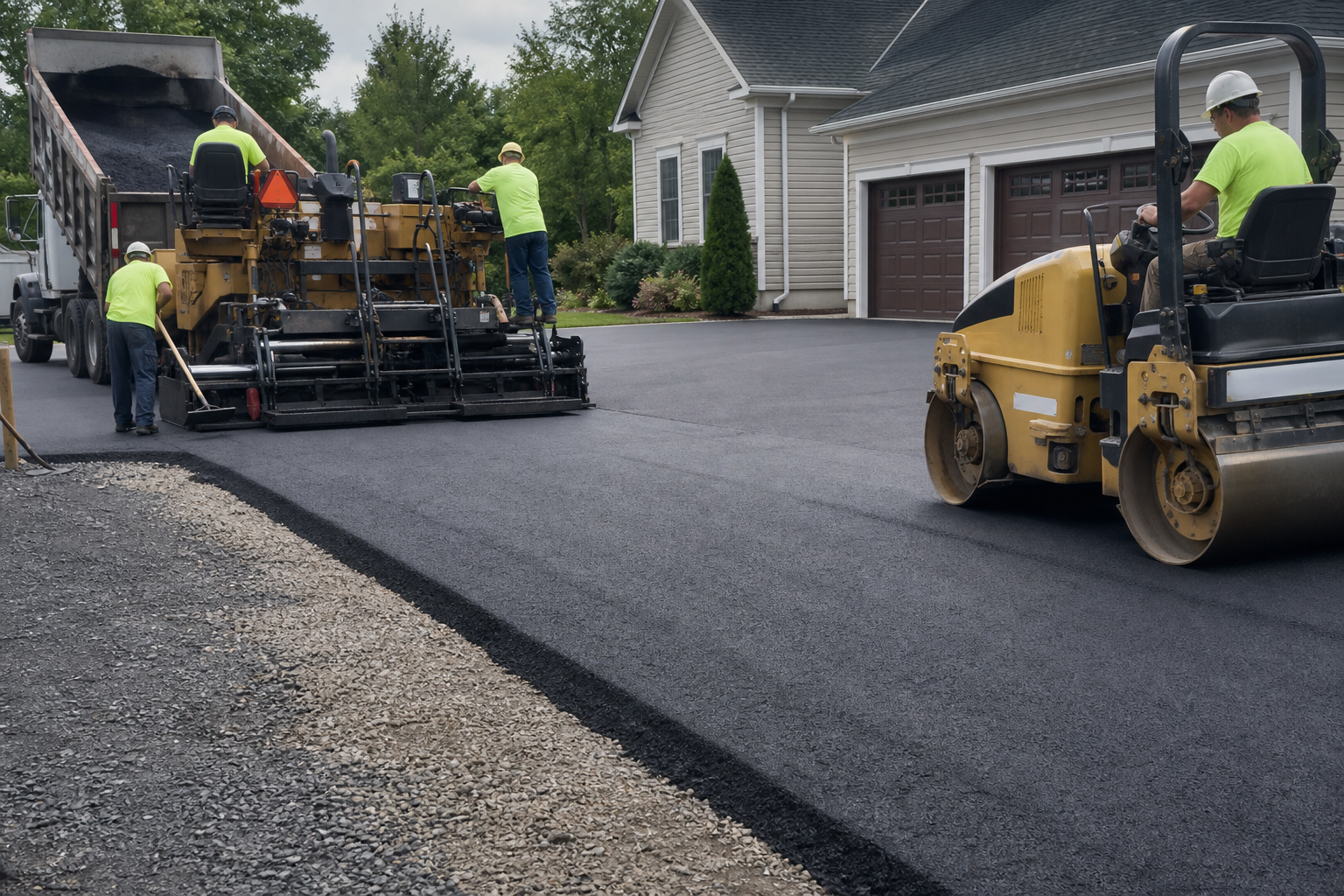
Asphalt Paving Guide: How Proper Installation Creates a Stronger, Longer Lasting Surface
Quality asphalt paving depends on much more than placing a layer of black material over the ground. Long term pavement performance starts with site evaluation, drainage, subgrade condition, aggregate base preparation, an appropriate asphalt mixture, suitable weather conditions, correct placement, and adequate compaction. Whether planning a residential driveway, commercial parking area, private road, or another paved surface, understanding these fundamentals can help property owners compare contractors, recognize weak proposals, and make maintenance decisions based on pavement condition rather than appearance alone.
What Is Asphalt Paving?
Asphalt paving is the process of constructing a pavement surface using asphalt mixture, generally consisting of aggregates such as crushed stone and sand combined with asphalt binder.
The precise mixture and pavement structure depend on the application, climate, anticipated traffic, underlying soils, and applicable specifications.
Asphalt is used extensively for roads, driveways, parking areas, pathways, and other transportation surfaces because it can provide a smooth, durable surface when properly designed and constructed.
The visible asphalt layer is only part of a pavement system.
Beneath it may be a prepared subgrade and one or more aggregate or asphalt base layers. These underlying components transfer loads and influence how well the finished pavement performs.
A high quality surface placed on unstable or poorly drained material can still fail prematurely.
9 Powerful Benefits of Asphalt Paving
Asphalt has several practical characteristics that make it suitable for many residential and commercial applications. Its performance, however, depends strongly on design, construction, traffic, climate, and maintenance.
1. A Smooth Driving and Walking Surface
Properly placed asphalt can create a relatively smooth and continuous surface.
This makes it suitable for vehicle access, parking, pedestrian paths, and other applications where an even pavement is desirable.
Surface smoothness depends on preparation and paving technique.
Uneven base material, poor grading, unsuitable equipment, or inconsistent compaction can produce depressions or irregularities that remain visible after construction.
2. Relatively Fast Installation
Asphalt projects can often be constructed more quickly than certain alternative pavement systems, although actual schedules vary by project.
Preparation typically requires excavation or grading, base work, drainage adjustments, asphalt placement, and compaction.
Weather can affect schedules considerably.
Rain, excessively cold conditions, site access, material supply, and project size can delay work.
A reputable contractor should explain when the new surface can accept foot traffic or vehicles based on the mixture, weather, pavement design, and project conditions.
3. Repairable Pavement Structure
One advantage of asphalt is that damaged areas can often be repaired without reconstructing the entire pavement.
Treatment can range from crack management to localized patching, milling and resurfacing, or complete reconstruction.
The correct method depends on the cause and depth of distress.
Simply covering a structural failure with new material will not necessarily solve the underlying problem.
4. Flexible Pavement Characteristics
Asphalt is categorized as a flexible pavement system.
Loads are distributed through pavement layers to the underlying foundation.
Pavement thickness and base design need to match expected traffic.
A residential driveway carrying passenger vehicles has very different structural demands from a loading area regularly used by heavy trucks.
Asphalt Paving Thickness and Structural Design
There is no universal asphalt thickness suitable for every property.
Appropriate design depends on:
• Subgrade strength
• Aggregate base
• Vehicle type
• Traffic frequency
• Climate
• Drainage
• Asphalt mixture
• Local specifications
Commercial or heavy duty applications may warrant engineering input rather than relying on a standard residential specification.
5. Strong Visual Appearance
New asphalt provides a dark, relatively uniform surface that can give driveways and commercial properties a clean appearance.
Markings can also be applied where parking layouts, accessible spaces, traffic directions, or other controls are required.
Appearance should not be used as the sole measure of quality.
A newly installed pavement can look excellent while concealing inadequate base preparation or poor compaction.
6. Practical Maintenance Options
Asphalt pavement can be maintained through a combination of drainage management, crack treatment, surface treatments where appropriate, patching, and periodic rehabilitation.
Maintenance should respond to actual pavement condition.
Applying products merely because a calendar interval has passed can create unnecessary cost.
Regular inspection helps identify small problems before they develop into larger failures.
7. Recyclability of Asphalt Materials
Reclaimed asphalt pavement, commonly called RAP, is widely reused in pavement applications.
Recovered material can be processed and incorporated into new asphalt mixtures under appropriate specifications.
Actual recycled content and environmental impact depend on the mixture, production process, transportation, project design, and local practices.
Sustainability claims should therefore be specific rather than assuming all asphalt projects have identical environmental performance.
8. Suitability for Multiple Property Types
Asphalt can be used for numerous applications, including:
• Residential driveways
• Parking lots
• Private roads
• Commercial access areas
• Paths
• Industrial facilities
• Municipal roadways
Each use requires an appropriate pavement design.
A contractor experienced primarily with small driveways may not necessarily have the equipment or engineering capability required for a large commercial pavement.
9. Potentially Cost Effective Lifecycle Management
Initial construction price is only one part of pavement cost.
A well designed asphalt surface can often be repaired, resurfaced, or rehabilitated as conditions change.
This can provide useful lifecycle options.
However, no contractor can responsibly guarantee a universal service life without considering traffic, climate, construction, drainage, materials, and maintenance.
How the Asphalt Paving Process Works
Understanding the basic construction sequence makes it easier to evaluate contractor proposals and monitor a project.
Site Inspection and Planning
A contractor should first assess existing conditions.
This can include current pavement, soil, drainage, slopes, structures, utilities, access, and expected vehicle use.
For replacement projects, visible surface damage can provide clues about underlying problems.
Repeated cracking or depressions may indicate issues below the asphalt layer.
Excavation and Removal
Where reconstruction is required, existing pavement and unsuitable underlying materials may need removal.
Excavation depth depends on pavement design and existing conditions.
Removed asphalt can often enter recycling streams where local facilities and specifications allow.
Subgrade Preparation
The subgrade is the soil foundation beneath the pavement structure.
Weak, wet, unstable, or poorly compacted subgrade can contribute to later pavement distress.
Why Asphalt Paving Subgrade Preparation Matters
Subgrade preparation may involve grading, compaction, removal of unsuitable soil, stabilization, or other measures depending on conditions.
The goal is to establish a reasonably uniform and stable foundation consistent with the pavement design.
Skipping necessary subgrade work to lower the initial price can undermine the layers placed above it.
Asphalt Base Preparation
An aggregate base can provide structural support and contribute to drainage depending on design and materials.
The base needs appropriate gradation, thickness, placement, and compaction.
Aggregate Selection
Crushed aggregate used beneath asphalt should meet suitable specifications for the project.
Particle size distribution influences compaction and structural behavior.
Random fill material should not automatically be treated as equivalent to engineered pavement aggregate.
Base Compaction
Loose base material needs to be compacted appropriately.
Compaction reduces voids and helps establish a stable supporting layer.
Equipment should match the material, layer thickness, and size of the project.
Asphalt Paving Base Problems to Avoid
Potential problems include:
• Insufficient base depth
• Poorly graded material
• Inadequate compaction
• Trapped water
• Weak subgrade
• Improper slopes
• Contaminated aggregate
• Uncorrected soft areas
Quality contractors address these conditions before asphalt placement.
Drainage and Asphalt Paving
Water is a major factor in pavement performance.
Pavement should be graded so water moves toward an appropriate drainage location rather than remaining in depressions or infiltrating vulnerable areas.
Surface Drainage
Proper slopes help move rainfall away from the pavement.
Exact grades depend on site conditions, accessibility requirements, surrounding elevations, and drainage infrastructure.
A contractor should plan drainage before paving starts.
Trying to solve serious drainage problems after the asphalt is installed can require expensive corrections.
Subsurface Water
Some sites have water issues that surface grading alone cannot solve.
Groundwater, springs, poorly draining soils, or runoff from adjacent areas can affect pavement foundations.
An engineer or drainage specialist may be appropriate for complex locations.
Asphalt Paving Around Buildings and Garages
Pavement grading should not direct water toward building foundations or other vulnerable structures.
Garage transitions also need careful attention to elevation and water movement.
Local building and drainage requirements should be incorporated into the design.
Asphalt Paving Installation and Compaction
Once the foundation is ready, hot asphalt mixture is transported to the site, placed, and compacted.
Temperature matters throughout this process because asphalt becomes more difficult to compact as it cools.
Asphalt Placement
Larger projects typically use paving machines to distribute material at a controlled thickness and profile.
Small or difficult areas may require additional handwork.
Joints between paving passes and transitions to existing surfaces require careful construction.
Asphalt Compaction
Rollers compact the freshly placed asphalt to achieve the density and smoothness required by the project specifications.
Undercompaction can leave excessive air voids and reduce pavement durability.
Excessive or poorly timed rolling can create other problems.
Weather Conditions for Asphalt Paving
Air temperature, surface temperature, wind, pavement thickness, mixture temperature, and haul time all influence the available compaction window.
Contractors should follow appropriate specifications and material guidance for the project.
Paving during unsuitable conditions merely to maintain a schedule can compromise results.
Residential Asphalt Driveways
Driveways may appear simple, but successful construction still requires proper drainage and foundation work.
Driveway Edge Support
Asphalt edges can be vulnerable because they lack lateral support.
Adjacent soil, aggregate shoulders, curbing, or other appropriate details may help support pavement edges depending on design.
Heavy vehicles should avoid unsupported edges.
Garage and Road Connections
Transitions should be smooth enough for vehicles while maintaining proper drainage.
A significant elevation difference can cause scraping or water problems.
Asphalt Paving for New Driveways
A new driveway project should address:
• Required excavation
• Subgrade condition
• Base thickness
• Asphalt thickness
• Drainage
• Width
• Edge treatment
• Road connection
• Garage transition
• Expected vehicle loads
Local permits or right of way requirements may apply, especially where a driveway connects with a public roadway.
Commercial Asphalt Paving
Parking lots and commercial pavements typically require more detailed planning than residential driveways.
They may experience delivery trucks, waste collection vehicles, buses, or other heavy loads.
Traffic and Load Considerations
Heavy vehicles can create substantial pavement stresses.
Loading zones and refuse collection areas may require a different pavement section from ordinary passenger vehicle parking spaces.
Engineering design may be appropriate for large or heavily loaded sites.
Parking Lot Layout
Commercial paving can involve striping, accessible parking, pedestrian routes, curbs, signs, drainage structures, wheel stops, and traffic circulation.
Applicable accessibility and local design requirements must be considered.
Commercial Asphalt Paving Project Planning
Business owners should coordinate paving with customer access, employee parking, deliveries, emergency access, and curing or reopening requirements.
Phased construction can sometimes keep part of a property operational while work proceeds elsewhere.
Asphalt Paving Costs
There is no single accurate cost per square foot or square metre for all asphalt paving projects.
Local material pricing, labor, fuel, site conditions, pavement design, and project scale all influence pricing.
Factors Affecting Asphalt Paving Cost
Major factors include:
• Pavement area
• Excavation requirements
• Existing surface removal
• Subgrade repairs
• Base depth
• Asphalt thickness
• Mix specification
• Drainage work
• Accessibility
• Equipment mobilization
• Traffic requirements
• Geographic location
Small projects can have higher unit costs because equipment mobilization is distributed across less pavement area.
New Pavement vs Overlay Cost
An overlay places new asphalt over an existing pavement after suitable preparation.
It can cost less than complete reconstruction because substantial foundation work may remain in place.
However, an overlay is only appropriate when underlying conditions are suitable.
Comparing Asphalt Paving Quotes
Ask contractors to specify:
• Excavation depth
• Base material and thickness
• Asphalt mixture
• Compacted asphalt thickness
• Number of lifts where relevant
• Drainage work
• Edge details
• Removal and disposal
• Warranty
• Payment schedule
Quotes describing only the total area and price provide limited insight into what will actually be constructed.
Asphalt Overlay vs Complete Replacement
Choosing between resurfacing and reconstruction requires an assessment of pavement distress.
When an Overlay May Be Appropriate
An overlay may be considered where the existing pavement retains adequate structural support and damage can be addressed through preparation and resurfacing.
Cracks and localized failures still require appropriate treatment beforehand.
Existing drainage and elevations must also accommodate the added pavement thickness.
When Reconstruction May Be Necessary
Widespread structural failure, severe base problems, drainage issues, substantial deformation, or unsuitable pavement elevations may justify reconstruction.
Removing the old pavement allows underlying problems to be addressed.
Why Asphalt Paving Over Failed Pavement Can Be Risky
New asphalt does not eliminate movement or structural defects below it.
Existing cracking and instability can eventually affect the new surface.
A contractor should explain why an overlay is technically appropriate rather than recommending it simply because it is cheaper.
Asphalt Repair Options
Damage should be diagnosed before selecting a repair.
Different crack patterns can indicate different underlying mechanisms.
Crack Repair
Certain cracks can be cleaned and sealed or filled using products suitable for the specific condition.
Crack treatment can help limit water intrusion but does not restore a failed structural base.
Asphalt Patching
Patching removes or repairs localized failed areas.
A more substantial repair may require cutting out damaged pavement, correcting the base, and placing new asphalt.
Pothole Repairs
Potholes often involve deterioration extending below the visible surface.
Temporary patch products can restore usability in some circumstances, but permanent repair should address failed material and underlying causes where possible.
When Asphalt Paving Repair Is Not Enough
If failures are widespread throughout the pavement, repeated localized patches can become inefficient.
At that point, resurfacing or reconstruction may provide a more appropriate lifecycle solution.
A pavement professional can evaluate the overall condition.
Asphalt Sealcoating and Surface Treatments
Sealcoating is commonly marketed for asphalt driveways and parking areas.
It is a surface treatment, not a structural repair.
What Sealcoating Can and Cannot Do
A suitable coating can change surface appearance and provide certain surface protection depending on the product.
It cannot correct base failure, major depressions, severe alligator cracking, or substantial structural damage.
Those conditions require other repairs.
Timing Surface Treatments
Fresh asphalt should not automatically be coated immediately.
Product manufacturers and paving professionals provide recommendations regarding pavement condition and appropriate timing.
Avoiding Asphalt Paving Maintenance Myths
More frequent sealcoating is not necessarily better.
Excessive coating can create buildup and other surface concerns.
Maintenance decisions should reflect pavement condition, traffic, climate, and product specifications.
How Long Does Asphalt Paving Last?
No universal pavement lifespan can be promised.
Service life is influenced by initial design, materials, installation quality, base condition, traffic, climate, drainage, utility work, and maintenance.
A lightly used residential driveway and a truck loading area will age differently.
Extending Pavement Service Life
Useful practices include:
• Maintain drainage
• Address significant cracks appropriately
• Repair localized failures
• Prevent persistent standing water
• Avoid unsupported edge loading
• Clean damaging spills when appropriate
• Monitor heavy vehicle use
• Follow evidence based maintenance practices
Regular inspection makes it easier to identify changing conditions.
Asphalt Paving in Hot and Cold Climates
Climate influences materials, construction, and pavement behavior.
Hot Weather Considerations
High pavement temperatures can soften asphalt and contribute to deformation under heavy loads where pavement design or materials are inadequate.
Mixture selection should reflect climate and traffic.
Cold Weather Considerations
Cold climates introduce freeze and thaw cycles that can affect pavement, particularly where water penetrates the pavement structure.
Good drainage remains fundamental.
Climate Appropriate Asphalt Paving
Experienced local contractors should understand materials and construction practices suitable for regional conditions.
Government transportation agencies and recognized asphalt industry guidance can also provide technical specifications relevant to particular climates.
Sustainable Asphalt Paving Considerations
Environmental performance can be improved through appropriate recycling, material selection, efficient transport, durable design, and maintenance.
Reclaimed Asphalt Pavement
RAP can replace portions of virgin aggregate and binder in suitable mixtures.
Allowable quantities and mixture designs depend on specifications and performance requirements.
Higher recycled content is not automatically better if it results in inappropriate pavement performance.
Warm Mix Asphalt
Warm mix technologies can allow asphalt production and placement at lower temperatures than conventional hot mix processes in suitable applications.
Potential benefits can include lower production energy requirements and reduced emissions during manufacture, depending on technology and circumstances.
How to Choose an Asphalt Paving Contractor
A paving project is difficult and expensive to correct after poor installation.
Contractor selection deserves careful attention.
Verify Credentials
Check business licensing where required, insurance, relevant experience, and local reputation.
Ask for examples of comparable completed projects.
Commercial property owners may also need contractors capable of meeting project specific bonding, safety, or specification requirements.
Ask About Equipment and Crews
Good paving requires suitable equipment and personnel.
Ask whether the company performs the work itself or subcontracts significant portions.
Understand who is responsible for excavation, drainage, paving, and final quality control.
Questions to Ask an Asphalt Paving Contractor
Before signing a contract, ask:
• How will the subgrade be evaluated?
• What base material will be used?
• What compacted base depth is specified?
• What asphalt mixture is proposed?
• What compacted pavement thickness is included?
• How will drainage be handled?
• How will edges be supported?
• Who performs the work?
• What warranty is provided?
• What is excluded from the price?
• How are unexpected subgrade problems priced?
• When can the pavement be used?
Put important specifications in the written contract.
Asphalt Paving Red Flags
Be cautious when contractors provide little written detail or pressure homeowners into immediate decisions.
Unsolicited offers claiming to have leftover asphalt from another job also warrant careful scrutiny, particularly when the contractor cannot provide verifiable credentials or a detailed contract.
Other warning signs include:
• No verifiable business information
• Requests for unusually large cash payments upfront
• No proof of required insurance
• Refusal to specify thicknesses
• Little discussion of drainage
• No explanation of base preparation
• Vague warranties
• Pressure to decide immediately
Contract requirements and consumer protections vary by jurisdiction, so property owners should check local rules.
Maintaining New Asphalt Pavement
Once construction is complete, follow contractor and material recommendations before allowing normal traffic.
Avoid making deep indentations or placing concentrated loads on pavement before it is ready.
The contractor should provide maintenance and use guidance appropriate to the project.
Inspect Drainage After Rain
Rainfall provides a useful opportunity to observe drainage.
Some temporary surface moisture is normal, but persistent deep ponding may indicate grading concerns.
Raise significant issues with the contractor promptly.
Protect Pavement Edges
New driveway edges can be susceptible to damage from vehicles that drive off the paved area.
Appropriate edge support and careful use can help protect them.
Ongoing Asphalt Paving Maintenance
Inspect the pavement periodically and after severe weather.
Look for changing cracks, depressions, edge failure, drainage problems, vegetation intrusion, or localized surface deterioration.
Early evaluation can prevent a small issue from being ignored until it requires more substantial work.
Frequently Asked Questions
What is asphalt paving?
Asphalt paving constructs a flexible pavement using asphalt mixture over a properly prepared foundation. Performance depends on subgrade, base, drainage, mixture, thickness, placement, and compaction.
How much does asphalt paving cost?
Cost varies by project size, excavation, base work, asphalt thickness, drainage, accessibility, material prices, traffic requirements, and location. Detailed local quotes are most reliable.
How long does asphalt paving last?
There is no fixed lifespan. Traffic, climate, drainage, structural design, installation quality, maintenance, and underlying soil conditions all influence pavement longevity.
What is the best thickness for asphalt paving?
There is no universal best thickness. Pavement structure should be selected according to subgrade, base, vehicle loads, traffic frequency, climate, and project specifications.
Can new asphalt be installed over old asphalt?
Sometimes. An overlay may be appropriate when the existing pavement and foundation remain structurally suitable, but significant base failure or drainage problems may require reconstruction.
How do I choose an asphalt paving contractor?
Compare experience, credentials, insurance, detailed specifications, base preparation, drainage plans, compacted thickness, materials, warranties, and comparable completed projects.
Conclusion
Asphalt paving performs best when the entire pavement structure is designed and constructed correctly, not simply when the finished surface looks smooth. Stable subgrade, quality aggregate base, effective drainage, an appropriate asphalt mixture, proper thickness, and controlled compaction all contribute to long term performance. By comparing detailed contractor proposals and maintaining the pavement according to its actual condition, property owners can make better decisions about installation, repair, and future rehabilitation.