Belt Tensioner: 7 Warning Signs You Should Never Ignore
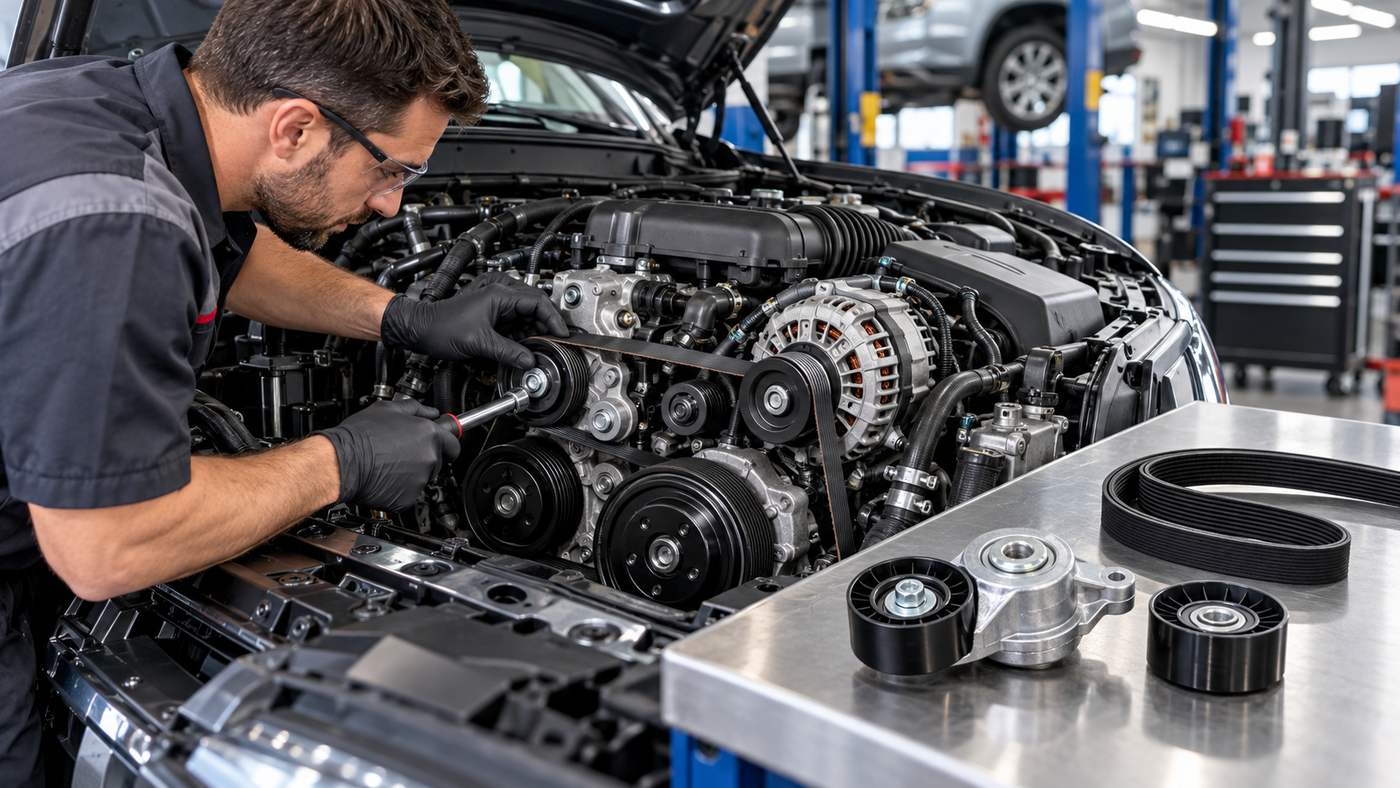
A belt tensioner is a critical part of the accessory drive system because it maintains the correct pressure on the serpentine or accessory belt as the engine operates. If the tensioner becomes weak, misaligned, noisy or seized, the belt may slip, track incorrectly or fail to drive important components such as the alternator, air-conditioning compressor and, on some engines, the water pump or power-steering system. Gates explains that an automatic tensioner continuously adjusts belt tension while also helping damp vibration and changing loads during engine acceleration and deceleration.
Because a tensioner usually works quietly in the background, many drivers do not think about it until a squealing belt or unusual pulley noise appears.
Ignoring those symptoms can result in more than an annoying sound.
A worn tensioner can shorten belt life and place additional stress on other components in the drive system. Dayco specifically identifies noise, poor belt tracking, loss of tension, rough tensioner movement and physical damage among the common signs that a tensioner needs attention.
Here are seven warning signs to understand before a relatively small belt-drive problem becomes a larger repair.
What Does a Belt Tensioner Do?
Most modern accessory-drive systems use one long serpentine belt routed around several pulleys.
Depending on the vehicle, that belt may help drive components such as:
- Alternator
- Air-conditioning compressor
- Water pump
- Power-steering pump
- Other engine accessories
The tensioner keeps the belt tight enough to transfer power without slipping.
An automatic tensioner normally combines several components:
- Spring mechanism
- Pivoting arm
- Pulley
- Pulley bearing
- Damping mechanism
Gates states that the tensioner supplies consistent pressure to the belt and helps absorb vibration and peak loads throughout changing engine conditions.
If that pressure becomes too low, the belt can slip.
If the tensioner pulley or pivot becomes misaligned, the belt can move sideways.
If a bearing begins failing, it can produce noise, heat or resistance.
This is why tensioner problems often appear to be belt problems at first.
1. Belt Tensioner Squealing or Chirping Noise
One of the most common warning signs is unusual noise from the front of the engine.
Possible sounds include:
- Squealing
- Chirping
- Rattling
- Grinding
- Whining
However, noise alone does not prove that the tensioner is defective.
A similar sound can come from:
- Serpentine belt
- Idler pulley
- Alternator bearing
- A/C compressor pulley
- Water-pump bearing
That is why diagnosis matters.
Squealing Can Indicate Low Belt Tension
Dayco notes that belt squealing can indicate tension loss. If the tensioner spring has weakened, the belt may not maintain sufficient contact with the accessory pulleys.
A slipping belt generates:
- Friction
- Heat
- Noise
Continued slipping can accelerate belt wear.
Bearing Noise Is Different
A failing tensioner pulley bearing may produce:
- Growling
- Grinding
- Rumbling
Dayco recommends checking pulley rotation when the belt is removed. Roughness, resistance or abnormal free spinning can indicate pulley-bearing problems.
A technician can often isolate pulley noise more accurately once belt tension has been released safely.
2. Serpentine Belt Is Tracking Off Center
A properly operating belt should generally run correctly along its designed pulley path.
If it begins riding:
- Close to one edge
- Partly off a pulley
- At an obvious angle
there may be an alignment problem.
Dayco identifies off-center belt tracking as a warning sign of tensioner bushing wear and tensioner misalignment.
Why Alignment Is Important
A serpentine belt has several ribs designed to fit matching grooves.
If the belt runs at an angle, it can develop:
- Frayed edges
- Uneven rib wear
- Noise
- Premature failure
In severe cases, the belt can come completely off the pulley system.
Do Not Automatically Blame the Belt
Installing a new belt will not permanently fix a misaligned tensioner.
The replacement belt may simply develop the same problem.
Check:
- Tensioner alignment
- Idler pulleys
- Accessory pulleys
- Brackets
- Belt routing
Gates notes that squeal, vibration and excessive belt wear can frequently be traced back to a worn or failing tensioner.
3. Belt Tensioner Arm Is Moving Excessively
An automatic tensioner arm does not remain completely motionless while the engine is running.
Some movement can be normal because engine speed and accessory loads constantly change.
However, excessive bouncing or vibration may indicate a problem.
Possible Causes Include
- Weak tensioner spring
- Worn tensioner damping mechanism
- Misaligned belt
- Damaged pulley
- Accessory drive problem
Gates notes that excessive tensioner arm movement or bounce can cause fluctuations in belt tension and contribute to accessory-system problems.
Why Excessive Movement Matters
A tensioner must control changing belt loads.
If it cannot stabilize the belt effectively, tension can repeatedly increase and decrease.
That can affect:
- Belt life
- Bearings
- Pulley alignment
- Accessory performance
Excessive movement should therefore be diagnosed rather than dismissed as normal engine vibration.
4. Tensioner Pulley Feels Rough or Wobbles
The pulley mounted on the tensioner contains a bearing.
Like other bearings, it wears.
With the engine switched off, cold and the belt safely removed, a technician can inspect the tensioner pulley for abnormal movement.
Warning Signs Include
- Rough rotation
- Grinding sensation
- Side-to-side looseness
- Visible wobble
- Bearing noise
Dayco recommends replacing tensioner components when a pulley bearing feels rough or shows runout or wobble.
A Seized Pulley Can Damage the Belt Quickly
If the bearing becomes severely damaged, the pulley may stop rotating correctly.
The moving belt can then slide across a nearly stationary pulley.
This generates significant:
- Friction
- Heat
and can damage the belt very quickly.
If burning rubber, smoke or extreme belt noise appears, stop the engine safely and have the accessory-drive system inspected.
5. Belt Tension Has Become Too Weak
The spring inside an automatic tensioner is designed to maintain pressure throughout the belt’s operating life.
Eventually, internal components can wear.
When spring force becomes insufficient, the belt can begin slipping.
Gates describes the tensioner as a wear component rather than a permanent hard part and warns that internal wear can affect the belt and connected accessories.
Symptoms of Low Belt Tension
Possible signs include:
- Belt squealing
- Poor accessory performance
- Belt flutter
- Excessive tensioner movement
- Premature belt wear
Charging Problems Can Sometimes Be Related
The alternator relies on the drive belt for mechanical power.
If belt tension is insufficient and the belt slips significantly, alternator speed may be affected.
However, a charging problem has many possible causes.
Do not replace a tensioner solely because the battery warning light appears.
A proper charging-system diagnosis should still be performed.
6. The Tensioner Sticks or Moves Roughly
When belt tension is released for service, an automatic tensioner arm should generally move smoothly through its designed travel.
It should not feel:
- Notchy
- Jerky
- Stuck
- Rough
Dayco lists sticking or notchy tensioner movement as a replacement warning sign.
Gates similarly advises checking the arm throughout its range of motion with the engine off and cold. Sticking or roughness can indicate wear in the tensioner bearing surfaces.
Never Force a Tensioner
Automatic tensioners are spring-loaded.
Incorrect tool placement or sudden release can cause injury.
Use:
- Correct tool
- Proper release point
- Manufacturer procedure
If you are unfamiliar with the system, professional installation is the safer choice.
7. Physical Damage Is Visible
Sometimes the problem can be seen without complicated diagnosis.
Inspect the tensioner for:
- Cracks
- Broken stops
- Metal-to-metal contact
- Damaged mounting points
- Severe corrosion
- Loose pulley
Dayco specifically identifies metal-to-metal contact and broken or cracked tensioner stops as indications of tensioner wear or failure.
A physically damaged tensioner should not be expected to maintain accurate belt control.
Automatic Belt Tensioner vs Manual Tensioner
Not every engine uses the same system.
Automatic Belt Tensioner
An automatic unit uses spring force to continuously maintain tension.
Advantages include:
- Automatic adjustment
- Consistent pressure
- Compensation for normal belt changes
Dayco notes that automatic systems do not require manual belt-tension adjustment because the correctly designed tensioner supplies the necessary force.
Manual Belt Adjustment
Some engines or older accessory systems use a fixed or adjustable accessory position.
In those applications, belt tension may need to be set manually to a specified value.
Too loose can cause slipping.
Too tight can place excessive stress on:
- Bearings
- Accessory shafts
Always follow the exact manufacturer specification.
Belt Tensioner vs Idler Pulley
These two parts are frequently confused.
Tensioner Pulley
The tensioner pulley is attached to the tensioner mechanism and helps maintain belt tension.
Idler Pulley
An idler generally redirects the belt so that it follows the proper route around the engine accessories.
Both contain bearings.
Both can:
- Wear
- Make noise
- Seize
A noisy pulley therefore needs to be correctly identified before parts are ordered.
What Happens When a Belt Tensioner Fails Completely?
The consequences depend heavily on the vehicle.
If belt tension disappears, the serpentine belt may:
- Slip
- Come off
- Break
Accessories driven by that belt can then stop working.
Potential effects may include loss of:
- Alternator charging
- Air conditioning
- Hydraulic power steering on vehicles using a belt-driven pump
On engines where the serpentine belt drives the water pump, cooling may also be affected.
The exact accessory layout differs by engine, so vehicle-specific service information matters.
Can a Bad Belt Tensioner Damage the Alternator?
It can contribute to problems within the accessory-drive system.
Gates explains that improper belt tension can create stress on components including the alternator, water pump and A/C compressor.
However, an alternator can fail independently for many reasons.
If a replacement alternator repeatedly develops:
- Bearing noise
- Belt problems
- Pulley issues
the complete belt-drive system should be inspected rather than repeatedly replacing the alternator alone.
Can a Bad Tensioner Damage a New Serpentine Belt?
Yes.
Installing a new belt onto a defective tensioner can shorten belt life.
Possible problems include:
- Slipping
- Edge wear
- Heat
- Misalignment
Gates recommends viewing belts, pulleys and tensioners as interacting system components rather than diagnosing each part in isolation.
This is especially important when the old belt failed unusually early.
When Should a Belt Tensioner Be Replaced?
There is no universal replacement mileage for every vehicle.
Follow the maintenance guidance for the specific:
- Make
- Model
- Engine
- Belt-drive design
Gates has historically recommended inspecting serpentine-drive components around 60,000 miles and replacing worn components by about 90,000 miles, while also emphasizing manufacturer-specific recommendations.
Mileage should not be treated as the only factor.
Replacement may be needed earlier if inspection finds:
- Bearing damage
- Weak tension
- Misalignment
- Rough movement
- Physical damage
Should You Replace the Belt and Tensioner Together?
Not automatically in every case, but it is often sensible to inspect the entire system at the same time.
If the belt is already removed, check:
- Belt condition
- Tensioner
- Idler pulleys
- Accessory pulley bearings
- Alignment
Dayco recommends system-level inspection because tensioners and other front-of-engine drive components experience wear together.
A good serpentine belt installed onto a failing pulley does not solve the underlying problem.
How to Choose the Correct Belt Tensioner
A tensioner must match the exact engine configuration.
Do not order one simply because it looks similar.
Check:
- Vehicle year
- Manufacturer
- Model
- Engine size
- Engine code where relevant
- Part number
Compare the Pulley
Different tensioners can have different:
- Pulley diameter
- Pulley width
- Grooved or smooth surfaces
- Mounting positions
For example, Gates’ current DriveAlign catalog shows tensioners with different pulley diameters, widths and materials depending on application.
Prefer Correct Fit Over Lowest Price
A poorly matched tensioner can create:
- Incorrect alignment
- Improper belt pressure
- Noise
Use a reputable application catalog or VIN-based lookup where available.
Belt Tensioner Replacement Basics
The exact procedure varies significantly by vehicle.
A typical accessory-drive repair may involve:
- Recording belt routing
- Releasing tension safely
- Removing serpentine belt
- Removing the old tensioner
- Comparing replacement parts
- Installing to manufacturer torque specifications
- Routing the belt correctly
- Releasing the tensioner slowly
- Verifying alignment
Take a Belt Routing Photo
Before removal, photograph the original belt routing if the diagram is not clearly available.
An incorrectly routed serpentine belt may:
- Drive an accessory backward
- Miss a pulley
- Create noise
- Fail quickly
Dayco warns that an incorrectly installed belt can generate noise and cause permanent rib damage.
Should You Use Belt Dressing?
Belt dressing should not be used as a substitute for diagnosing a noisy modern serpentine system.
Dayco specifically advises against trying to solve serpentine belt problems with belt dressing.
If a belt is squealing, determine whether the cause is:
- Tension loss
- Contamination
- Misalignment
- Bearing failure
- Belt wear
Masking the noise does not correct the mechanical cause.
Check for Oil or Coolant Contamination
A tensioner may be working correctly while the belt itself is contaminated.
Leaks from nearby engine components can expose the serpentine belt to:
- Engine oil
- Coolant
- Power-steering fluid
Dayco notes that petroleum-based contamination can weaken an EPDM drive belt and contribute to swelling and noise.
If contamination is present, repair the leak before installing a new belt.
Otherwise, the replacement can quickly develop the same problem.
Common Belt Tensioner Buying Mistakes
Ordering by Vehicle Model Without Engine Size
One model may have several engine options with different belt-drive systems.
Replacing Only the Pulley Without Diagnosis
Sometimes the pulley is the only failed component.
Other times the tensioner spring or pivot is worn.
Identify the actual problem.
Buying the Cheapest Available Part
The tensioner continuously controls a fast-moving belt.
Fit, spring calibration, bearing quality and damping matter.
Ignoring Belt Alignment
A new tensioner should leave the belt correctly aligned.
Reusing a Severely Damaged Belt
If the belt has:
- Frayed edges
- Missing ribs
- Oil contamination
replace it as required rather than reinstalling a compromised component.
Frequently Asked Questions
What does a belt tensioner do?
A belt tensioner maintains proper pressure on the serpentine or accessory belt so it can drive engine accessories without excessive slipping, vibration or misalignment.
What are the symptoms of a bad belt tensioner?
Common symptoms include squealing, rattling, off-center belt tracking, weak tension, excessive arm movement, rough pulley bearings and sticking tensioner movement.
Can I drive with a bad belt tensioner?
Continuing to drive can risk belt failure and loss of belt-driven accessories. The severity depends on the vehicle, so a failing tensioner should be inspected promptly.
Can a bad tensioner cause belt squeal?
Yes. Dayco and Gates both identify insufficient tension as a possible cause of belt squealing and slipping.
Should I replace the tensioner when replacing the serpentine belt?
Inspect it carefully whenever the belt is replaced. If the tensioner has weak spring force, rough bearings, poor alignment or damaged components, replacing it along with the belt can prevent premature belt failure.
How long does a belt tensioner last?
There is no single service interval for every vehicle. Follow the vehicle manufacturer’s maintenance schedule and replace the tensioner when inspection reveals wear, bearing damage, tension loss or misalignment.
Conclusion
A belt tensioner may be a relatively small component, but it plays a major role in keeping the serpentine drive stable and correctly loaded. Squealing, pulley noise, poor belt tracking, weak tension, excessive arm movement or rough bearings should never be ignored. Inspecting the belt, tensioner, idler pulleys and accessories as one system can prevent repeated repairs. When replacement is necessary, use the exact tensioner specified for the vehicle and engine rather than relying on appearance alone.