Custom Box Inserts: 7 Smart Ways to Protect Products and Create an Unforgettable Unboxing Experience
Packaging is more than a container used to transport products from one location to another. For modern American businesses, it plays an important role in product protection, customer satisfaction, brand presentation, and shipping efficiency. Whether a company sells cosmetics, electronics, jewelry, candles, glassware, or luxury gifts, Custom box inserts provide a practical way to keep products organized and secure while creating an attractive presentation.
Unlike loose packaging fillers, custom inserts are designed to support particular products inside a box. They can hold items in designated positions, separate fragile components, and reduce unnecessary movement during handling and transportation.
Businesses can choose from several materials, including corrugated cardboard, folding paperboard, foam, molded fiber, and other specialized packaging components.
The appropriate option depends on the product’s weight, fragility, dimensions, shipping environment, and presentation requirements.
A well-designed insert should also support efficient packing operations. Complicated packaging may look impressive in a prototype but become expensive or inconvenient when employees need to prepare hundreds of orders every day.
This guide explores seven important strategies for designing protective packaging inserts, compares common materials, and explains how American ecommerce brands, retailers, manufacturers, and packaging buyers can make informed decisions.
What Are Custom Box Inserts?
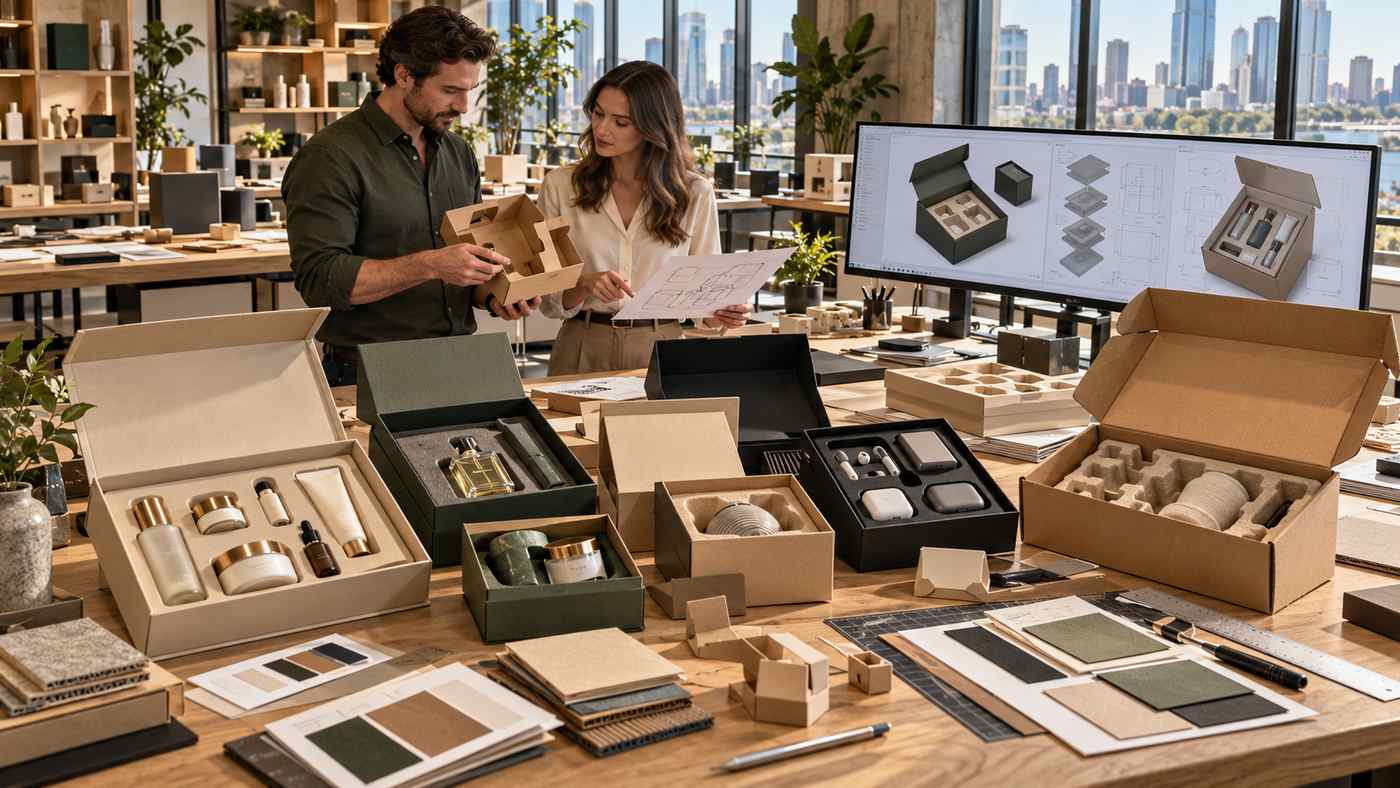
Custom box inserts are specially designed packaging components that fit inside an outer box to support, separate, display, or protect the products contained within it.
Unlike generic packing materials, custom inserts are usually manufactured according to the dimensions and arrangement of particular products.
They may include precision-cut openings, folded supports, dividers, cushioning pads, or shaped compartments.
For example, a skincare gift set containing three glass bottles may use an insert with separate compartments for each bottle.
A consumer electronics package may include a protective tray holding the main device, charging cable, and other accessories.
A luxury watch presentation box may use a shaped cushion or foam insert to position the product securely.
How Do Custom Packaging Inserts Work?
Packaging inserts help control the position and movement of items within a container.
During transportation, packages may experience impacts, vibration, compression, and changes in orientation.
An appropriately designed insert helps manage these conditions by supporting products and providing suitable cushioning or separation.
Some inserts primarily prevent movement, while others are designed to absorb impact energy.
The outer carton and internal insert should be evaluated as one complete packaging system.
A strong insert inside an unsuitable shipping carton may still provide inadequate protection.
Why Are Custom Inserts Important for Product Packaging?
Businesses use inserts to solve several practical problems.
They can reduce unnecessary movement, organize multiple products, support attractive presentation, and improve packing consistency.
Well-designed packaging may also reduce the amount of loose filler required.
However, the benefits depend on the design and actual shipping conditions.
An insert that looks attractive does not automatically protect fragile products from damage.
Different Types of Custom Box Inserts
Packaging materials vary in their protective performance, appearance, production methods, and cost.
Understanding the main options helps businesses identify appropriate solutions.
Corrugated Cardboard Inserts
Corrugated cardboard inserts use paper-based material with a fluted middle layer.
The structure can provide strength and cushioning characteristics depending on its construction.
These inserts are commonly used for electronics, consumer products, glassware, and other items requiring organized compartments or spacing.
They may be die-cut, folded, or assembled into protective structures.
Advantages of Corrugated Inserts
Corrugated inserts can be designed to support products while reducing the need for certain plastic cushioning materials.
They are also compatible with many familiar paper-based packaging production processes.
However, their performance depends on flute type, board grade, design, humidity exposure, and the product being packed.
Folding Paperboard Inserts
Folding paperboard inserts are often selected for retail presentation.
They can provide clean edges, attractive printed surfaces, and precisely arranged compartments.
They are particularly useful when the primary objective is organization and appearance rather than heavy impact cushioning.
Common applications include cosmetics, small accessories, stationery, gift sets, and certain consumer electronics products.
Custom Foam Inserts
Foam inserts are manufactured from materials with different cushioning and structural properties.
Examples include polyethylene foam, polyurethane foam, and ethylene-vinyl acetate, commonly called EVA.
Different foam types should not be treated as interchangeable.
EVA Foam Inserts
EVA foam is frequently used in presentation cases, specialty packaging, and selected protective applications.
It can be cut into shaped compartments and is available in different densities and finishes.
Its clean appearance makes it attractive for certain luxury products and equipment kits.
However, designers should verify material compatibility with delicate coatings, surfaces, and product finishes.
Polyethylene Foam Inserts
Polyethylene foam is often used for protective packaging because appropriate grades can provide resilient cushioning.
Its performance depends on density, thickness, geometry, and product weight.
Engineering evaluation may be required for sensitive or high-value products.
Molded Pulp Inserts
Molded pulp, also known as molded fiber, is a paper-based packaging material formed into specific shapes.
It is commonly associated with protective trays and packaging for certain consumer goods.
Molded fiber can be an option for companies seeking paper-based cushioning and product support.
However, the environmental performance and recyclability of the finished insert depend on its composition, coatings, manufacturing processes, and available recovery systems.
Specialty Packaging Inserts
Some applications require additional features.
Sensitive electronic components may need packaging materials with appropriate electrostatic discharge properties.
Food-contact products may require materials suitable for the intended contact conditions.
Medical or other regulated products can involve specialized packaging validation.
Businesses should use materials and testing appropriate to their specific products rather than assume that ordinary decorative packaging is sufficient.
7 Essential Tips for Designing Custom Box Inserts
Effective packaging combines product protection, attractive presentation, manufacturing practicality, and reasonable cost.
The following seven strategies help businesses evaluate the complete packaging design.
1. Start With Accurate Product Measurements
An effective insert begins with understanding the product’s exact physical characteristics.
Small dimensional differences can influence whether an item fits securely inside its intended compartment.
A product that fits too tightly may be difficult to remove or could experience unwanted pressure.
A loose fit may permit excessive movement during transportation.
Measure the Complete Product
Record the overall length, width, height, and weight.
Include any accessories, protruding components, lids, handles, or irregular surfaces that affect the required clearance.
For bottles and jars, consider cap dimensions and variations in the product shape.
For electronics, account for protective coverings and other necessary components.
Allow for Manufacturing Tolerances
Commercial products may vary slightly in their dimensions.
Packaging materials can also have manufacturing tolerances.
A design based on a single product sample may not accommodate every production unit.
The packaging supplier should explain reasonable clearances and relevant material tolerances.
Consider the Unpacking Experience
A secure fit should not make the product unnecessarily difficult to remove.
Customers should be able to access the item without excessive force.
Suitable finger openings, tabs, and lifting features can improve usability.
These features should be considered during the structural design stage.
2. Select Materials Based on Product Protection Requirements
Material choice has a significant influence on packaging performance.
A decorative paperboard tray may be suitable for a lightweight accessory but inappropriate for a fragile instrument requiring substantial impact cushioning.
The correct material should respond to the product’s actual requirements.
Consider Product Weight
Heavier items may require stronger supports or different cushioning structures.
However, weight alone is not the only consideration.
Fragility, shape, surface finish, and distribution conditions also matter.
A relatively lightweight glass item may require more careful impact protection than a heavier but less fragile metal component.
Evaluate Cushioning Performance
Protective foam can compress during impact and help manage transmitted forces.
However, cushioning depends on material characteristics and loading conditions.
An insert that is too rigid may transfer excessive shock.
An insert that is too soft may compress completely under certain loads.
For fragile products, appropriate packaging engineering can help determine suitable material properties and geometry.
Consider Surface Compatibility
Certain products have delicate finishes.
Painted surfaces, polished metals, optical components, and coated products may require protective coverings or specific contact materials.
Before placing a product directly against foam or another insert, evaluate the possibility of abrasion, marking, or chemical incompatibility.
Match the Material to the Brand
An appropriate material should also support the intended presentation.
Natural kraft paperboard may complement an understated or minimalist identity.
Precision-cut black foam can create a technical or premium appearance.
Printed paperboard may be suitable when decorative graphics form part of the packaging experience.
The visual choice should never compromise the product’s required protection.
3. Design Inserts for Real Shipping Conditions
One of the most important aspects of custom box inserts is the ability to perform during actual distribution.
Packages can experience drops, vibration, compression, and repeated handling.
The risks differ between direct-to-consumer parcel delivery, palletized transportation, and retail distribution.
Understand Your Distribution Environment
A small ecommerce package shipped individually through a parcel network experiences different handling conditions from a pallet of identical products delivered by truck.
Businesses should consider how products move from manufacturing facilities to warehouses, retailers, and final customers.
Important questions include how many handling stages are involved and whether packages are regularly stacked or repacked.
Use Appropriate Transit Testing
The International Safe Transit Association develops laboratory test procedures for evaluating packaged products.
ISTA 3A, for example, addresses certain individual packaged products moving through parcel delivery systems.
Other procedures are designed for different transportation conditions.
The appropriate test should be selected for the complete package and its distribution environment.
Passing a laboratory test can provide useful evidence, but it does not guarantee that damage will never occur.
Evaluate the Complete Packaging System
Protective performance depends on the interaction between the outer box, insert, product, and closure system.
A well-designed insert may still fail if the carton is too weak.
Similarly, a strong shipping box may provide limited protection when the product moves freely inside.
Testing should evaluate the complete configuration.
Improve Designs Using Damage Information
Customer returns and transportation damage records can help identify recurring packaging weaknesses.
For example, repeated corner damage may indicate that the cushioning or product position needs improvement.
However, conclusions should be based on actual evidence rather than isolated assumptions.
Testing proposed changes can help determine whether they improve performance.
4. Create an Attractive Branded Unboxing Experience
Product protection is essential, but packaging also influences presentation.
When customers open an order, they see how the product has been arranged and protected.
A carefully designed insert can make the contents appear organized and intentional.
Position Products Clearly
The arrangement should help customers identify the main item and any included accessories.
For a skincare kit, bottles can be placed in consistent positions with labels visible.
For a technology product, the main device may occupy the central compartment, with smaller accessories organized separately.
The exact layout should reflect product dimensions and usability.
Coordinate Colors and Finishes
Insert materials may be available in different colors or surface finishes.
A luxury brand may prefer a neutral palette that complements its outer packaging.
A consumer electronics brand might use charcoal gray, white, or another restrained color scheme.
However, brand presentation should not require unnecessary material complexity.
Consider Printed Inserts
Some paperboard inserts can incorporate printed graphics, product information, or simple visual branding.
Printing may be appropriate when the insert is intended to be part of the customer-facing presentation.
However, every additional printing process can influence cost, lead time, and material recovery.
The design should remain practical.
Make Products Easy to Remove
A premium appearance is less valuable if customers struggle to access the item.
Suitable openings and lifting features can make the experience more convenient.
Where a product includes several parts, the arrangement should also help customers identify the included components.
Good unboxing design supports clarity rather than unnecessary complexity.
5. Evaluate Sustainable Packaging Materials Carefully
Many American businesses want to reduce packaging waste and use materials more efficiently.
Custom inserts can support this objective when they are designed appropriately.
However, environmental performance should not be judged solely by whether a material looks natural or contains recycled fibers.
Prioritize Material Efficiency
The U.S. Environmental Protection Agency identifies source reduction as an important waste prevention strategy.
For packaging, this can include reducing unnecessary materials, designing efficient product layouts, and avoiding oversized boxes.
A smaller, well-designed insert may help reduce the amount of filler required.
However, material reduction should not compromise product protection.
Excessive damage can create additional waste through replacement products and transportation.
Consider Paper-Based Alternatives
Paperboard, corrugated cardboard, and molded fiber may provide alternatives to certain plastic-based inserts.
The appropriate option depends on cushioning requirements, weight, manufacturing processes, and the local recovery infrastructure.
Not every paper-based insert will be appropriate for every fragile product.
Understand FSC Certification
The Forest Stewardship Council provides chain-of-custody certification for qualifying forest-based materials and supply chains.
Businesses seeking FSC-labeled packaging should confirm that the necessary certification and trademark requirements are satisfied.
A supplier’s general sustainability statement does not automatically authorize the buyer to place an FSC label on every finished package.
Avoid Misleading Recyclability Claims
The Federal Trade Commission provides guidance concerning environmental marketing claims.
A packaging component should not be described as universally recyclable when appropriate collection facilities are not widely available.
Recyclability may also be affected by coatings, adhesives, laminations, or combinations of materials.
Businesses should substantiate claims and provide suitable qualifications where necessary.
Evaluate Actual Sustainability Tradeoffs
A lightweight insert may use less material but offer insufficient protection.
A heavier design may reduce damage while increasing material use.
The most responsible option depends on the complete product lifecycle and distribution requirements.
A balanced approach considers protection, material use, transportation, recovery, and product waste together.
6. Control Manufacturing Costs Without Sacrificing Quality
Custom packaging inserts involve material, design, tooling, production, assembly, and transportation expenses.
Businesses should evaluate the complete cost rather than the price of a single component.
Understand Tooling Requirements
Some inserts are manufactured using cutting dies or other specialized tooling.
A custom die may require an initial investment.
Tooling costs can influence the economics of short production runs.
However, the cost may be distributed across a larger quantity when the design is reused.
Ask About Minimum Order Quantities
Packaging suppliers may establish minimum order quantities based on material, machinery, and production requirements.
A higher order quantity can sometimes reduce unit costs.
However, purchasing more inserts than necessary creates inventory and storage expenses.
Businesses should choose quantities based on realistic demand.
Simplify Complicated Designs
An insert with numerous folds, separate components, or complicated assembly requirements may require additional labor.
A simpler structural design may provide equivalent performance at lower cost.
Packaging engineers can sometimes reduce component count without reducing functionality.
Consider Warehouse Efficiency
Large or awkwardly assembled inserts can occupy substantial storage space.
Flat-packed paperboard inserts may offer operational advantages in certain environments.
However, assembly time must also be considered.
An insert that saves storage space but requires extensive folding may not produce the lowest total cost.
Compare Total Packaging Economics
Evaluate material cost, tooling, packing labor, shipping weight, product damage rates, storage, and disposal considerations.
An apparently inexpensive insert may become costly when it creates slow packing operations or poor product protection.
Good packaging procurement balances several operational factors.
7. Test Prototypes Before Committing to Production
One of the most useful strategies is developing and reviewing prototypes before ordering large quantities.
A packaging design may look accurate on a computer but behave differently when assembled.
Physical testing allows businesses to identify fit, protection, and handling problems early.
Begin With Structural Samples
Request a sample made from the proposed material where practical.
Place the actual product inside the insert and evaluate its position.
Check whether all accessories fit correctly.
Review clearances, pressure points, and product removal.
Test With Production Products
A prototype should be evaluated using representative items from normal production.
If product dimensions vary, test the expected range.
A single ideal sample may not reveal problems affecting other units.
Conduct Appropriate Performance Testing
Testing requirements depend on product risk and shipping conditions.
For certain products, transit simulation may be appropriate.
The ISTA framework provides different procedures for different distribution environments.
A supplier should not describe an insert as ISTA-certified merely because its material resembles one used in a tested package.
Testing applies to the relevant complete packaged-product configuration.
Review Packing Operations
Ask employees or fulfillment personnel to assemble the packaging during a realistic trial.
Observe how long preparation takes and whether the process is easy to repeat.
Look for steps that cause confusion or unnecessary handling.
Operational feedback can lead to improvements before production begins.
Approve a Final Production Specification
Once the design is accepted, document materials, dimensions, tolerances, finishing, printing, and assembly requirements.
This creates a reference for manufacturing and quality checks.
Significant design changes should be evaluated before the supplier proceeds with production.
How Custom Box Inserts Improve Ecommerce Packaging
Ecommerce companies need packaging that performs during transportation while remaining practical for fulfillment.
A product may move through several handling locations before reaching the customer.
This creates different demands from packaging used only for in-store display.
Reducing Product Movement
Custom compartments can help hold items in a predictable position.
This can be especially useful when shipping multiple products within one box.
However, the insert should provide suitable protection against expected impacts rather than simply prevent visible movement.
Improving Fulfillment Consistency
A well-designed insert can help employees arrange products in the same configuration for every order.
This may reduce uncertainty during packing.
It can also make it easier to verify whether required accessories are included.
Supporting Product Bundles
Many online businesses sell curated sets or product bundles.
A custom insert can accommodate multiple items in one presentation.
Examples include personal care sets, electronics bundles, promotional kits, and corporate gifts.
Avoiding Oversized Shipping Cartons
Efficient insert geometry can sometimes allow products to fit into a smaller shipping carton.
This may reduce excess empty space and certain material requirements.
However, dimensional weight and carrier charges depend on the actual shipping service and carton dimensions.
Businesses should evaluate the complete package before assuming a reduction in cost.
Industries That Commonly Use Custom Box Inserts
Packaging inserts are useful across several industries, but their designs differ according to product characteristics.
Cosmetics and Skincare Packaging
Cosmetic products often include bottles, jars, pumps, droppers, and decorative packaging.
Custom inserts can separate items and present them neatly.
Products containing liquids may require additional attention to sealing and leakage protection.
Electronics Packaging
Electronic devices may need protection from shock, vibration, abrasion, or static electricity.
Depending on the product, specialized materials and handling procedures may be appropriate.
An ordinary decorative foam insert should not automatically be assumed suitable for sensitive electronic components.
Jewelry and Watches
Jewelry and watch packaging often places strong emphasis on presentation.
Custom foam, paperboard, and other inserts can help position products attractively.
The selected contact materials should be compatible with the item’s finish.
Candle and Glassware Packaging
Glass containers may be vulnerable to breakage during transportation.
Appropriate inserts can help separate products and control movement.
Fragile goods should be evaluated using realistic shipping conditions.
Subscription Boxes
Subscription businesses may ship changing combinations of products.
A fixed custom insert is not always suitable when product dimensions change frequently.
Modular dividers or flexible compartments may provide practical alternatives.
Corporate Gift Packaging
Corporate gifts may combine notebooks, accessories, drinkware, and other items.
Custom inserts help organize mixed products into a coordinated presentation.
The design should accommodate realistic product tolerances and packaging quantities.
Custom Box Inserts vs. Loose Packaging Fillers
Loose fillers and custom inserts serve related but different purposes.
Loose paper, air pillows, and other cushioning products may fill empty space inside shipping cartons.
Custom inserts provide more defined product positioning.
When Custom Inserts Are Useful
Custom inserts are particularly useful for repeatable product configurations.
They can support consistent placement and improve presentation.
For high-volume products, a well-engineered insert may help standardize packing operations.
When Loose Fillers May Be More Practical
Businesses shipping many differently sized products may benefit from flexible packing materials.
A custom insert for every possible combination may create unnecessary complexity.
Can Both Methods Be Combined?
Yes.
Some products may benefit from a fitted insert inside an outer shipping carton with additional appropriate cushioning.
The complete design should be tested rather than assuming that more packaging always provides better protection.
How Much Do Custom Box Inserts Cost in the USA?
The cost depends on material selection, dimensions, design complexity, production quantity, and finishing requirements.
There is no single price that accurately represents every insert.
A simple die-cut paperboard divider has different production requirements from a precision-machined foam presentation insert.
Factors Affecting Pricing
Important considerations include material grade, insert thickness, production method, tooling, design complexity, printing, order quantity, and supplier location.
Freight charges and assembly requirements can also influence total cost.
Standard vs. Custom Production
Standard insert designs may reduce certain setup requirements when they match the product.
Fully customized designs can offer improved fit and presentation, but may require additional development.
A business should consider whether a custom solution provides measurable operational or presentation benefits.
Is Bulk Ordering Always Cheaper?
Larger orders may reduce certain unit costs.
However, additional inventory creates storage commitments and possible obsolescence.
Businesses introducing new products should consider the possibility of packaging redesign before ordering extensive quantities.
How to Order Custom Box Inserts From a Packaging Manufacturer
A structured procurement process can make the project more efficient.
Define the Product Requirements
Provide product dimensions, weight, fragility information, and intended shipping conditions.
Explain whether the packaging is intended primarily for retail presentation, transport protection, or both.
Select the Material
Discuss paperboard, corrugated structures, molded fiber, foam, or other suitable options.
Ask how the proposed material will perform in the intended application.
Review Structural Drawings
The supplier may prepare packaging dielines or digital design previews.
Review compartment placement, clearances, and assembly.
Request Samples
Evaluate physical prototypes with representative products.
Document any changes needed before final approval.
Confirm Manufacturing Details
Agree on final specifications, minimum order quantities, lead times, tooling ownership, quality checks, and commercial terms.
Inspect Initial Production
Compare initial production units with the approved sample and specification.
Identify dimensional or material inconsistencies before distributing large quantities.
Common Mistakes Businesses Make With Custom Packaging Inserts
One frequent mistake is prioritizing appearance over protection.
A perfectly arranged product presentation may still be unsuitable for parcel transportation.
Another mistake is using approximate product measurements.
Small errors can cause fitting problems across a production run.
Some brands also select materials based only on marketing descriptions.
Terms such as sustainable, premium, and protective should be supported by relevant product information.
Another issue is overlooking packaging assembly time.
A complex insert may create unnecessary labor costs in a fulfillment environment.
Finally, businesses should not order large quantities without approving a suitable prototype.
Design verification before manufacturing can help reduce avoidable rework.
The Future of Custom Box Inserts and Packaging Design
Packaging design continues to evolve as businesses seek better protection, practical manufacturing methods, and improved material efficiency.
Digital structural design tools can help packaging engineers develop and revise layouts.
Prototype cutting equipment may also make it easier to evaluate new configurations before investing in production tooling.
More Efficient Material Usage
Packaging teams are increasingly considering how to achieve the required protection with less unnecessary material.
The objective should be to improve the complete packaging system rather than simply remove cushioning.
Modular Packaging Designs
Some companies may benefit from inserts that accommodate several product variations.
Modular systems can help reduce the need for separate designs.
However, they should still provide adequate protection for each supported configuration.
Better Packaging Testing
Transport simulation and performance evaluation can help organizations understand how packaging behaves during distribution.
Testing should be selected according to the relevant risks.
Results can inform practical design improvements.
Greater Attention to Environmental Claims
Packaging sustainability claims are likely to remain important to buyers and regulators.
Businesses should distinguish verified material information from broad, unsupported marketing statements.
Clear disposal instructions and properly substantiated claims can help customers understand how to handle packaging after use.
How to Choose the Best Custom Box Inserts for Your Business
The right insert should match your product’s physical requirements, shipping conditions, customer presentation goals, and operating budget.
Begin by measuring the product accurately.
Identify where it is most vulnerable to damage and how it will be distributed.
Compare suitable materials based on documented performance rather than appearance alone.
Ask the supplier about structural design capabilities, prototype production, relevant testing, manufacturing tolerances, and quality control.
Review the full cost, including tooling, assembly, inventory, and transportation.
Where environmental considerations matter, verify material information and avoid unsupported recyclability claims.
A practical insert should protect the product, support efficient packing, and provide an attractive customer experience without unnecessary complexity.
Frequently Asked Questions
1. What are custom box inserts used for?
Custom box inserts hold, separate, display, and protect products inside packaging. They are commonly used for cosmetics, electronics, glassware, jewelry, gift sets, and ecommerce orders.
2. Which materials are best for custom box inserts?
Corrugated cardboard, paperboard, foam, and molded fiber are common options. The best material depends on product weight, fragility, presentation needs, shipping conditions, and budget.
3. Are custom cardboard box inserts recyclable?
Many paper-based inserts can be recyclable, but acceptance depends on coatings, adhesives, material composition, and available local recycling facilities.
4. Do custom box inserts help prevent shipping damage?
Properly engineered inserts can help reduce movement and manage shipping impacts. Their effectiveness should be evaluated through appropriate testing of the complete packaged product.
5. How much do custom box inserts cost?
Prices vary according to material, size, structural complexity, tooling, production quantity, and finishing requirements. A supplier quotation is needed for accurate project pricing.
6. Can custom box inserts be manufactured with branded designs?
Yes. Certain paperboard and other insert systems can incorporate custom colors, printing, compartments, and presentation features while meeting the product’s protection requirements.
Conclusion
Custom box inserts help businesses combine practical product protection with organized, attractive packaging presentation. The most effective designs consider accurate dimensions, material selection, shipping conditions, manufacturing costs, and the customer unboxing experience. Appropriate prototyping and performance testing help companies make better packaging decisions before large-scale production. By prioritizing functionality, quality, and responsible material use, American brands can create packaging solutions that support their products and long-term business goals