Exterior Painting Toronto: 7 Smart Tips for a Durable Home Finish
exterior painting toronto projects require more than choosing an attractive colour and applying a fresh coat of paint. Toronto homes experience cold winters, warm summers, rain, snow, moisture and large seasonal temperature changes, so successful exterior painting depends heavily on surface preparation, weather conditions, paint selection and professional application.
Environment and Climate Change Canada’s 1991–2020 climate normals show how significant Toronto’s seasonal variation can be. The Toronto City station records an average January temperature of about -3.5°C and an average July temperature of about 22.5°C, with normal daily maximums reaching approximately 27°C in July.
That seasonal cycle places exterior finishes under repeated environmental stress.
Paint must tolerate:
- Moisture
- UV exposure
- Summer heat
- Winter cold
- Freeze-thaw cycles
- Seasonal expansion and contraction
The quality of the preparation therefore matters just as much as the quality of the paint.
Whether you own a detached home, semi-detached property, townhouse or older Toronto brick house, these seven considerations can help produce an exterior finish that looks better and lasts longer.
1. Choose the Right Time for Exterior Painting Toronto Projects
Weather is one of the biggest factors affecting an exterior paint job.
Exterior coatings need suitable:
- Air temperature
- Surface temperature
- Humidity
- Drying time
Painting simply because the afternoon feels warm is not enough.
Toronto’s Painting Season
Late spring through early fall generally provides the most practical opportunities for outdoor painting in Toronto.
Environment and Climate Change Canada’s climate normals show average Toronto City temperatures of approximately:
- 7.8°C in April
- 14.5°C in May
- 19.8°C in June
- 22.5°C in July
- 21.9°C in August
- 17.9°C in September
- 11.2°C in October
However, averages do not guarantee suitable conditions on an individual day.
Check the Specific Paint Product
Benjamin Moore Canada states that suitable painting conditions can range broadly from about 1.7°C to 37.8°C, depending on the specific product, and identifies approximately 25°C as an ideal temperature. The company also emphasizes checking each coating’s technical data sheet because individual products have different temperature requirements.
Some modern exterior paints can therefore be applied in cooler weather than traditional formulations.
Sherwin-Williams similarly notes that certain modern exterior products can be used at temperatures down to approximately 35°F, or 1.7°C, while traditional latex products have generally required warmer conditions.
Do Not Look Only at Afternoon Temperature
Nighttime temperature matters too.
A wall may be painted during a mild afternoon but experience:
- Cold temperatures
- Dew
- Condensation
later that evening.
Sherwin-Williams recommends keeping conditions within the product’s recommended range and above the dew point long enough for proper curing.
This makes weather forecasting essential when planning exterior painting in Toronto.
2. Surface Preparation Is More Important Than Most Homeowners Realize
Excellent exterior paint applied over a poor surface can still fail.
Before painting begins, the substrate should be:
- Clean
- Dry
- Stable
- Properly repaired
Sherwin-Williams states that inadequate surface preparation can significantly reduce coating integrity and service life. Its guidance recommends removing contaminants including dirt, grease, mildew, loose paint, rust and other materials that could interfere with adhesion.
Wash the Exterior
Exterior walls naturally collect:
- Dust
- Pollution
- Pollen
- Mildew
- Dirt
Toronto properties near busy roads may develop particularly noticeable surface contamination.
Cleaning creates a better surface for paint adhesion.
However, if pressure washing is used, the surface must be allowed to dry properly before painting.
Remove Loose Paint
Peeling or flaking coatings should not simply be painted over.
Loose material should be:
- Scraped
- Sanded where appropriate
- Feathered into surrounding surfaces
Painting directly over unstable layers can lead to premature peeling.
Repair Cracks and Gaps
Exterior inspection may reveal:
- Failed caulking
- Small cracks
- Damaged trim
- Open joints
These should be repaired before finish coats are applied.
Address Moisture Problems First
Paint is not a solution for an active water problem.
If moisture is entering through:
- Leaking gutters
- Roof defects
- Failed flashing
- Damaged masonry
repair the source before repainting.
Otherwise, moisture can continue damaging the coating from behind.
3. Match the Paint System to the Exterior Material
Toronto homes use many different exterior materials.
Common surfaces include:
- Brick
- Wood
- Stucco
- Aluminum siding
- Fibre-cement siding
- Previously painted masonry
- Exterior trim
One coating system should not automatically be used everywhere.
Exterior Wood
Wood expands and contracts as moisture and temperature change.
Preparation may include:
- Scraping
- Sanding
- Priming bare areas
- Replacing rotted sections
- Caulking appropriate joints
Bare wood typically benefits from a compatible primer before finish coats.
Stucco
Stucco requires careful inspection for:
- Cracking
- Moisture problems
- Loose areas
Hairline cracks may require suitable repair products before painting.
A masonry-compatible coating should be selected rather than assuming every exterior latex paint is appropriate.
Brick
Brick is particularly important in Toronto because many houses use traditional brick façades.
Painting brick is a more permanent design decision than painting wood trim.
Before painting, determine whether the masonry is:
- Structurally sound
- Properly dry
- Previously painted
- Experiencing efflorescence
Do not trap active moisture problems under a new coating.
Previously Painted Brick
If brick has already been painted, repainting may be practical after appropriate cleaning and repairs.
Unpainted Brick
Homeowners should think carefully before covering original masonry.
Once brick is painted, ongoing coating maintenance becomes part of home ownership.
Aluminum and Metal Surfaces
Metal components may require:
- Rust removal
- Proper cleaning
- Specialized primer
Applying ordinary wall paint directly over corrosion is unlikely to provide durable results.
4. Understand Toronto Rain, Moisture and Drying Conditions
Paint should never be applied simply because it is not raining at that exact moment.
The surface itself needs to be sufficiently dry.
Sherwin-Williams recommends avoiding exterior painting immediately after rain and notes that wood and masonry can absorb significant moisture.
Benjamin Moore similarly advises avoiding rainy conditions and waiting until the painting surface is dry before continuing.
Why Moisture Causes Problems
Painting a damp surface can contribute to:
- Poor adhesion
- Blistering
- Peeling
- Uneven finish
The underlying water may try to escape through the new paint film.
Humidity Also Matters
High humidity slows evaporation.
That can extend:
- Drying
- Recoat time
- Cure time
Benjamin Moore notes that high humidity can interfere with proper drying and recommends accounting for the relationship between surface temperature and dew point.
Avoid Direct Intense Sun
Very hot surfaces are another issue.
A dark south-facing wall may become much hotter than the surrounding air.
Painting an excessively hot wall can cause the coating to dry too quickly.
Possible results include:
- Poor leveling
- Visible brush marks
- Reduced adhesion
Benjamin Moore advises avoiding painting or staining in strong direct sunlight where possible and checking surface temperature rather than relying only on air temperature.
Professional painters may therefore work around the house according to sun exposure.
5. Choose Exterior Paint for Performance, Not Colour Alone
Colour is important, but exterior paint is a protective coating.
A quality exterior product needs to resist:
- UV light
- Moisture
- Temperature changes
- Dirt
- Normal weathering
100% Acrylic Exterior Paint
High-quality acrylic latex coatings are commonly used for many residential applications because they provide good flexibility and weather resistance.
The exact product should still match the substrate.
Primer May Still Be Necessary
Paint-and-primer marketing does not mean dedicated primer is unnecessary in every situation.
Primer may be important when dealing with:
- Bare wood
- Repairs
- Stains
- Bare metal
- Significant colour changes
- Certain masonry surfaces
A professional painter should explain where primer will be used rather than treating every wall identically.
Two Coats Can Improve Results
Sherwin-Williams recommends two coats for many exterior applications and notes that adequate drying should occur between coats.
Two properly applied coats can provide:
- More uniform colour
- Better coverage
- More consistent film thickness
However, manufacturer instructions should always determine the actual system.
6. Hire an Exterior Painter Based on Scope, Not Just Lowest Price
Toronto homeowners may receive dramatically different estimates for what appears to be the same painting project.
Often the difference comes from what is actually included.
One contractor may quote:
- Basic cleaning
- One coat
- Limited repairs
Another may include:
- Extensive scraping
- Sanding
- Caulking
- Priming
- Two finish coats
- Detailed trim work
The cheaper quote is not necessarily offering the same job.
Ask for a Written Scope
A professional estimate should identify important details such as:
- Surfaces being painted
- Preparation work
- Primer requirements
- Paint manufacturer and product line
- Number of coats
- Areas excluded
- Cleanup
- Warranty terms
Ask About Insurance
Exterior painting can involve:
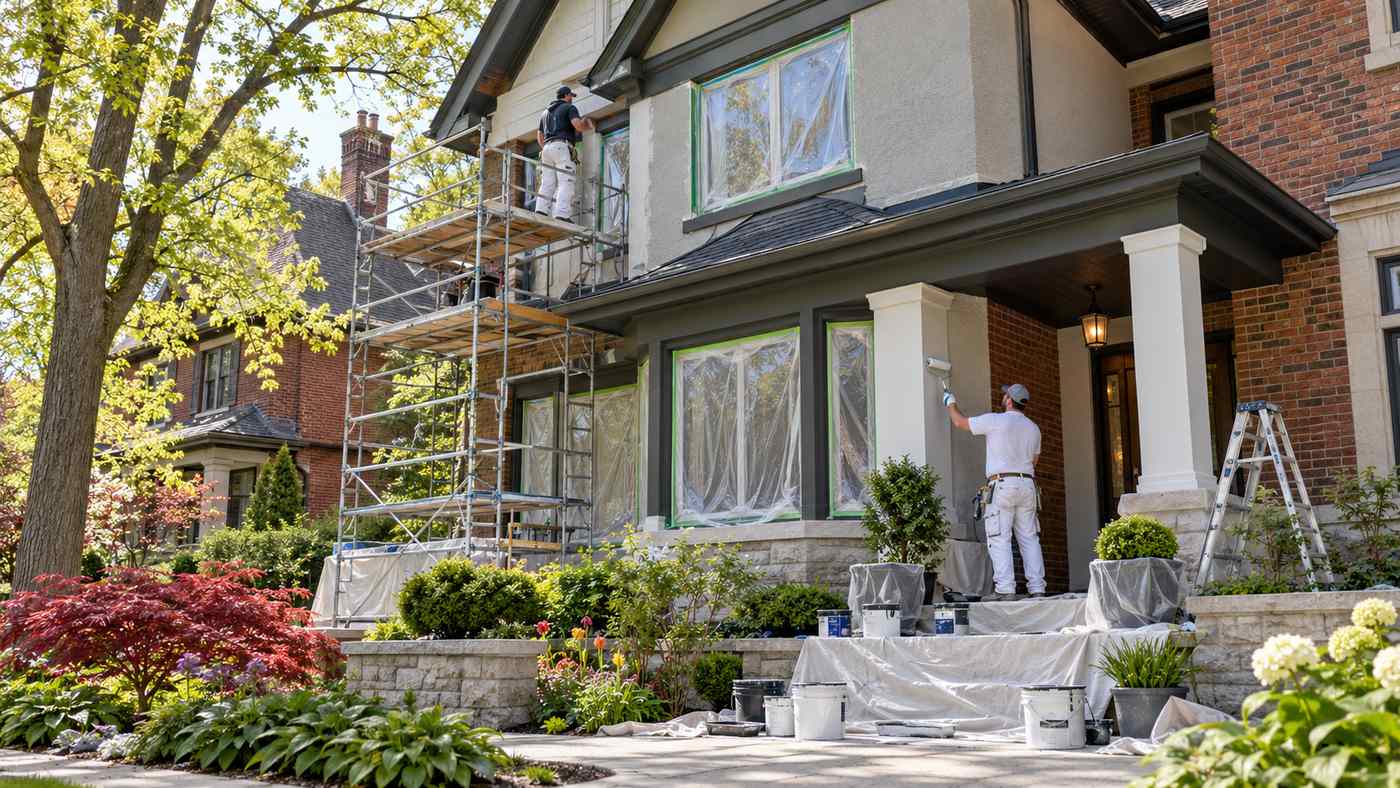
- Ladders
- Scaffolding
- Elevated work
Homeowners should confirm that the contractor carries appropriate business and liability coverage.
Ask How Heights Will Be Accessed
Second and third-storey painting may require:
- Extension ladders
- Scaffolding
- Lift equipment
The contractor should have a clear and safe access plan.
References and Past Work
Photos of similar Toronto homes can help you evaluate:
- Preparation
- Finish quality
- Detail work
Online reviews can also help, but they should not be the only factor.
7. Think About Long-Term Maintenance Before Choosing Colours and Finishes
Exterior painting is not permanent.
The service life depends on:
- Substrate
- Exposure
- Paint quality
- Preparation
- Number of coats
- Moisture
- Maintenance
Sherwin-Williams gives a broad estimate of roughly 7 to 10 years for exterior repainting in suitable conditions, while noting that climate, paint quality and surface material all affect actual longevity.
Toronto homes may vary substantially from that range.
South and West Exposures
Walls exposed to stronger sunlight may fade and weather differently from shaded elevations.
Horizontal Surfaces
Elements such as:
- Railings
- Porch floors
- Window sills
often experience greater exposure than vertical siding.
They may require more frequent maintenance.
Inspect Annually
A simple annual walkaround can identify early signs of:
- Peeling
- Cracking
- Failed caulking
- Moisture staining
Fixing small defects early may prevent a much larger repainting project later.
Best Season for Exterior Painting in Toronto
For many projects, late spring through early fall provides the most dependable conditions.
May and September can be particularly attractive because temperatures are often moderate.
However, the calendar itself is less important than:
- Temperature
- Surface dryness
- Humidity
- Rain forecast
Modern coatings can extend the traditional painting season.
Benjamin Moore currently notes that some products can perform at temperatures down to about 1.7°C, though each product’s Technical Data Sheet should determine the actual application limits.
How Much Does Exterior Painting Toronto Cost?
There is no accurate universal price per house.
Exterior painting cost depends heavily on the property.
Major factors include:
House Size
A larger home requires:
- More paint
- More labour
- More preparation
Height
A three-storey home may require more access equipment and labour than a bungalow.
Surface Condition
A house with extensive peeling paint can require substantially more preparation.
Exterior Material
Painting:
- Wood siding
- Brick
- Stucco
- Trim
can involve different materials and labour.
Number of Colours
A simple single-colour siding project is generally less complex than a design involving several trim and accent colours.
Access
Closely spaced Toronto homes can sometimes make side-wall access difficult.
Restricted access may affect:
- Scaffolding
- Ladders
- Labour time
For this reason, homeowners should request a property-specific written estimate rather than relying on generic online price ranges.
Exterior Painting for Toronto Brick Homes
Brick houses are common across many Toronto neighbourhoods.
Painting can dramatically change their appearance, but it deserves careful consideration.
Inspect Mortar First
Damaged mortar should be repaired before coating.
Check for Efflorescence
White mineral deposits can indicate moisture moving through masonry.
Painting over the symptom without identifying the cause may produce future coating problems.
Consider Existing Architectural Character
On older homes, original brick can be part of the property’s architectural identity.
A painted finish is difficult to reverse completely.
Exterior Painting and Toronto Heritage Properties
Owners of designated heritage properties should take additional care before altering exterior finishes.
Toronto has specific heritage-property regulations. For some designated properties, the City’s heritage bylaw provides streamlined treatment for work such as painting existing wood, metal finishes or existing/new stucco in colours complementary to the building’s architecture.
However, heritage requirements depend on the property and proposed work.
If your house is:
- Individually designated
- Located within a Heritage Conservation District
confirm requirements with the City before making significant exterior changes.
Routine painting on a normal house should not be confused with structural construction, but Toronto states that building permits are required for new buildings, additions and material alterations, so projects that extend beyond painting into structural exterior work may require additional approvals.
Exterior Paint Colour Selection
Colour should work with the permanent features of the property.
Consider:
- Brick
- Roofing
- Stone
- Windows
- Doors
- Landscaping
Test Colours Outdoors
Small colour chips can look very different when applied across an entire exterior wall.
Paint sample areas and view them during:
- Morning
- Midday
- Evening
Natural light changes colour perception significantly.
Consider Neighbouring Properties
Your home does not need to match neighbouring houses, but a colour palette that works within the streetscape can improve overall curb appeal.
Should You Paint Vinyl Siding?
Certain vinyl siding can be painted successfully with compatible exterior products.
However:
- Colour choice matters
- Surface preparation matters
- Manufacturer recommendations matter
Very dark colours may absorb more heat than the siding was originally designed to tolerate.
Use a paint specifically approved for the application.
Signs Your Toronto Home Needs Exterior Painting
Watch for:
- Peeling
- Flaking
- Fading
- Chalky finish
- Cracked caulking
- Exposed wood
- Staining
Peeling around one isolated location may indicate moisture rather than general paint failure.
Identify the cause before repainting.
Professional Exterior Painting Process
A well-managed project typically includes several stages.
Inspection
The contractor evaluates:
- Substrate
- Damage
- Accessibility
- Existing coating
Protection
Landscaping, windows, roofing and surrounding surfaces are covered where necessary.
Cleaning
Dirt and contaminants are removed.
Surface Repairs
Loose paint, cracks and failed caulking are addressed.
Priming
Bare and problem areas receive the appropriate primer.
Painting
Finish coats are applied under suitable weather conditions.
Final Inspection
The crew checks:
- Coverage
- Details
- Cleanup
Homeowners should understand this workflow before work begins.
Mistakes to Avoid With Exterior Painting Toronto Projects
Painting Over Peeling Paint
New paint will not stabilize a failing old coating.
Painting Damp Walls
Moisture can lead to adhesion problems.
Starting Too Late in the Day
Even if afternoon temperatures are acceptable, nighttime cooling and dew can affect fresh paint.
Ignoring Surface Temperature
A sun-heated wall can be much hotter than the surrounding air.
Choosing a Contractor Only by Price
Compare scope, materials and preparation.
Ignoring Water Damage
Repair the moisture source before repainting.
Frequently Asked Questions
What is the best time for exterior painting Toronto homes?
Late spring through early fall usually provides the most practical conditions, but the exact weather matters more than the month. Follow the temperature and moisture requirements of the specific paint product.
What temperature is suitable for exterior painting in Toronto?
Some modern exterior paints can be applied at temperatures around 1.7°C or 35°F, while others require warmer conditions. Always use the manufacturer’s technical data sheet.
Can exterior painting be done after rain?
Only after the surface has dried sufficiently. Wood and masonry can retain moisture after rain, and painting damp substrates may contribute to peeling or adhesion failure.
How long does exterior house paint last?
A broad estimate is roughly 7 to 10 years, but actual lifespan depends on climate, preparation, substrate, exposure and paint quality.
Can brick homes in Toronto be painted?
Yes, but masonry should be inspected for moisture, damaged mortar and efflorescence first. Painting original brick also creates an ongoing coating-maintenance requirement.
How should I choose an exterior painting contractor in Toronto?
Compare written scopes rather than price alone. Check preparation methods, paint products, number of coats, insurance, access methods, warranty and examples of similar completed projects.
Conclusion
Exterior painting Toronto homes successfully requires careful timing, strong surface preparation and coatings suited to both the substrate and local weather. Toronto’s large seasonal temperature swings make it especially important to paint dry surfaces under conditions that allow proper curing. Homeowners should address moisture and repairs before painting, compare contractor scopes carefully and select products based on performance rather than colour alone. Done correctly, exterior painting can protect the building envelope while giving the home a cleaner, more attractive appearance for years