Order Custom Hydraulic Hoses: How to Get the Right Hose Assembly for Your Equipment
When you need to Order Custom Hydraulic Hoses, choosing the correct assembly involves far more than matching the length of an old hose. Hydraulic systems operate under pressure and may face heat, movement, vibration, chemicals and demanding work cycles, so size, pressure rating, fluid compatibility, fittings, routing and operating temperature all need to match the actual application. A properly specified hose assembly can support reliable equipment operation, while an unsuitable hose or fitting combination can lead to leakage, premature failure, costly downtime and serious safety risks.
Custom hose assemblies are used across construction equipment, agricultural machinery, manufacturing systems, material handling equipment, mobile hydraulics and many other fluid power applications. The purpose of ordering a custom assembly is to receive a hose that matches the machine rather than forcing a generic replacement into an application it was not designed to serve.
This guide explains the information a supplier needs, the main specifications to check and the mistakes buyers should avoid when ordering replacement or new hydraulic hose assemblies.
What Does It Mean to Order Custom Hydraulic Hoses?
A custom hydraulic hose is an assembly manufactured to specific application requirements rather than supplied only as a standard length of hose.
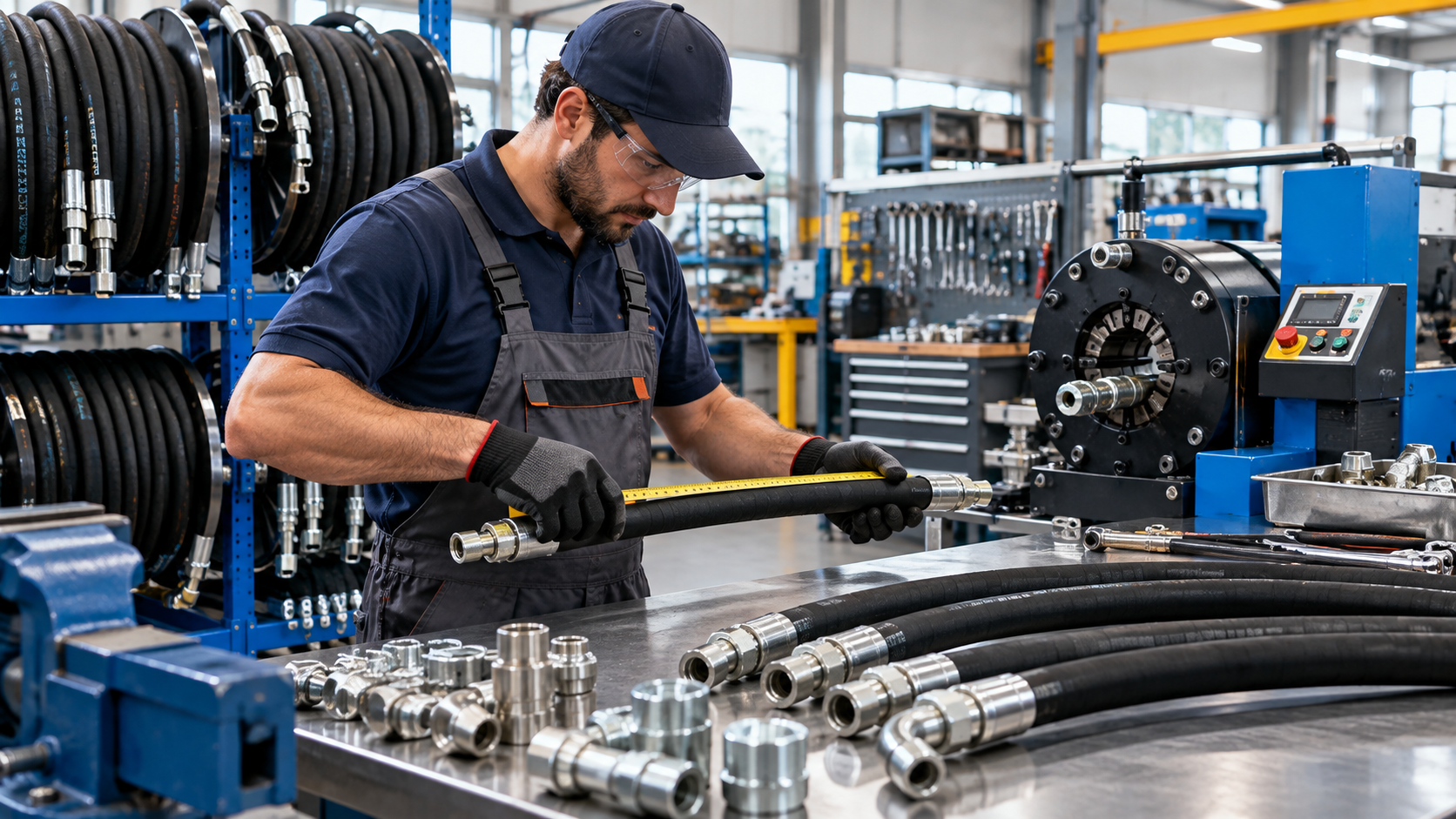
The finished assembly normally includes hydraulic hose, compatible end fittings and professionally crimped connections.
Specifications may include:
- Hose inside diameter
- Overall assembly length
- Working pressure
- Operating temperature
- Hydraulic fluid type
- End connection types
- Fitting size
- Fitting orientation
- Bend requirements
- Environmental conditions
- Abrasion protection
- Application details
The supplier uses this information to select components that are designed to work together.
SAE J1273 provides industry guidance covering the selection, routing, fabrication, installation, replacement, maintenance and storage of hydraulic hose assemblies. This illustrates why hose selection involves the complete application rather than one measurement alone.
Why Custom Hydraulic Hoses Are Often Necessary
Many machines use hose assemblies that have specific lengths and connection styles.
A standard hose may be too long, too short or equipped with the wrong ends.
An incorrect length can also affect routing.
A hose that is too short may become stretched as equipment moves, while excessive hose length can create unnecessary bends, rubbing or interference.
Custom manufacturing allows the assembly to be matched more closely to the equipment.
It can also make replacement easier when an original hose is damaged but the machine manufacturer part is difficult to obtain.
7 Easy Proven Tips to Order Custom Hydraulic Hoses Correctly
A reliable order starts with accurate information.
The following seven areas cover the most important details to confirm before a hose assembly is made.
1. Identify the Correct Hydraulic Hose Size
Hose size has a direct effect on hydraulic fluid flow.
One of the most important measurements is the inside diameter.
Gates uses the STAMPED selection approach for hydraulic hoses, covering Size, Temperature, Application, Medium, Pressure, Ends and Delivery. Its hydraulic hose guidance warns that an inside diameter that is too small can increase pressure loss and heat through excessive fluid turbulence, while unnecessary oversizing can increase cost, weight and bulk.
This means size should not be estimated by looking at the outside of a hose.
The outside diameter includes reinforcement and cover materials, so it does not directly identify the fluid passage size.
How to Find Hydraulic Hose Size
Start by checking the printed information on the existing hose.
The hose layline may identify the manufacturer, product family, size and specification.
If the markings are readable, provide that information to the supplier.
When the markings are missing or damaged, the supplier may need to identify the hose based on measurements and application information.
Gates advises using the existing hose layline when identifying replacement size and notes that inside diameter can be measured if the original identification is no longer available.
Do Not Guess Hose Size From the Fitting Alone
Two assemblies can use fittings that appear similar while using different hose sizes or construction.
Provide as much original information as possible.
If practical, bringing the complete old assembly to a qualified hydraulic hose supplier can reduce identification errors.
2. Know the Maximum System Pressure
Pressure rating is one of the most important safety specifications.
The hose must be suitable for the actual working pressure of the system.
Parker states that the published maximum recommended working pressure of the hose should be equal to or greater than the maximum system pressure. It also notes that surge or peak transient pressures must remain below the hose’s published working pressure.
This is important because hydraulic systems may experience short pressure spikes that are not obvious from an ordinary mechanical pressure gauge.
Do not select a hose based on burst pressure.
Burst pressure is a test and design value, not the pressure at which the hose should normally operate.
Parker specifically warns against using burst pressure to determine acceptable working pressure.
Information to Provide About Pressure
Tell the hose supplier:
- Normal operating pressure
- Maximum system pressure
- Known pressure surges
- Whether the application includes suction
- Whether the system experiences frequent pressure cycles
A supplier cannot make a reliable selection if the actual application pressure is unknown.
3. Confirm Temperature Requirements
Temperature affects hose performance.
Both the temperature of the fluid and the temperature surrounding the hose matter.
A hose running near an engine, exhaust system, furnace or other heat source may face higher external temperatures than the hydraulic fluid itself.
Likewise, very cold environments can influence hose flexibility and material performance.
Parker notes that final hose selection depends on factors including pressure, fluid temperature and ambient temperature.
Consider Fluid and Ambient Temperature Separately
Do not report only the weather temperature.
A hydraulic system can operate at a much higher fluid temperature than the surrounding air.
Likewise, a hose routed close to a heat source may require protection even when the hydraulic oil remains within the hose specification.
For demanding applications, the supplier may recommend a hose construction, cover or protective sleeve designed for the environment.
4. Check Hydraulic Fluid Compatibility
Hydraulic hoses are made from different materials.
Not every hose tube or fitting material is suitable for every fluid.
Common applications may involve petroleum based hydraulic oils, synthetic fluids, water based fluids or specialised media.
Chemical compatibility should always be checked rather than assumed.
Parker’s hydraulic hose guidance recommends selecting hose and fitting materials according to the medium being carried and explains that fluid compatibility is only one part of the complete application review.
Tell the Supplier Exactly What Fluid Is Used
Provide the exact fluid name or specification when possible.
Saying only hydraulic oil may not provide enough information in a specialised system.
The supplier may need to consider:
- Base fluid
- Additives
- Operating temperature
- Concentration
- Environmental exposure
- Compatibility with seals and fittings
This becomes especially important when replacing hoses in industrial processes using unusual fluids.
5. Identify the Correct Hose Ends and Fittings
Hydraulic connections come in many different configurations.
Threads that look similar may use different sealing methods, thread forms or dimensions.
A fitting may seal through a tapered thread, an O ring, a flare, a cone or another connection design.
Trying to identify a hydraulic fitting only by visual appearance can therefore result in the wrong part.
Information That Helps Identify Fittings
Useful information includes:
- Thread outside diameter
- Thread pitch
- Male or female connection
- Straight or angled fitting
- Sealing surface
- Fitting orientation
- Existing manufacturer information
If possible, provide the original assembly.
A qualified technician can often identify the ends more reliably using thread gauges, measuring tools and fitting references.
Do Not Mix Unapproved Hose and Fitting Systems
Hydraulic hose, couplings and crimp specifications are engineered as systems.
Parker warns against mixing its hoses with another manufacturer’s fittings because hose, fittings and assembly equipment are designed to operate as an integrated system.
The broader lesson is important regardless of brand.
Use combinations that are approved by the manufacturer or assembly system rather than assuming that physically similar components are automatically compatible.
6. Measure Custom Hydraulic Hose Length Correctly
Length sounds simple, but incorrect measurement is a common source of ordering errors.
Hydraulic hose assembly length is generally measured between defined points on the end fittings, not simply according to the visible rubber section.
Different fitting types can also affect the measurement points.
For this reason, copying only the exposed hose length from an old assembly may produce an incorrect replacement.
Consider Equipment Movement
A hydraulic hose may change position as a boom, arm, cylinder or steering mechanism moves.
The correct assembly must accommodate that movement without excessive tension, twisting or bending.
SAE J1273 includes routing and installation as important parts of hydraulic hose assembly practice.
Before placing an order, consider the complete movement range of the machine.
A hose that fits while equipment is stationary may become too tight when the component moves.
7. Explain the Application Before You Order
Application information brings all the specifications together.
A supplier should know what the hose is doing and where it will operate.
Two hoses with identical size and pressure requirements may still need different constructions because one operates inside protected factory equipment while another works on a construction machine exposed to abrasion, mud and constant movement.
Describe:
- Equipment type
- Hose function
- Operating environment
- Frequency of movement
- Abrasion exposure
- Weather exposure
- Tight routing areas
- Nearby heat sources
- Electrical hazards where relevant
- Required protective covers or sleeves
Gates includes Application as a core part of its STAMPED hose selection process because the operating conditions help determine what type of assembly is appropriate.
What Information Should You Have Before Ordering?
Good preparation can make the ordering process faster and reduce the risk of receiving an unsuitable assembly.
Gather the following information before contacting the supplier:
- Hose identification from the original layline
- Inside diameter
- Complete assembly length
- Maximum system pressure
- Hydraulic fluid type
- Fluid temperature
- Ambient temperature
- Fitting types
- Fitting sizes
- Fitting orientation
- Application description
- Quantity needed
Photographs can also help with initial identification, although measurements and physical inspection are usually more reliable.
Keep the Old Hydraulic Hose When Possible
An old assembly can provide valuable information.
Even when the hose itself has failed, the fittings, dimensions and remaining markings can help a technician understand the original configuration.
Do not clean or modify the assembly so aggressively that useful identification marks disappear.
If the hose failed during operation, information about the failure location can also help determine whether routing, abrasion or another system issue contributed.
Hydraulic Hose Construction Explained
A typical hydraulic hose contains several layers with different functions.
Inner Tube
The inner tube carries the hydraulic fluid.
Its material must be compatible with the medium being transported.
Reinforcement
Reinforcement helps the hose withstand system pressure.
Depending on the hose design, reinforcement may use textile material, wire braid or spiral wire construction.
The required design depends on pressure, size, flexibility and application.
Outer Cover
The outer cover protects the reinforcement against environmental exposure.
Different covers may provide additional resistance to abrasion, weather, oil or other operating conditions.
Selecting a hose should therefore involve the complete construction rather than only pressure rating.
Why Minimum Bend Radius Matters
Hydraulic hose is flexible, but it cannot be bent without limits.
Every hose design has a specified minimum bend radius.
Routing the hose more tightly than permitted can stress the reinforcement and reduce service life.
The hose should also not be forced into a sharp bend immediately next to a fitting.
Routing should allow natural movement while limiting rubbing and unnecessary flexing.
Gates includes dedicated routing guidance in its current hydraulic hose catalog, reflecting the importance of routing to assembly performance.
Protecting Custom Hydraulic Hoses From Abrasion
Abrasion is common on mobile equipment.
A hose that repeatedly rubs against a frame, another hose or a moving component may eventually wear through its outer cover.
The best solution is usually correct routing first.
Where contact cannot be completely avoided, protective sleeves, guards or clamps may be appropriate.
Regular inspections should look for:
- Exposed reinforcement
- Cuts
- Cracks
- Flattened sections
- Kinks
- Damaged fittings
- Leaks
- Severe rubbing
- Cover deterioration
A hose showing serious damage should be evaluated and replaced according to applicable maintenance requirements.
Hydraulic Hose Safety Matters
Hydraulic systems can operate at pressures capable of causing serious injuries.
Parker’s hose safety guidance identifies hazards including fittings being thrown off, high velocity fluid discharge, hose whipping and high pressure fluid injection injuries.
OSHA accident records document workers being hospitalised after hydraulic fluid was injected through the skin from damaged hoses and connections.
Never Search for a Hydraulic Leak With Your Hand
A very small leak may be difficult to see.
Do not run a hand over a pressurised hose to find it.
OSHA guidance addressing hydraulic equipment specifically recognises the danger of high pressure hydraulic oil injection and states that workers should not use body parts to locate or stop hydraulic leaks.
If a high pressure fluid injection injury is suspected, it should be treated as a medical emergency even when the external wound looks small.
Relieve System Pressure Before Service
Equipment should be placed in a safe condition and hydraulic energy controlled before components are disconnected or serviced.
The exact procedure depends on the machine and workplace.
Follow equipment manufacturer instructions and applicable workplace safety procedures.
Custom Hydraulic Hoses for Different Industries
Custom assemblies are used wherever flexible fluid power connections are required.
Construction Equipment
Excavators, loaders, cranes, compact equipment and other construction machines often contain numerous hydraulic lines.
These hoses may experience movement, dirt, vibration and abrasion.
Agricultural Machinery
Tractors, harvesters and agricultural implements rely heavily on hydraulic systems.
Replacement hoses may need to withstand outdoor exposure and frequent equipment connection.
Manufacturing Equipment
Industrial machines can use hydraulic hoses for presses, material handling systems, automation equipment and production machinery.
Downtime can make correct replacement especially important.
Material Handling
Forklifts and similar machines rely on hydraulic systems for lifting and other functions.
Hose routing must account for moving components and regular working cycles.
Should You Order Hydraulic Hoses Online?
Ordering online can be convenient when every specification is already known.
It is best suited to repeat orders or assemblies with clearly documented requirements.
You should be able to provide the exact hose, ends, size, length and orientation without guessing.
For an unknown or damaged assembly, visiting a qualified hose shop can be safer because technicians can physically inspect the components.
When Online Ordering Works Well
Online ordering may be suitable when:
- You have an existing part specification
- You know the fitting types
- Length is accurately documented
- Working pressure is known
- Fluid compatibility is confirmed
- The application is already validated
When Professional Identification Is Better
Professional assistance is preferable when:
- Fittings cannot be identified
- The hose markings are missing
- The original assembly failed unexpectedly
- The application has unusual fluids
- Operating pressure is uncertain
- Routing needs to be changed
Guessing is not a good strategy for a pressurised hydraulic system.
Can a Damaged Hydraulic Hose Be Repaired?
A damaged pressure hose should not automatically be treated like an ordinary rubber tube.
The hose assembly is engineered around its hose, reinforcement, ends and crimp.
A damaged section can indicate that the integrity of the assembly has been compromised.
For many hydraulic applications, replacement of the complete assembly is the appropriate approach rather than attempting an improvised patch.
SAE J1273 specifically addresses replacement and maintenance as part of hydraulic hose assembly practice.
The equipment manufacturer or qualified hydraulic hose professional should determine the correct replacement procedure for the application.
How to Make Reordering Custom Hydraulic Hoses Easier
Businesses that regularly replace hydraulic hoses can save time by maintaining accurate assembly records.
Give each frequently used assembly an internal reference number.
Record:
- Hose type
- Hose size
- Length
- Fittings
- Fitting orientation
- Pressure requirements
- Machine location
- Equipment model
- Supplier part number
Photographs can be added to the record for identification.
Once the assembly has been properly specified and validated, future orders become much easier.
Create a Hose Identification System
Labelling important assemblies can reduce confusion when a machine contains many similar hoses.
The identification should correspond with maintenance records so technicians can quickly determine which approved assembly is required.
This can also help purchasing teams avoid ordering only from memory or appearance.
Common Mistakes When You Order Custom Hydraulic Hoses
One common mistake is copying only the length of an old hose.
A correct replacement also requires suitable size, pressure, fittings, fluid compatibility and temperature rating.
Other mistakes include:
- Guessing thread types
- Ignoring pressure surges
- Using burst pressure as working pressure
- Mixing unapproved hose and fitting components
- Measuring the hose incorrectly
- Forgetting fitting orientation
- Ignoring minimum bend radius
- Failing to consider abrasion
- Ordering before confirming hydraulic fluid type
- Choosing based only on price
A custom hose should be specified as a complete assembly designed for its application.
Frequently Asked Questions
What information do I need to Order Custom Hydraulic Hoses?
Provide the hose size, length, maximum pressure, temperature, fluid type, fitting types, fitting orientation and details about where the hose will operate.
Can a hydraulic hose be made to any length?
Assemblies can be produced in many lengths, but the final dimensions must still allow correct routing, equipment movement and the hose manufacturer’s bend requirements.
How do I identify hydraulic hose fittings?
Check thread diameter, pitch, connection gender and sealing style. When identification is uncertain, have the original fitting inspected by a qualified hydraulic hose technician.
Can I use a hose with a higher pressure rating?
The replacement must meet the full application requirements, not pressure alone. Size, fluid compatibility, temperature, fittings and routing still need to be correct.
How often should hydraulic hoses be replaced?
There is no single replacement interval suitable for every application. Inspection, operating conditions, manufacturer guidance and applicable maintenance standards should determine replacement.
Is it safe to repair a leaking hydraulic hose?
Improvised repairs on pressurised hydraulic hoses can be dangerous. Depressurise the equipment and have the damaged assembly evaluated and replaced using approved components and procedures.
Conclusion
When you Order Custom Hydraulic Hoses, accurate specifications are essential for both equipment performance and safety. Size, pressure, temperature, fluid compatibility, fittings, length and routing should all be reviewed before an assembly is manufactured. Working with a qualified supplier and maintaining clear hose records can make future replacement faster, reduce ordering mistakes and help keep hydraulic equipment operating reliably.