Playground Installation Services: How to Build a Safer, Engaging Play Space
Professional playground installation services help transform an empty outdoor area into a carefully planned play environment by coordinating site preparation, equipment assembly, anchoring, protective surfacing, accessibility, drainage, inspections, and ongoing maintenance needs. Whether the project is intended for a school, childcare facility, public park, homeowners association, church, apartment community, or private property, equipment selection is only part of the process. Age appropriateness, use zones, fall protection, accessibility requirements, manufacturer specifications, applicable safety standards, permits, and local site conditions all influence the final design. Understanding these elements helps property owners compare installers and make better decisions from initial planning through opening day.
What Are Playground Installation Services?
Playground installation services involve the planning, site preparation, assembly, placement, anchoring, surfacing, and completion of playground equipment at a designated site.
The scope differs among contractors. Some companies provide complete turnkey services, while others only assemble equipment supplied by the customer.
A comprehensive commercial project can involve:
• Site assessment
• Playground layout
• Utility locating
• Grading
• Drainage preparation
• Equipment assembly
• Footings and anchoring
• Safety surfacing
• Accessible routes
• Borders or curbing
• Site furnishings
• Final inspection
• Maintenance documentation
Understanding exactly which tasks are included is important when comparing proposals.
Why Professional Playground Installation Matters
Commercial playground equipment is a system of interconnected components rather than a collection of independent toys.
Incorrect spacing, assembly, anchoring, surfacing, or hardware installation can introduce avoidable hazards and can conflict with manufacturer requirements.
Professional installation also helps coordinate multiple technical concerns that may not be obvious from looking at an equipment catalog.
Residential Versus Commercial Playground Installation
A backyard playset and a large public playground have different requirements.
Commercial playgrounds serve larger numbers of users and are commonly designed around established standards, accessibility requirements, inspection procedures, and public or organizational risk management practices.
Residential equipment should still be installed according to manufacturer instructions, with appropriate clearances and impact attenuating surfacing where specified.
7 Powerful Playground Installation Services Benefits
Experienced installers can add value throughout the project, particularly when they are involved before equipment is ordered. The following seven areas deserve attention.
1. Playground Installation Services Start With Site Planning
Successful installation begins by understanding the site.
Equipment should not simply be placed wherever open land appears available.
Evaluate the Available Space
A site assessment should consider:
• Property boundaries
• Existing structures
• Slopes
• Drainage
• Trees
• Overhead obstructions
• Underground utilities
• Vehicular traffic
• Pedestrian circulation
• Sun exposure
• Accessible routes
• Emergency access
• Future development
These conditions can influence both playground layout and project cost.
Use Zones Require Adequate Space
Playground equipment typically requires surrounding areas that allow users to enter, exit, and use components appropriately.
The required layout depends on the equipment and applicable standards.
Swings Need Special Planning
Moving equipment such as swings has different spatial requirements from stationary play panels or platforms.
A professional designer should use manufacturer documentation and applicable standards to establish suitable use zones rather than relying on visual estimates.
Consider Supervision and Sightlines
Adults responsible for children benefit from clear visibility across the play environment.
Large structures, landscaping, fencing, and site furnishings can block sightlines when poorly positioned.
Planning should consider how the space will actually be supervised.
2. Choose Age Appropriate Playground Equipment
Playground activities should match the developmental abilities of intended users.
Equipment designed for older children can create challenges that are inappropriate for much younger users.
Define the Intended Age Group
Before selecting equipment, determine which children are expected to use the site.
A childcare playground serving young children may need a very different design from an elementary school or community park.
Separate Activities When Appropriate
Where facilities serve multiple age ranges, design can help distinguish areas intended for different users.
Signage and layout can reinforce appropriate use.
Equipment manufacturers commonly identify intended age ranges for their products.
Offer Different Types of Play
An engaging playground can support varied activities rather than relying exclusively on slides.
Depending on the intended users, options can include:
• Climbing
• Sliding
• Swinging
• Balance activities
• Sensory play
• Social play
• Imaginative activities
• Musical features
• Ground level activities
• Accessible play components
Variety can provide children with multiple ways to participate.
3. Playground Installation Services Prioritize Protective Surfacing
Falls are an important playground safety concern.
Appropriate impact attenuating surfacing beneath and around applicable equipment is therefore a central design consideration.
Common Playground Surfacing Options
Depending on the project, surfaces can include:
• Engineered wood fiber
• Poured in place resilient surfacing
• Rubber tiles designed for playground use
• Synthetic turf systems with appropriate impact layers
• Other tested playground surfacing systems
Each option has different installation, accessibility, drainage, maintenance, and lifecycle characteristics.
Surface Performance Matters More Than Appearance
A brightly colored surface is not necessarily suitable playground safety surfacing.
Products should have performance documentation appropriate to the equipment and anticipated fall heights.
Critical Fall Height
Playground surfacing is commonly evaluated in relation to fall height using applicable impact attenuation test methods.
The selected surface system should be appropriate for the equipment under which it is installed.
This is a technical design requirement, not something that should be estimated by appearance or softness alone.
Loose Fill Surfacing Needs Maintenance
Materials such as engineered wood fiber can migrate, compact, or become displaced through use.
Maintaining appropriate depth is part of ongoing playground care.
Wear areas, particularly beneath swings, at slide exits, and around high traffic locations, need regular attention.
4. Accessibility Should Be Built Into Playground Installation Services
Accessible play is easier to achieve when incorporated during the design stage rather than added as an afterthought.
In the United States, certain public and commercial playground projects can be subject to accessibility requirements under the Americans with Disabilities Act and applicable standards.
Accessible Routes
Playgrounds may require accessible routes connecting eligible play components.
Surface firmness, stability, slope, transitions, and route dimensions can influence accessibility.
Ground Level Play Components
Accessible design involves more than simply providing a pathway to the playground.
Ground level play experiences can offer meaningful options for children with different mobility and developmental needs.
Inclusive Design Goes Beyond Minimum Compliance
A technically accessible playground is not automatically an inclusive play environment.
Designers can consider sensory experiences, social interaction, transfer opportunities, quiet spaces, varied challenge levels, and activities usable in different ways.
Consider Caregivers Too
Accessible routes, seating, entrances, and circulation can also matter for parents, grandparents, teachers, and caregivers with disabilities.
The complete environment should be considered.
5. Professional Playground Installation Services Follow Equipment Specifications
Manufacturer instructions are essential because each play system has specific assembly and anchoring requirements.
Commercial equipment can contain numerous posts, decks, barriers, panels, slides, clamps, hardware components, and foundations.
Correct Anchoring Is Essential
Equipment needs to remain stable during normal intended use.
Foundation requirements depend on the product, soil, installation type, and engineering.
Installers should follow documented requirements regarding footing dimensions, concrete, post depth, anchors, and curing conditions.
Do Not Improvise Structural Components
Substituting unapproved bolts, brackets, posts, or other components can affect equipment performance.
Use manufacturer approved parts and procedures.
Hardware Needs Correct Installation
Fasteners need to be installed in the specified locations and tightened appropriately.
Exposed projections, missing protective components, or improperly installed hardware can create hazards.
A final inspection should verify assembly before users are permitted onto the playground.
6. Playground Installation Services Can Coordinate Codes and Safety Standards
Rules vary according to property type, ownership, jurisdiction, and intended use.
Project owners should determine which standards and legal requirements apply before construction.
Playground Safety Guidance
In the United States, the Consumer Product Safety Commission publishes the Public Playground Safety Handbook, which provides guidance covering issues such as layout, equipment, surfacing, and maintenance.
ASTM International also publishes standards relevant to public playground equipment and impact attenuating surfacing.
Standards Can Change
Project teams should use current versions of applicable requirements rather than relying on an old checklist or outdated internet article.
Manufacturers and qualified playground professionals can help identify standards relevant to the project.
Local Permits
Depending on jurisdiction and scope, playground installation may involve permits or approvals related to:
• Construction
• Site work
• Accessibility
• Electrical systems
• Shade structures
• Drainage
• Fencing
• Zoning
• Building setbacks
• Public facilities
Confirm current requirements with the appropriate local authority.
7. Playground Installation Services Should Include Inspection Planning
Installation is not complete simply because every piece of equipment appears assembled.
A systematic inspection should occur before the playground opens.
Post Installation Inspection
The final review can verify:
• Equipment assembly
• Hardware
• Anchoring
• Use zones
• Surfacing
• Accessibility
• Clearances
• Entrapment related concerns
• Protrusions
• Moving equipment
• Site cleanup
• Manufacturer requirements
The appropriate inspection process depends on facility type and applicable standards.
Certified Playground Safety Inspectors
In the United States, some organizations use Certified Playground Safety Inspectors, commonly known as CPSIs, to assess playground conditions.
Certification does not eliminate the owner’s responsibility for maintenance, but qualified inspection can provide valuable independent review.
Keep Inspection Documentation
Maintain records of:
• Installation
• Equipment manufacturer information
• Warranties
• Inspections
• Repairs
• Surfacing maintenance
• Replacement components
• Reported incidents
Documentation supports consistent long term management.
How the Playground Installation Process Works
A professional project generally progresses through distinct planning and construction stages.
The exact sequence changes with site and equipment.
Initial Playground Site Assessment
The installer or design team reviews the available area and project goals.
Important questions include expected users, age groups, daily capacity, budget, accessibility, supervision needs, and desired play activities.
Measure the Site Accurately
Property measurements should account for boundaries, buildings, utilities, trees, slopes, and other permanent features.
For significant projects, survey information may be appropriate.
Locate Underground Utilities
Excavation for footings, drainage, fencing, or site work can encounter buried utilities.
In the United States, use the applicable utility notification process, commonly reached through 811, before digging as required.
Private utilities may require additional locating services.
Playground Design and Equipment Selection
The design stage coordinates individual equipment components into a complete play environment.
The objective should be functional variety without sacrificing required space and safety considerations.
Consider Playground Capacity
The expected number of children can influence equipment quantity, circulation, seating, and site size.
A small playground designed for limited residential use is not equivalent to a school facility serving many children during recess.
Plan for Future Expansion
If future growth is expected, reserve space where practical.
Expanding later can be difficult if the original installation consumes all available area or creates incompatible use zones.
Site Preparation for Playground Installation
Site preparation can involve demolition, excavation, grading, drainage work, and base construction.
Poor preparation can create drainage problems even when equipment is correctly assembled.
Grading and Drainage
Water should not routinely collect beneath play structures or within surfacing.
Standing water can interfere with use, accelerate deterioration, displace loose materials, and create maintenance problems.
Subbase Preparation
Some safety surfaces require carefully prepared aggregate, concrete, drainage, or other bases.
Follow surfacing manufacturer requirements.
The visible top layer is only one part of the installed system.
Installing Playground Equipment
Components should be organized and checked against project drawings before assembly.
Missing or damaged parts should be resolved rather than substituted informally.
Foundations and Footings
Installers establish post locations and foundations according to design drawings and manufacturer instructions.
Measurements should be checked before concrete or other permanent anchoring is completed.
Equipment Assembly
Structures are assembled using specified hardware and connections.
Alignment matters because an error at one post can affect decks, bridges, slides, barriers, and other connected components.
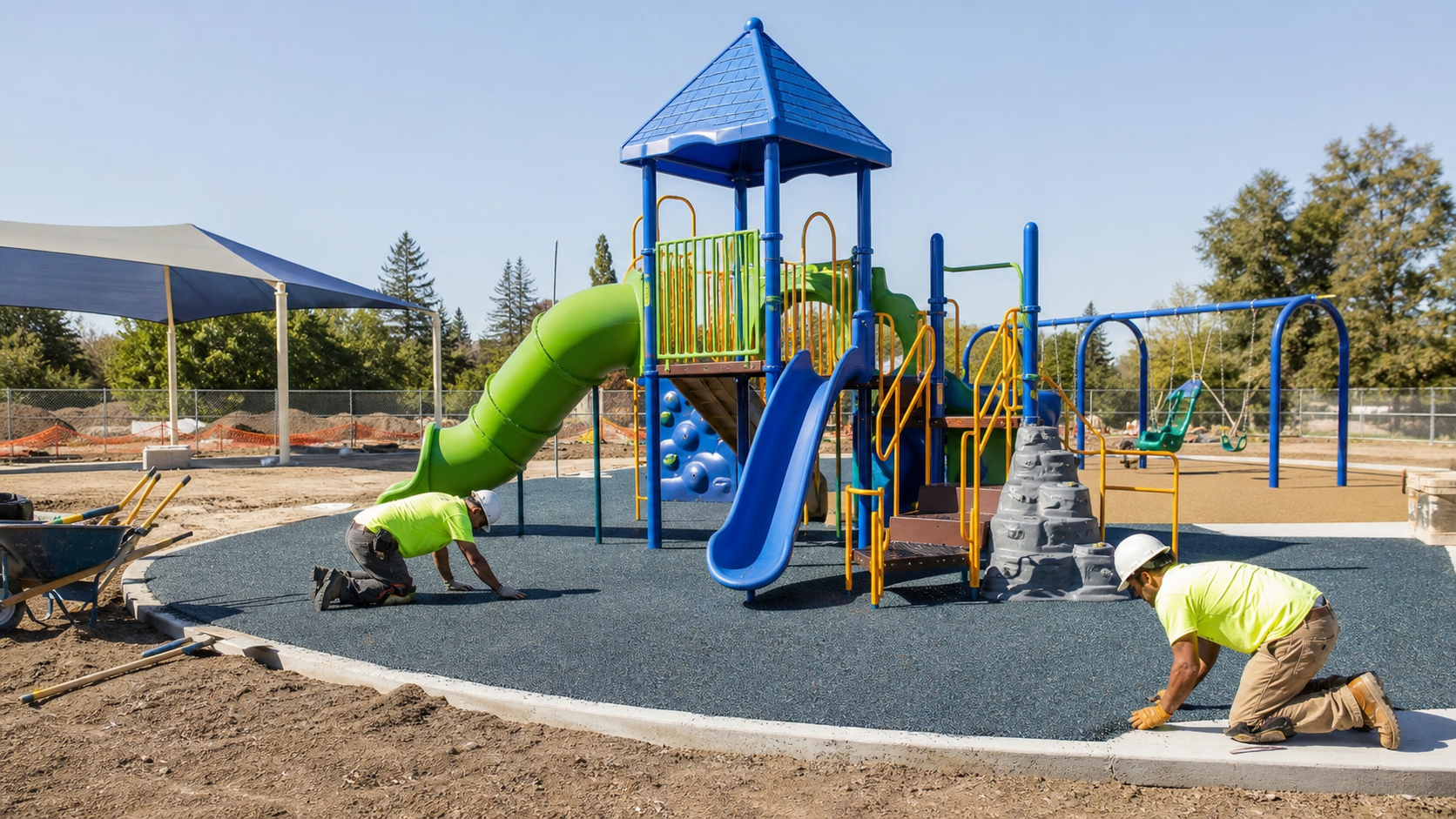
Playground Safety Surfacing Installation
Surfacing is installed according to the selected system after site and equipment work has reached the appropriate stage.
Requirements differ among loose fill and unitary surfaces.
Poured in Place Surfacing
Poured systems commonly use multiple layers designed to work together.
Installation conditions such as temperature and moisture can affect certain products.
Engineered Wood Fiber
Engineered wood fiber intended for playground applications should not be confused with ordinary landscape mulch.
Product performance, installation depth, containment, drainage, and ongoing maintenance all need consideration.
Final Playground Inspection
The site should remain closed until the installation is complete and appropriate inspections have occurred.
Construction materials and incomplete equipment can create hazards.
Correct Deficiencies Before Opening
Missing hardware, inadequate surfacing, incomplete barriers, construction debris, or other deficiencies should be resolved before children use the playground.
Establish the Maintenance Schedule
Owners should receive relevant manufacturer instructions and maintenance information.
Responsibility for routine inspections should be assigned before opening day.
Residential Playground Installation Services
Backyard play equipment has smaller scale requirements but still needs careful installation.
Homeowners should follow the manufacturer’s instructions regarding placement, anchoring, spacing, surfacing, and supervision.
Choose a Suitable Backyard Location
Avoid locations with hidden or obvious hazards.
Consider:
• Traffic
• Driveways
• Water features
• Tree limbs
• Utilities
• Slopes
• Drainage
• Fences
• Structures
• Sun exposure
The installation should also preserve appropriate clearance around moving equipment.
Residential Safety Surfacing
Grass and soil can become compacted and may not provide sufficient impact attenuation for relevant fall heights.
Use surfacing recommendations appropriate to the play equipment and follow current safety guidance.
Commercial Playground Installation Services
Schools, parks, childcare centers, apartment communities, and public facilities generally require more complex planning.
High use levels increase the importance of durability and maintenance.
School Playgrounds
School projects should coordinate age groups, supervision, scheduling, accessible circulation, equipment capacity, and applicable district requirements.
Construction may need to occur during restricted periods to minimize disruption.
Childcare Playgrounds
Childcare facilities serve younger users and can be subject to state or local licensing requirements.
Equipment, fencing, surfacing, and supervision design should reflect the ages being served.
Parks and Community Playgrounds
Public parks may serve broad age groups and high daily traffic.
Design needs can extend beyond equipment to parking, pathways, shade, seating, restrooms, landscaping, and accessibility.
Playground Installation Services and Shade
Play equipment and surfacing can become hot in direct sunlight.
Shade planning can improve comfort, although it should not interfere with equipment clearances.
Natural Shade
Existing mature trees can provide useful shade but need assessment for branch condition, roots, debris, and interference with equipment.
Tree roots may also affect surfacing over time.
Shade Structures
Engineered shade structures can provide more predictable coverage.
Their foundations, wind loads, permits, positioning, and clearances should be integrated into the original site plan.
Playground Fencing and Gates
Some facilities need fencing to control access, separate play areas from traffic, or meet licensing requirements.
Fence design should avoid creating additional hazards.
Gate Placement
Gates should support safe circulation and emergency access.
Childcare requirements can include specific gate or fence provisions depending on jurisdiction.
Avoid Climbing Conflicts
Fence location relative to equipment should account for how children may interact with nearby structures.
Use zones should not be compromised merely to fit a fence around the site.
Playground Installation Services for Inclusive Play
Inclusive playgrounds aim to provide meaningful participation opportunities for children with varied physical, sensory, cognitive, and developmental characteristics.
No single piece of equipment makes a playground inclusive.
Provide Variety
Possible design features include:
• Ground level activities
• Accessible elevated routes where applicable
• Sensory panels
• Musical components
• Cooperative play opportunities
• Quiet areas
• Accessible swings
• Transfer systems
• Varied challenge levels
Features should be integrated rather than isolated from the main play environment.
Accessibility and Inclusion Are Related but Different
Accessibility generally refers to meeting specific technical access requirements.
Inclusion is a broader design goal focused on meaningful participation.
High quality projects consider both.
Playground Installation Services Cost
There is no universal installation price because projects differ greatly in size and complexity.
Equipment itself may represent only one part of the total budget.
Playground Installation Cost Factors
Potential expenses include:
• Equipment
• Freight
• Design
• Site preparation
• Excavation
• Drainage
• Concrete
• Installation labor
• Safety surfacing
• Accessible routes
• Borders
• Fencing
• Shade
• Landscaping
• Permits
• Inspections
• Site furnishings
• Removal of existing equipment
A complete budget should account for the entire site rather than only catalog equipment prices.
Ask for an Itemized Proposal
An installer should clearly identify which services are included.
Compare proposals using equivalent scope and equipment specifications.
A lower installation price can reflect exclusions such as surfacing, excavation, drainage, freight, or final inspection.
DIY Versus Professional Playground Installation Services
Small residential playsets can sometimes be installed by homeowners who carefully follow manufacturer instructions.
Large commercial equipment is substantially more complex.
Commercial Installation Expertise
Commercial projects can involve engineered foundations, complex assembly, regulatory requirements, accessibility, specialized surfacing, and inspection.
Professional experience can reduce installation errors and improve coordination.
Manufacturer Certified Installation
Some manufacturers provide installer training or certification programs for their equipment.
Ask whether installers have experience with the exact product being purchased.
Manufacturer training is useful but should be considered alongside licensing, insurance, project history, and overall competence.
Choosing Playground Installation Services
Do not evaluate an installer solely on labor price.
The contractor should understand both equipment assembly and the complete site.
Questions to Ask an Installer
Consider asking:
• Have you installed this manufacturer’s equipment?
• Is site preparation included?
• Who handles utility locating?
• Who obtains permits?
• Is drainage included?
• Which surfacing system is proposed?
• How are use zones verified?
• Who handles accessibility details?
• Is a post installation inspection included?
• What warranty applies to installation?
• How are corrections handled?
Written answers reduce misunderstandings.
Verify Insurance and Qualifications
Contractor licensing requirements vary by jurisdiction.
Confirm applicable credentials, appropriate insurance, and experience with comparable playground projects.
Ask for recent references where appropriate.
Playground Maintenance After Installation
Playground ownership includes ongoing inspection and maintenance.
Normal use, weather, vandalism, landscaping, and material aging can change site conditions.
Routine Playground Inspection
Items to monitor can include:
• Loose hardware
• Broken components
• Worn moving parts
• Damaged surfacing
• Loose fill depth
• Exposed foundations
• Corrosion
• Sharp edges
• Damaged barriers
• Drainage
• Debris
• Vandalism
Inspection frequency should reflect manufacturer guidance, applicable standards, usage, and local conditions.
Repair Damaged Equipment Promptly
Restrict access to unsafe components until appropriate repairs are complete.
Replacement components should be compatible with the original equipment.
Improvised parts can create new hazards.
Common Playground Installation Mistakes
A frequent mistake is purchasing equipment before confirming whether the site is large enough for required use zones.
Another is treating safety surfacing as a decorative afterthought.
Inadequate Drainage
Water accumulation can undermine surfacing and make playground areas unusable.
Drainage should be considered before installation rather than repaired after repeated flooding.
Incorrect Equipment Spacing
Moving and stationary equipment require sufficient surrounding space.
Crowding more activities onto a small site does not necessarily create a better playground.
Poor Surfacing Maintenance Planning
Choosing a surface based only on installation cost can ignore future maintenance.
Evaluate lifecycle needs before committing to a product.
Frequently Asked Questions
What do playground installation services include?
Services can include design, site preparation, equipment assembly, anchoring, surfacing, accessible routes, drainage, inspections, and cleanup. Exact scope varies by contractor.
How much do playground installation services cost?
Costs depend on equipment, site size, grading, foundations, surfacing, accessibility, freight, permits, and labor. A site specific proposal provides the most useful pricing.
How long does playground installation take?
Duration depends on project size, site preparation, equipment complexity, surfacing, weather, curing requirements, permits, and inspections.
What is the safest playground surface?
There is no single best surface for every site. The system should meet applicable impact attenuation requirements for the equipment while also addressing accessibility and maintenance.
Do playground installations require permits?
Some projects require building, zoning, accessibility, drainage, electrical, or other approvals. Requirements depend on the project and local jurisdiction.
Should commercial playground equipment be professionally installed?
Professional installation is generally appropriate because commercial systems can involve complex assembly, foundations, use zones, accessibility, surfacing requirements, and safety inspections.
Conclusion
High quality playground installation services coordinate far more than equipment assembly. Site planning, age appropriate design, impact attenuating surfacing, accessibility, drainage, anchoring, applicable standards, and final inspection all contribute to a functional play environment. By selecting an experienced installer and planning for ongoing inspections and maintenance from the beginning, property owners can create an engaging playground designed around the needs of its actual users.