Standing Lamp: 9 Smart Ways to Choose the Perfect Floor Light
A standing lamp can change the atmosphere of a room without requiring major electrical work, new ceiling fixtures or permanent alterations. Positioned beside a sofa, reading chair, bed, console or empty corner, the right floor lamp can provide useful illumination while also working as a decorative feature that adds height, texture and visual balance to an interior.
Modern floor lamps are available in far more styles than the simple fabric-shade designs once common in homes. Today’s collections include sculptural metal frames, marble bases, glass globes, stainless-steel structures, multi-light arrangements and outdoor-compatible designs.
The current Daze floor-lamp collection demonstrates this variety. Its catalog includes designs made with stainless steel, metal, glass and marble, with products ranging from the brushed-gold Yuri lamp to glass, marble and contemporary metal designs. The collection is intended for living rooms, bedrooms, entryways and other interior settings.
Choosing the right lamp, however, requires more than finding an attractive shape.
You should also consider:
- Room size
- Lighting purpose
- Lamp height
- Brightness
- Color temperature
- Shade design
- Base stability
- Interior materials
- Placement
This guide explains how to make those decisions and use floor lighting effectively throughout a modern home.
What Is a Standing Lamp?
A standing lamp is a freestanding lighting fixture designed to sit directly on the floor.
It is also commonly called a:
- Floor lamp
- Reading lamp
- Tall lamp
- Standard lamp
Unlike ceiling fixtures, it usually does not require permanent electrical installation.
Most designs simply plug into a nearby outlet.
This makes floor lamps particularly useful for people who want additional lighting without:
- Cutting into ceilings
- Installing new electrical boxes
- Rewiring rooms
- Making permanent changes
They can also be repositioned as furniture layouts change.
The standing lamp collection from Daze currently includes metal, stainless-steel, marble and glass designs, along with an outdoor floor lamp, illustrating how broad the category has become.
1. Decide What the Standing Lamp Needs to Do
The first question should not be:
Which design looks best?
Instead ask:
What type of light does this area need?
Floor lamps can serve several different functions.
Ambient Lighting
Ambient lighting provides general illumination for a room.
A lamp with:
- Multiple bulbs
- Frosted glass
- Wide shade
- Upward-facing diffuser
can distribute soft light across a larger area.
Daze specifically notes that frosted or smoked glass shades can diffuse illumination and help create softer ambient light with fewer harsh shadows.
Task Lighting
Task lighting is designed for activities such as:
- Reading
- Writing
- Working
- Crafting
For task use, the lamp should direct enough light toward the activity rather than simply illuminating the ceiling.
A floor lamp beside a reading chair can work well when its light source sits above or slightly behind the reader’s shoulder.
Accent Lighting
Accent lighting helps highlight:
- Artwork
- Furniture
- Architectural features
- Decorative corners
In this case, the lamp itself may become part of the visual composition.
A sculptural floor lamp can therefore function as both lighting and décor.
Mood Lighting
Soft floor lighting can create a calmer environment in the evening than relying entirely on bright overhead fixtures.
For living rooms, bedrooms and lounge spaces, layered lighting often feels more comfortable than one strong central source.
2. Choose the Right Height
Floor-lamp height affects both appearance and performance.
A lamp that is too short may disappear visually beside large furniture.
A lamp that is extremely tall may overpower a small room.
Typical Placement Beside a Sofa
When placing a lamp beside a sofa, the light source should generally sit high enough to illuminate the seating area without shining directly into people’s eyes.
The ideal height depends on:
- Sofa height
- Lamp design
- Shade position
- Seating arrangement
Instead of choosing purely by overall lamp height, consider where the bulb or shade will actually sit relative to seated eye level.
Example From the Daze Collection
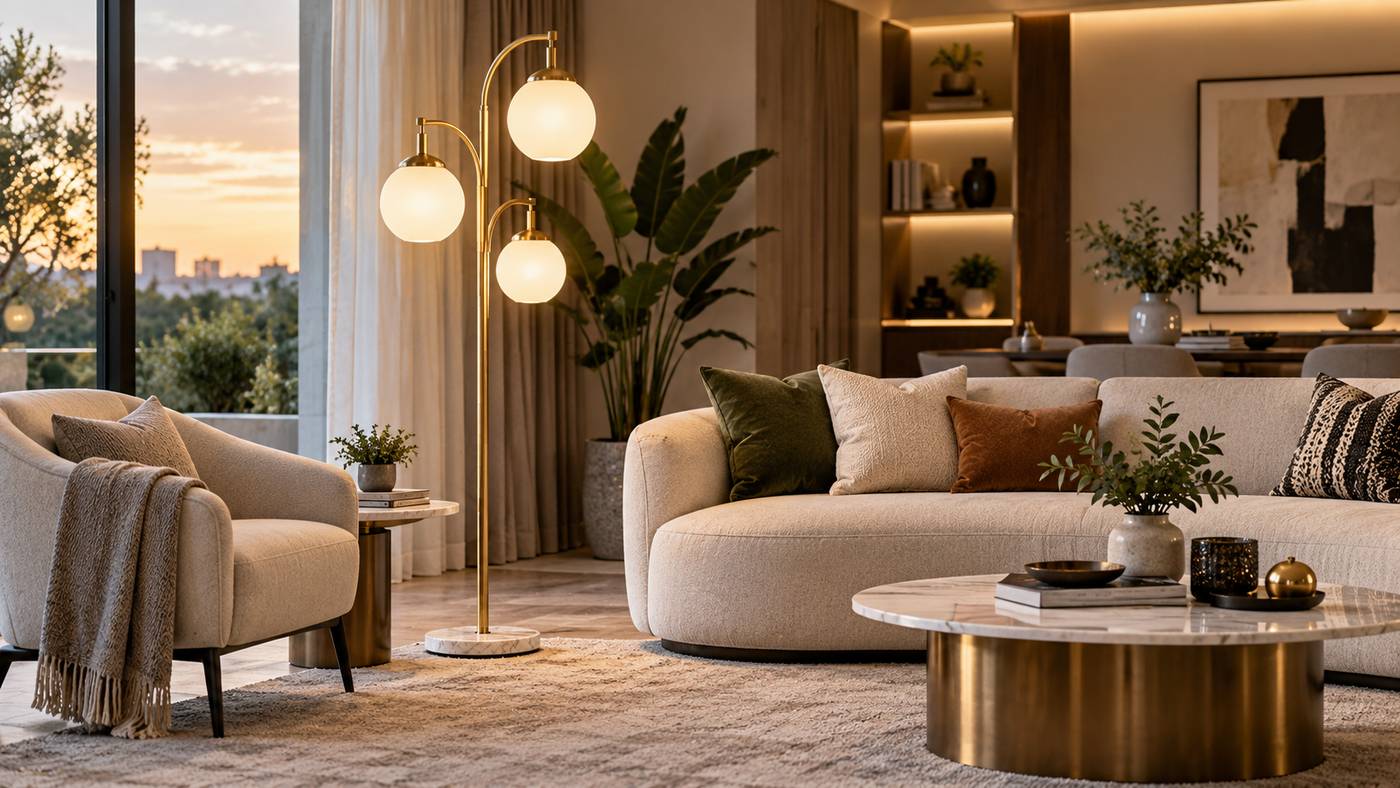
The Yuri Stainless Steel Floor Lamp is listed at approximately 150 cm high and 65 cm wide. Its brushed-gold stainless-steel structure incorporates opaline bulbs in three different shapes.
That type of measurement is useful because it helps buyers understand the lamp’s visual scale before placing it next to furniture.
Measure Before Buying
Before ordering a floor lamp:
- Measure the available floor area.
- Measure nearby furniture height.
- Check ceiling height.
- Mark the lamp’s approximate height on the wall.
This simple step can prevent a lamp from looking unexpectedly small or oversized.
3. Understand Lumens Instead of Just Watts
One of the most common lighting mistakes is evaluating brightness only through wattage.
Watts measure energy consumption.
Lumens measure light output.
ENERGY STAR recommends using lumens when choosing brightness rather than relying on watts. As a general comparison, an old 40-watt incandescent produced around 450 lumens, while a 60-watt incandescent was roughly equivalent to 800 lumens.
A useful reference is:
| Traditional Incandescent | Approximate Brightness |
|---|---|
| 40 W | 450 lumens |
| 60 W | 800 lumens |
| 75 W | 1,100 lumens |
| 100 W | 1,600 lumens |
| 150 W | 2,600 lumens |
How Many Lumens Does a Floor Lamp Need?
There is no single correct number.
A decorative mood lamp may need relatively modest output.
A reading lamp may require more focused illumination.
A multi-bulb standing lamp can produce much greater total output than a single-light fixture.
Always check:
- Maximum permitted bulb wattage
- Bulb socket type
- Number of bulbs
- Manufacturer instructions
Do not install a bulb that exceeds the fixture’s electrical rating.
4. Choose the Right Color Temperature
Brightness is only one part of lighting quality.
Color temperature affects how the entire room feels.
It is measured in Kelvin, written as K.
The U.S. Department of Energy describes common residential lighting around 2700K as warm and friendly, while higher color temperatures appear progressively cooler and whiter.
2700K: Warm and Relaxed
Around 2700K typically produces warm, slightly yellow light.
It works especially well in:
- Living rooms
- Bedrooms
- Lounges
- Hospitality-inspired interiors
Warm light complements materials such as:
- Wood
- Brass
- Beige upholstery
- Warm stone
3000K: Warm but Cleaner
Around 3000K remains welcoming but appears slightly clearer.
It can work well in contemporary homes where you want warmth without a very yellow appearance.
3500K–4100K: Neutral to Cool
These temperatures create a cleaner appearance and may be more appropriate in:
- Work areas
- Offices
- Utility spaces
DOE notes that approximately 2700K is commonly associated with warm residential environments, while around 4100K provides a cleaner, cooler appearance often used in offices and work-oriented spaces.
Match Nearby Lighting
Try not to combine dramatically different white-light temperatures in the same small room unless the contrast is intentional.
For example, pairing a very warm floor lamp with extremely cool ceiling lighting may make the room appear visually inconsistent.
5. Consider the Shade and Diffuser
The shade affects both the lamp’s appearance and how light enters the room.
Different shade materials produce different results.
Frosted Glass
Frosted glass softens light and helps reduce harsh glare.
It works particularly well for ambient lighting.
Daze’s current collection specifically highlights frosted and smoked glass globes as ways to produce a softer glow.
Opaline Glass
Opaline glass has a milky translucent appearance that diffuses the bulb.
The Daze Yuri floor lamp, for example, uses opaline bulbs in three shapes with a brushed-gold stainless-steel frame.
This can create a more decorative visual effect than an exposed standard bulb.
Fabric Shades
Fabric shades can make a room feel softer and more traditional.
They often direct light both upward and downward while reducing side glare.
Clear Glass
Clear glass can create a brighter and more dramatic appearance because the bulb remains visually prominent.
Decorative filament-style LEDs may work well in suitable clear fixtures, provided they meet the lamp manufacturer’s specifications.
6. Match the Material to Your Interior
A floor lamp is often tall enough to become a significant decorative object.
Its material should therefore relate to the rest of the room.
Metal Standing Lamps
Metal works especially well in:
- Modern interiors
- Minimalist rooms
- Contemporary apartments
- Industrial-inspired spaces
Finishes may include:
- Black
- Chrome
- Brushed steel
- Brass
- Gold
Daze’s current catalog includes several metal designs, including AURORA, FOGLIA, BOLTON, HELIOS, CICLO, LUCA and COSTELLA models.
Stainless Steel
Stainless steel can give a lamp a cleaner and more refined appearance.
Daze currently lists models including Yuri, VITRY and CAN CAN using stainless-steel construction.
Marble Bases
Marble introduces visual weight and a premium furniture-like character.
Daze lists several marble-based or marble-featured floor lamps, including BONBORI, STALA, STALO and MORELIA.
A marble base can work particularly well beside:
- Luxury sofas
- Stone coffee tables
- Brass accents
- Contemporary consoles
Glass
Glass floor lamps can feel lighter visually even when physically substantial.
Daze’s catalog currently includes glass models such as HALLO, ASTRA, UNO, MASSY and RAM.
7. Pay Attention to Base Stability
Floor lamps are tall objects with relatively high centers of gravity.
The base therefore deserves careful attention.
A good lamp should remain stable during normal use.
Daze describes its floor-lamp range as using sturdy weighted bases designed to improve stability.
Stability Is Especially Important When:
- Children live in the home
- Pets move around the room
- The lamp is beside a busy walkway
- The design has a large shade
- The lamp uses a long projecting arm
Avoid Awkward Placement
Do not position electrical cords where people regularly walk.
Where possible:
- Place the lamp near an outlet.
- Route the cable behind furniture.
- Avoid stretching the cord across open walkways.
- Follow manufacturer safety instructions.
A beautiful lamp becomes a poor choice if it introduces a constant trip hazard.
8. Use LED Lighting Efficiently
Modern LED bulbs offer substantial efficiency advantages compared with traditional incandescent lamps.
ENERGY STAR states that LED lighting products can produce light up to about 90% more efficiently than incandescent bulbs.
This makes LEDs particularly suitable for lamps that are used for several hours every evening.
Benefits of LEDs
LED bulbs can provide:
- Lower energy consumption
- Long operating life
- Multiple color temperatures
- Various brightness levels
- Dimming options on compatible systems
Check Compatibility
Not every LED bulb is appropriate for every fixture.
Confirm:
- Socket type
- Bulb shape
- Maximum fixture rating
- Dimming compatibility
ENERGY STAR also advises checking the fixture application and dimmer compatibility when selecting a bulb.
Integrated LED vs Replaceable Bulbs
Some modern standing lamps have built-in LED modules.
Others use replaceable bulbs.
Integrated LED
Advantages may include:
- Slimmer designs
- Specialized shapes
- Even light distribution
However, when the LED system eventually fails, replacement may require servicing or replacement of more than just a bulb.
Replaceable Bulbs
These offer flexibility because you can change:
- Brightness
- Color temperature
- Bulb style
without replacing the entire fixture.
9. Position a Standing Lamp Correctly
The same lamp can look completely different depending on where it is placed.
Beside a Sofa
A standing lamp can help visually frame the sofa and create evening ambient lighting.
Place it:
- Near one end of the sofa
- Behind the sofa corner
- Between two seating pieces
Make sure the lamp does not interfere with normal movement.
Beside a Reading Chair
This is one of the most functional locations.
Position the light so that it illuminates the reading material without producing uncomfortable glare.
In an Empty Corner
Tall lamps can visually fill unused vertical space.
This is especially effective in rooms where furniture is concentrated lower to the ground.
Beside a Console
A sculptural floor lamp can balance:
- Artwork
- Mirrors
- Decorative accessories
around a console or cabinet.
In a Bedroom
Floor lamps can work beside:
- Lounge chairs
- Dressers
- Reading corners
They may also replace bedside lamps where nightstands are small.
In an Entryway
A decorative standing lamp can make an entry feel more welcoming while adding vertical emphasis.
Just make sure it does not reduce the usable walking width.
Standing Lamp vs Table Lamp
Both can provide excellent lighting, but they solve different problems.
Standing Lamp Advantages
A standing lamp:
- Does not need a table
- Provides greater height
- Can produce broader illumination
- Can become a stronger decorative statement
Table Lamp Advantages
A table lamp:
- Works well on side tables
- Takes up less floor area
- Can be positioned close to seated users
Daze separates its lighting catalog into floor lamps, table lamps and chandeliers, which makes it easier to combine multiple lighting layers rather than relying on one fixture type.
Standing Lamp vs Ceiling Light
Ceiling lighting is excellent for general illumination.
Floor lighting adds flexibility.
A strong interior usually does not need to choose one or the other.
Instead, combine:
- Ceiling light
- Floor lamps
- Table lamps
- Accent lighting
This creates layers.
During the day, all lights may remain off.
For general evening activity, ceiling lighting can provide broad illumination.
Later at night, a few warm floor and table lamps can create a much softer atmosphere.
Choosing a Standing Lamp for a Small Room
Small rooms require careful scale.
Look for:
- Narrow bases
- Slim vertical frames
- Minimal shades
- Compact footprints
Avoid placing an extremely wide arc lamp where it blocks circulation.
A visually lightweight metal or glass fixture can make the room feel less crowded.
Use Height to Your Advantage
A tall narrow lamp draws the eye upward without consuming the surface area required by another side table.
This can make floor lighting particularly useful in compact apartments.
Choosing One for a Large Living Room
Large rooms can support more sculptural fixtures.
Consider:
- Multi-globe lamps
- Oversized shades
- Marble bases
- Statement metallic finishes
- Multiple coordinated floor lamps
Daze’s floor-lamp category includes both simple metal models and more elaborate marble-and-glass designs, offering options for different interior scales.
How to Style a Gold Standing Lamp
Gold and brass finishes work especially well with:
- Cream
- Beige
- Navy
- Green
- Brown
- Black
- Natural wood
- Marble
The Yuri floor lamp currently shown by Daze combines brushed-gold stainless steel with opaline lighting elements, demonstrating how metallic structure and diffused white glass can create a luxurious contemporary look.
Avoid trying to match every metal finish perfectly.
A room can successfully combine:
- Brass
- Black metal
- Stainless steel
provided the overall palette feels intentional.
How to Style a Marble Floor Lamp
A marble-based lamp naturally has visual weight.
It works best when the room includes other substantial materials such as:
- Stone
- Wood
- Thick upholstery
- Large rugs
Daze’s current category includes multiple designs combining marble with glass or other lighting elements.
Use marble lamps where the floor can safely support the fixture and where the heavy base will not need frequent movement.
Choose the Lamp Before Finalizing the Furniture Layout
Many people furnish the entire room and only afterward try to squeeze a lamp into whatever space remains.
A better approach is to consider lighting during the furniture-planning stage.
Mark locations for:
- Sofa
- Chairs
- Side tables
- Floor lamps
- Outlets
This prevents situations where the best lamp location is several meters away from usable power.
Check Measurements Before Ordering Online
Product photography can make it difficult to judge scale.
Always read measurements.
For example, Daze lists the Yuri Stainless Steel Floor Lamp at 65 × 150 cm, information that gives buyers a much clearer idea of how it will relate to their furniture and room height.
Before ordering, measure:
- Height
- Width
- Base footprint
- Shade diameter
- Distance to outlet
Use masking tape on the floor if necessary to visualize the base.
Common Standing Lamp Buying Mistakes
Choosing Style Without Considering Light Output
An attractive lamp that does not provide the type of lighting you need may become purely decorative.
Ignoring Scale
A small lamp can disappear beside a large sectional sofa.
An oversized lamp may overwhelm a narrow bedroom.
Using the Wrong Color Temperature
Very cool light can feel uncomfortable in a room designed for relaxation.
Ignoring the Base
A tall lamp needs adequate stability.
Forgetting Outlet Location
Extension cords crossing walkways create visual clutter and possible trip hazards.
Looking Only at Watts
Use lumens when comparing brightness.
Frequently Asked Questions
What is the best standing lamp for a living room?
The best choice depends on whether you need ambient, task or accent lighting. For living rooms, stable floor lamps with warm diffused light often provide the most versatile combination of comfort and décor.
How bright should a standing lamp be?
Use lumens rather than watts to judge brightness. For reference, about 800 lumens is comparable to the light output of a traditional 60-watt incandescent bulb.
What color temperature is best for a floor lamp?
Around 2700K–3000K generally creates a warm, comfortable appearance suitable for living rooms and bedrooms. Higher Kelvin values create progressively cooler-looking light.
Where should I place a standing lamp?
Popular locations include beside a sofa, next to a reading chair, in an empty corner, near a console or within a bedroom seating area. Keep electrical cords away from busy walkways.
Are LED bulbs good for standing lamps?
Yes, when compatible with the fixture. LEDs use substantially less energy than traditional incandescent lighting while providing a wide range of brightness and color options.
What materials are available in modern floor lamps?
Contemporary floor lamps are available in metal, stainless steel, glass, marble and mixed-material designs. Daze’s current collection includes examples across all of these categories.
Conclusion
A standing lamp can provide much more than extra brightness. The right design can create comfortable task lighting, soften a room at night, fill an awkward empty corner and act as a strong decorative element. Before choosing one, consider its purpose, dimensions, lumens, color temperature, shade design, base stability and relationship with nearby furniture. Collections such as Daze’s current floor-lamp range show how materials like marble, stainless steel, metal and glass can combine practical lighting with contemporary interior design