Privacy Fence: How to Choose the Right Material, Height, and Design for Your Property
A well designed privacy fence can reduce direct sightlines into a yard, define property boundaries, create a more secluded outdoor environment, and complement the architecture and landscaping of a home. Choosing one involves much more than selecting a fence style, however. Material durability, local height restrictions, property lines, wind exposure, drainage, underground utilities, gates, maintenance, installation quality, and relationships with neighboring properties can all affect the finished project. Planning these details before construction can help avoid expensive changes and create fencing that performs reliably over time.
What Is a Privacy Fence?
A privacy fence is a relatively solid fencing system designed primarily to limit visibility through or over a property boundary or enclosed outdoor area.
Unlike decorative open fencing, privacy designs typically use closely spaced or overlapping boards, panels, slats, masonry elements, composite components, or other materials that restrict sightlines.
Complete visual screening is not always necessary.
Some homeowners prefer semi private designs with narrow gaps, horizontal spacing, lattice sections, or angled components that provide separation while preserving light and airflow.
The appropriate design depends on why the fence is being installed.
Screening a patio from a nearby property can require a different solution from enclosing an entire backyard, concealing bins, separating a swimming pool, or reducing views toward a road.
9 Powerful Benefits of Installing a Privacy Fence
Fencing can provide several practical and aesthetic advantages, although results depend on the design, property, and surrounding environment.
1. Greater Backyard Privacy
The most obvious benefit is reduced visibility into outdoor living spaces.
A solid fence can make patios, pools, gardens, and seating areas feel more secluded, particularly where neighboring homes are close together.
Fence height alone does not determine privacy.
Elevation differences matter too. A tall fence may provide limited screening from an uphill neighbor or a second story window.
Assess actual sightlines before finalizing the design.
2. Clearly Defined Property Boundaries
A fence can physically identify where one property ends and another begins.
However, the fence itself should not be treated as definitive legal evidence of a boundary.
Old fencing may have been installed away from the actual property line or without an accurate survey.
Privacy Fence Property Line Planning
Before building close to a boundary, review reliable property documentation.
Depending on location and uncertainty, this might involve:
• Recorded plats
• Existing survey documents
• Boundary markers
• A new professional survey
• Local planning records
If the boundary is disputed or unclear, resolve that issue before construction begins.
3. More Secluded Outdoor Living Areas
Privacy fencing can help a backyard function more like an outdoor room.
Furniture, dining areas, play spaces, pools, and gardens can feel visually separated from streets or adjacent properties.
Fence design can also influence the character of the space.
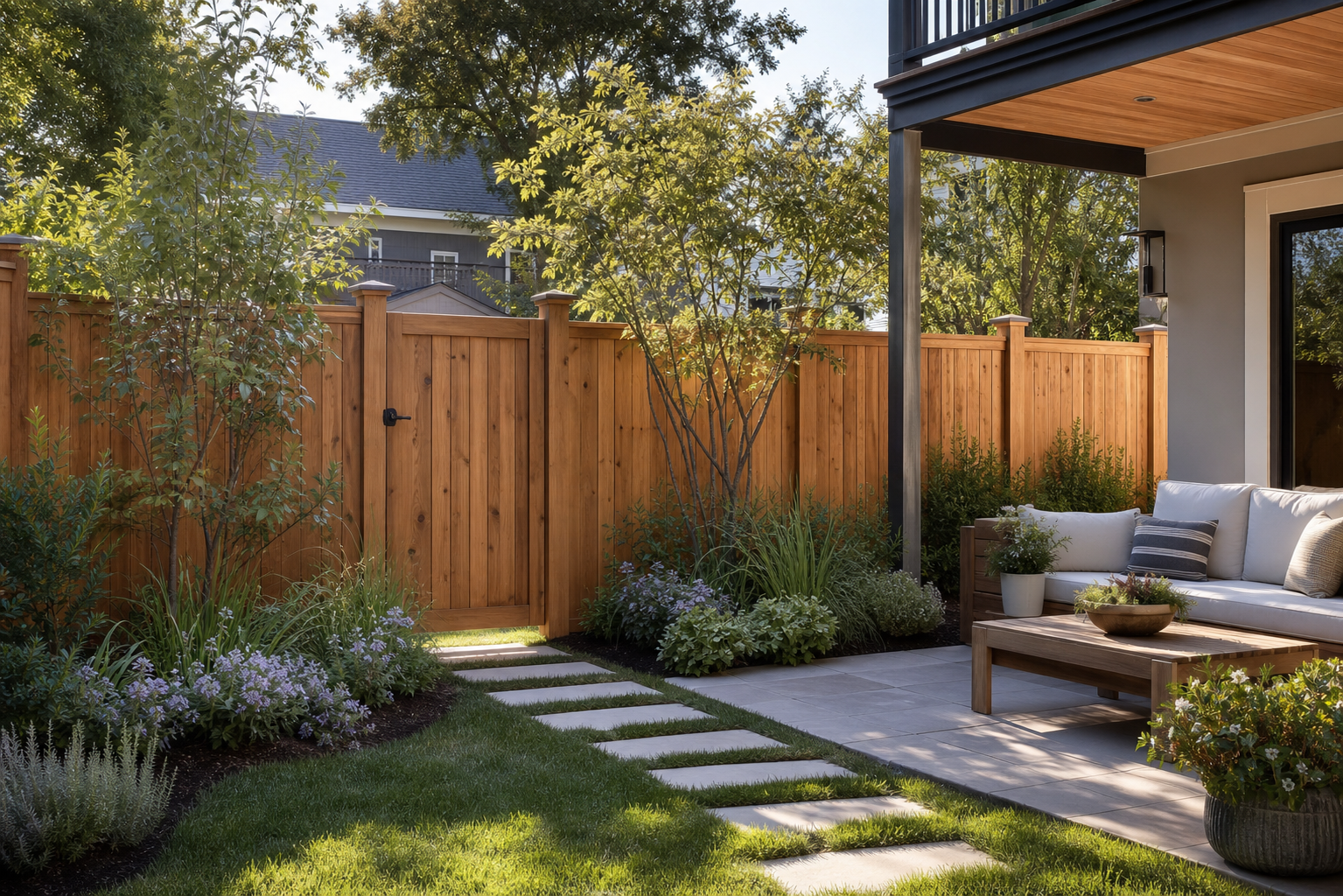
Natural timber can create warmth, while composite or metal systems may support more contemporary architecture.
4. Better Control of Certain Pets
Appropriately designed fencing can help contain some household pets.
Pet security depends on much more than fence height.
Gaps beneath the fence, gate latches, spacing, digging behavior, climbing ability, and nearby objects can all affect containment.
No generic fence design guarantees that every dog or other animal will remain contained.
5. Reduced Direct Views of Utility Areas
A privacy fence or screen can conceal bins, HVAC equipment, utility zones, pool equipment, or storage areas where local codes and equipment clearances permit.
Mechanical equipment must still have appropriate airflow and service access.
Do not tightly enclose air conditioning condensers, meters, utility equipment, or other systems without checking manufacturer and utility requirements.
6. Some Wind and Weather Screening
A fence can alter airflow around a property.
However, completely solid fencing also receives substantial wind load.
The stronger the wind exposure, the more important post dimensions, depth, footing design, spacing, and structural construction become.
7. Architectural and Landscape Value
A carefully designed fence can become part of the landscape rather than simply a barrier.
Color, orientation, post spacing, caps, gates, planting, and height transitions can connect it visually with the house.
8. Flexible Material and Style Choices
Privacy fences can be built using wood, vinyl, composite, masonry, metal systems, or combinations of materials.
This gives homeowners choices across maintenance levels, price points, appearance, and climate suitability.
9. Potentially Improved Buyer Appeal
A functional fenced yard can appeal to some buyers, particularly those seeking pet containment or outdoor privacy.
It should not, however, be assumed to increase property value by a specific percentage.
Real estate value depends on location, fence quality, design, condition, market preferences, and project cost.
Best Privacy Fence Materials
Material selection influences appearance, maintenance, durability, structural requirements, and installed cost.
There is no universal best material.
Wood Privacy Fence
Wood remains popular because of its natural texture and design flexibility.
Common options vary by region and may include cedar, redwood, pine, spruce, cypress, and other species.
Some fencing uses pressure treated lumber, particularly for structural components.
Wood quality, treatment, moisture content, fasteners, and installation details can all influence service life.
Vinyl Privacy Fence
Vinyl fencing typically uses PVC based components manufactured into posts, rails, and panels.
It does not require conventional painting or staining and is available in numerous profiles.
Quality varies among systems.
Impact resistance, ultraviolet exposure, thermal expansion, internal reinforcement, and installation specifications should be considered.
Composite Privacy Fence
Composite fencing combines materials according to the manufacturer’s formulation, often incorporating plastics and wood derived fibres.
It can create wood inspired appearance with different maintenance characteristics.
Product quality and structural systems vary substantially.
Choosing Privacy Fence Materials for Your Climate
Evaluate:
• Wind exposure
• Rainfall
• Freeze and thaw conditions
• Sun exposure
• Coastal conditions
• Termite or insect concerns
• Soil drainage
• Temperature extremes
Local contractor experience and product specific warranties can provide useful guidance.
Wood Privacy Fence Options
Wood fencing offers numerous layouts.
Vertical Board Fencing
Vertical boards create a traditional appearance and can be installed with narrow gaps, tightly arranged edges, or overlapping configurations.
Board on board designs overlap alternating boards to reduce sightlines that can appear as timber shrinks.
Wood naturally responds to moisture and environmental conditions, so dimensional movement should be expected.
Horizontal Privacy Fence
Horizontal boards create a contemporary appearance.
Long horizontal spans need suitable support to reduce bowing or sagging.
Manufacturer or engineering requirements should determine structural details.
Shadowbox Fencing
A shadowbox fence places boards on alternating sides of rails.
This provides partial screening while allowing some airflow and visibility at certain angles.
Privacy Fence Wood Maintenance
Wood maintenance can involve:
• Periodic inspection
• Cleaning
• Replacing damaged boards
• Addressing loose fasteners
• Staining or sealing where appropriate
• Managing vegetation contact
• Monitoring post condition
Follow coating manufacturer recommendations for the wood and local conditions.
Vinyl Privacy Fence Advantages and Limitations
Vinyl can appeal to homeowners seeking reduced routine finishing.
Routine Cleaning
Many vinyl products can be washed using methods recommended by the manufacturer.
They do not require the same periodic staining associated with many timber fences.
Temperature and Impact
Vinyl properties change with temperature, and impact behavior differs from wood.
Product quality and climate suitability should be considered.
Vinyl Privacy Fence Installation
Vinyl fence components are typically engineered as systems.
Post spacing, reinforcement, footing dimensions, panel installation, and expansion considerations should follow product instructions.
Mixing incompatible components can compromise performance.
Composite Privacy Fence Options
Composite can provide a relatively uniform appearance with limited need for repainting depending on product.
Color and Texture
Products are available in different wood inspired and contemporary finishes.
Colors can change over time because of weather exposure, with the amount depending on product formulation.
Weight and Structure
Some composite boards are heavier than comparable wood components.
Structural systems must be designed to support them.
Is a Composite Privacy Fence Worth It?
Compare initial cost with maintenance expectations, warranty, local availability, repair methods, replacement components, and expected ownership period.
Higher upfront price does not automatically create better lifecycle value for every homeowner.
Privacy Fence Height
Fence height is one of the most important design and legal considerations.
Common residential privacy fences are often relatively tall, but permitted dimensions vary by jurisdiction and location on the property.
Backyard Fence Height
Local zoning ordinances may establish maximum fence heights.
Rules can differ between rear yards, side yards, and areas adjacent to roads.
Front Yard Fence Height
Front yard fencing is often subject to stricter height or visibility requirements.
Sight triangles near driveways and road intersections may also limit fence placement or opacity.
Privacy Fence Height and Local Codes
Before selecting panels, check:
• Municipal ordinances
• Planning requirements
• Permit rules
• Homeowners association restrictions
• Easements
• Corner lot visibility rules
• Pool barrier requirements
Do not assume a neighbor’s fence proves that the same design is currently permitted on your property.
Privacy Fence Permits and Regulations
Fence regulations differ significantly across cities and neighborhoods.
Building or Zoning Permits
Some jurisdictions require permits above certain heights or for particular materials and locations.
Others regulate fencing through zoning review.
Homeowners Association Approval
An HOA or similar community organization may impose additional design restrictions.
Approval from one authority does not necessarily satisfy another.
Historic District Requirements
Properties in conservation or historic districts can have special rules concerning fence materials, design, and placement.
Privacy Fence Rules Before Installation
Get relevant approvals in writing.
A contractor obtaining a permit does not automatically mean the homeowner has satisfied HOA, easement, or property boundary requirements.
Property Surveys and Fence Placement
Incorrect placement can create expensive disputes.
Do Not Rely on Landscaping
Hedges, mowing lines, utility poles, and existing fences do not reliably establish legal boundaries.
Use survey information where necessary.
Build on the Correct Side of the Boundary
Some homeowners intentionally locate fences within their property line to reduce uncertainty.
This can have maintenance or land use implications.
Privacy Fence and Neighbor Considerations
Discussing the project with neighbors can reduce surprises, particularly when replacing shared or boundary adjacent fencing.
Legal obligations concerning boundary fences and cost sharing vary by jurisdiction.
For disputes, obtain local legal or surveying advice rather than relying on general internet guidance.
Underground Utilities Before Fence Installation
Fence posts require excavation, making underground utilities a significant safety concern.
Request Utility Locating
In the United States, contact 811 before digging so participating utility operators can mark eligible underground infrastructure.
Other countries have different systems.
Private Utility Lines
Public locating services may not mark privately owned lines after the meter or other service point.
These can include irrigation, private electrical lines, pool systems, lighting, and outbuilding services.
Privacy Fence Post Holes and Utility Safety
Never assume an unmarked area is automatically safe to excavate.
Follow utility markings and required tolerance zones.
Additional professional locating may be appropriate when private lines are suspected.
Privacy Fence Posts and Foundations
Posts support wind loads and maintain alignment.
Poor post installation can cause an otherwise attractive fence to lean.
Post Depth
There is no universal correct post depth.
Requirements depend on:
• Fence height
• Soil
• Frost depth
• Wind
• Post material
• Spacing
• Footing design
• Local codes
Generic rules should not override structural or manufacturer requirements.
Concrete Footings
Many fence systems use concrete around posts.
Drainage and post material influence appropriate details.
Privacy Fence Wind Resistance
Solid fences act as large surfaces against wind.
Exposed properties and high wind regions may require stronger posts, closer spacing, deeper foundations, engineered systems, or permit review.
Use design requirements applicable to the location.
Privacy Fence Gates
Gates are moving components and require additional structural attention.
Gate Width
A pedestrian gate and a vehicle access gate have very different demands.
Choose width based on actual access requirements.
Hinges and Posts
Gate posts support substantial leverage.
Undersized or poorly installed posts can cause gates to sag.
Latches
Latch design should reflect household use.
Privacy Fence Gates for Pools
Pool barriers and gates can be subject to specific requirements involving height, openings, self closing, self latching, latch position, and other safety provisions.
Follow applicable pool safety codes rather than treating an ordinary backyard gate as automatically compliant.
Privacy Fence Installation Process
Professional projects usually begin with planning rather than digging.
Mark the Fence Layout
Confirm boundaries and mark fence lines, corners, gates, utilities, and elevation changes.
Prepare the Site
Vegetation, old fencing, debris, or obstacles may require removal.
Protect desirable landscaping and tree roots.
Set Posts
Post alignment and foundation quality have a major influence on final appearance and performance.
Install Rails and Panels
Components should follow the selected fence system.
Privacy Fence Final Inspection
Before accepting completion, check:
• Alignment
• Post stability
• Gate movement
• Latches
• Board or panel attachment
• Ground clearance
• Visible damage
• Hardware
• Cleanup
• Permit inspection where required
Address concerns before final payment where contract terms permit.
Privacy Fence Costs
Cost depends on much more than linear footage.
Factors Affecting Privacy Fence Cost
Pricing can vary with:
• Material
• Fence height
• Property length
• Terrain
• Soil
• Old fence removal
• Gates
• Post requirements
• Access
• Landscaping
• Permits
• Labor
• Local pricing
Sloped or rocky sites can be significantly more labor intensive than level open yards.
Compare Complete Quotes
Ask contractors to specify material brands or grades, posts, rails, fasteners, gates, disposal, and permits.
Privacy Fence Cost Per Foot
Cost per linear foot can be useful for rough comparison, but it can conceal important differences in construction.
A low unit price may reflect lighter posts, wider spacing, cheaper hardware, or excluded site work.
Compare specifications rather than price alone.
Privacy Fence Installation on Slopes
Sloping yards require additional planning.
Stepped Fencing
Stepped panels remain level while changing elevation in sections.
This can create larger gaps below some areas depending on grade.
Racked Fencing
Some fence systems can follow the slope more continuously.
Not every panel type can be racked.
Privacy Fence Gaps on Sloped Ground
Large gaps can undermine privacy or pet containment.
Discuss transitions before installation rather than improvising them once panels are onsite.
Privacy Fence and Drainage
Fences should not unintentionally create water management problems.
Maintain Natural Drainage Where Appropriate
Solid masonry walls and certain tightly constructed systems can affect surface water differently from ordinary board fencing.
Drainage planning is particularly important where grade changes are involved.
Avoid Burying Wood
Wood components not specifically intended for ground contact should not be buried.
Maintain manufacturer recommended clearances.
Privacy Fence Near Retaining Walls
A fence installed on or near a retaining wall can add structural loads.
Do not assume an existing wall can support fence posts.
Engineering assessment may be appropriate depending on wall construction, height, and fence design.
Privacy Fence Maintenance
Maintenance needs differ by material.
Inspect Posts and Panels
Check periodically for leaning posts, loose boards, damaged panels, corrosion, unstable gates, and vegetation contact.
Address problems before they expand.
Maintain Gates
Hinges and latches experience repeated movement.
Adjustment or replacement may be necessary over time.
Clean Carefully
Use methods compatible with the fence material.
Pressure Washing a Privacy Fence
Excessive pressure can damage wood fibres, coatings, vinyl, or composite surfaces.
Follow product recommendations and test unfamiliar methods discreetly.
Privacy Fence Security Considerations
Privacy fencing can limit visibility into a yard, but reduced visibility can have security tradeoffs.
A completely enclosed space may also prevent neighbors or passersby from seeing unusual activity.
Security should therefore be layered.
Use appropriate door and gate locks, exterior lighting, and other measures according to property needs.
Gates and Access
Keep gates functional and appropriately secured.
Emergency access should also be considered.
Privacy Fence vs Security Fence
Privacy and security are related but distinct objectives.
Residential privacy fencing is primarily designed to block sightlines and define space.
Properties requiring specialized security should obtain advice appropriate to their risk rather than assuming a standard privacy fence serves that purpose.
Landscaping Around a Privacy Fence
Plants can soften a large fence and improve visual integration.
Allow Maintenance Access
Avoid planting large shrubs so close that fence inspection or repair becomes impossible.
Consider mature plant size rather than nursery size.
Protect Fence Materials
Continuous moisture and direct vegetation contact can affect some materials.
Good airflow may help surfaces dry.
Combining Plants With a Privacy Fence
Trees and shrubs can extend visual screening above the fence line where appropriate.
Choose species suitable for local climate, available space, roots, and maintenance.
Avoid planting invasive species.
Privacy Fence Alternatives
A conventional solid fence is not the only way to create privacy.
Options may include:
• Hedges
• Decorative screens
• Trellises
• Pergolas
• Partial fencing
• Strategic planting
• Masonry walls
• Mixed landscape screening
These alternatives have different maintenance and regulatory considerations.
A small patio may require only targeted screening rather than enclosing an entire property.
Sustainable Privacy Fence Considerations
Environmental performance depends on sourcing, durability, maintenance, transportation, and end of life.
Responsibly Sourced Wood
Consumers interested in forest management can investigate credible certification such as FSC where appropriate and available.
Verify actual product certification rather than relying on general environmental marketing.
Recycled Content
Some composite products incorporate recycled materials.
Ask for specific manufacturer information.
Long Service Life
Maintaining an existing serviceable fence can sometimes avoid unnecessary replacement materials.
Eco Conscious Privacy Fence Decisions
Consider:
• Material source
• Expected lifespan
• Repairability
• Coatings
• Replacement components
• Maintenance
• Recyclability
• Local availability
No single material is environmentally superior in every category.
How to Choose a Privacy Fence Contractor
Fence installation quality has a major effect on appearance and durability.
Check Relevant Experience
Ask to see fences made from the material you intend to use.
Wood, vinyl, composite, metal, and masonry require different methods.
Verify Licensing and Insurance
Requirements vary by jurisdiction.
Check applicable contractor credentials and appropriate insurance.
Read the Contract
The agreement should identify material, dimensions, gates, post construction, disposal, permits, schedule, warranty, and payment terms.
Questions to Ask a Privacy Fence Contractor
Ask:
• Who verifies property lines?
• Who handles permits?
• Who requests utility marking?
• What material and grade will be installed?
• What posts are used?
• How are posts set?
• How is wind exposure addressed?
• What fasteners are used?
• How are slopes handled?
• What gate hardware is included?
• What warranty applies?
• Who removes the old fence?
Specific written answers make quotes easier to compare.
Common Privacy Fence Mistakes
Most expensive fencing mistakes are created before or during installation.
Avoid:
• Building without verifying boundaries
• Ignoring permits
• Forgetting utility locations
• Choosing height without checking regulations
• Underestimating wind load
• Using inadequate posts
• Blocking drainage
• Ignoring gate support
• Using unsuitable fasteners
• Failing to plan for slopes
• Assuming a privacy fence meets pool barrier rules
• Planting large vegetation too close to the structure
Careful planning is considerably easier than relocating a completed fence.
Frequently Asked Questions
What is the best material for a privacy fence?
The best material depends on climate, appearance, maintenance, budget, wind exposure, and expected lifespan. Wood, vinyl, and composite systems each offer different advantages.
How tall can a privacy fence be?
Maximum fence height depends on local zoning, location on the property, HOA requirements, corner visibility, and other regulations. Check current local rules before installation.
How much does a privacy fence cost?
Cost varies by material, height, length, terrain, soil, gates, old fence removal, permits, labor, and location. Detailed local quotations provide the most reliable estimate.
Do I need a permit for a privacy fence?
Possibly. Permit and zoning requirements vary by municipality and can depend on height, location, materials, and property type.
Should I get a property survey before installing a privacy fence?
A survey can be valuable when boundaries are uncertain or construction will occur close to the property line. Existing fences and landscaping do not reliably establish legal boundaries.
How long does a privacy fence last?
Service life varies by material, climate, installation quality, soil, maintenance, exposure, and damage. There is no single reliable lifespan for every privacy fence.
Conclusion
A privacy fence can create a more secluded and functional outdoor space while clearly defining areas of a property and complementing the home’s landscape. Successful projects depend on choosing an appropriate material and addressing boundaries, permits, utilities, wind, drainage, gates, foundations, and maintenance before installation begins. Comparing detailed contractor specifications rather than price alone can help homeowners build a fence that remains attractive, stable, and practical for years.