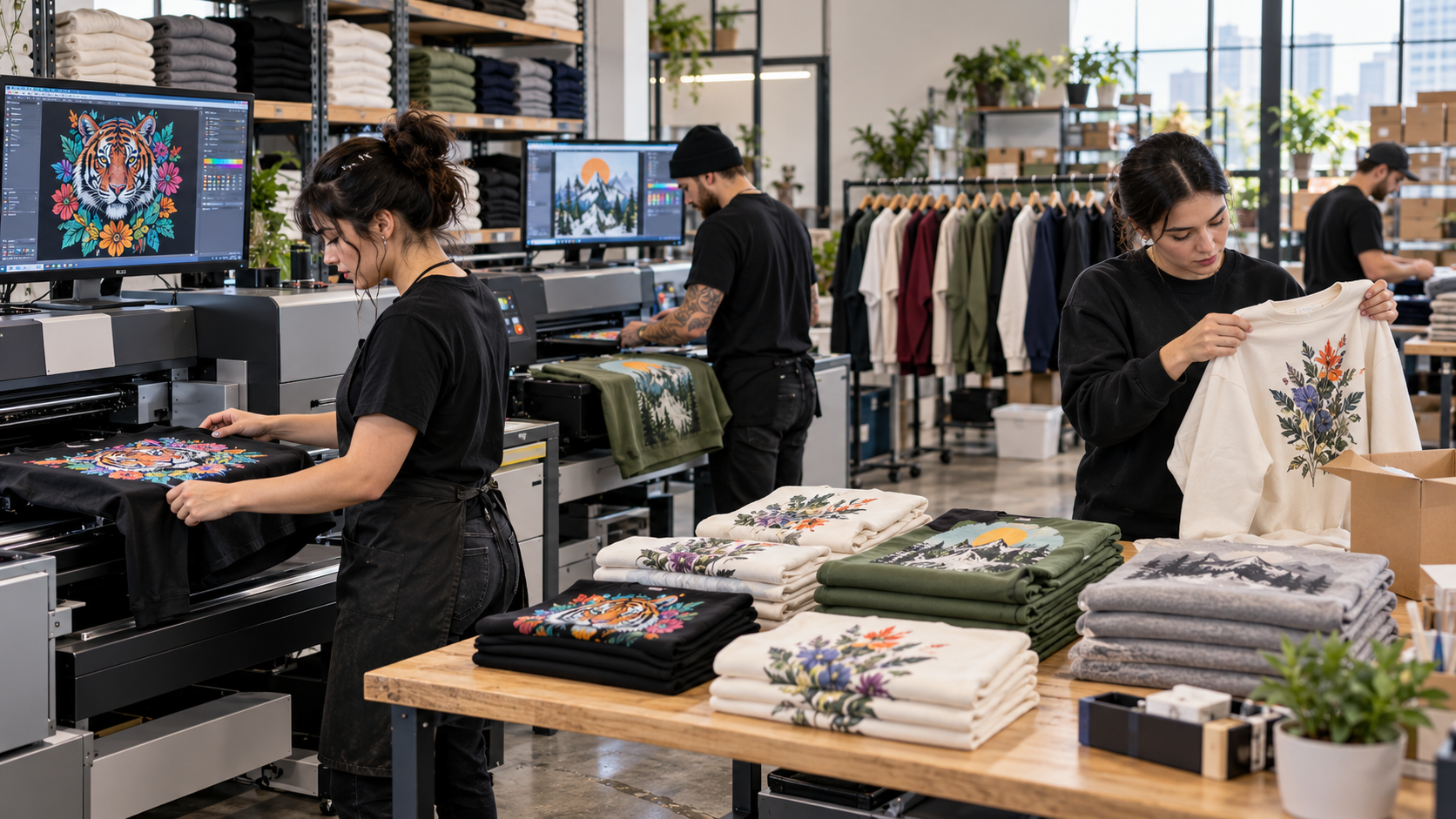
Fast Shirt Factory Makes Custom Apparel Faster and Easier
Ordering custom apparel often sounds simple until a deadline, minimum quantity, artwork problem, or complicated proofing process gets involved. Fast Shirt Factory is built around reducing that friction by allowing customers to choose apparel, upload artwork, review a mockup, and move toward production through a simplified process. Its current product offering includes custom shirts, hoodies, and crewnecks, with no minimum order requirement and support for orders ranging from a single garment to quantities above 1,000 pieces.
That flexibility can be useful for businesses, creators, event planners, schools, nonprofits, contractors, families, and anyone who needs personalised clothing without committing to a large inventory.
The growing interest in custom apparel is easy to understand. A printed shirt can function as workwear, merchandise, event clothing, a team uniform, promotional material, or a personalised gift.
However, successful custom apparel depends on more than simply placing a logo on fabric.
Garment quality, artwork preparation, printing method, placement, colour, quantity, turnaround, and proof approval all influence the finished product.
Understanding these factors before placing an order can make custom printing much easier.
What Is Fast Shirt Factory?
Fast Shirt Factory is a custom apparel printing service focused on fast production, straightforward ordering, and flexible quantities.
The company currently promotes custom shirts, hoodies, and crewnecks, along with a process that allows customers to upload their design and receive a visual mockup before production.
Its website highlights several core features:
• No minimum orders
• Instant mockups
• Orders from one to more than 1,000 shirts
• Custom shirts
• Hoodies
• Crewnecks
• Fast proofing
• Deadline focused production
• Design upload tools
The service is positioned for people who need custom apparel without dealing with the large minimum quantities traditionally associated with some printing methods.
Why No Minimum Orders Matter
Traditional apparel printing can sometimes involve minimum order quantities because production setup becomes more cost efficient when the same design is printed repeatedly.
That model works well for large organisations, but it can create problems for people who need only a few garments.
Fast Shirt Factory states that it accepts custom apparel orders without a minimum quantity.
This can be useful when someone needs:
• One sample shirt
• A small team order
• Limited merchandise
• Prototype apparel
• Family event clothing
• A test product before a larger launch
• Replacement staff shirts
• Small creator drops
Customers can order the quantity that matches their actual requirement instead of purchasing excess stock simply to reach a printer’s minimum.
7 Powerful Benefits of Using Fast Shirt Factory
The right custom apparel service should make the entire process easier from artwork submission to final delivery.
1. Fast Shirt Factory Supports Small and Large Orders
One of the clearest benefits is quantity flexibility.
Fast Shirt Factory currently promotes orders from one garment to more than 1,000 shirts.
This gives different customers room to use the same service for very different projects.
A small business may need five shirts for staff.
A creator may want to test twenty pieces before launching a larger collection.
An event organiser may need hundreds.
Flexible quantities can also reduce inventory risk.
Ordering too many branded garments can leave businesses with unused sizes, outdated designs, or unsold merchandise.
Starting smaller allows the customer to learn what actually sells or gets used.
2. Uploading Artwork Makes Ordering Simpler
Customers who already have a logo, illustration, or finished artwork can upload the file instead of rebuilding the design manually.
Fast Shirt Factory says customers can submit logos, artwork, or print ready files and receive a proof showing what will be produced.
This can help businesses maintain visual consistency.
The most useful artwork files are generally those that are:
• High resolution
• Correctly proportioned
• Clear around the edges
• Free from unwanted backgrounds
• Prepared in appropriate colours
• Suitable for the required print size
Artwork quality matters because a poor source file cannot always be transformed into a sharp large print.
3. Instant Mockups Help Catch Mistakes
A mockup gives customers a preview of how a design may appear on the selected garment.
Fast Shirt Factory currently promotes instant mockups as part of its ordering experience.
This is useful because customers can review important details before printing begins.
Check:
• Logo placement
• Design size
• Garment colour
• Spelling
• Orientation
• Artwork proportions
• Front or back placement
• Overall visual balance
A digital mockup cannot reproduce every physical detail perfectly, but it gives customers an important opportunity to identify obvious mistakes.
4. Fast Production Helps With Tight Deadlines
Custom apparel is frequently connected to a specific date.
A business launch cannot always be postponed because shirts are late.
Neither can a conference, school event, fundraiser, family gathering, product drop, or promotional campaign.
Fast Shirt Factory places strong emphasis on production deadlines and states that it establishes a ready by date early in the process.
Its published guidance also describes rush printing as a process that prioritises orders through artwork approval, production, and fulfilment on accelerated schedules where eligible.
Customers with urgent requirements should still confirm the actual deadline for their individual order.
Turnaround can depend on garment availability, artwork readiness, quantity, print method, delivery location, and production capacity.
5. Multiple Apparel Types Create More Branding Options
Custom apparel does not need to stop with basic T shirts.
Fast Shirt Factory currently lists shirts, hoodies, and crewnecks among its primary products.
This gives businesses and creators opportunities to build more complete collections.
For example, a brand could use:
• T shirts for warm weather
• Hoodies for colder seasons
• Crewnecks for casual workwear
• Different colours for different teams
• Limited designs for special campaigns
Using the same visual identity across several garment categories can create a more consistent brand appearance.
6. Fast Shirt Factory Can Work for Different Customer Types
The company currently presents its service to several groups, including small businesses, event planners, contractors, schools, churches, nonprofits, creators, apparel brands, and families.
Each group has different requirements.
A contractor may prioritise durability and repeat ordering.
An event planner may care most about deadline certainty.
A creator may focus on appearance and small production runs.
A school may need multiple sizes and simple ordering.
The same printing process can support very different goals when garment choice and artwork are planned properly.
7. Repeat Orders Can Be Easier
Reordering is important for organisations that use branded clothing continuously.
Fast Shirt Factory states that customer logos, sizes, and preferences can be stored to make repeat ordering simpler.
This can be particularly useful for:
• Growing businesses
• Contractors
• Restaurants
• Retail teams
• Event companies
• Clubs
• Nonprofits
• Creators with recurring merchandise
Reordering from an existing approved design reduces the need to restart the process every time.
Fast Shirt Factory Custom T Shirts
Custom T shirts remain one of the most widely used forms of branded apparel.
They can be simple, affordable, and suitable for many situations.
Common uses include:
• Staff uniforms
• Promotional giveaways
• Merchandise
• Conferences
• Sports events
• Family gatherings
• School activities
• Charity events
• Product launches
• Construction crews
• Restaurant teams
The quality of a custom shirt depends on both the garment and the print.
Choosing the Right Shirt
When selecting a blank shirt, consider:
• Fabric
• Weight
• Fit
• Colour
• Neck style
• Size range
• Intended use
• Washing frequency
A lightweight shirt may work well for events and warm climates.
A heavier shirt may suit premium merchandise or work environments where customers want a more substantial feel.
Fast Shirt Factory Hoodies
Custom hoodies can provide a higher value apparel option for brands and organisations.
They can work well for merchandise, team clothing, uniforms, creator collections, clubs, and seasonal campaigns.
Fast Shirt Factory currently lists hoodies among its main product categories.
When selecting a hoodie, consider:
• Fabric weight
• Pullover or zip style
• Hood construction
• Pocket design
• Print area
• Colour
• Fit
• Size availability
• Intended climate
Large graphics may behave differently on fleece than on lightweight T shirt fabric, so artwork should be evaluated for the specific garment.
Fast Shirt Factory Crewnecks
Crewneck sweatshirts can offer a middle ground between T shirts and hoodies.
They provide warmth without a hood and can work particularly well for company uniforms, campus apparel, merchandise, and minimalist branded clothing.
The simpler front and back areas also create useful spaces for printing.
Possible placements include:
• Large front graphic
• Small chest logo
• Full back artwork
• Sleeve decoration where supported
• Combination front and back branding
The best placement depends on the purpose of the garment.
Understanding Custom Apparel Printing Methods
Different decoration methods work best for different jobs.
Fast Shirt Factory’s own custom T shirt guide discusses options including screen printing, direct to garment printing, direct to film printing, heat transfer, sublimation, and embroidery.
Customers do not always need to choose the technical process themselves, but understanding the basics helps when discussing an order.
Screen Printing
Screen printing uses prepared screens to apply ink to garments.
It can work particularly well for repeat designs and larger quantities.
Advantages can include strong colour and efficient bulk production.
Setup requirements mean it may be less practical for some very small orders.
Direct to Garment Printing
Direct to garment printing applies ink directly to suitable fabric using specialised equipment.
It can be useful for detailed artwork and lower quantities.
The best results depend on garment fabric, artwork, pretreatment, equipment, and production process.
Direct to Film Printing
Direct to film printing transfers a printed design from film onto the garment.
It can support detailed, colourful designs across a range of compatible fabrics.
Fast Shirt Factory’s published guide describes DTF as one of the methods suitable for lower quantity and complex artwork requirements.
Heat Transfer
Heat transfer methods use temperature and pressure to attach a prepared graphic to fabric.
There are several forms of heat transfer, so performance depends on the exact technology and material.
Embroidery
Embroidery uses thread rather than printed ink.
It can create a premium appearance for logos and is commonly used on workwear, hats, polos, jackets, and other garments.
The ideal decoration method depends on artwork, quantity, fabric, deadline, and intended use.
How to Prepare Artwork for Fast Shirt Factory
Good artwork preparation can reduce production delays.
Use High Resolution Files
Low resolution graphics can appear blurred or pixelated when enlarged.
Whenever possible, start with the original design file rather than a screenshot or image downloaded from social media.
Check Spelling Carefully
Printing one shirt with a spelling error is frustrating.
Printing hundreds is much worse.
Review:
• Business name
• Website address
• Phone numbers
• Event dates
• Social handles
• Slogans
• Names
A proof should be treated as the final opportunity to catch mistakes.
Think About Background Colours
A design created on a white screen may look very different on a black shirt.
Contrast is important.
Dark artwork on a dark garment may become difficult to see.
Check Design Placement
A logo may look better as a small chest print than as a large centre graphic.
Other artwork may need the opposite treatment.
Consider the final garment rather than evaluating artwork in isolation.
Fast Shirt Factory for Small Businesses
Small businesses often need branded apparel without ordering hundreds of units.
No minimum ordering can make this easier.
A local service company might order shirts for five employees.
A startup could print a small merchandise batch.
A new restaurant could test uniform designs before committing to larger quantities.
Fast Shirt Factory specifically identifies small business owners among the customers its production model is designed to serve.
Branded apparel can support:
• Team identification
• Professional appearance
• Brand recognition
• Event participation
• Customer merchandise
• Social media content
The design should remain readable and consistent with the wider brand.
Fast Shirt Factory for Events
Events are particularly sensitive to timing.
The clothing has little value if it arrives after the event.
Before ordering event apparel, confirm:
• Event date
• Required delivery date
• Shirt quantities
• Size distribution
• Artwork approval deadline
• Shipping destination
• Backup time
Ordering earlier creates more flexibility if changes are required.
Rush production can be useful, but planning ahead remains the safer approach whenever possible.
Fast Shirt Factory for Creators and Apparel Brands
Creators often want to launch merchandise without storing large quantities.
Small initial runs can help test demand.
Instead of printing hundreds of garments before knowing whether a design will sell, creators can begin with a smaller quantity and reorder when necessary.
Fast Shirt Factory specifically markets its service to creators and apparel brands, including those planning sample drops and later scaling production.
This approach can reduce:
• Unsold inventory
• Storage requirements
• Upfront spending
• Size forecasting problems
• Risk from untested designs
Quality should still remain consistent when moving from a sample run to larger quantities.
Common Custom Shirt Ordering Mistakes
Several avoidable mistakes can affect the final order.
Choosing Garments Only by Price
The cheapest blank is not always the best choice.
Consider how the shirt will actually be used.
Ignoring Fabric
Different fabrics can affect comfort, printing, durability, and fit.
Sending Poor Artwork
Low quality source files can limit print quality.
Skipping Proof Review
Never assume the design is correct because the original file looked correct.
Check the mockup.
Ordering the Wrong Size Mix
Bulk orders often fail because too many garments are ordered in one size and not enough in another.
Collect sizes before production when possible.
Leaving Everything Until the Last Minute
Fast production helps, but artwork revisions, stock availability, and shipping can still affect schedules.
How to Make Custom Apparel Look More Professional
Professional apparel usually comes from simple decisions executed well.
Use clean artwork.
Choose readable colours.
Avoid placing too many messages on one garment.
Keep logos proportionate.
Choose a blank that matches the brand image.
Check the proof.
Use consistent placement across the order.
For businesses, consistency matters more than unnecessary complexity.
A simple logo printed cleanly can often look more professional than a crowded design containing multiple fonts, messages, contact details, and decorative elements.
Frequently Asked Questions
What is Fast Shirt Factory?
Fast Shirt Factory is a custom apparel printing service offering shirts, hoodies, and crewnecks with a simplified design upload, mockup, proofing, and production process.
Does Fast Shirt Factory have a minimum order?
The company currently states that it has no minimum order requirement and can support orders ranging from a single garment to larger quantities.
What products does Fast Shirt Factory print?
Its current main product categories include custom shirts, hoodies, and crewnecks.
Can I upload my own design to Fast Shirt Factory?
Yes. Customers can upload logos, artwork, or print ready files and review a mockup before production.
Does Fast Shirt Factory offer fast custom printing?
Fast turnaround is a central part of the company’s service model, including deadline focused and rush printing options where an order qualifies. Actual timing should be confirmed for each project.
Can businesses use Fast Shirt Factory for branded apparel?
Yes. The service is presented for small businesses, contractors, event planners, schools, nonprofits, creators, apparel brands, and other customers needing custom garments.
Conclusion
Fast Shirt Factory simplifies custom apparel by combining flexible order quantities, artwork uploading, digital mockups, fast production, and options for shirts, hoodies, and crewnecks. The strongest results still come from choosing the right garment, preparing high quality artwork, checking the proof carefully, and planning quantities around the real purpose of the order. Whether the goal is staff clothing, merchandise, an event, or a new apparel concept, an organised printing process can turn a simple design into professional custom clothing.





One Comment