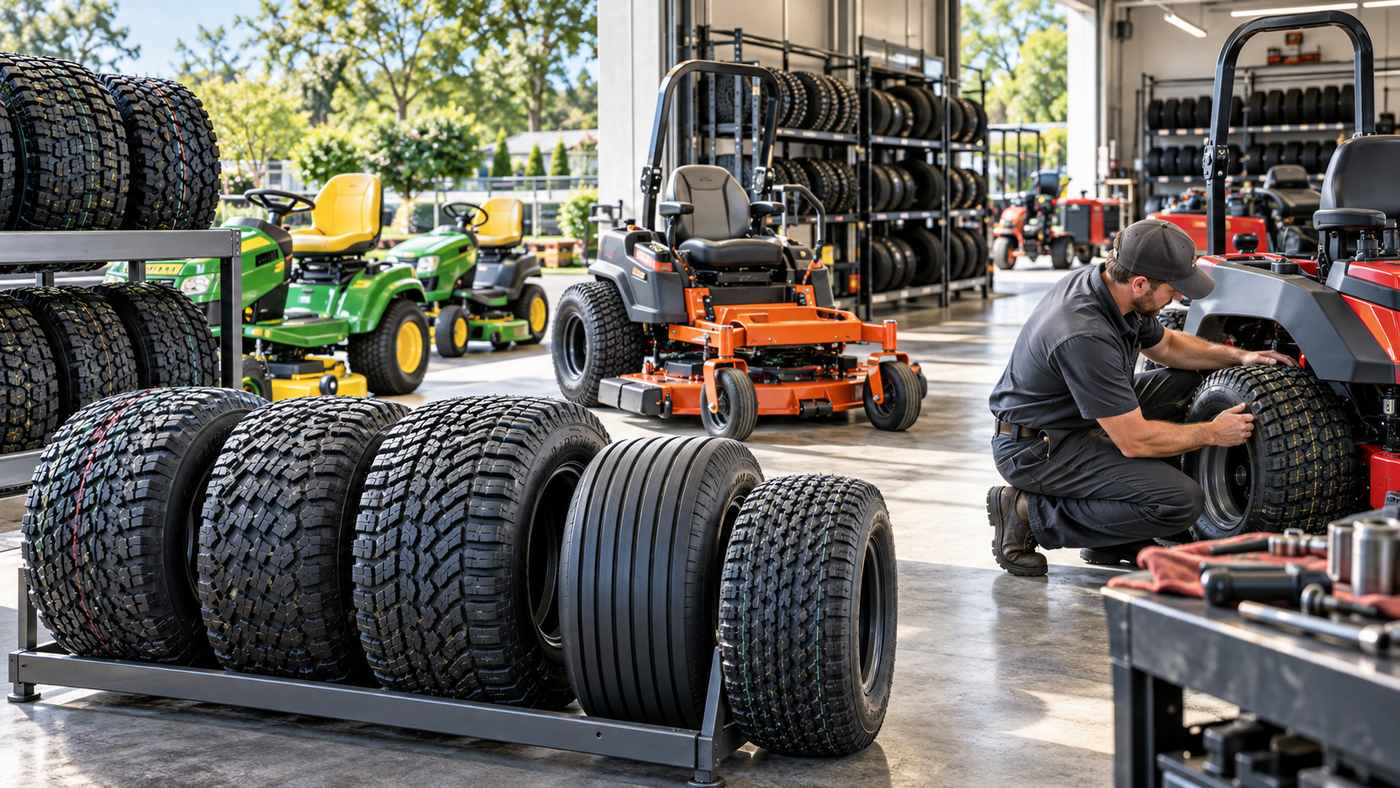
Lawn Mower Tires for Sale: 9 Smart Tips Before Buying Replacement Tires
Finding the right lawn mower tires for sale is more important than simply choosing a tire that looks similar to the one currently fitted to your mower. Tire size, tread pattern, rim diameter, ply rating, load capacity and inflation pressure can all affect traction, steering, ride quality and how much damage a mower causes to grass.
Residential riding mowers, lawn tractors and commercial zero-turn machines can use very different tire configurations.
A smooth or ribbed front tire may be designed mainly for steering, while a wider rear turf tire provides traction without aggressively tearing the lawn.
Commercial machines may require heavier-duty tires capable of carrying higher loads for long working periods.
Major lawn-and-garden tire manufacturers publish detailed specifications covering tire dimensions, maximum loads, inflation pressures and intended applications. For example, Kenda’s current turf range includes residential, commercial and zero-turn mower tires with different tread patterns and load ratings.
Before ordering a replacement, use these nine checks to make sure the tire actually matches your mower and the type of ground you cut.
1. Read the Lawn Mower Tire Size Correctly
The first step when comparing lawn mower tires for sale is finding the exact tire size.
The numbers are usually molded into the sidewall.
A common size might look like:
20×10.00-8
These numbers generally represent:
- 20 = approximate overall tire diameter in inches
- 10.00 = approximate tire width in inches
- 8 = rim diameter in inches
Another common example is:
15×6.00-6
This usually means approximately:
- 15-inch overall diameter
- 6-inch section width
- 6-inch rim diameter
Why Rim Diameter Matters
A tire designed for an 8-inch rim cannot simply be installed on a 6-inch rim.
Even if the overall tire height looks similar, the bead diameter is different.
Do Not Rely on Appearance Alone
Two lawn mower tires can appear almost identical while having different:
- Width
- Diameter
- Rim requirements
- Load ratings
Always use the numbers on the old tire or the mower manufacturer’s specifications.
Kenda’s current lawn-tire specifications demonstrate how the same tread family can be offered in many different sizes, rim widths and maximum load ratings.
2. Choose the Correct Tread Pattern
Tread style affects how your mower behaves on grass.
The best pattern depends on:
- Terrain
- Mower type
- Ground conditions
- Required traction
Turf Tread Tires
Turf tires are the most common choice for riding lawn mowers and lawn tractors.
They usually have rounded, closely spaced blocks or chevron-shaped tread.
The goal is to provide enough traction while reducing damage to grass.
Kenda describes its Turf Rider as a turf-friendly chevron design intended to deliver grip while remaining gentle on lawns.
Commercial Turf Tires
Commercial mowing equipment may need a wider contact patch.
A wider footprint can distribute machine weight over a larger area and help reduce ground compaction.
For example, Kenda’s K507 commercial turf tire uses a wide footprint specifically intended for high flotation and reduced turf compaction on applications such as commercial mowing equipment and golf-course machinery.
Bar or Lug Tires
Deep bar tread provides much stronger traction.
These tires are more appropriate for applications involving:
- Mud
- Loose soil
- Snow
- Garden tractors
Kenda’s agricultural bar tread is designed to dig into hard or soft terrain for increased traction, including mud and snow.
However, aggressive tread can damage delicate lawns more easily.
3. Match the Tire to Your Mower Type
Different mower designs place different demands on their tires.
Riding Lawn Mowers
Residential riding mowers generally benefit from turf-friendly rear tires that provide predictable traction without tearing grass.
Lawn Tractors
Lawn tractors may perform more than mowing.
They may also pull:
- Small carts
- Spreaders
- Lawn rollers
- Other attachments
If you regularly tow equipment, load capacity becomes more important.
Zero-Turn Mowers
Zero-turn machines use the rear drive tires for both propulsion and turning.
The tires must therefore provide traction without becoming overly aggressive.
A tread that grips too strongly can increase the risk of grass damage during tight turns.
Kenda’s K500 Super Turf is marketed for both zero-turn and high-end commercial mower applications and uses siped lugs intended to improve traction while limiting turf damage.
Commercial Mowers
Commercial machines operate for longer periods and may carry more weight.
Heavy-duty tires with stronger carcasses and greater load capacity can be more appropriate.
4. Understand Ply Rating
When browsing lawn mower tires for sale, you may see descriptions such as:
- 2PR
- 4PR
- 6PR
PR means ply rating.
Modern tires do not necessarily contain the literal number of fabric layers indicated by the old terminology.
Instead, the rating represents relative tire strength and load-carrying capability.
2-Ply-Rated Tires
These may be suitable for light residential applications.
Potential advantages include:
- Softer ride
- Lower weight
- Lower cost
4-Ply-Rated Tires
Four-ply-rated tires are common when buyers want greater durability or load capacity.
For example, Kenda lists its 20×10.00-8 Turf Pro in both 2PR and 4PR versions. The published maximum load rises from about 750 pounds for the 2PR specification to about 1,190 pounds for the 4PR version, though inflation specifications also differ.
6-Ply-Rated Tires
Some commercial applications use 6PR tires.
They can offer greater load capability, but you should not automatically choose the strongest tire available.
The correct choice should match:
- Wheel
- Mower weight
- Manufacturer requirements
- Operating conditions
5. Check Maximum Load Capacity
A lawn mower tire has a maximum load rating.
This is one of the most important specifications and one of the easiest to overlook.
The tire must support:
- Mower weight
- Operator weight
- Fuel
- Attachments
- Cargo where applicable
Tires of the Same Size Can Have Different Ratings
Consider how much ratings can vary.
Kenda currently lists certain commercial turf tires in both 4PR and 6PR versions with substantially different maximum load capacities.
Its K513 22×11.00-10, for example, is listed at roughly 1,485 pounds maximum load for the 4PR specification.
The rating depends on the exact model and inflation pressure.
Do not assume every tire carrying the same dimensions has identical capacity.
6. Tubeless vs Tube-Type Lawn Mower Tires
Many modern lawn mower tires are tubeless, but some models can use an inner tube.
Product specifications may include abbreviations such as:
- TL = tubeless
- TT = tube type
Some tires are designed to support either configuration.
Kenda currently lists several lawn and garden tire sizes as TT/TL, meaning the relevant specification can accommodate tube-type or tubeless use depending on the wheel setup.
Tubeless Tires
Advantages can include:
- Fewer components
- Easier puncture repair in some cases
- No tube to pinch during installation
A tubeless setup requires a wheel and bead area capable of holding air correctly.
Inner Tubes
A tube may be useful when:
- Wheel has minor sealing problems
- Existing equipment was designed for a tube
- Tire specification permits it
However, installing a tube should not be used to hide severe wheel damage.
A bent, rusted or cracked rim should be repaired or replaced appropriately.
7. Use the Correct Tire Pressure
More pressure is not always better.
Each tire has a specified maximum inflation pressure, and the mower manufacturer may recommend an operating pressure suited to the machine.
Tire pressure influences:
- Ride comfort
- Traction
- Tire shape
- Turf impact
- Steering
Overinflated Tires
Too much pressure can:
- Create a harsher ride
- Reduce the effective contact patch
- Increase uneven wear
Underinflated Tires
Too little pressure can:
- Increase sidewall flex
- Affect steering
- Allow the bead to move
- Cause excessive heat or damage
Manufacturer data shows that lawn tire pressures vary considerably.
Some turf tires may operate at relatively low pressures, while smaller or higher-ply tires may use much higher maximum pressures.
Always use the specifications for your exact tire and mower.
8. Know When Lawn Mower Tires Need Replacement
A tire does not need to be completely bald before replacement becomes sensible.
Watch for:
Cracked Sidewalls
Rubber deteriorates over time from:
- Sunlight
- Weather
- Age
- Storage conditions
Deep cracking may indicate that the tire has lost flexibility.
Repeated Air Loss
Frequent inflation may indicate:
- Puncture
- Bad valve
- Bead leak
- Rim corrosion
Diagnose the actual cause before replacing the tire unnecessarily.
Worn Tread
Rear drive tires need enough tread to maintain traction.
If the tread blocks have become smooth, the mower may spin more easily on:
- Damp grass
- Slopes
- Loose soil
Visible Damage
Replace tires with serious:
- Cuts
- Bulges
- Exposed reinforcement
- Bead damage
Uneven Wear
Uneven wear can indicate more than a tire problem.
Check:
- Tire pressure
- Wheel alignment where relevant
- Bearings
- Steering components
9. Compare More Than Price
Cheap lawn mower tires can look attractive online, but purchase price is only one consideration.
Compare:
- Exact tire size
- Ply rating
- Maximum load
- Tread type
- Tubeless or tube compatibility
- Brand reputation
- Warranty
- Shipping cost
Calculate Cost Over Time
A slightly more expensive tire may provide better value if it offers:
- Longer tread life
- Better puncture resistance
- Improved traction
Kenda describes several commercial turf tires as using increased rubber contact areas or durable compounds intended to improve wear and puncture resistance.
Common Lawn Mower Tire Sizes
There are many sizes, but frequently encountered examples include:
- 11×4.00-5
- 13×5.00-6
- 15×6.00-6
- 16×6.50-8
- 18×8.50-8
- 18×9.50-8
- 20×8.00-8
- 20×10.00-8
- 22×11.00-10
- 24×12.00-12
Not every size is suitable for every mower.
Even when dimensions match, check:
- Rim width
- Load capacity
- Tread application
before ordering.
Front vs Rear Lawn Mower Tires
Front and rear tires usually perform different jobs.
Front Tires
Front mower tires mainly influence:
- Steering
- Directional stability
- Turning effort
Some use ribbed patterns designed to track straight without excessive turf disturbance.
Rear Tires
Rear tires usually provide propulsion.
They need more traction, particularly on:
- Hills
- Damp lawns
- Loose ground
That is why rear mower tires often use deeper turf tread.
Best Tires for Wet Grass
Wet grass is one of the most challenging surfaces for a riding mower.
Too little tread can cause wheelspin.
Too much tread aggressiveness can tear soft ground.
A well-designed turf tread with:
- Open channels
- Siping
- Moderate lugs
can provide a practical compromise.
Kenda’s K513 commercial turf design specifically states that its siped tread is intended to improve traction in wet and dry conditions as well as during side-hill mowing.
However, avoid mowing saturated ground whenever possible because even a good tire can leave ruts.
Best Tires for Hills and Slopes
Slope mowing requires caution.
Tires are only one part of safe operation.
Better traction can help, but mower stability and manufacturer slope limits matter far more.
For rolling ground, look for a tire designed for:
- Predictable side grip
- Adequate drive traction
- Appropriate load support
Never assume aggressive tires make an unsafe slope safe to mow.
Follow the mower manufacturer’s operating instructions.
Should You Replace Lawn Mower Tires in Pairs?
Replacing both tires on the same axle can be a good idea when:
- Both are similarly worn
- Tread depth differs significantly
- Tire dimensions have changed through wear
- One model is no longer available
Matching rear tires can provide more balanced traction.
If only one tire has a recent puncture while the other is nearly new, a single replacement may be reasonable if it matches the original specifications.
Can You Put Larger Tires on a Lawn Mower?
Sometimes physically possible does not mean mechanically correct.
A larger tire can affect:
- Gear ratio
- Ground speed
- Deck height
- Steering clearance
- Fender clearance
A wider tire may also rub against:
- Deck components
- Steering linkage
- Frame
If you want to change tire size rather than simply replace it, confirm compatibility with the mower manufacturer or a qualified equipment dealer.
Lawn Mower Tire Maintenance Tips
Good maintenance can extend tire life.
Check Pressure Regularly
Unequal pressure can cause:
- Uneven cutting
- Steering problems
- Poor traction
Keep Tires Clean
Remove:
- Mud
- Chemicals
- Grass buildup
This makes it easier to spot damage.
Avoid Long Exposure to Sunlight
If practical, store the mower in a:
- Garage
- Shed
- Covered location
UV exposure and weather contribute to rubber aging.
Inspect Valve Stems
A tire that repeatedly loses air may simply have a damaged valve stem.
Avoid Overloading
Using a lawn tractor to pull loads beyond its intended limits can put excessive stress on tires, transmission components and brakes.
Lawn Mower Tires for Residential Use
Residential buyers usually prioritize:
- Lawn protection
- Comfortable ride
- Affordable pricing
A conventional turf tread is usually the most practical option.
Kenda’s Turf Rider and Turf Pro are examples of tires specifically positioned for residential lawn tractors, using chevron designs intended to combine traction with turf protection.
Lawn Mower Tires for Commercial Use
Professional landscapers may prioritize:
- Long tread life
- Sidewall strength
- Load capacity
- Puncture resistance
- Consistent traction
Commercial machines may operate for many hours every week.
A tire that lasts longer may reduce:
- Downtime
- Labor cost
- Replacement frequency
The correct tire should still remain turf-friendly if the mower is used on finished lawns.
Mistakes to Avoid When Buying Lawn Mower Tires
Buying by Wheel Diameter Only
An 8-inch rim can support several different lawn tire sizes.
Ignoring Ply Rating
The same size may be available in different strength ratings.
Choosing Aggressive Tread for a Finished Lawn
Extra traction is not automatically better.
Assuming All Tires Are Tubeless
Check TT or TL specifications.
Ignoring Load Capacity
This is especially important for commercial equipment.
Using Maximum PSI as the Normal Operating Pressure
The sidewall maximum and mower manufacturer’s recommended setting are not necessarily the same thing.
How to Shop for Lawn Mower Tires for Sale Online
Before adding a tire to your cart, compare the listing against your existing tire.
Write down:
- Full size
- Ply rating
- Tire type
- Brand or equivalent specification
- Rim size
Then inspect product specifications carefully.
Good listings should clearly state:
- Dimensions
- Load rating
- PSI
- Tube/tubeless type
- Intended application
Avoid listings that give only a photo and a vague title.
Frequently Asked Questions
How do I know what lawn mower tire size I need?
Read the complete size printed on the existing tire sidewall and compare it with the mower manual. A marking such as 20×10.00-8 indicates approximate overall diameter, width and rim diameter.
Are lawn mower tires tubeless?
Many are tubeless, but not all. Product specifications may use TL for tubeless and TT for tube type, so check the exact tire and wheel configuration before buying.
What tread is best for a riding lawn mower?
A turf-friendly chevron or block tread is usually a strong choice for normal residential mowing because it balances traction with reduced grass damage.
Is a 4-ply lawn mower tire better than a 2-ply tire?
A 4PR tire generally offers greater load capacity and durability, but the correct choice depends on the mower and application. Do not upgrade solely based on ply rating without checking compatibility.
Can I install larger tires on my lawn mower?
Possibly, but larger tires can alter speed, deck height, clearance and steering. Use the manufacturer’s recommended size unless a compatible alternative has been verified.
When should lawn mower tires be replaced?
Consider replacement when tires show serious cracking, repeated air loss, significant tread wear, bulges, bead damage or poor traction that cannot be corrected through maintenance.
Conclusion
Finding the right lawn mower tires for sale starts with matching the exact size, rim diameter, load rating and intended application rather than buying on price alone. Turf-friendly tread is usually best for residential mowing, while commercial equipment may benefit from higher ply ratings, wider footprints and stronger construction. Always check inflation specifications, tubeless compatibility and maximum load before installation. A properly selected mower tire can improve traction, steering and lawn protection while reducing unnecessary downtime.