NiMH Battery: A Complete Guide to Nickel Metal Hydride Rechargeables
Rechargeable batteries quietly power a remarkable share of modern life, from cordless tools and emergency lighting to remote controls and industrial equipment, and the chemistry that carries much of that load is the nickel metal hydride cell. A NiMH battery sits in a useful middle ground: more affordable and robust than lithium in many applications, and far more capable and environmentally sound than the older nickel-cadmium chemistry it replaced. This guide explains what NiMH batteries are, how they work, where they are used, how they compare with the alternatives, and how a supplier such as GM Cell Tech fits into the market for cells, packs, and OEM sourcing.
What a NiMH Battery Is
The definition is straightforward, and it is worth getting precise before the details.
A NiMH battery is a rechargeable battery based on nickel metal hydride chemistry, in which the positive electrode uses nickel hydroxide and the negative electrode uses a hydrogen-absorbing alloy rather than the cadmium used in older NiCd cells. A single NiMH cell has a nominal voltage of 1.2 volts, which is a defining characteristic and one that shapes how the cells are used, because devices built for NiMH are designed around that voltage rather than the 1.5 volts of a disposable alkaline.
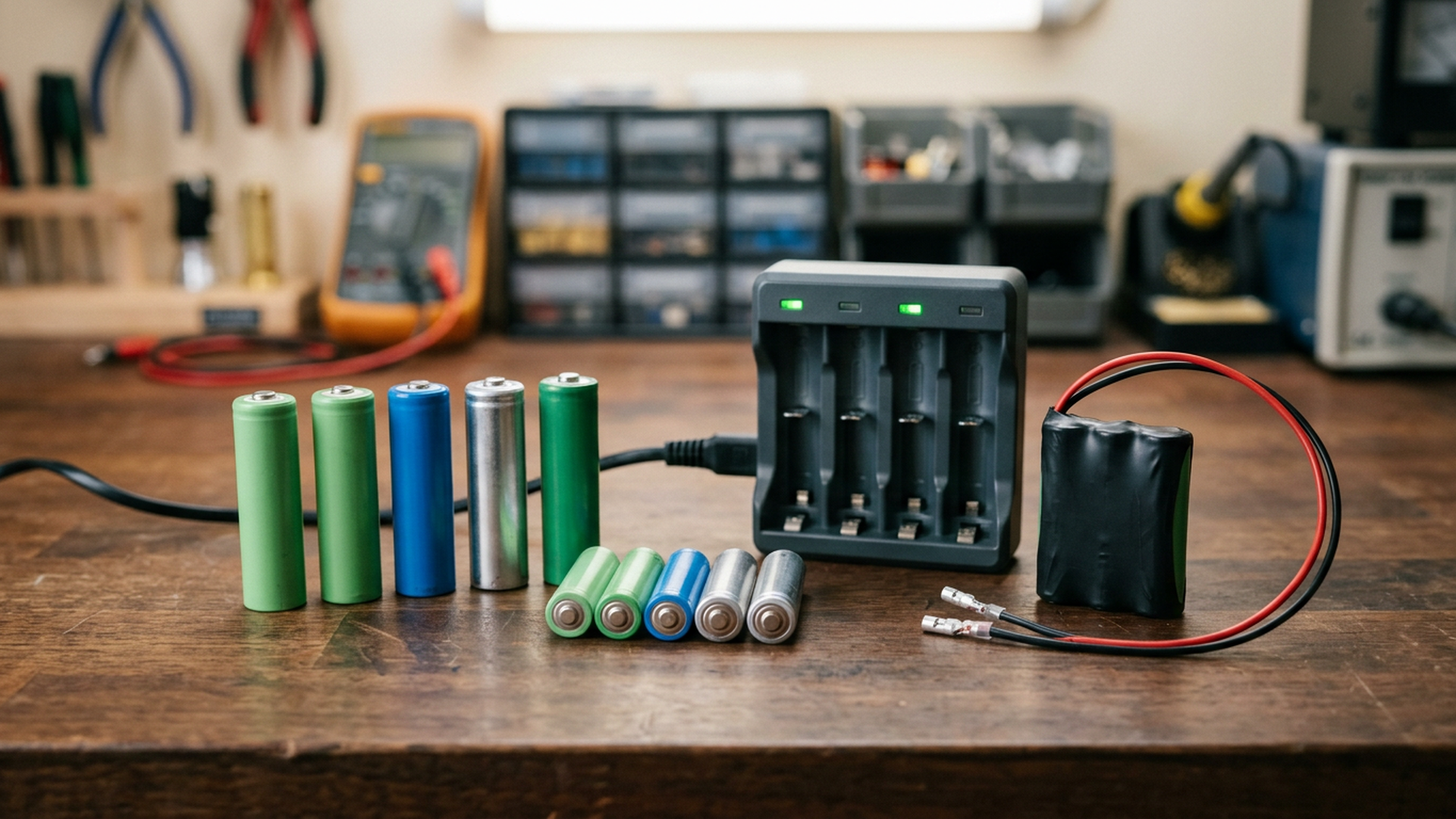
The cells are made in standard formats that map to everyday use: AA, AAA, C, D, SC, and 9V, among others. They can also be assembled into custom battery packs with specific voltages, capacities, and connector wiring for original equipment manufacturers. This flexibility, from a single loose cell to a purpose-built pack, is what makes NiMH such a workhorse chemistry across consumer and industrial applications.
The essential value proposition is simple: a reusable alternative to disposable alkaline batteries, and a safer, higher-capacity replacement for legacy NiCd batteries. That dual role explains why the chemistry has persisted for decades despite the rise of lithium-ion.
How NiMH Batteries Work
The chemistry itself is worth a brief explanation, because the behaviour of these cells, including their quirks, follows directly from it.
During discharge, the hydrogen-absorbing alloy releases hydrogen, and the nickel hydroxide is reduced as current flows, producing the cell’s 1.2 volts. During charging, the reaction reverses, and the cell stores the energy again. This cycle can be repeated hundreds of times, which is the entire point of a rechargeable chemistry.
The 1.2-volt nominal voltage is the detail most people notice first, because a freshly charged NiMH cell measures below the 1.5 volts of an alkaline. In most devices this makes no practical difference, because equipment built for rechargeables is designed around the lower voltage, but it is why NiMH cells are not always a drop-in replacement in every device. For devices that demand the full 1.5 volts, low self-discharge or alternative chemistries are sometimes the better fit.
The second behavioural point is self-discharge. Traditional NiMH cells lose their charge over weeks of sitting on a shelf, which is why they are best used in devices that see regular use and regular recharging. Low self-discharge NiMH variants, sometimes labelled as “ready to use,” have largely solved this for consumer applications, and they hold their charge for months rather than weeks.
Where NiMH Batteries Are Used
The applications are broad, and understanding them explains why the chemistry remains relevant in a lithium-dominated era.
In consumer electronics, NiMH cells power cordless phones, remote controls, wireless keyboards and mice, toys, and flashlights, anywhere a device is used regularly and benefits from rechargeable cells. The economics are compelling: a set of NiMH AA cells and a charger replaces dozens of disposables over its life.
In industrial and professional equipment, NiMH appears in cordless power tools, medical devices, emergency backup systems, and instrumentation, where its robustness and predictable discharge curve are valued. In RC and hobby products, NiMH packs remain a common choice for cars, boats, and other models, where their ruggedness and simple charging outweigh the higher energy density of lithium.
The largest volume application is OEM supply. Manufacturers across these industries specify NiMH cells or packs built to their exact voltage, capacity, and connector requirements, and they source them through wholesale channels that supply everything from samples to hundred-thousand-piece orders. GM Cell Tech operates in exactly this space, offering standard cells, custom packs, and OEM supply paths for replacement, assembly, and long-term sourcing.
NiMH vs Alkaline vs NiCd vs Lithium
The best way to understand where NiMH fits is to compare it against the chemistries it competes with, because the choice is always relative to the application.
Against alkaline, the difference is reusability. Alkaline batteries are disposable and become waste after a single use, while a NiMH cell recharges hundreds of times, which is both cheaper over time and less wasteful. The trade-off is the lower nominal voltage and the need for a charger, which is why NiMH suits devices used frequently and alkaline suits devices that sit for years between uses.
Against NiCd, the difference is capability and safety. NiCd cells suffer from the memory effect, in which partial discharge followed by recharge gradually reduces usable capacity, and they contain toxic cadmium. NiMH largely eliminates the memory effect, offers higher capacity in the same size, and removes the cadmium, which is why NiMH became the direct, environmentally friendlier replacement for NiCd in almost every application.
Against lithium-ion, the comparison is less a contest than a division of labour. Lithium holds more energy per gram and per volume, which is why it dominates phones, laptops, and electric vehicles, but it costs more and requires more careful management. NiMH remains competitive where cost, robustness, and simple charging matter more than maximum energy density, which describes a large share of industrial and consumer devices.
Understanding Capacity, Voltage, and Cell Sizes
Reading a NiMH specification is straightforward once the terms are clear, and a few of them cover most buying decisions.
Capacity is measured in milliamp-hours, written mAh, and it describes how much charge a cell holds. A higher mAh rating means longer run time in the same device, so an AA cell rated at 2,700 mAh runs longer than one rated at 1,000 mAh. The trade-off is that higher-capacity cells of the same size are sometimes slightly less robust, but for most uses the higher number is the better choice.
Voltage is determined by the cell count, because each NiMH cell contributes 1.2 volts. A pack built from three cells is a 3.6-volt pack, four cells makes 4.8 volts, and so on, which is how custom packs are specified for OEM devices. The pack’s capacity stays the same as its individual cells, while the voltage adds with each cell in series.
Cell sizes follow the standard formats, from AA and AAA through C, D, and SC to 9V and the specialist sizes used in industrial packs. The size determines both the physical fit and the practical capacity ceiling, and a supplier’s catalogue is organised around these formats for exactly that reason. GM Cell Tech, for instance, lists capacities from 400 mAh 2/3AA cells up to 4,500 mAh 18670A cells, spanning the range most devices require.
Buying NiMH Cells and Packs: What to Know
Whether you are replacing batteries in a device or sourcing for a product, the buying considerations are consistent.
For consumer replacement, the key is matching the size, and then choosing the capacity and self-discharge behaviour that suit the device. A high-capacity AA suits a device in daily use, while a low self-discharge cell suits a device that sits idle for long stretches, such as a flashlight kept for emergencies. A proper NiMH charger is part of the system, because charging these cells correctly is what delivers their rated life.
For OEM and wholesale buyers, the considerations are different: voltage, capacity, connector type, and pack construction all must match the device specification, and the supplier must be able to deliver consistent quality at scale. The buying path typically moves from a sample order, through pilot quantities, to production volumes, with the supplier providing consistent cells and packs across the entire sequence.
GM Cell Tech structures its offering around this path, with a product range covering loose rechargeable cells, OEM battery packs, RC packs, and chargers, and an ordering scale that runs from sample quantities to orders of more than 100,000 pieces. The company also offers a 9V range from 160 mAh to 250 mAh and an AA range spanning 450 mAh to 2,700 mAh, which illustrates the granularity a serious supplier provides.
Getting the Longest Life From NiMH Batteries
A few habits extend the life of NiMH cells considerably, and they cost nothing.
Use a charger designed for NiMH chemistry, because the charge termination method matters, and a charger meant for another chemistry can overcharge and damage the cells. Avoid leaving cells on a trickle charge indefinitely, because even NiMH dislikes being held at full charge forever, and charge cells before they are deeply discharged in high-drain devices.
Store cells in a cool, dry place rather than in heat, which degrades all battery chemistries, and if cells will sit unused for a long period, charge them to roughly half rather than storing them empty. These habits, applied consistently, are the difference between cells that last years and cells that fade within months.
The Role of NiMH in a Lithium World
It is fair to ask why NiMH still matters when lithium dominates the headlines, and the answer is that the two chemistries serve different masters.
Lithium-ion wins where energy density is everything, in the phone, the laptop, and the electric car. NiMH wins where cost, robustness, simplicity, and form-factor continuity matter more, in the cordless tool, the emergency fixture, the RC model, and the thousands of OEM devices built around 1.2-volt cells and their standard sizes. The installed base of devices designed for NiMH is enormous, and it will be for a long time.
There is also a practical argument. NiMH is a proven, safe, well-understood chemistry with a mature supply chain, and for manufacturers it offers a predictable path to rechargeability without the management complexity lithium requires. That is why the chemistry endures, and why suppliers such as GM Cell Tech continue to serve a steady, broad market for cells, packs, and OEM supply.
Conclusion
In conclusion, the NiMH battery is the rechargeable workhorse of the middle market, a chemistry that replaced NiCd, outlasts alkaline, and complements rather than competes with lithium. Its 1.2-volt cells come in every standard size, its packs scale from 3.6 volts to whatever an OEM device requires, and its applications span consumer electronics, industry, RC products, and emergency systems. For consumers, the right cell and charger turn a disposable expense into a reusable asset. For manufacturers, the right supplier turns a specification into a consistent, scalable supply of cells and packs. GM Cell Tech represents that supply side, with a catalogue spanning loose cells, custom packs, chargers, and OEM quantities from samples to production runs. The chemistry is mature, the format is proven, and for the enormous range of devices built around it, the NiMH battery remains exactly the right tool.
Frequently Asked Questions
1. What is a NiMH battery?
A NiMH battery is a rechargeable nickel metal hydride battery with a nominal voltage of 1.2 volts per cell, used in consumer, industrial, and OEM applications.
2. What is the difference between NiMH and NiCd?
NiMH offers higher capacity, has no significant memory effect, and contains no toxic cadmium, making it the environmentally friendlier replacement for NiCd.
3. Can NiMH replace alkaline batteries?
Yes, in most devices, NiMH cells of the same size replace disposable alkaline batteries, offering hundreds of recharges, though their nominal voltage is 1.2 volts rather than 1.5.
4. What does mAh mean on a NiMH battery?
mAh, milliamp-hours, measures capacity; a higher mAh rating means the cell stores more charge and runs a device longer between charges.
5. How many times can a NiMH battery be recharged?
A quality NiMH cell typically recharges hundreds of times over its life, making it far more economical than disposables over time.
6. What is the difference between a NiMH cell and a battery pack?
A cell is a single 1.2-volt unit, while a battery pack is multiple cells assembled in series and parallel to provide a specific voltage and capacity for a device.