Drain Rain Gutter: A Complete Guide to Gutter Drainage Solutions for Your Home
A gutter system only works as well as its drainage, and this is the point most homeowners miss until the damage shows up. Gutters catch the water, but if that water is not carried safely away, it pools against the foundation, saturates the soil, and begins the slow work of damaging the very structure the gutters were meant to protect. Learning how to properly drain rain gutter water away from the home is therefore one of the most valuable maintenance skills a homeowner can develop. This guide explains why gutter drainage matters, the five main solutions available, and how to choose the right approach for your home and your landscape.
Why Gutter Drainage Is the Part That Matters
To understand the solutions, it helps to understand the problem they solve, because the failure mode is consistent and costly.
A gutter collects rainwater from the roof and channels it to the downspouts, where it is discharged at ground level. If that discharge happens too close to the foundation, the water saturates the soil directly against the home. Saturated soil expands and shifts, which stresses the foundation, and the persistent moisture finds its way into basements and crawl spaces. The result, over time, is foundation cracking, interior dampness, landscape erosion, and damage to the home’s exterior.
The instinct to focus on the gutters themselves is understandable, but the drainage is where the protection actually happens. A gutter that catches every drop of water but discharges it against the foundation is doing half its job. This is why the solutions described below, all of which address where the water goes after the downspout, are the difference between a protected home and a slowly eroding one.
The Five Gutter Drainage Solutions
The options range from a ten-dollar fix to a full underground installation, and each has a defined place.
Downspout Extensions
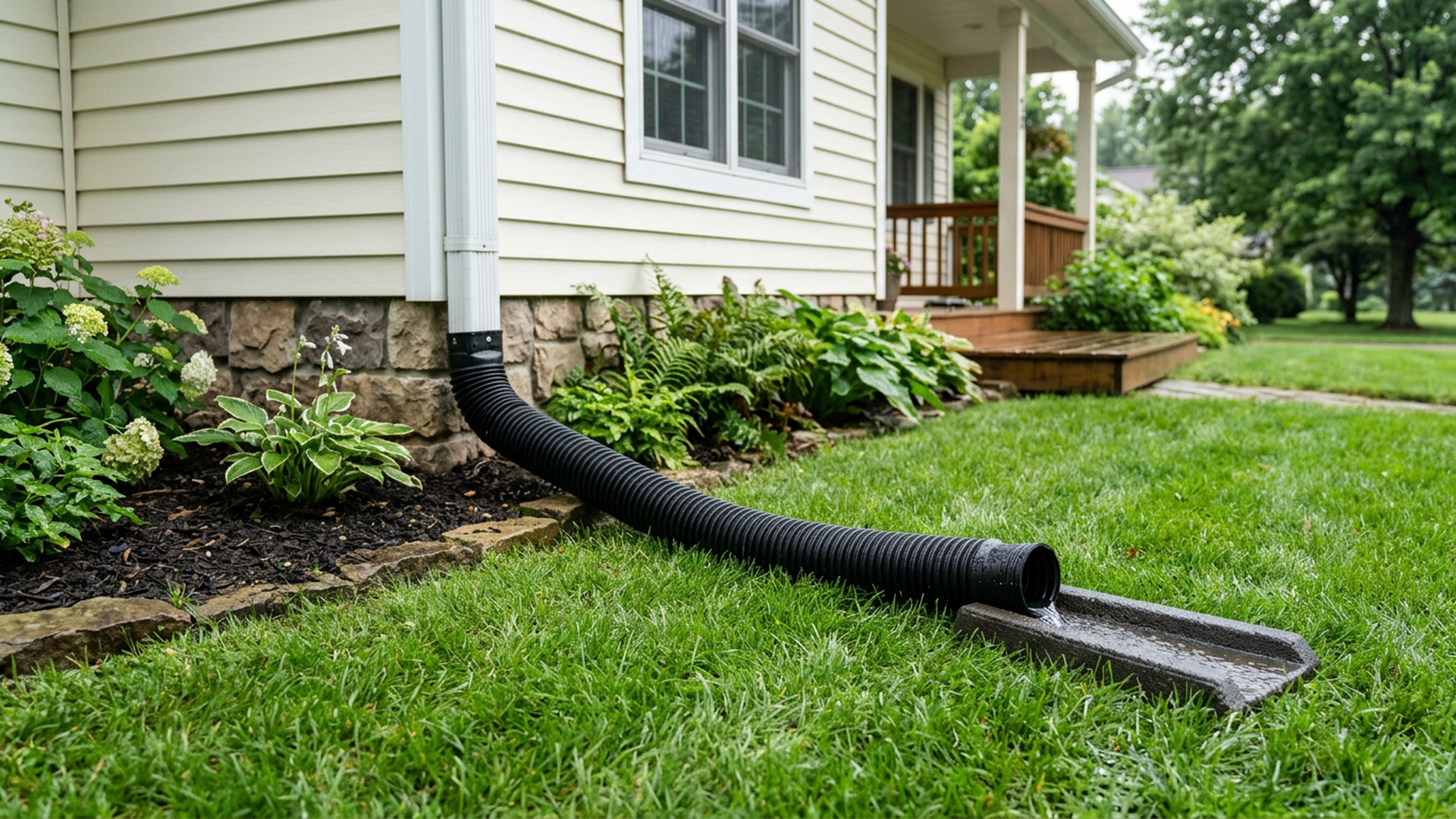
Downspout extensions are the simplest and most affordable solution, and for many homes they are all that is needed. The idea is straightforward: the downspout is extended so that water discharges several feet away from the foundation rather than directly against it.
Extensions come in flexible and rigid forms. Flexible extensions are easy to install and can be shaped around landscaping, while rigid extensions are more durable and stay in place. The practical rule is that water should be discharged at least a few feet from the foundation, and further on sloped or poorly draining sites. For a home where the downspouts currently empty against the wall, this single change is often the highest-value improvement available.
Splash Guards and Blocks
Splash guards and splash blocks address two different failure points in the same system, and they are frequently used together.
Splash guards are small, angled pieces installed inside the gutter at points where water overshoots, particularly at inside corners and where two rooflines meet. They prevent water from spilling over the edge during heavy rain, which is a common cause of water running down the fascia and the wall. Splash blocks, by contrast, sit under the downspout at ground level, dispersing the water evenly and preventing the trenching and erosion that form where a downspout dumps water in one spot.
Together, these two inexpensive additions solve the problems of overshoot and concentrated discharge, and they cost very little relative to the damage they prevent.
Underground Drainage
For homeowners who want a cleaner look and a more complete solution, underground drainage carries the water through buried pipe to a discharge point far from the home.
This approach connects the downspouts to a series of buried pipes that run to a designated drainage area or storm drain. It is the most effective solution for preventing water accumulation around the foundation, and it has the aesthetic advantage of removing visible downspout extensions from the yard entirely. The trade-off is cost and installation effort, because the work involves trenching, but for homes with persistent drainage problems or long runs to a suitable discharge point, it is the definitive answer.
Rain Chains and Rain Barrels
Rain chains and rain barrels offer a solution for homeowners who want drainage that is both functional and decorative, or who want to put the water to use.
A rain chain replaces a conventional downspout with a decorative chain that guides the water from the gutter to the ground or into a rain barrel. It adds a visual element to the home while doing the same job, and it pairs naturally with a barrel. Rain barrels collect the rainwater for later use, most commonly irrigation, which reduces water bills and conserves a resource while keeping the water out of the foundation zone.
The consideration here is capacity: a barrel fills, and once full, it needs an overflow path that still carries water away from the house. For the right homeowner, though, the combination of chain and barrel turns drainage into a feature.
French Drains
For homes with persistent standing water in the yard or against the foundation, a French drain is the solution that addresses the water already in the ground, not just the water coming off the roof.
A French drain is a trench filled with gravel and a perforated pipe, designed to redirect both surface water and groundwater away from problem areas. Water seeps into the gravel, flows into the perforated pipe, and is carried to a discharge point, drying out the soggy areas and relieving the pressure of excess moisture against the foundation. It is the most involved of the five solutions, but it is the right tool when the problem is not the downspout but the site itself.
How to Choose the Right Solution
The five solutions are not competitors; they answer different problems, and the choice begins with diagnosis.
Start by watching where the water actually goes during a heavy rain. If the downspouts discharge against the foundation, extensions are the immediate fix. If water overshoots the gutters at corners, splash guards address it, and if erosion forms under a downspout, a splash block does. If the water is carried away but the yard still holds standing water, the problem is the site, and a French drain or underground drainage is the answer. If the goal is appearance or water reuse, chains and barrels fit.
Most homes benefit from a combination rather than a single solution, and the sequence matters: correct the immediate discharge first, then address the site if problems persist. A professional assessment can identify which combination a specific home needs, because the right answer depends on the roof, the slope, the soil, and the surrounding landscape.
The Cost of Ignoring Gutter Drainage
It is worth stating plainly what poor drainage costs, because the numbers make the case for acting early.
Foundation repair is the most expensive consequence, and it is routinely the costliest repair a homeowner ever faces. Basement and crawl space water intrusion brings its own costs, from remediation to the ongoing risk of mould. Landscape erosion is cheaper to fix but recurring, and exterior damage, rotted fascia, stained siding, damaged paint, adds up quietly over years.
Against these costs, the drainage solutions described here are inexpensive. A downspout extension costs a few dollars, a splash block a little more, and even a full French drain is a small fraction of a foundation repair. This is the definition of a maintenance decision that pays for itself, and the reason drainage should be checked as regularly as the gutters themselves.
Keeping the Whole System Working
Drainage solutions only work if the system above them works, and a few habits keep everything functioning together.
Keep the gutters clean, because a clogged gutter overflows and defeats the drainage below it regardless of how well the discharge is set up. Check the downspouts and extensions seasonally, clearing blockages and making sure connections are secure, and confirm that water is still discharging where it should after any landscaping work changes the grade. And inspect the foundation perimeter after heavy rain, because standing water there is the earliest and clearest sign that the drainage needs attention.
These habits are unglamorous, but they are the difference between a home that sheds water properly and one that slowly absorbs it, and they cost nothing compared with the alternative.
When to Call a Professional
Some drainage work is simple enough for a confident homeowner, and some is not, and knowing the boundary protects both the home and the budget.
Extensions, splash blocks, and rain barrels are realistic weekend projects. Underground drainage and French drains, by contrast, involve trenching, grading, and in some cases connection to storm systems, and the consequences of doing them wrong, water routed toward rather than away from the home, are severe. A professional gutter company can assess the whole system and install the right solution correctly the first time.
GutterPro Solutions positions itself for exactly this role, offering gutter installation, repair, and maintenance alongside advanced drainage solutions, with the stated goal of protecting the home from water damage. For a homeowner who is unsure which drainage approach their property needs, a professional assessment is the fastest path to the right answer.
Conclusion
In conclusion, the ability to properly drain rain gutter water away from the home is the difference between a gutter system that protects and one that merely collects. The five solutions, downspout extensions, splash guards and blocks, underground drainage, rain chains and barrels, and French drains, each answer a specific problem, and most homes benefit from a combination chosen after watching where the water actually goes. The costs are modest and the consequences of neglect are severe, which makes drainage the rare home improvement that is both cheap and urgent. For homeowners who want certainty, a professional assessment, such as the one GutterPro Solutions offers, turns a guess into a plan. The water will keep coming; the only question is where it goes when it arrives, and that answer is worth getting right.
Frequently Asked Questions
1. How far should a downspout drain water from the foundation?
Water should discharge at least a few feet from the foundation, and further on sloped or poorly draining sites, to keep soil around the home from saturating.
2. What is the cheapest gutter drainage solution?
Downspout extensions are the simplest and most affordable fix, directing water away from the foundation for a few dollars.
3. What is a French drain and when is it needed?
A French drain is a gravel-filled trench with a perforated pipe that redirects surface and groundwater, used when standing water persists in the yard or against the foundation.
4. Do rain barrels help with drainage?
Yes, rain barrels collect and store rainwater for reuse, keeping it out of the foundation zone, though they need an overflow path once full.
5. How do I know if my gutter drainage is failing?
Look for standing water near the foundation after rain, erosion under downspouts, damp basements, or water running down exterior walls.
6. Should I hire a professional for gutter drainage work?
Extensions and splash blocks are DIY-friendly, but underground drainage and French drains involve trenching and grading, where professional installation prevents costly mistakes.