Retractable Screen Doors: 7 Smart Things to Know Before Buying
retractable screen doors provide insect protection and fresh-air ventilation without permanently covering a doorway with a traditional fixed screen. When the screen is not required, the mesh rolls or folds into a slim housing, restoring a clearer view and keeping the entrance visually uncluttered. Current systems are available for standard entry doors, French doors, sliding openings and even large multi-panel glass walls, making them increasingly useful in modern indoor-outdoor living spaces.
Unlike a conventional hinged screen door, a retractable system is designed to disappear when not in use.
That basic idea offers several advantages:
- Better outdoor views
- Fresh-air ventilation
- Insect protection
- Cleaner architectural appearance
- Flexible use with different door styles
However, not every retractable system is identical.
Mesh construction, track design, dimensions, installation method and pet resistance can all affect long-term performance.
These seven buying considerations will help homeowners choose a system that fits both the doorway and the way the home is actually used.
What Are Retractable Screen Doors?
Retractable screen doors use flexible screen material that moves across a doorway and stores inside a side cassette or another compact housing when opened.
Phantom Screens describes the basic advantage as providing bug protection and airflow while allowing the screen to disappear into its housing when it is not required.
A typical system includes:
- Screen mesh
- Side housing
- Handle
- Top track
- Bottom guide or track
- Latching mechanism
- Return or retraction mechanism
Depending on the product, the screen may retract using:
- Spring tension
- Controlled roll-up system
- Pleated folding action
The operating method matters less than whether the product is properly sized, installed and matched to the application.
1. Choose the Right Retractable Screen Door Type
The first decision is matching the screen to the doorway.
Retractable screen systems are now available for far more than a conventional single front door.
Single Entry Doors
A single retractable screen usually stores on one side of the opening and pulls across to the opposite side.
This arrangement can work with:
- Front doors
- Back doors
- Side entrances
It is especially useful where the homeowner wants ventilation but does not want a permanent storm or screen door affecting the home’s appearance.
French Doors
Double or French doors need a wider solution.
Some retractable systems use two screens that meet toward the center.
Phantom currently offers screen configurations for both single and double doors, while its mesh-lock system supports widths up to 48 inches for a single screen and 96 inches for a double-screen arrangement.
Sliding Patio Doors
Retractable screens can also work with sliding glass doors.
This can be useful when the existing fixed sliding screen:
- Blocks the view
- Is difficult to operate
- Takes up visual space
Oversized Glass Openings
Contemporary homes increasingly use:
- Bi-fold doors
- Multi-slide doors
- Stacking glass walls
- Lift-and-slide systems
Phantom currently offers oversized retractable solutions for these larger applications.
Before purchasing anything, identify the exact door type.
A screen designed for a basic single entrance should not be assumed to work on a large sliding-wall system.
2. Measure the Door Opening Carefully
Incorrect measurement is one of the easiest ways to turn a simple screen project into a frustrating one.
Do not choose a retractable screen only from the nominal door size.
The actual opening can vary because of:
- Trim
- Threshold
- Door frame
- Sill shape
- Previous remodeling
Measure Width
Measure across the actual installation area.
Take measurements near:
- Top
- Middle
- Bottom
If they differ, the opening may not be perfectly square.
Measure Height
Measure from the intended top mounting location to the sill or lower mounting surface.
Check multiple points rather than assuming the height is identical across the opening.
Check Available Mounting Space
A retractable screen needs space for its housing.
The cassette may mount:
- Inside the jamb
- On the surface of the trim
- Around the exterior frame
Phantom’s technical documentation shows multiple mounting arrangements and sill adapters for different door configurations.
Check the Threshold
The bottom of the doorway matters because the screen may need a track or guide.
An uneven threshold can affect:
- Smooth operation
- Alignment
- Mesh retention
A professional installer can often use a sill adapter where necessary.
3. Select the Correct Screen Mesh
Many homeowners think all screen mesh is the same.
It is not.
The weave of the screen can affect:
- Airflow
- Visibility
- Insect control
- Sun reduction
- Privacy
Phantom’s current door-screen lineup includes different insect and privacy mesh options with significantly different openness and solar-blocking characteristics.
Standard Insect Mesh
A conventional insect screen is designed primarily to:
- Let air pass
- Preserve visibility
- Keep larger insects outside
This is usually a good choice for ordinary patios and entryways.
No-See-Um Mesh
Areas with very small insects may benefit from a tighter weave.
The tradeoff is simple:
A tighter mesh can improve insect protection but may reduce airflow slightly.
Solar Mesh
Some screen materials provide additional sun and UV control.
Phantom states that certain solar-screen configurations can block up to 80% of UV rays.
That can be useful on doors facing strong afternoon sun.
Privacy Mesh
Privacy mesh uses a much tighter structure.
Some of Phantom’s current privacy options are rated for up to about 90% to 95% sun and UV blockage depending on the material.
The tradeoff is lower openness.
Before choosing privacy mesh, decide whether your main priority is:
- Maximum airflow
- Insect protection
- Shade
- Privacy
No single mesh maximizes every feature simultaneously.
4. Consider Pets and Children
A standard insect screen should not automatically be treated as a pet barrier.
A determined dog or cat can:
- Push against mesh
- Scratch it
- Dislodge it from a track
Homeowners with pets should specifically ask about reinforced mesh and track retention.
Captured Edge Screens
Some newer systems secure the mesh inside both the upper and lower tracks.
Phantom’s mesh-lock design uses a captured-edge system intended to reduce mesh blowout while helping keep small pets inside and unwanted animals or debris outside.
This is a meaningful difference from loosely guided mesh.
Pet-Resistant Mesh
A more durable mesh can also reduce damage from claws.
However, no retractable insect screen should automatically be considered a substitute for:
- Security gate
- Child barrier
- Pool fence
Visibility Matters
One subtle risk with highly transparent screens is that people may not notice them.
This is especially relevant for:
- Children
- Guests
- Pets
Some systems offer visible markings or other design elements that make the screen easier to see when extended.
5. Decide Between DIY and Professional Installation
Some retractable screens are specifically designed for DIY installation.
Others are custom products installed by trained professionals.
Larson currently markets its Brisa retractable screen as a surface-mounted DIY product that can be installed in about 30 minutes on standard applications by someone with average DIY skills.
By contrast, Phantom’s current custom retractable screens are professionally installed through its authorized installer network.
DIY Can Make Sense When
The doorway is:
- Standard size
- Square
- Easy to access
and the screen is designed specifically for homeowner installation.
Professional Installation Can Be Better When
The project involves:
- French doors
- Oversized openings
- Unusual thresholds
- Custom colors
- Complicated mounting
Proper installation affects more than appearance.
It affects:
- Track alignment
- Retraction
- Latching
- Mesh tension
- Long-term durability
A high-quality screen that is installed incorrectly may perform worse than a simpler product installed correctly.
6. Understand Maintenance Requirements
Retractable screen doors are relatively simple products, but they still require maintenance.
Dust, pet hair and outdoor debris can collect in the tracks.
Over time this can make operation less smooth.
Clean the Tracks
Phantom recommends regularly cleaning tracks using either:
- Vacuum
- Rag
to remove dirt and debris.
Use the Correct Lubricant
The manufacturer recommends its greaseless silicone spray for the track and specifically warns that products such as WD-40 can damage the system.
Always follow the instructions for your particular product.
Clean the Mesh
Phantom recommends cleaning mesh and housing once or twice per season using:
- Water
- Mild detergent
- Soft brush
while avoiding harsh chemicals and pressure washers.
Inspect the Mesh
Look for:
- Tears
- Loose edges
- Track separation
- Fraying
Small problems are usually easier to repair before they become large ones.
7. Compare the Whole System, Not Just the Price
A low purchase price can be attractive, but retractable screen value depends on more than initial cost.
Compare:
- Frame construction
- Mesh material
- Track design
- Maximum opening size
- Warranty
- Replacement-part availability
- Installation requirements
Frame Material
Many higher-quality systems use aluminum housings and tracks.
Phantom says its retractable screens use extruded aluminum components with fiberglass or polyester mesh.
Warranty
Warranty coverage varies widely.
Read what is actually included.
Coverage may differ between:
- Frame
- Mechanical parts
- Mesh
- Labor
Phantom currently promotes a limited lifetime warranty on its retractable screens, subject to its warranty terms.
Replacement Mesh
Ask whether damaged mesh can be replaced without buying an entirely new system.
A serviceable system may offer better long-term value.
Major Benefits of Retractable Screen Doors
Clearer Views
The screen disappears when not required.
This prevents permanent mesh from covering attractive:
- Glass doors
- Landscaping
- Outdoor views
Improved Ventilation
Opening an exterior door can allow natural airflow through the home.
This may make spring and fall conditions more comfortable without relying exclusively on mechanical cooling.
Insect Protection
Screens provide a physical barrier against:
- Flies
- Mosquitoes
- Other insects
while allowing air movement.
Cleaner Appearance
A housing matched to the door frame can be much less visually prominent than a traditional hinged screen door.
Phantom currently offers multiple frame colors and custom finishes, including wood-grain options.
Retractable Screen Doors vs Traditional Screen Doors
Both approaches have advantages.
Traditional Hinged Screen Door
A conventional screen door may offer:
- Simple construction
- Lower complexity
- Familiar operation
But it remains permanently visible.
It also needs swing clearance.
Retractable Screen Door
A retractable design:
- Stores away
- Does not require swing space
- Preserves the doorway appearance
However, its tracks and retraction system require correct installation and maintenance.
The better choice depends on the home.
Retractable Screen Doors for French Doors
French doors are one of the strongest use cases for retractable screens.
A traditional fixed screen arrangement can be awkward because both doors may need to open.
A paired retractable system can keep most of the opening clear until the screens are needed.
Before ordering, check:
- Total width
- Center meeting point
- Handle clearance
- Threshold
Custom installation is often worthwhile for large double-door openings.
Retractable Screens for Sliding Glass Doors
Retractable screens can create a cleaner alternative to a permanently visible sliding-screen panel.
They can be especially attractive in rooms where the patio door is a major architectural feature.
However, the product must be designed for the sliding-door configuration.
Check whether the system interferes with:
- Existing track
- Door handle
- Lock
- Threshold
Retractable Screens for Large Patio Openings
Modern architecture often includes openings far larger than a normal door.
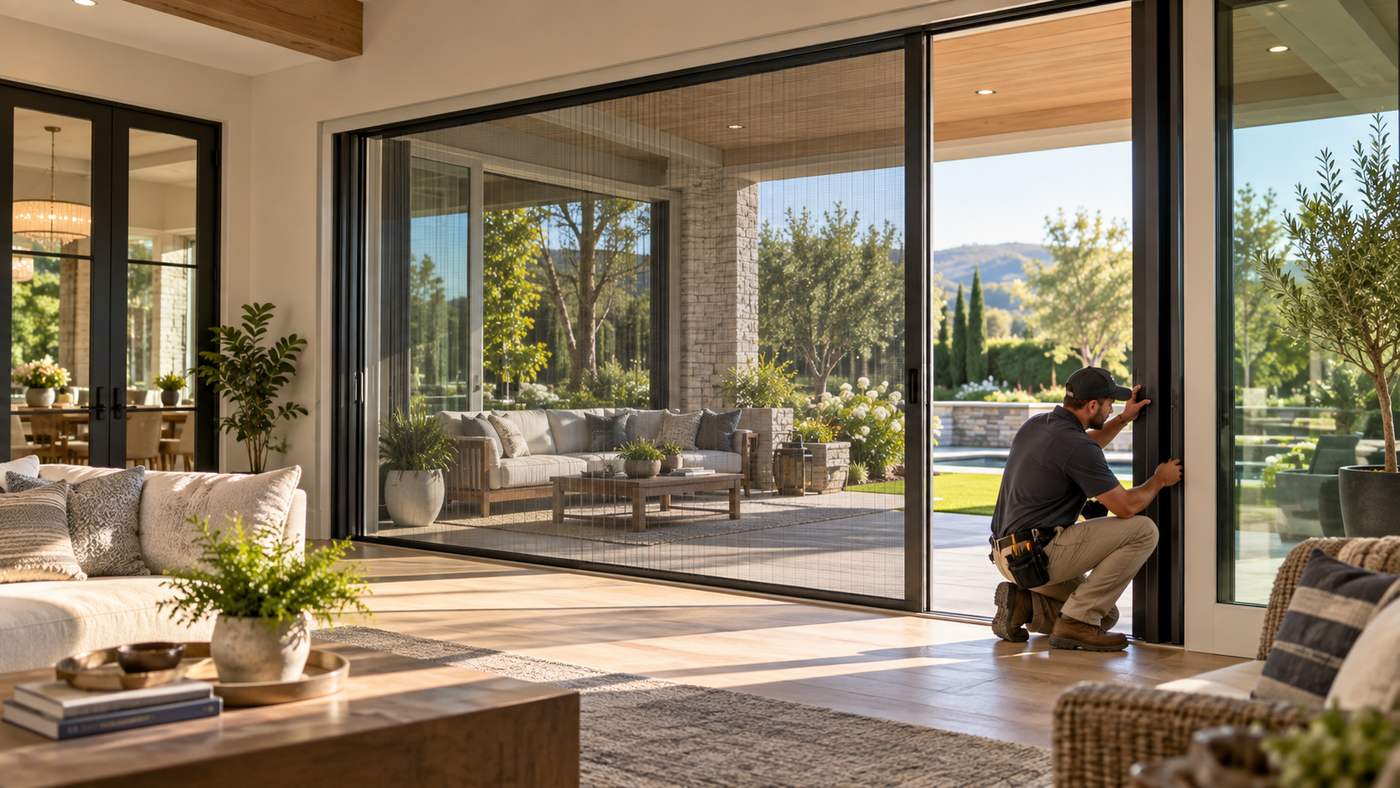
Motorized or oversized retractable screen systems can cover:
- Outdoor kitchens
- Covered patios
- Large glass walls
Phantom’s oversized products are currently designed for bi-fold, sliding, stacking and lift-and-slide systems.
These installations usually require professional measurement and installation.
Can Retractable Screen Doors Help With Sunlight?
Yes, depending on the mesh.
Standard insect mesh primarily focuses on airflow and bugs.
Solar or privacy mesh can reduce more solar exposure.
For example, Phantom currently lists privacy meshes providing up to around 90% or 95% UV and solar blockage depending on the product.
That can help make certain patios and rooms more comfortable.
However, a screen is not the same as:
- Insulated door
- Window film
- Full exterior shade system
Choose the solution according to the actual heat-control goal.
How Long Do Retractable Screen Doors Last?
There is no universal lifespan.
Durability depends on:
- Material quality
- Installation
- Climate
- Frequency of use
- Maintenance
- Pet activity
A professionally installed, well-maintained system can provide years of service.
The mesh is generally more vulnerable than the aluminum housing.
Phantom notes that screen mesh can be replaced if damaged while the underlying system is serviced.
Common Retractable Screen Door Problems
Screen Does Not Retract Smoothly
Possible causes include:
- Dirty track
- Misalignment
- Worn mechanism
Clean the track first according to manufacturer guidance.
Mesh Comes Out of the Track
This can happen from:
- Strong impact
- Wind
- Pets
A captured-edge design may reduce the risk.
Screen Does Not Latch
Check:
- Alignment
- Handle position
- Closing surface
Do not force the mechanism.
Torn Mesh
Repair options depend on the system.
Some designs allow replacement mesh without replacing the full frame.
Common Buying Mistakes
Buying Before Measuring
Never assume every 36-inch door opening is identical.
Choosing Mesh Only by Appearance
Think about:
- Insect size
- Sun exposure
- Airflow
Ignoring the Threshold
Bottom-track installation can be difficult on unusual sills.
Assuming Every Screen Is Pet-Proof
Standard insect mesh is not automatically intended to restrain pets.
Choosing Price Over Serviceability
A cheap system can become expensive if replacement components are unavailable.
Frequently Asked Questions
What are retractable screen doors?
Retractable screen doors use flexible mesh that extends across an entrance when needed and stores inside a slim housing when opened, preserving airflow and outdoor views.
Do retractable screen doors work with French doors?
Yes. Manufacturers currently offer double-screen configurations designed specifically for French and other double-door openings.
Are retractable screen doors good for pets?
They can be, but pet owners should consider reinforced or captured-edge mesh. Some mesh-lock systems are designed to reduce the chance of small pets pushing the screen out of its tracks.
Can I install a retractable screen door myself?
Some products are designed for DIY installation, while custom systems require professional installers. Larson, for example, currently markets Brisa as a quick surface-mount DIY screen.
How should retractable screen doors be cleaned?
Keep the tracks free of debris and clean the mesh periodically with mild detergent, water and a soft brush. Avoid harsh chemicals or pressure washing unless the manufacturer specifically permits them.
Do retractable screen doors block sunlight?
Standard insect screens provide limited shading, but specialized solar and privacy meshes can significantly reduce sunlight and UV exposure. Some current mesh options advertise up to 90% to 95% blockage.
Conclusion
Retractable screen doors provide a flexible way to bring fresh air into a home while keeping insects outside and preserving clear views when the screen is not needed. The best system depends on the doorway size, mesh type, pet requirements, installation method and desired level of sun or privacy control. Measuring carefully and choosing a serviceable, correctly installed product can significantly improve long-term performance. With routine track and mesh maintenance, a quality retractable screen can become a practical part of everyday indoor-outdoor living