Polyurea: Complete Guide to Protective Coatings & Industrial Flooring
Polyurea has revolutionized the protective coatings and industrial flooring industries, offering unmatched durability, flexibility, and speed. Originally developed in the 1980s for automotive bed liners, this advanced elastomeric coating has evolved into the premier solution for safeguarding concrete, steel, and tank substrates across the globe. Unlike traditional coatings that take days to cure, polyurea sets in seconds, drastically reducing downtime and allowing facilities to return to full operation almost immediately. Whether you are specifying a coating for a secondary containment pad, a wastewater treatment plant, or a heavy-duty commercial garage, understanding the capabilities of this technology is essential. This comprehensive guide explores the chemistry, benefits, applications, and professional application process of this transformative seamless membrane.
What is Polyurea and How Does It Work?
To understand why polyurea is rapidly replacing older technologies, you must look at its fundamental chemistry and physical properties. It is an elastomer—a polymer with viscoelasticity—derived from the reaction of an isocyanate component with a resin blend component.
The Chemistry of Elastomeric Coatings
The magic of polyurea lies in its molecular structure. During application, the isocyanate and resin components are mixed at high pressure and temperature. The resulting chemical reaction creates a tightly cross-linked polymer chain.
This dense cross-linking provides exceptional structural integrity. It makes the coating highly resistant to chemical attacks, impact, and abrasion. Because the reaction is driven by the chemical mixing process rather than ambient moisture or temperature, the coating cures remarkably fast and forms a completely seamless, waterproof membrane.
Fast-Curing Technology: Seconds vs. Hours
The most defining characteristic of polyurea is its cure time. Traditional epoxy coatings can take 24 to 72 hours to dry and up to a week to fully cure. Polyurea, by contrast, is touch-dry in seconds and fully cured for traffic in just hours.
This rapid return-to-service is a game-changer for industrial facilities. Manufacturing plants, commercial kitchens, and municipal infrastructure cannot afford prolonged shutdowns for floor renovations. With polyurea, a floor can be blasted, sprayed, and ready for heavy forklift traffic by the next morning.
Key Benefits of Polyurea Protective Coatings
Specifying polyurea for your next project provides a suite of advantages that simply cannot be achieved with conventional paints, epoxies, or polyurethanes.
Extreme Durability and Abrasion Resistance
Industrial environments are brutal. Floors are subjected to point loads from forklifts, scraping from metal carts, and constant physical wear. Polyurea protective coatings exhibit tensile strengths that far exceed standard epoxies. They will not crack, chip, or peel under extreme impact. Their innate flexibility allows them to absorb heavy impacts that would cause rigid epoxy coatings to fracture.
Seamless Membrane and Superior Waterproofing
Because polyurea is spray-applied, it creates a monolithic, seamless membrane. There are no seams, joints, or weak points where water and chemicals can penetrate. This makes it an extraordinary waterproofing solution. It bonds directly to the substrate, preventing delamination caused by hydrostatic pressure or moisture vapor transmission from the concrete slab below.
Thermal Stability and Chemical Resistance
Polyurea remains flexible in extreme cold and stable in extreme heat. It can withstand temperature fluctuations from -40°F to over 300°F without becoming brittle or softening. Furthermore, its dense cross-linked chemistry makes it highly resistant to a wide array of harsh chemicals. It easily repels sulfuric acid, fuels, oils, solvents, and caustic cleaning agents, making it the standard for secondary containment and chemical processing plants.
Elongation and Crack-Bridging Capabilities
Concrete naturally cracks due to settling and thermal expansion. A rigid coating will simply crack right along with the concrete. Polyurea boasts elongation properties of 300% to over 1000%. This means it can stretch dramatically without breaking. When the concrete substrate cracks or shifts, the polyurea membrane bridges the gap, maintaining a continuous, waterproof seal.
Top Applications for Polyurea in Industrial and Commercial Settings
The versatility of polyurea allows it to be formulated for hundreds of specialized applications. Here are the most common uses across various industries.
Polyurea Industrial Flooring and Garage Coatings
Polyurea is rapidly becoming the gold standard for industrial flooring. It is widely used in manufacturing plants, automotive service centers, and residential garage floor coatings.
Its rapid cure time prevents dust and debris from settling into the finish, ensuring a flawless, high-gloss surface. Custom formulations include UV-stable aliphatic polyurea topcoats that will not yellow or fade in sunlight, ensuring the floor looks pristine for decades.
Tank Linings and Secondary Containment
Storage tanks, pipes, and secondary containment areas require absolute protection against leaks. A failure in a chemical tank can lead to environmental disaster and massive fines. Polyurea creates an impermeable, chemical-resistant barrier inside steel and concrete tanks. It is heavily utilized in the oil and gas industry, wastewater treatment facilities, and agricultural silos.
Roof and Foundation Waterproofing
Spray polyurea is an exceptional roofing system for flat commercial roofs. It creates a seamless, reflective membrane that eliminates the leak-prone seams associated with traditional rubber or tar roofs. It is also used to waterproof below-grade foundations, protecting basements from groundwater intrusion and structural decay.
Truck Bed Liners and Automotive Protection
The technology that started it all remains a massive market. Spray-on truck bed liners protect pickup trucks from dents, scratches, and rust. Beyond trucks, polyurea is used to line the interiors of mining equipment, dump trucks, and railroad hopper cars. Its abrasion resistance prevents payload from wearing through the steel.
Polyurea vs. Epoxy vs. Polyurethane Coatings
Facility managers often debate which coating system to specify. Understanding the distinct differences between these three technologies is critical for project success.
Cure Time and Return to Service
- Epoxy: Cures slowly. Often requires 7 days before heavy traffic is allowed.
- Polyurethane: Faster than epoxy, but still requires 24 to 48 hours.
- Polyurea: Cures in seconds. Ready for heavy traffic in 24 hours or less.
Flexibility and Elongation Properties
- Epoxy: Inherently rigid. Excellent for hardness, but poor at handling substrate movement. Will crack if concrete shifts.
- Polyurethane: Offers moderate flexibility. Better than epoxy for exterior applications but can still fail under extreme movement.
- Polyurea: Highly flexible elastomeric coating. Easily bridges moving cracks and handles structural expansion without failure.
Weather, UV, and Temperature Resistance
- Epoxy: Chalks and yellows badly in UV light. Not suitable for exterior exposure without a topcoat. Becomes brittle in extreme cold.
- Polyurethane: Better UV resistance than epoxy, but can degrade over time in harsh sunlight.
- Polyurea: Aliphatic polyurea formulations offer exceptional UV stability. Unaffected by freeze-thaw cycles and extreme thermal shock.
While epoxy is cheaper upfront, the rapid return-to-service, superior longevity, and zero re-coat windows of polyurea often make it more cost-effective over the lifecycle of the asset.
The Professional Polyurea Application Process
Polyurea is an unforgiving chemistry. It cannot be rolled or brushed out of a can. It requires highly specialized, expensive equipment and trained professionals. A flawless application relies on three critical phases.
Surface Preparation and Concrete Profiling
The most common reason for coating failure is poor surface preparation. Polyurea relies on a mechanical bond with the substrate. The concrete must be clean, dry, and profiled.
Professionals use industrial shot blasters or diamond grinders to remove existing coatings, laitance, and contaminants. This opens the pores of the concrete, creating a profile similar to medium-grit sandpaper. Any cracks, spalls, or bugholes must be patched with a fast-curing polyurea grout or epoxy mortar before the topcoat is applied.
Primer Application for Optimal Adhesion
While some pure polyurea formulations are primer-less, most industrial flooring applications require a primer. A high-quality epoxy or polyurea primer penetrates the concrete pores, locking into the substrate. It also acts as a moisture vapor barrier, preventing hydrostatic pressure from pushing the topcoat off the slab. The primer must be allowed to flash off before the polyurea is sprayed.
Spray Application Using Plural Component Equipment
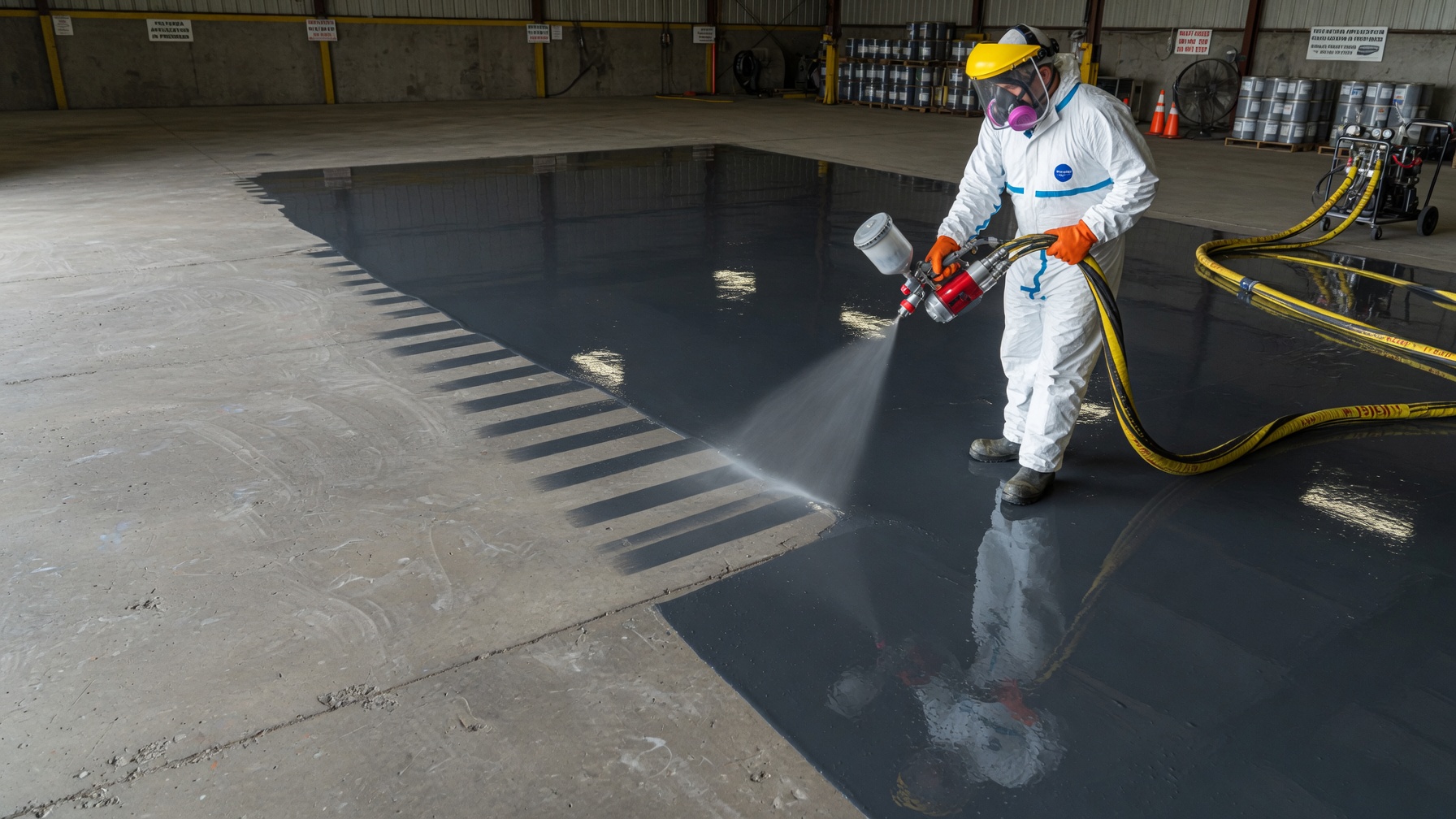
Polyurea is applied using plural-component spray rigs. These machines precisely meter the isocyanate and resin at a 1:1 ratio (or as specified). The materials are heated to over 150°F and sprayed at pressures exceeding 2,000 PSI through a specialized spray gun.
The impingement mixing head inside the gun blends the components milliseconds before they hit the substrate. The applicator must move smoothly and steadily to ensure an even millage thickness. Because the material gels in seconds, the applicator must be highly skilled to avoid runs, sags, or thin spots.
Conclusion: The Future of Protective Coatings is Polyurea
The demands of modern industry require modern solutions. Facilities cannot afford weeks of downtime for floor installations, nor can they tolerate coatings that crack, delaminate, or fail under chemical exposure. Polyurea answers these challenges with unprecedented speed, resilience, and versatility. By creating an indestructible, seamless membrane that bonds directly to the substrate, this elastomeric coating protects critical infrastructure far into the future. Whether you are lining a chemical tank, waterproofing a roof, or upgrading your industrial flooring, the long-term ROI of polyurea is impossible to ignore. Partner with certified applicators, specify the right formulation, and invest in the ultimate protective coating for your assets.
Frequently Asked Questions (FAQs)
1. What is a polyurea coating?
It is a fast-curing, highly durable elastomeric coating created by reacting isocyanates with resin blends, used primarily for industrial flooring and waterproofing.
2. Is polyurea better than epoxy?
Yes, for demanding environments; polyurea cures in seconds rather than days, is highly flexible to bridge cracks, and resists UV rays and chemicals far better than rigid epoxy.
3. How long does polyurea take to cure?
Polyurea is touch-dry in seconds and typically fully cured for heavy foot and forklift traffic within 24 hours, minimizing facility downtime.
4. Can polyurea be applied over concrete?
Yes, polyurea bonds exceptionally well to properly prepared concrete, creating a seamless, waterproof membrane that protects against spalling and chemical attack.
5. Is polyurea waterproof?
Yes, polyurea is completely impermeable to water; its seamless application makes it an industry-leading solution for tank linings and foundation waterproofing.
6. Can I apply polyurea myself?
No, polyurea requires specialized plural-component spray equipment that heats and pressurizes the materials, meaning it must be applied by trained professional contractors.