DONGSHENG Precious Metals: 7 Smart Ways to Maximize Industrial Recycling Value and Support Sustainable Manufacturing
Industrial facilities generate substantial quantities of metal-containing materials through manufacturing, maintenance, production upgrades, and equipment replacement. Some of these materials contain valuable metals that can be recovered through specialized recycling processes instead of being discarded. DONGSHENG Precious Metals operates in this specialized market, offering industrial precious metal recycling and recovery services for businesses handling catalysts, electrodes, electronic components, and other recyclable industrial materials.
Precious metals are essential to modern industries because of their electrical conductivity, chemical stability, corrosion resistance, and catalytic properties. Platinum, palladium, rhodium, iridium, ruthenium, gold, and silver are used in a wide range of industrial applications.
However, recovering these materials requires more than collecting ordinary scrap metal. Their actual value depends on composition, recoverable metal content, market conditions, processing requirements, and transparent commercial arrangements.
For manufacturers, metal recyclers, procurement teams, and industrial businesses, understanding the recycling process can help improve material management and identify potential recovery opportunities.
This guide explores DONGSHENG’s published services, the industrial materials involved, seven important recycling considerations, and the practical steps businesses should follow when evaluating precious metal recovery partners.
What Is DONGSHENG Precious Metals?
DONGSHENG Precious Metals is associated with Hong Kong Dongsheng Metal Trading Co., Ltd., a business focused on industrial metal recycling, precious metal recovery, and related trading activities.
According to its published company information, the business handles materials containing platinum, palladium, rhodium, ruthenium, iridium, gold, silver, and other commercially valuable metals.
Its stated purchasing interests also include titanium electrodes, nickel mesh, industrial catalysts, electronic circuit boards, catalytic converters, and selected specialty metal components.
The company’s published information identifies a Hong Kong office and describes processing and sourcing operations connected with mainland China and international markets.
These descriptions are company-reported information rather than independently audited operational findings.
What Makes Industrial Precious Metal Recycling Different?
Ordinary scrap recycling often focuses on separating bulk materials such as steel, aluminum, and copper.
Precious metal recycling can require more specialized evaluation because valuable metals may be present in relatively small quantities.
For example, a used industrial catalyst may contain a precious metal distributed across a larger support material.
Similarly, an electrode may contain a titanium substrate with a specialized coating containing valuable metals.
The recycling process must account for these material characteristics.
Why Accurate Material Identification Matters
Two industrial components may look similar while containing very different materials.
One electrode may feature a recoverable precious metal coating, while another may contain only base metals.
A professional recovery assessment helps distinguish these differences.
Businesses should avoid estimating scrap value solely from weight, appearance, or an online price quotation.
Industrial Materials Handled by DONGSHENG Precious Metals
The company’s published recycling categories cover several important industrial material streams.
Understanding these categories helps manufacturers determine which obsolete components and production residues may warrant professional assessment.
Platinum and Palladium Catalysts
Platinum and palladium are used in selected industrial catalytic processes.
Depending on the application, these metals may be present in chemical catalysts, automotive catalytic converters, and other specialized equipment.
Spent catalysts can retain recoverable metal content after they are removed from service.
However, the amount remaining varies.
The original formulation, operating environment, contamination, and previous processing history all affect recovery potential.
Rhodium, Ruthenium, and Iridium Materials
Rhodium, ruthenium, and iridium belong to the platinum group metals.
Their properties make them useful in certain chemical, electrochemical, and industrial applications.
Examples include selected catalyst formulations and coated electrode systems.
DONGSHENG lists materials containing these metals among its recycling interests.
Because their concentrations may be relatively low, accurate testing is essential when calculating material value.
Titanium Anodes and Industrial Electrodes
Titanium anodes are used in applications such as water treatment, electroplating, and certain electrolytic processes.
Some electrode systems use mixed metal oxide coatings containing precious metals such as iridium or ruthenium.
The titanium substrate and the coating should be considered separately when assessing recycling value.
Not every titanium component contains economically significant precious metal content.
Nickel Mesh and Industrial Metal Scrap
Nickel materials are used in multiple industrial applications because of their mechanical, chemical, and electrical properties.
DONGSHENG identifies nickel mesh and certain nickel-containing components within its purchasing categories.
The value of these materials depends on their alloy composition, condition, purity, and recoverable quantity.
Nickel is not classified as a precious metal in the conventional sense, but it can be an economically important recyclable industrial metal.
Electronic Circuit Boards and Components
Printed circuit boards may contain copper, gold, silver, palladium, and other metals.
Their recovery value varies significantly depending on the board type and component composition.
High-value electronics and lower-grade mixed electronic waste should not be assumed to offer equivalent returns.
Electronic recycling also introduces important environmental and data security considerations.
7 Essential Tips for Working With DONGSHENG Precious Metals and Industrial Recyclers
Successful recycling begins with careful material evaluation and clear commercial arrangements.
These seven tips can help companies manage industrial scrap more effectively while reducing avoidable purchasing and processing risks.
1. Identify and Separate Valuable Industrial Scrap
One of the most important steps is recognizing which materials may contain recoverable metals.
Factories often accumulate unused parts, damaged components, production residues, and obsolete equipment during routine operations.
Some of these materials may contain valuable elements that are not obvious from their external appearance.
Create a Material Inventory
Begin by recording the industrial components available for recycling.
Useful information includes:
- Material or component name
- Original manufacturer
- Product specifications
- Approximate quantity
- Previous industrial application
- Known metal composition
- Storage condition
- Available technical documents
This information can help a recycling company determine whether the materials are suitable for further evaluation.
Separate Materials by Type
Where appropriate and safe, organize different categories of scrap separately.
For example, precious metal catalysts should not automatically be mixed with ordinary steel scrap.
Different electrode types may also require separate identification.
Mixing incompatible materials can complicate sampling, processing, and valuation.
However, workers should not dismantle hazardous equipment or process unknown chemical residues simply to improve scrap sorting.
Material handling must follow applicable workplace safety requirements.
2. Confirm Precious Metal Content Through Appropriate Testing
The value of industrial precious metal scrap depends heavily on the amount of recoverable material it contains.
Visual inspection is rarely sufficient to determine this accurately.
Professional analysis can help establish the presence and concentration of particular metals.
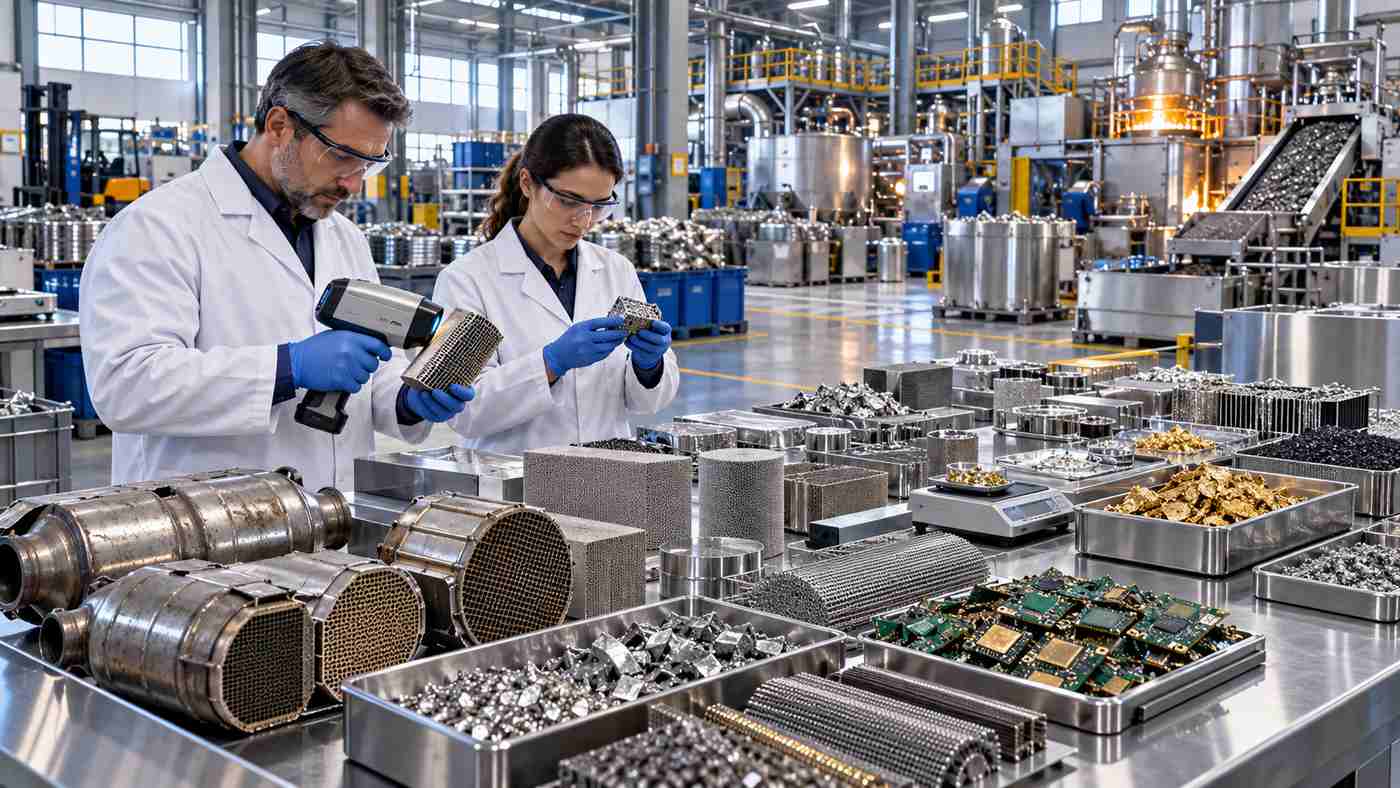
DONGSHENG describes using portable X-ray fluorescence equipment as part of its preliminary material assessment.
What Is X-Ray Fluorescence Testing?
X-ray fluorescence, commonly known as XRF, is an analytical technique used to identify and estimate certain elements in materials.
Portable XRF instruments can provide useful screening information for suitable metal alloys and accessible surfaces.
However, results depend on the instrument, calibration, material condition, and testing method.
Understand XRF Limitations
A surface reading may not represent the composition of an entire component.
For example, an electrode with a thin precious metal coating over titanium may require additional evaluation.
A bulk catalyst containing metal distributed within a ceramic support may also need a different sampling approach.
XRF should not automatically be treated as a definitive settlement assay for every material.
Request Appropriate Laboratory Analysis
For significant transactions, businesses should discuss representative sampling and analytical methods with the recycling company.
In some situations, laboratory techniques such as inductively coupled plasma analysis may be appropriate.
The selected method depends on the matrix, target elements, and required accuracy.
Independent testing may provide additional confidence when material value is substantial.
3. Understand How Precious Metal Recycling Prices Are Calculated
Metal prices can change significantly over time.
However, the market price of refined metal is not the same as the amount a recycler can reasonably pay for industrial scrap.
Industrial recycling value depends on several additional factors.
Key Elements of Scrap Metal Valuation
Important considerations include the measured metal content, material quantity, recoverability, processing requirements, and applicable charges.
Transportation, testing, treatment, refining, and commercial settlement terms can affect the final payment.
An industrial component containing platinum does not necessarily have a scrap value equivalent to its total weight multiplied by the published platinum price.
Only the recoverable precious metal content is relevant to that part of the calculation.
Use Market Prices as Reference Information
DONGSHENG publishes indicative precious metal prices and states that these figures are market references rather than guaranteed recycling purchase prices.
Businesses should therefore request a specific quotation for their materials.
Ask how pricing relates to market benchmarks and whether any adjustments or deductions apply.
Example of a Commercial Valuation
Consider an illustrative industrial lot weighing 100 kilograms.
Laboratory analysis indicates that the lot contains an estimated 0.5% of a particular valuable metal by mass.
That corresponds to approximately 0.5 kilograms of contained metal before accounting for sampling uncertainty, recovery losses, and contractual deductions.
The actual payable quantity may differ depending on refining results and agreed settlement terms.
This example illustrates the importance of separating contained metal content from final commercial value.
4. Evaluate Processing Capabilities and Recovery Methods
Precious metal recovery requires processes suited to the materials being handled.
A method appropriate for metal alloy scrap may not be suitable for chemical catalysts or mixed electronic materials.
Industrial recovery operations may involve physical preparation, thermal treatment, chemical processing, and final metal purification.
These activities should occur in appropriately equipped and authorized facilities.
Understand the Role of Refining
Recycling and refining are related but different processes.
Recycling includes collecting, sorting, preparing, and recovering useful materials.
Refining focuses on producing metals with specified purity or composition.
Some businesses perform both activities, while others use downstream specialist facilities.
Ask About Processing Arrangements
DONGSHENG describes industrial refining and processing capabilities within its international service network.
Before entering a transaction, customers should confirm which legal entity will receive the material and where the actual processing will occur.
Request information about relevant authorizations, subcontractors, and final material destinations where appropriate.
Why Recovery Efficiency Matters
Different processes produce different recovery outcomes.
Metal recovery efficiency depends on the material composition, treatment method, operational controls, and losses during processing.
Businesses should ask how recovery results are measured and reflected in settlement calculations.
Claims of exceptionally high recovery rates should be supported by appropriate documentation rather than accepted as universal guarantees.
5. Review Environmental and Safety Practices
Industrial precious metal recycling can support resource conservation, but recycling itself may involve environmental and workplace risks.
Certain materials contain hazardous substances or require specialized handling.
Responsible recycling should therefore include appropriate environmental controls, worker protection, and waste management procedures.
Evaluate Environmental Compliance
Ask the recycler about permits or authorizations relevant to the material and processing location.
The applicable requirements vary by jurisdiction and waste classification.
Facilities may need controls for emissions, wastewater, chemical storage, residual waste, and occupational exposure.
A company should be able to explain how its activities comply with the regulations governing its operations.
Consider Electronics Recycling Standards
For electronic waste, the U.S. Environmental Protection Agency identifies R2 and e-Stewards as recognized third-party certification standards for electronics recyclers.
These programs address responsible material handling, environmental practices, worker safety, and data security.
However, certification should be verified for the specific facility.
The existence of these industry standards does not establish that DONGSHENG or any other particular recycler holds the certifications.
Keep Hazardous Material Processing With Specialists
Industrial metal recovery can involve dangerous chemical and high-temperature processes.
Businesses should use suitably qualified facilities rather than attempt informal precious metal extraction.
Improper processing may create exposure risks, environmental contamination, or regulatory violations.
6. Plan Secure Transportation and International Logistics
Industrial scrap transactions may involve movement between warehouses, processing plants, and international destinations.
Transport requirements depend on the material’s physical properties, chemical composition, legal classification, and route.
Confirm Material Classification
Before shipment, identify whether the material is classified as ordinary recyclable scrap, regulated waste, hazardous waste, or another controlled category.
Different rules can apply to catalysts, electronic waste, chemical residues, and certain industrial byproducts.
A commercial description such as recyclable metal does not automatically determine the legal classification.
Understand Cross-Border Requirements
The Basel Convention regulates certain international waste movements.
Its electronic waste amendments took effect on January 1, 2025, expanding controls on transboundary shipments of electronic and electrical waste for covered parties.
The United States is not a party to the Basel Convention, but American exporters may still face relevant U.S. rules and destination-country restrictions.
Regulatory requirements must be assessed for the specific shipment.
Document Custody and Receipt
Businesses should establish who is responsible for collection, transportation, insurance, customs documentation, and receipt.
Appropriate records may include material descriptions, shipping documents, weight records, and receiving confirmations.
For valuable shipments, clear chain-of-custody procedures help reduce disagreements about quantity or condition.
7. Establish Transparent Contracts and Payment Terms
Precious metal recycling transactions can involve substantial material value.
A clear written agreement is important before releasing custody of valuable scrap.
The agreement should identify both parties and explain the commercial process.
Essential Contract Terms
Important matters to address include:
- Material description and quantity
- Sampling and testing procedures
- Applicable price references
- Refining and processing deductions
- Payable metal calculation
- Transportation responsibilities
- Ownership transfer
- Settlement timeline
- Dispute resolution procedure
- Applicable legal jurisdiction
These terms can help prevent misunderstandings.
Confirm the Legal Entity
The name used in marketing materials may differ from the legal company signing the contract.
Confirm the contracting entity, business registration, physical receiving location, and payment details.
Where appropriate, conduct independent supplier due diligence.
Agree on Disputed Assay Procedures
For high-value metal lots, buyers and sellers may agree on how differences in analytical results will be handled.
This can include retained samples or analysis by an independent laboratory.
Such arrangements should be documented before the material is processed.
Do Not Assume Immediate Payment
DONGSHENG’s marketing materials describe prompt settlement as part of its service offering.
However, payment timing may depend on the actual contract, material category, analysis requirements, and processing arrangements.
Businesses should obtain written confirmation of the settlement conditions for their specific transaction.
How Does the DONGSHENG Precious Metals Recycling Process Work?
The company’s published information outlines a process involving preliminary material evaluation, composition assessment, quotation, logistics, and recovery.
The actual procedure may differ according to material type and transaction terms.
Step 1: Initial Material Information
The supplier provides information about the scrap.
Photographs, component specifications, estimated weights, and available analysis results may help determine whether the recycler is interested.
Step 2: Technical Assessment
The recycler evaluates the material’s potential value.
This may involve preliminary identification, screening, representative sampling, or more detailed laboratory testing.
The level of analysis should correspond to the material and transaction value.
Step 3: Commercial Quotation
The parties discuss pricing based on available information.
A preliminary quote may differ from final settlement when detailed assay results are pending.
The quotation should distinguish estimates from agreed final values.
Step 4: Collection and Transportation
Once the parties agree on appropriate terms, collection or shipping can be arranged.
The material must be transported in compliance with applicable requirements.
Step 5: Processing and Refining
The recycling facility uses appropriate industrial methods to recover valuable metals.
Processing details depend on the material composition and facility capabilities.
Step 6: Settlement and Documentation
The parties reconcile the material quantity, applicable test results, charges, and payable amounts.
Useful documentation may include weight records, assays, settlement statements, and relevant recycling or treatment records.
Which Industries Can Benefit From DONGSHENG Precious Metals Recycling?
Industrial precious metal recovery is relevant to a variety of commercial sectors.
Electronics Manufacturing
Electronics manufacturers may generate circuit board scrap, connectors, production residues, and other metal-containing materials.
Some components contain recoverable gold, silver, or palladium.
A suitable recycling program can help distinguish valuable streams from low-value mixed electronic waste.
Chemical and Pharmaceutical Manufacturing
Certain chemical and pharmaceutical processes use precious metal catalysts.
These catalysts may become unsuitable for continued operation while retaining recoverable metal content.
Their recycling requires careful attention to contamination, hazardous constituents, and applicable treatment requirements.
Electroplating and Surface Treatment
Electroplating facilities may use precious metal-bearing materials in selected applications.
Production residues, electrodes, or process equipment may warrant professional assessment.
Material composition and contamination can strongly influence recycling suitability.
Automotive and Transportation
Catalytic converters and certain specialized vehicle components may contain valuable metals.
However, sourcing and ownership controls are important.
Businesses should require appropriate proof of lawful ownership and comply with relevant rules intended to prevent trafficking in stolen catalytic converters.
Water Treatment and Electrochemical Industries
Some water treatment and electrochemical systems use titanium electrodes with specialty coatings.
When these components reach the end of their useful life, recovery may be commercially viable.
The actual value depends on the coating and remaining metal content.
Why Precious Metal Recycling Matters for Sustainability
Precious metals are finite resources whose primary production can require substantial mining, processing, energy, and materials.
Recycling can help return recoverable metals to productive use.
However, the environmental benefits depend on how the materials are collected, transported, processed, and refined.
Supporting the Circular Economy
A circular economy aims to retain the usefulness and value of materials for longer periods.
Precious metal recovery can support this objective by returning suitable metals to industrial supply chains.
Recycled metals may be used in appropriate manufacturing applications after processing to the required specifications.
Reducing Dependence on Primary Materials
Secondary metal recovery can reduce demand for certain newly mined resources.
However, it does not eliminate the need for mining or guarantee a fixed environmental saving for every recycling operation.
A credible sustainability assessment should consider actual recovery efficiency, energy consumption, transportation, and other relevant impacts.
Improving Industrial Resource Management
Businesses can benefit from maintaining more complete records of material use and scrap generation.
This can help identify avoidable waste and opportunities for improved production efficiency.
Recycling becomes most effective when integrated into broader material management rather than treated as an isolated disposal activity.
How Should U.S. Businesses Evaluate International Metal Recyclers?
American manufacturers considering a recycling company outside the United States should conduct additional due diligence.
International transactions may involve different legal systems, shipping requirements, currencies, and dispute resolution arrangements.
Verify the Business and Receiving Facilities
Confirm the legal company identity and relevant business registration details.
Request information about the facility receiving the material.
For significant transactions, an independent audit or site inspection may be appropriate.
Confirm Environmental Requirements
Determine which laws apply to the scrap and its movement.
Some materials may require additional environmental documentation.
Consult appropriate compliance professionals before exporting regulated waste.
Protect Commercial Information
Industrial equipment and electronic scrap may contain confidential data.
If storage devices are included, determine whether secure data sanitization or destruction is required before recycling.
A metal recovery agreement does not automatically provide adequate information security protections.
Compare Net Recovery Value
Compare commercial offers using the same material information and assumptions.
A higher advertised price does not necessarily provide the highest final return once testing, logistics, processing, and other costs are included.
A reliable comparison should consider the net amount payable under documented terms.
Common Mistakes to Avoid in Industrial Precious Metal Recycling
One common mistake is assuming all precious metal-containing scrap has a high recovery value.
Actual value depends on the metal concentration and processing economics.
Another mistake is mixing materials with different compositions before evaluation.
This can complicate testing and reduce transparency.
Businesses should also avoid relying exclusively on surface XRF results for complex layered materials.
A preliminary screening result may not represent the entire batch.
Ignoring export restrictions, hazardous waste rules, or documentation requirements can create serious compliance problems.
Finally, companies should not select recycling partners based solely on marketing claims about the highest prices or fastest payments.
Independent verification, transparent testing, and clear agreements are more dependable decision criteria.
What Should You Ask DONGSHENG Precious Metals Before Selling Scrap?
Before committing valuable materials, prepare detailed questions about technical and commercial procedures.
Ask whether the company accepts your exact material category.
Confirm how samples are collected and analyzed.
Request an explanation of price calculations and deductions.
Establish where the materials will be processed and who will manage transportation.
Ask what environmental and operating authorizations apply to the facilities involved.
Discuss payment timing, documentation, and procedures for resolving disagreements.
Clear answers help determine whether the proposed service suits your business.
The Future of Industrial Precious Metal Recovery
Industrial precious metal recycling will continue to be relevant to sectors that rely on specialty catalysts, electronic components, and electrochemical materials.
Advances in analytical equipment and process controls may support better material characterization and operational efficiency.
However, the economic viability of recovery will continue to depend on metal content, market conditions, processing costs, and regulatory requirements.
Businesses should focus on practical improvements such as better scrap segregation, reliable material records, appropriate testing, and responsible supplier selection.
Technology can support these processes, but transparent commercial practices and qualified technical oversight remain essential.
For industrial recyclers, maintaining credible operating standards and accurate customer documentation can be as important as investing in new equipment.
Frequently Asked Questions
1. What does DONGSHENG Precious Metals specialize in?
DONGSHENG Precious Metals describes industrial recycling and recovery services for precious metals, spent catalysts, titanium electrodes, nickel materials, electronic scrap, and other selected industrial components.
2. Which precious metals does DONGSHENG Precious Metals recycle?
Its published service categories include platinum, palladium, rhodium, iridium, ruthenium, gold, and silver, along with several other commercially valuable industrial metals and materials.
3. How are industrial precious metal scrap prices calculated?
Prices generally depend on verified recoverable metal content, relevant market values, material condition, processing requirements, logistics, and agreed commercial deductions.
4. Can DONGSHENG Precious Metals recycle electronic circuit boards?
The company lists printed circuit boards among its recycling interests. Acceptance and valuation depend on board type, composition, condition, quantity, and applicable regulatory requirements.
5. Is precious metal recycling environmentally beneficial?
Responsible recycling can conserve resources and reduce reliance on certain primary materials. Actual environmental benefits depend on recovery methods, energy use, transportation, and appropriate waste management.
6. How can businesses arrange recycling with DONGSHENG Precious Metals?
Businesses can begin by submitting material descriptions, photographs, quantities, and available technical information for assessment. Testing, quotation, shipping, and payment terms should be confirmed in writing.
Conclusion
DONGSHENG Precious Metals represents a specialized industrial recycling option for businesses seeking to evaluate precious metal-containing scrap, spent catalysts, electrodes, and electronic components. Successful metal recovery depends on accurate identification, reliable testing, transparent pricing, regulatory compliance, and appropriate processing arrangements. Companies should verify supplier capabilities and document commercial terms before transferring valuable materials. With informed decisions and responsible recycling practices, industrial organizations can improve resource management while supporting more efficient use of recoverable metals.