Moissanite Watch: 9 Things to Know Before Buying an Iced-Out Watch
A moissanite watch combines a conventional wristwatch with lab-created moissanite gemstones set across parts of the case, bezel, dial or bracelet to create the highly reflective “iced-out” appearance associated with luxury diamond watches. Moissanite has become popular for this style because it delivers intense brilliance and colorful fire at a substantially lower cost than comparable diamond-set jewelry.
However, the stones are only one part of the purchase.
A watch can use attractive moissanite while still having:
- A weak movement
- Poor stone setting
- Low-quality metal
- Inaccurate product descriptions
- Limited repair support
That is why buyers should evaluate the watch itself as carefully as the gemstones.
The Gemological Institute of America explains that synthetic moissanite is a durable gem with a Mohs hardness of about 9.25. It also displays slightly more brilliance and more than twice the fire of diamond, which is one reason moissanite jewelry can produce such dramatic flashes under direct lighting.
The following nine tips explain how to compare moissanite watches more intelligently.
What Is a Moissanite Watch?
A moissanite watch is a watch decorated with moissanite stones.
Depending on the design, stones may be set into:
- Bezel
- Dial
- Case
- Bracelet
- Hour markers
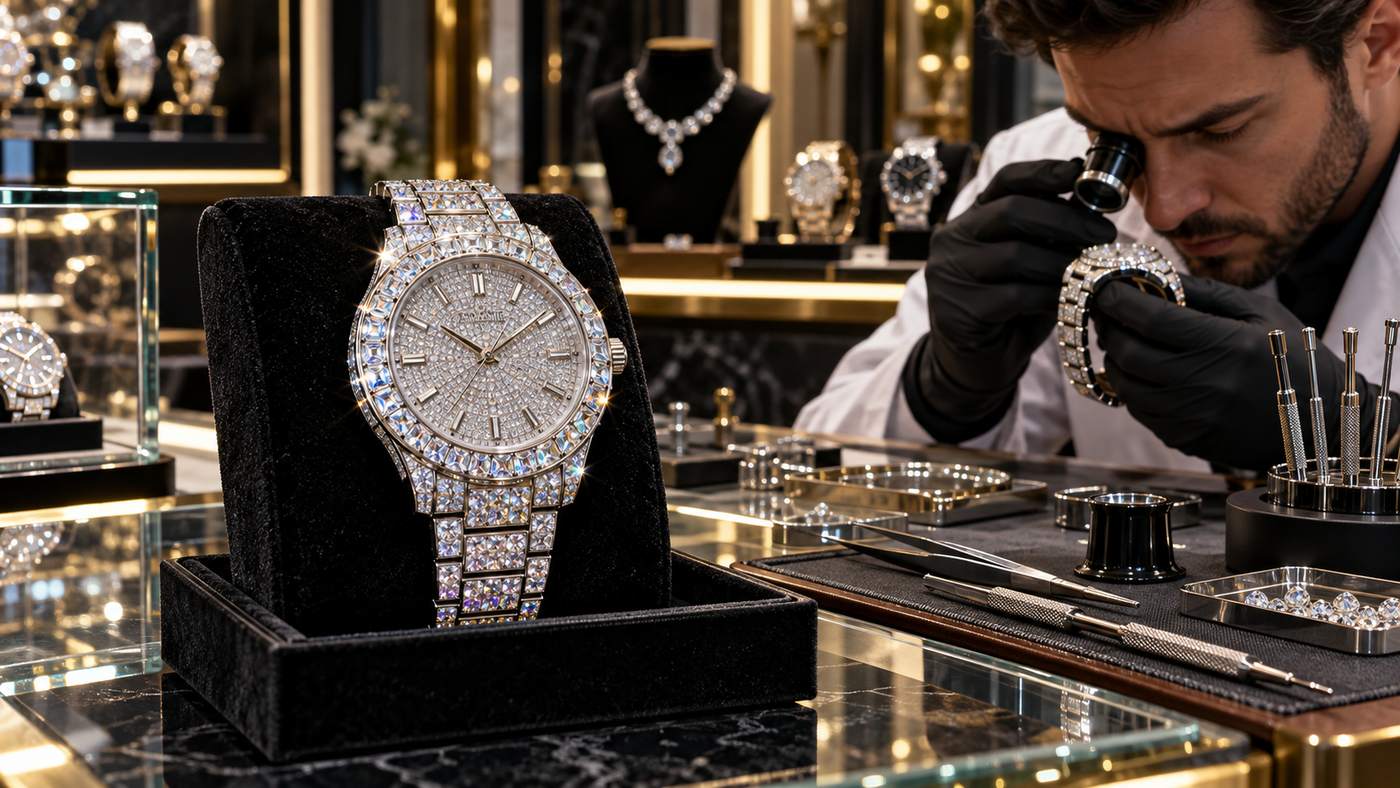
A heavily stone-covered model is often described as an iced-out watch.
The term “iced out” is informal jewelry language describing a surface covered with numerous bright stones.
Moissanite itself is a gemstone material distinct from diamond.
GIA explains that colorless synthetic moissanite became increasingly popular as a diamond alternative because of its strong brilliance, fire and durability.
That difference should be clearly understood when buying.
1. Understand Moissanite vs Diamond
Moissanite can look extremely bright, but it is not diamond.
The two materials have different:
- Chemical composition
- Optical properties
- Hardness
- Value
FTC consumer guidance specifically advises shoppers not to assume that a stone is diamond merely because it looks like one. The agency uses moissanite as an example of a gemstone that can visually resemble diamond while remaining a different material.
Moissanite Sparkles Differently
GIA states that moissanite has:
- Slightly more brilliance than diamond
- More than twice the fire of diamond
“Fire” refers to the colorful rainbow flashes created when white light separates into spectral colors.
This can make an iced-out moissanite watch particularly dramatic under:
- Jewelry-store lights
- Sunlight
- Flash photography
Some buyers specifically prefer this appearance.
Others prefer the more restrained optical character of diamond.
Neither preference is wrong.
Moissanite Is Doubly Refractive
GIA also notes that moissanite is doubly refractive.
This optical property can sometimes make internal facet reflections look doubled when viewed closely.
This is one way trained gemologists can distinguish it from diamond.
2. Moissanite Is Durable Enough for Regular Jewelry Wear
Watches are exposed to considerably more contact than many pieces of jewelry.
A ring, bracelet or watch may repeatedly encounter:
- Desks
- Doors
- Clothing
- Everyday objects
That makes gemstone durability important.
GIA rates moissanite at approximately 9.25 on the Mohs hardness scale, below diamond at 10 but still exceptionally hard compared with many jewelry stones.
Hardness Does Not Mean Indestructible
GIA also emphasizes that gemstone durability involves more than hardness.
Durability considers resistance to:
- Wear
- Heat
- Chemicals
- Environmental conditions
rather than only scratch resistance.
A moissanite watch should therefore still be treated carefully.
The stones may be hard, but other components such as:
- Prongs
- Plating
- Crystal
- Bracelet links
can still be damaged.
3. Examine the Stone Setting Carefully
The most important quality difference between two iced-out watches may not be the gemstone itself.
It may be the setting.
A watch can contain hundreds of small stones.
Every stone needs to remain secure while the wearer moves the wrist throughout the day.
Common Setting Styles
Moissanite watches may use:
- Pavé settings
- Prong settings
- Channel-style settings
The exact design depends on where the stones are installed.
Inspect for Uneven Stones
Poor setting quality may appear as:
- Crooked rows
- Uneven stone heights
- Visible gaps
- Loose stones
Good setting should create a consistent surface.
Ask Whether Stones Are Hand-Set
Many higher-quality jewelry watches use individually set stones rather than glued decorative crystals.
That does not automatically guarantee quality.
But the seller should clearly explain how the stones are attached.
Avoid Assuming “Iced Out” Means Luxury Quality
The amount of sparkle does not tell you:
- Movement quality
- Case material
- Setting durability
A heavily decorated inexpensive watch can still have lower overall build quality than a simpler watch.
4. Check the Watch Movement
One of the most common buying mistakes is focusing entirely on the stones.
The movement is the mechanism that actually keeps time.
A beautiful moissanite watch with a poor movement may become frustrating quickly.
Quartz Movement
Quartz watches use battery-powered electronic regulation.
Advantages commonly include:
- High accuracy
- Low maintenance
- Lower production cost
Quartz can be an excellent practical choice for an iced-out fashion watch.
Automatic Movement
Automatic mechanical watches use a mechanical movement that winds through wrist motion.
Many enthusiasts prefer them for:
- Mechanical craftsmanship
- Traditional watchmaking
However, automatic movements generally require more maintenance than quartz.
Ask Who Makes the Movement
The product description should ideally identify:
- Movement type
- Movement origin
- Manufacturer where relevant
A listing that simply says:
“Luxury movement”
provides very little useful information.
5. Verify the Case and Bracelet Material
The appearance of the metal can change long before the stones do.
Common base materials include:
- Stainless steel
- Sterling silver
- Gold-plated metal
- Solid gold
These are very different products.
Stainless Steel
Stainless steel is common in watches because it can provide:
- Good durability
- Corrosion resistance
- Reasonable cost
The exact grade may vary.
Gold Plating
Some gold-colored moissanite watches use a thin surface coating rather than solid gold.
That is not necessarily a problem if clearly disclosed.
However, plating can wear over time, especially on areas exposed to friction.
Solid Gold
A solid-gold watch is significantly different in cost and intrinsic metal value.
The karat purity should be clearly identified.
FTC Jewelry Guides emphasize that jewelry sellers should accurately represent metallic content and other material facts about their products.
Ask specifically:
Is this solid gold, gold plated or gold-tone stainless steel?
Those terms should not be treated as interchangeable.
6. Do Not Confuse Carat and Karat
These two words sound similar but refer to different things.
Carat
Carat measures gemstone weight.
One carat equals one-fifth of a gram.
A heavily iced watch might be advertised with a total stone carat weight.
Karat
Karat describes gold purity.
Examples include:
- 10K gold
- 14K gold
- 18K gold
If a seller says:
“20 carat watch”
you need to know whether that means gemstone weight or something else.
Clear product descriptions matter.
7. Confirm That the Stones Are Actually Moissanite
Because iced-out watches are sold across many marketplaces, gemstone descriptions can vary widely.
Some watches use:
- Moissanite
- Cubic zirconia
- Glass crystals
- Diamonds
These materials should not be represented as though they are identical.
FTC guidance emphasizes that jewelry descriptions should truthfully disclose the nature of gemstones and whether they are mined, laboratory-created or simulated.
Ask for Gemstone Documentation
For a significant purchase, ask whether the seller provides:
- Gemstone report
- Testing information
- Written stone description
Do not rely solely on marketing phrases such as:
- VVS
- Diamond tester approved
- Diamond-like
Diamond Testers Can Be Misleading
This is particularly important with moissanite.
The FTC warns that some traditional thermal diamond testers may incorrectly register moissanite as diamond.
Therefore:
“It passes a diamond tester” does not prove the stone is a diamond.
A modern tester designed to distinguish diamond from moissanite or professional gemological examination is more useful.
8. Understand What VVS Moissanite Means
Many moissanite watches are advertised as:
VVS moissanite
VVS is a clarity term strongly associated with diamond grading.
In online moissanite marketing, sellers often use it to suggest that stones have very few visible inclusions.
However, buyers should not automatically assume that a seller’s “VVS moissanite” label represents the same grading process used in a formal GIA diamond report.
Clarity Still Matters Visually
Small watch stones are viewed primarily as a group.
For most buyers, the overall appearance depends heavily on:
- Cut
- Color
- Uniformity
- Setting
A single microscopic inclusion is unlikely to dominate the appearance of an iced-out watch.
Colorless vs Near-Colorless
GIA states that moissanite can range from colorless to near-colorless, and some stones may show slight yellow or gray tones from certain angles.
This becomes especially relevant on watches because many stones are positioned next to each other.
Poor color matching can become visible across a large bracelet or bezel.
9. Compare the Entire Watch Price, Not Just Stone Count
Moissanite watches are sold across a very broad price range.
Price may reflect:
- Stone quantity
- Stone quality
- Movement
- Metal
- Setting labor
- Brand
A watch containing more stones is not automatically better.
Example
Watch A:
- Heavy moissanite coverage
- Basic quartz movement
- Plated base metal
Watch B:
- Fewer stones
- Better automatic movement
- Stainless-steel case
- Better finishing
Watch A may sparkle more.
Watch B may be the better watch.
The correct choice depends on whether you prioritize:
- Jewelry appearance
- Horology
- Everyday durability
Moissanite Watch vs Diamond Watch
The biggest difference is price and gemstone type.
Moissanite Watch Advantages
Possible advantages include:
- Strong brilliance
- Strong rainbow fire
- High hardness
- Lower gemstone cost
Diamond Watch Advantages
Diamond has:
- Greater hardness
- Different optical appearance
- Higher traditional market value
The better choice depends on budget and personal preference.
Someone who wants a dramatic iced appearance may prefer moissanite.
Someone prioritizing natural-diamond jewelry value may prefer diamonds.
Moissanite Watch vs Cubic Zirconia Watch
Moissanite is generally harder than cubic zirconia.
GIA lists moissanite around 9.25 Mohs, while CZ is about 8.5.
Moissanite also tends to offer greater durability for frequent jewelry wear.
Optical Difference
Both stones can appear bright.
However, moissanite’s distinctive fire and optical characteristics make it visually different from CZ.
Price
CZ is generally less expensive.
A buyer simply seeking a highly affordable fashion watch may be satisfied with CZ.
For a more durable stone-focused watch, moissanite may offer better long-term appeal.
What Does “Iced-Out Moissanite Watch” Mean?
“Iced out” means that much of the visible watch surface is covered with bright gemstones.
Common areas include:
- Bezel
- Dial
- Case
- Bracelet
Some watches have only an iced bezel.
Others are almost completely covered.
Fully Iced Watches
These create maximum visual impact.
However, more stones also mean:
- More settings
- More potential maintenance
The craftsmanship becomes increasingly important as stone count rises.
Should You Buy a Custom Moissanite Watch?
Some jewelers customize existing watches by adding moissanite stones.
This can create a distinctive product.
However, customization introduces additional questions.
Ask:
- Was the original case altered?
- Does customization affect water resistance?
- Does it affect manufacturer warranty?
- Can the jeweler replace lost stones?
If the base watch originally had factory warranty protection, aftermarket modification may affect that coverage.
Verify before purchasing.
Water Resistance Matters
A jewelry watch is still a watch.
Check the stated water-resistance rating.
Common descriptions may range from basic splash resistance to ratings suitable for greater water exposure.
Do not assume an iced-out watch is waterproof simply because it looks substantial.
Custom Setting Can Affect Seals
Heavy aftermarket modification can potentially involve:
- Bezel removal
- Case work
Ask whether water resistance was tested after modification.
Check the Watch Crystal
The clear surface over the dial is called the crystal.
Common materials include:
- Mineral glass
- Sapphire crystal
Sapphire is generally more scratch resistant than mineral glass.
A heavily jeweled watch may still disappoint if the crystal scratches easily.
Therefore, include crystal material in your comparison.
Bracelet Quality Is Important
An iced bracelet can contain a very large number of stones.
But comfort and construction still matter.
Check:
- Link movement
- Clasp quality
- Bracelet adjustment
- Sharp edges
A heavy watch should still sit comfortably on the wrist.
Watch Weight
Fully iced designs can feel substantial.
Before buying online, check the listed:
- Case dimensions
- Bracelet width
- Overall weight
Large watches may look impressive in photos but feel uncomfortable for some wearers.
How to Care for a Moissanite Watch
Regular cleaning helps maintain sparkle.
Oils from:
- Skin
- Lotion
- Soap
can reduce brilliance temporarily.
Gentle Cleaning
For the gemstone surfaces, use cleaning methods recommended by the watch seller or jeweler.
Avoid automatically immersing the entire watch unless its water-resistance rating and condition make that safe.
Soft Brush
A very soft brush may help remove buildup around stone settings where appropriate.
Avoid applying excessive pressure to small prongs.
Professional Inspection
For a heavily iced watch, occasional inspection can help identify:
- Loose stones
- Damaged prongs
- Bracelet wear
before a gemstone is lost.
Can Moissanite Scratch?
Yes.
Hardness does not mean impossible to scratch.
Moissanite is extremely hard, but diamond is harder. GIA ranks diamond at the top of the Mohs scale while placing moissanite at about 9.25.
Avoid storing the watch loose beside harder jewelry.
Can Moissanite Get Cloudy?
Moissanite itself does not normally become cloudy simply from ordinary aging in the same way some low-quality imitation materials may appear dull.
However, surface buildup can make stones look less bright.
Cleaning can restore appearance when the issue is:
- Oil
- Soap
- Dirt
If the watch suddenly looks dull, inspect both stones and settings.
Is a Moissanite Watch a Good Investment?
Buy it primarily as a wearable product rather than assuming it will appreciate.
The resale value of a customized or fashion-oriented watch can depend on:
- Base watch
- Brand
- Movement
- Metal
- Market demand
Moissanite generally does not carry the same traditional resale profile as high-grade natural diamonds.
A watch you genuinely enjoy wearing may still offer excellent personal value.
Just distinguish:
wearing value
from
investment value.
What to Ask Before Buying
Before ordering, ask the seller:
- Is the stone moissanite?
- Is it lab created?
- What total gemstone weight is stated?
- What is the case metal?
- Is the gold solid or plated?
- What movement is used?
- What crystal is installed?
- What is the water-resistance rating?
- Are stones hand-set?
- What warranty is included?
Clear answers are a strong sign of transparent selling.
Red Flags When Buying a Moissanite Watch
Be cautious if a seller claims:
“Real Diamond Because It Passes a Tester”
FTC guidance confirms that moissanite can fool certain thermal diamond testers.
“Solid Gold” Without Karat Information
Precious-metal descriptions should be specific.
Huge Discounts With No Original Price Context
An inflated reference price can make a normal selling price look like an extraordinary bargain.
No Movement Information
A watch seller should be able to tell you what mechanism powers the watch.
No Return Policy
Online jewelry purchases should have clearly stated terms.
Frequently Asked Questions
What is a moissanite watch?
A moissanite watch is a wristwatch decorated with lab-created moissanite gemstones across areas such as the bezel, dial, case or bracelet to create a diamond-like iced-out appearance.
Is moissanite real diamond?
No. Moissanite is a different gemstone material. The FTC specifically advises consumers not to assume that moissanite is diamond even though the two may look similar.
Does moissanite pass a diamond tester?
Some traditional thermal testers may incorrectly register moissanite as diamond. The FTC advises that more appropriate testing is needed to reliably distinguish the two.
Is moissanite durable enough for a watch?
Yes, generally. GIA rates moissanite at about 9.25 on the Mohs hardness scale, making it a highly durable jewelry gemstone, although the watch setting and metal also affect overall durability.
Why does moissanite sparkle so much?
GIA states that moissanite has slightly more brilliance and more than twice the fire of diamond, producing strong white and rainbow flashes.
Is a moissanite watch worth buying?
It can be a good choice for buyers who want strong sparkle and durable stones at a lower cost than a comparable diamond-set watch. Evaluate the movement, case material, stone setting and warranty as carefully as the gemstones.
Conclusion
A moissanite watch can deliver the dramatic iced-out look of luxury gemstone watches without the cost associated with equivalent diamond coverage. Moissanite itself is highly durable and produces exceptional brilliance and rainbow fire, but gemstone quality is only one part of a good purchase. Buyers should also evaluate the movement, metal, crystal, setting quality, bracelet construction and seller disclosures. When those elements are strong and the product is accurately represented, a moissanite watch can be an attractive combination of jewelry styling and practical watchmaking.