Penrith Air Conditioning: Choosing the Right Cooling System for Western Sydney
Reliable penrith air conditioning can make a major difference to indoor comfort during Western Sydney’s hot summer weather. Penrith regularly experiences hotter conditions than coastal parts of Sydney; Bureau of Meteorology data shows Penrith Lakes reached 42.5°C during January 2026, while its average daily maximum for that month was 30.8°C. For households and businesses, choosing an appropriately sized, energy-efficient air conditioner can therefore be about more than occasional comfort. It can affect energy use, sleep, productivity and how usable different rooms remain during extreme heat.
Modern air conditioning options range from compact wall-mounted split systems for individual rooms to multi-split and fully ducted systems designed for several rooms or an entire home. The right choice depends on the size and layout of the property, insulation, window orientation, how many rooms need conditioning and how the occupants use the space.
The NSW Government identifies split, multi-split and ducted reverse-cycle systems as the main residential options and notes that reverse-cycle air conditioners can provide both heating and cooling from one appliance.
This guide explains seven major benefits of choosing the right system in Penrith, how to compare split and ducted air conditioning, what energy ratings mean, installation considerations and how regular servicing can support reliable performance.
What Is Penrith Air Conditioning?
Penrith air conditioning refers to residential and commercial cooling and heating systems installed throughout Penrith and surrounding Western Sydney suburbs.
These systems may provide cooling only, although reverse-cycle air conditioners are particularly common because they can also provide heating during winter.
A reverse-cycle system works by moving heat rather than generating all heating directly through electrical resistance. In cooling mode, it transfers heat from inside the building to the outdoors. In heating mode, the process is reversed.
The NSW Government describes reverse-cycle systems as an all-in-one heating and cooling option and currently identifies them as an energy-efficient upgrade for homes and small businesses.
Why Penrith Homes Need Appropriate Air Conditioning
Penrith’s inland location means summer temperatures can become substantially hotter than locations closer to Sydney Harbour and the coast.
Bureau of Meteorology records for 2025 show Penrith Lakes reached 42.5°C during the year.
Heat exposure can be especially noticeable in homes with large west-facing windows, poor roof insulation, limited shading or upper-floor bedrooms.
Air conditioning performance therefore depends on more than simply purchasing the largest unit available.
An oversized system may cycle inefficiently, while an undersized system may run continuously without maintaining the desired indoor temperature.
Correct sizing requires consideration of room area, ceiling height, insulation, windows, orientation and local climate.
7 Benefits of Penrith Air Conditioning
1. Reliable Cooling During Western Sydney Summers
The most obvious benefit is temperature control during hot weather.
A properly selected air conditioner can maintain a more comfortable indoor environment when outside temperatures rise significantly.
This is particularly valuable in rooms exposed to afternoon sunlight.
Bedrooms, living rooms, home offices and open-plan areas can experience very different heat loads, so the same system size is not appropriate for every space.
Good installation begins with understanding how the building behaves during the hottest part of the day.
Managing Extreme Heat
When temperatures move above 40°C, an air conditioner must work harder.
The outdoor condenser also operates in hot external conditions, which makes suitable equipment selection and correct installation particularly important.
Homeowners can help reduce the cooling load by combining air conditioning with external shading, curtains or blinds, ceiling fans and good insulation.
The NSW Government recommends using window shading and ceiling fans alongside air conditioning and suggests a summer thermostat range of 24°C to 26°C for efficient operation.
2. Reverse-Cycle Systems Provide Heating and Cooling
A reverse-cycle air conditioner can cool the property in summer and provide heating during cooler months.
This eliminates the need for separate appliances in many homes.
Australia’s Energy Rating program states that reverse-cycle air conditioners are generally among the most energy-efficient combined heating and cooling systems available.
This can be useful in Penrith because Western Sydney experiences both hot summer days and cool winter mornings.
Instead of relying on portable heaters in winter and another appliance in summer, one correctly selected reverse-cycle system can handle both functions.
3. Modern Systems Can Improve Energy Efficiency
Air conditioners can be one of the larger household electricity loads, particularly when used for extended periods.
Energy efficiency should therefore be considered alongside purchase price.
Australia uses the Zoned Energy Rating Label for applicable air conditioners.
The label provides star ratings and estimated annual energy consumption for different Australian climate zones, allowing consumers to compare models more meaningfully.
The Energy Rating program explains that the efficiency of an air conditioner is affected by the climate in which it operates, which is why the label separates performance into hot, average and cold zones.
Compare Annual Energy Use, Not Only Stars
Two systems can have similar capacities and star ratings while still using different amounts of electricity.
The NSW Government recommends checking annual energy use in kilowatt-hours when comparing models with similar capacity and star ratings.
Homeowners can also use the Australian Government’s Energy Rating Calculator and enter a postcode to estimate climate-specific running costs.
4. Split Systems Offer Flexible Room-by-Room Cooling
A single-split system has one indoor unit connected to one outdoor unit.
It is commonly used for bedrooms, living rooms, offices and other individual areas.
Split systems can be an effective choice when only one or two rooms require regular air conditioning.
They can also be useful when homeowners want to avoid the construction work associated with ducted systems.
When a Split System Makes Sense
A split system may suit a small home, apartment, bedroom, home office or household where only the main living zone needs frequent cooling.
Because each system serves a specific room or zone, occupants can avoid cooling unused areas.
This can improve control over energy consumption.
A multi-split system provides another option where several indoor units connect to one outdoor unit.
The NSW Government identifies multi-splits as useful for multiple rooms where installing ductwork may not be practical.
5. Ducted Air Conditioning Can Condition the Whole Home
Ducted air conditioning uses a central unit connected to vents throughout the property.
It can provide a cleaner visual appearance because most equipment is concealed in the ceiling or roof space.
Ducted systems can be particularly attractive for larger homes where several rooms require heating and cooling.
The NSW Government describes ducted systems as suitable for controlling the temperature of an entire home or business.
Zoning Can Improve Control
Many ducted systems can divide the property into zones.
For example, bedrooms may form one zone while the living area forms another.
This allows occupants to avoid conditioning every room simultaneously.
Zoning can improve convenience and may help manage energy use when configured correctly.
The effectiveness depends on the design of the ductwork, system capacity and how the zones are used.
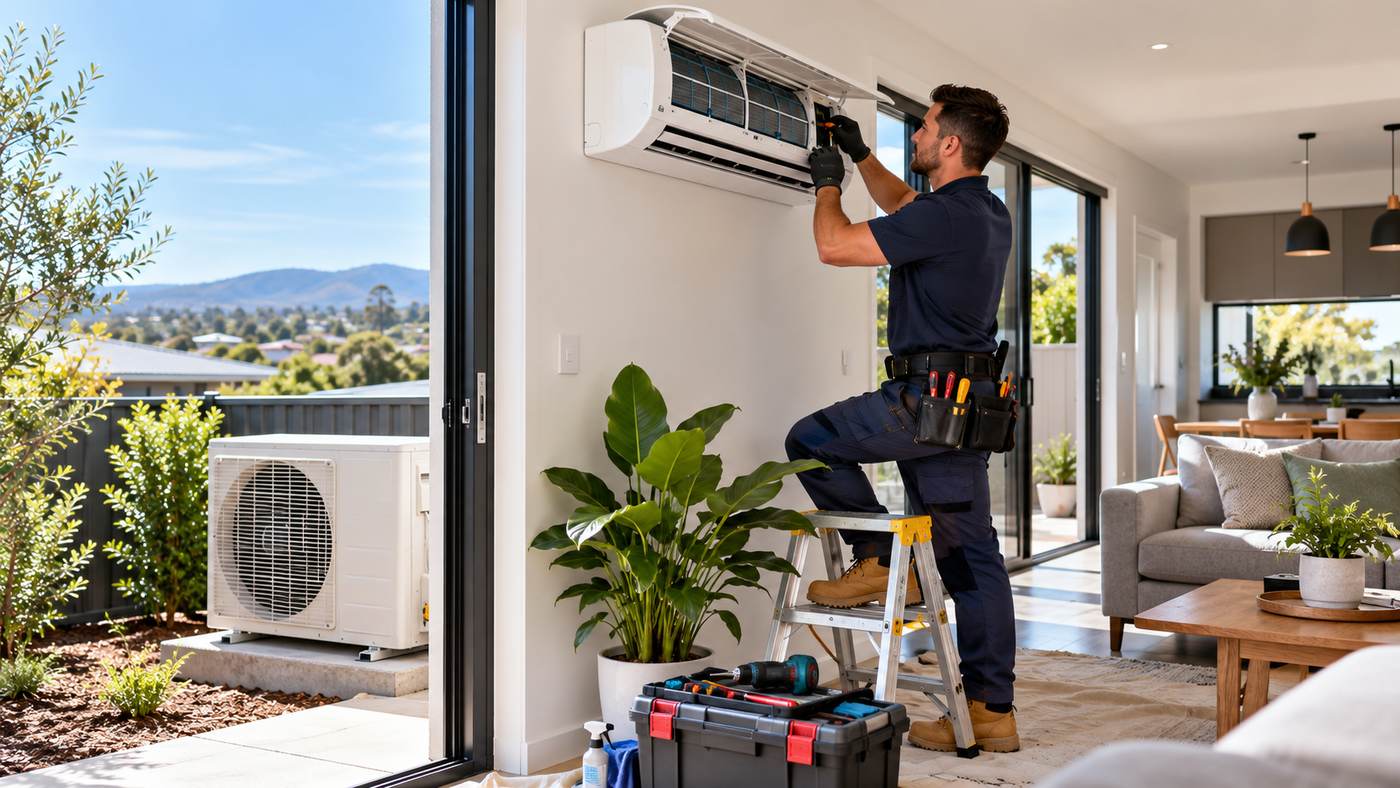
6. Professional Installation Supports Performance and Safety
Even an efficient air conditioner can perform poorly if installation is inadequate.
Unit position, pipework, drainage, electrical connections, refrigerant handling and condenser airflow all affect performance.
The NSW Government advises consumers to use licensed air conditioning and refrigeration technicians for installation to support safety, compliance and warranty requirements.
An installer should assess the property rather than simply recommend a unit based on floor area alone.
Important factors include window size, insulation, sun exposure, ceiling height and whether doors connect the conditioned space to other rooms.
Outdoor Unit Placement
The outdoor condenser requires sufficient airflow.
Placing it in a confined space where hot discharge air cannot escape can reduce performance.
The location should also allow future servicing.
Noise, drainage and neighbour considerations may influence the final position.
Indoor Unit Placement
For a wall-mounted split system, the indoor unit should distribute air effectively through the occupied space.
Placing the unit directly above furniture or where air cannot circulate freely may reduce comfort.
The installer should also plan a suitable condensate drainage route.
7. Regular Servicing Can Help Maintain Performance
Air conditioners move large volumes of air through filters, coils and fans.
Dust can gradually accumulate and reduce airflow.
The NSW Government recommends cleaning filters every few months to help maintain airflow and efficiency.
Homeowners can usually clean accessible filters according to the manufacturer’s instructions, while deeper maintenance should be handled by an appropriately qualified technician.
Professional servicing may include inspecting coils, drainage, electrical connections and general system condition.
Signs an Air Conditioner May Need Attention
Common warning signs include weaker airflow, unusual noise, water leakage, unpleasant odours, inconsistent cooling or a noticeable rise in electricity use.
A system that operates continuously but no longer reaches the selected temperature should also be investigated.
Not every problem requires complete replacement.
Dirty filters, blocked drains or relatively minor faults can sometimes be repaired.
Older systems with repeated failures or poor efficiency may make replacement more economical.
Split System vs Ducted Penrith Air Conditioning
| Feature | Split System | Ducted System |
|---|---|---|
| Best suited to | Individual rooms or selected zones | Whole homes and larger properties |
| Installation | Usually less invasive | Requires suitable roof or ceiling space |
| Upfront cost | Generally lower | Generally higher |
| Appearance | Indoor wall unit visible | Mostly concealed |
| Zoning | Individual units control rooms | Multiple zones often available |
| Maintenance | Individual units | Central equipment and ductwork |
| Expansion | Additional units can be added | More complex after initial installation |
There is no universal winner.
A small two-bedroom property may receive little benefit from an expensive full ducted system.
A large family home requiring air conditioning across many rooms may find multiple separate split systems less convenient.
A professional assessment can help compare total installation cost, expected usage and long-term running requirements.
How to Choose the Correct Air Conditioner Size
Air conditioner capacity is normally expressed in kilowatts.
Capacity should not be confused with electricity consumption.
A 7kW cooling capacity does not necessarily mean the unit constantly consumes 7kW of electricity.
Selecting the correct capacity requires a heat-load assessment.
Room dimensions are only the starting point.
An installer should also consider insulation, ceiling height, window area, orientation and occupancy.
Why Bigger Is Not Always Better
An oversized air conditioner may cool the space rapidly and switch off frequently.
This repeated cycling can affect efficiency and comfort.
An undersized unit may struggle to reach the thermostat setting and operate for extended periods.
Correct sizing allows the equipment to operate closer to its intended performance range.
Energy Rating Labels for Penrith Air Conditioning
Australia regulates air conditioners through minimum energy performance requirements under the Greenhouse and Energy Minimum Standards framework.
The Australian Government states that air conditioners up to 65kW are subject to minimum performance standards, with applicable systems using the Zoned Energy Rating Label.
The label provides cooling and heating capacity, star ratings and estimated annual electricity use.
When comparing systems, homeowners should consider the rating for the climate zone relevant to their location rather than relying on a generic efficiency claim.
Current NSW Air Conditioning Incentives
Eligible NSW households and businesses may currently be able to access an upfront discount for installing or replacing an energy-efficient air conditioner.
The NSW Government states that indicative discounts can reach up to $550 for a new 6kW air conditioner and up to $560 when replacing an older unit with a 6kW split system, although the actual amount depends on the property, provider, installation and equipment.
These schemes and eligibility rules can change.
Homeowners should confirm current conditions before making a purchase decision rather than assuming an advertised incentive will automatically apply.
How Much Does Air Conditioning Cost in Penrith?
Installation cost depends on system type, capacity and complexity.
The NSW Government currently gives a broad indicative range from around $1,500 for a single-split installation to more than $10,000 for a fully ducted system.
Individual Penrith quotes may be higher or lower.
Factors affecting price include equipment brand, capacity, electrical upgrades, pipe length, building access, number of zones, ductwork and installation complexity.
Obtaining several itemised quotes helps homeowners understand what is included.
The lowest price should not automatically determine the decision.
Licensing, workmanship, warranty support and correct system design are also important.
Air Conditioning for Penrith Bedrooms
Bedrooms usually require quieter operation than living spaces.
Night mode, low fan settings and suitable indoor unit placement can therefore be important.
Oversizing should be avoided because bedrooms are often relatively small.
External condenser noise should also be considered if the unit is close to bedroom windows.
Air Conditioning for Open-Plan Living Areas
Open-plan rooms can require significantly more cooling capacity than individual bedrooms.
Kitchen appliances, large glass doors, high ceilings and afternoon sun can increase heat load.
An installer should consider the entire connected space rather than measuring only the immediate lounge area.
In larger homes, a ducted system may be worth comparing with one or more high-capacity split systems.
Penrith Air Conditioning for Businesses
Commercial premises have different cooling requirements from typical homes.
Offices, retail stores, restaurants and workshops may experience higher internal heat loads from people, computers, lighting and equipment.
Commercial systems should therefore be designed around operating hours, occupancy and business activity.
Reliability can also become particularly important because air conditioning failure during extreme heat can affect staff and customers.
Preventive maintenance can reduce the likelihood of unexpected breakdowns during periods of high demand.
How to Use Air Conditioning More Efficiently
The NSW Government recommends setting air conditioning at approximately 24°C to 26°C during summer and 18°C to 20°C during winter. It states that each degree of adjustment in the energy-saving direction can reduce heating or cooling costs.
Efficiency also improves when homeowners reduce unnecessary heat gain.
Closing blinds before strong afternoon sunlight reaches the glass can be more effective than waiting until the room is already hot.
Doors to unused rooms can be closed where appropriate, and filters should be kept clean.
Ceiling fans can improve perceived comfort, allowing some households to use a slightly higher air-conditioning temperature.
Repair or Replace an Old Air Conditioner?
Replacement may be worth considering when an older system requires frequent repairs, no longer provides sufficient cooling or uses substantially more electricity than modern alternatives.
However, age alone does not automatically mean replacement is necessary.
A well-maintained unit that still performs effectively may continue to provide useful service.
A technician can evaluate the system and explain whether the fault is economical to repair.
When replacement is needed, compare current energy ratings rather than simply purchasing a direct capacity equivalent to the old model.
Efficiency, building conditions and household needs may have changed since the original installation.
Frequently Asked Questions
What type of Penrith air conditioning is best for a home?
Split systems are often suitable for individual rooms, while ducted systems can condition an entire house. The best choice depends on property size, usage, budget and available installation space.
Why does Penrith need powerful air conditioning?
Western Sydney regularly experiences hot summer conditions. Penrith Lakes recorded a maximum of 42.5°C during January 2026, demonstrating the level of heat local systems may need to handle.
What temperature should I set my air conditioner to in summer?
NSW Government guidance suggests around 24°C to 26°C in summer as an efficient comfort range.
Are reverse-cycle air conditioners energy efficient?
Yes. Australia’s Energy Rating program describes reverse-cycle air conditioning as generally one of the most energy-efficient combined heating and cooling options.
How often should air conditioning filters be cleaned?
NSW Government guidance recommends cleaning filters every few months to help maintain airflow and efficiency, while manufacturer instructions should also be followed.
Are there NSW rebates for installing air conditioning?
Eligible NSW households and businesses may currently qualify for air-conditioner upgrade incentives, with the amount depending on the system, installation and provider.
Conclusion
Penrith air conditioning needs to handle the demanding summer conditions common across Western Sydney while remaining efficient throughout the year. Choosing the correct capacity, comparing energy ratings and using licensed installers can have a major effect on comfort and running costs. Whether a home needs a single split system, multiple units or ducted air conditioning, the best solution is one designed around the property rather than simply choosing the biggest available unit.