Fastest Ebike: 7 Thrilling Secrets to Unleash Extreme Speed, Unmatched Torque, and Maximum Range
Electric micro-mobility has evolved far beyond modest pedal-assist commuter runabouts, crossing over into high-output, light electric vehicle performance. Sourcing the fastest e-bike gives speed enthusiasts, off-road trailblazers, and long-range cross-country riders blistering acceleration, hill-conquering torque, and motorcycle-level cruising capabilities. However, engineering a platform capable of sustaining speeds exceeding thirty, forty, or even fifty miles per hour requires far more than strapping an oversized hub motor to a lightweight bicycle chassis. It demands high-voltage lithium battery packs with sophisticated thermal dissipation, advanced sine-wave motor controllers, multi-piston hydraulic disc braking assemblies, and reinforced hydroformed aerospace aluminum frames. Exploring the mechanical architecture behind top-tier speed bikes enables performance riders to maximize velocity, preserve electrical efficiency, and maintain vehicle stability across dynamic road surfaces.
The Electrical Powertrain Engineering of High-Velocity Electric Bikes
Operating at extreme electric bicycle speeds requires overcoming exponential aerodynamic drag and high rolling resistance. As vehicle velocity doubles, aerodynamic air resistance quadruples, demanding exponential electrical wattage to sustain forward momentum. Understanding how the electrical trifecta—motor, battery pack, and motor controller—interacts is the foundation of high-speed performance evaluation.
High-Voltage System Architecture: 48V vs. 52V vs. 72V Systems
In direct-current electric vehicle powertrains, electrical voltage directly dictates motor rotational velocity (RPM), while electrical amperage dictates mechanical rotational torque. Standard entry-level electric bikes utilize 36V or 48V architectures, which reach mechanical limits around twenty to twenty-eight miles per hour. High-velocity platforms step up to 52V, 60V, or 72V electrical systems:
- 52V Powertrains: Provide a sustained voltage curve with minimal voltage sag under heavy throttle loads, allowing Class 3 speed bikes to reach top speeds of thirty to thirty-four miles per hour.
- 72V Performance Architectures: Deliver massive electrical power throughput, spinning internal motor windings at high RPMs to propel custom speed bikes and specialized hyper-commuters to top speeds of forty to fifty-five miles per hour.
Mitigating Voltage Sag Under Peak Throttle Acceleration
When a rider twists the throttle on an open straightaway, high-amperage draw can cause weak battery packs to experience voltage drop, triggering low-voltage cut-offs and sluggish acceleration. The fastest e-bike models integrate tier-one cylindrical lithium-ion cells (such as Samsung 21700 or LG Chem cells) assembled with nickel-plated copper busbars and high-discharge 50A to 80A continuous Battery Management Systems, delivering instantaneous throttle response without battery thermal stress.
Motor Topologies: High-Torque Mid-Drives vs. Gearless Direct-Drive Hubs
The choice of electric motor fundamentally shapes power delivery, speed ceiling, and drivetrain maintenance.
Direct-Drive Gearless Hub Motors
Direct-drive hub motors feature a simplified, durable design containing no internal planetary gears. The motor stator bolts directly to the rear wheel axle, while external neodymium magnets rotate with the outer wheel shell. Because direct-drive motors eliminate internal friction gears, they can absorb massive wattage (up to three thousand to five thousand peak watts) without mechanical gear stripping, making them the preferred architecture for sustained high-speed flat-ground commuting and regenerative electronic braking.
High-Torque Mid-Drive Systems
Mid-drive motors mount directly within the central bottom bracket shell, transferring rotational torque through the bicycle chain and rear cassette gears. By leveraging the mechanical gear ratios of the rear derailleur, mid-drives deliver unmatched hill-climbing torque and rapid low-end acceleration. However, transmitting extreme wattage through a standard bicycle chain can accelerate chain stretch and sprocket wear unless paired with hardened steel e-bike cassettes or heavy-duty internal gear hubs.
Intelligent Field-Oriented Control (FOC) Controllers
Raw motor wattage is useless without an advanced motor controller managing current distribution. Early speed bikes utilized square-wave controllers that generated loud motor humming and jerky low-speed throttle response. Modern performance bikes integrate Field-Oriented Control (FOC) or advanced sine-wave controllers. These microprocessors calculate rotor position thousands of times per second, delivering smooth, whisper-quiet motor operation, refined throttle modulation, and maximum electrical efficiency during sustained high-speed runs.
Performance and Powertrain Matrix by Vehicle Class
| Performance Tier | Powertrain Specs (Voltage / Peak Watts) | Realistic Top Speed | Typical Battery Capacity | Primary Terrain & Application |
|---|---|---|---|---|
| Standard Class 3 | 48V / 750W – 1000W Peak | 28 mph (Pedal Assist) | 672 Wh – 840 Wh | City bike lanes, paved commuter corridors |
| High-Speed Commuter | 52V / 1200W – 1800W Peak | 32 mph – 36 mph | 960 Wh – 1200 Wh | Suburban arterial roads, rural trail routes |
| Dual-Motor All-Terrain | 52V Dual 1000W Motors (2000W+) | 35 mph – 38 mph | 1200 Wh – 1500 Wh | Steep gravel fire roads, sand dunes, snow trails |
| Hyper-Performance / Outlaw | 72V / 3000W – 5000W Peak | 45 mph – 55 mph | 1800 Wh – 2500 Wh | Private tracks, off-road OHV vehicle parks |
| Ultra-Lightweight Carbon Racer | 36V – 48V / Specialized Mid-Drive | 28 mph – 32 mph | 400 Wh – 600 Wh | Paved road cycling, fast group training rides |
Frame Metallurgy, Aerodynamics, and High-Speed Chassis Stability
Sustaining speeds over thirty miles per hour exposes a bicycle frame to severe vibrational harmonics, high cornering forces, and elevated torsional stress. Standard lightweight bicycle frames can suffer dangerous high-speed steering wobble if geometry and suspension are poorly calibrated.
Reinforced Hydroformed 6061-T6 Aluminum Frames
The fastest e-bike builds utilize heavy-duty, hydroformed 6061 or 7005 aircraft-grade aluminum alloy tubing with reinforced gussets welded at the head tube and rear dropouts. Thicker wall profiles provide torsional stiffness, preventing frame flex during full-throttle acceleration and aggressive cornering.
Rake, Trail, and Steering Head Angle Dynamics
Chassis stability at speed is dictated by steering geometry. Steep head tube angles (common on agile urban road bikes) feel nervous and twitchy at high velocities. In contrast, performance speed bikes feature relaxed, slacker head angles (between sixty-five and sixty-seven degrees) paired with longer fork offsets. This geometry increases mechanical trail, allowing the front wheel to self-center smoothly at speed and eliminating high-speed headshake.
Full Suspension Integration: Inverted Motorcycle-Style Forks
Hitting a recessed pothole, asphalt seam, or gravel rut at thirty-five miles per hour on a rigid bicycle frame can easily cause a rider to lose control. Modern performance speed bikes feature full-suspension layouts incorporating:
- Inverted air-oil or coil suspension forks: Sized with thick 34 mm to 38 mm stanchions that resist lateral twisting under hard front braking.
- Four-bar linkage rear air shocks: Providing adjustable rebound damping and compression lockout to smooth out high-speed chatter without absorbing pedaling energy.
High-Performance Stopping Power: Four-Piston Hydraulic Braking
The ability to accelerate rapidly is meaningless without the engineering capacity to stop safely. Kinetic energy increases with the square of velocity; stopping a forty-mile-per-hour electric bike requires four times the braking energy demanded by a twenty-mile-per-hour cruiser.
Multi-Piston Hydraulic Disc Calipers
Mechanical cable-actuated rim or disc brakes are dangerously inadequate for high-speed e-bikes. Performance builds mandate four-piston hydraulic disc brakes:
- Mineral oil or DOT fluid hydraulic lines provide instant, fade-free clamping force with minimal hand lever effort.
- Four opposing pistons distribute hydraulic pressure evenly across enlarged brake pads, preventing uneven pad wear and brake glaze.
- High-diameter rotors (203 mm or 220 mm diameter) measuring 2.3 mm in thickness provide massive heat dissipation, preventing brake fade during prolonged descents.
Electronic Motor Cut-Off Sensors and Regenerative Braking
Safety standards demand integrated microswitch cutoff sensors inside brake levers. The instant a rider pulls a brake lever, the motor controller cuts power to the drive motor, eliminating unintentional motor resistance during emergency braking maneuvers. On direct-drive hub platforms, pulling the lever activates magnetic regenerative braking, which uses the motor’s reverse electromagnetic resistance to slow the bike while returning kinetic energy back into the battery pack.
Regulatory Frameworks, Safety Equipment, and Responsible Riding
Because the fastest e-bike models deliver speeds that blur the line between bicycles and mopeds, riders must understand local vehicle regulations and safety gear requirements.
The Three-Class Legal Framework vs. Private Land Use
In the United States, federal and state laws govern public road access through a three-class tier system:
- Class 1: Pedal-assist only, maximum motor assist speed of 20 mph, 750W motor cap.
- Class 2: Throttle-actuated, maximum motor assist speed of 20 mph, 750W motor cap.
- Class 3: Pedal-assist only, maximum motor assist speed of 28 mph, speedometer required.
Electric bikes that exceed twenty-eight miles per hour or feature throttles operating above twenty miles per hour are classified as out-of-class electric vehicles. In many jurisdictions, these high-speed machines are restricted to private property, off-road OHV trails, or require moped registration, driver licensing, and turn signal lighting for street-legal operation.
Essential High-Speed Protective Gear
Riding an electric bike at automotive speeds demands protective gear beyond lightweight foam bicycle helmets:
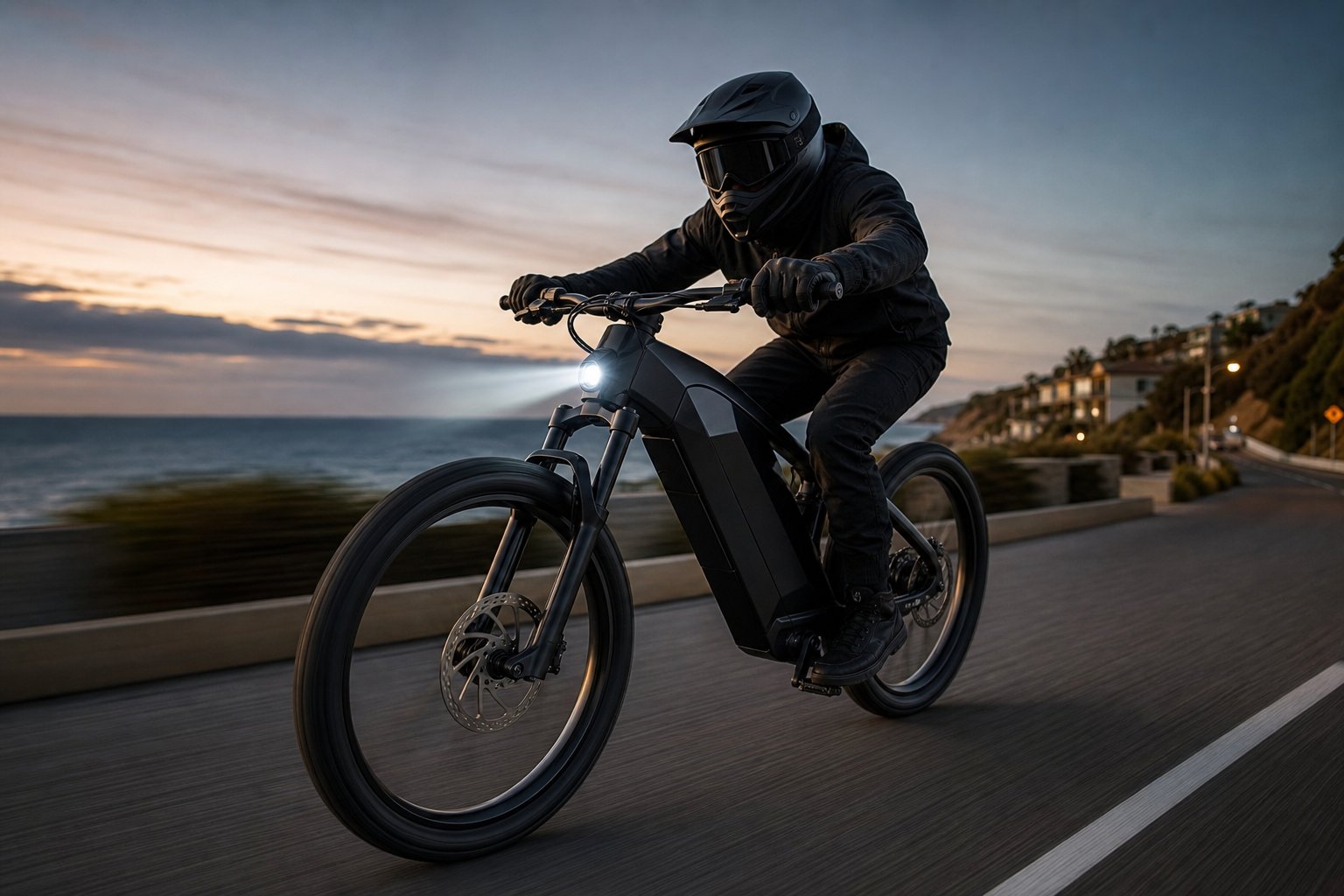
- Helmets: Wear a downhill-certified full-face bicycle helmet (ASTM F1952) or a lightweight DOT/ECE-approved motorcycle helmet to protect against facial and cranial impacts.
- Eye Protection: Shatterproof polycarbonate goggles or helmet visors shield eyes from wind, tears, dust, and flying road debris.
- Abrasion-Resistant Apparel: Kevlar-lined jackets, armored riding gloves, and reinforced footwear protect soft tissue against severe road rash in the event of an unexpected slide.
Frequently Asked Questions About the Fastest Ebike
What is considered the fastest e-bike currently available for consumer purchase?
Specialized hyper-performance off-road e-bikes utilizing 72V powertrains can reach speeds between forty-five and sixty miles per hour on private tracks and designated OHV areas.
How fast can a road-legal Class 3 electric bicycle travel on public roads?
Under standard state regulations, a road-legal Class 3 electric bicycle provides motor assist up to a statutory maximum speed of twenty-eight miles per hour.
How does riding at maximum speed affect total battery range?
Riding at continuous top speeds drains battery capacity two to three times faster than cruising at moderate speeds due to steep increases in aerodynamic drag.
Are dual-motor electric bikes faster than single-motor bikes?
Dual-motor setups provide exceptional low-end acceleration and superior hill-climbing traction on loose surfaces, though top speed is ultimately governed by system voltage and motor winding RPM rather than motor count alone.
Can I upgrade a standard 48V e-bike to reach forty miles per hour easily?
No, exceeding thirty miles per hour safely requires upgrading the motor controller, installing higher-voltage batteries, reinforcing the frame dropouts, and fitting four-piston hydraulic disc brakes.
Why are direct-drive hub motors often preferred for high-speed electric commuting?
Direct-drive hubs contain no internal gears to strip under heavy continuous wattage, run whisper-quiet, and support magnetic regenerative braking that saves mechanical brake pads.
Conclusion
The pursuit of the fastest e-bike represents the convergence of high-capacity lithium battery technology, intelligent motor control, and aerospace chassis engineering. Reaching and sustaining exhilarating speeds safely requires an integrated machine designed from the ground up to manage intense thermal loads, aerodynamic drag, and high braking forces. By prioritizing 52V or 72V electrical architectures, four-piston hydraulic disc brakes, full suspension geometry, and high-discharge tier-one battery cells, performance riders unlock unprecedented speed without sacrificing reliability. Balancing high-speed power delivery with responsible riding etiquette, full-face protective equipment, and compliance with local trail and road regulations ensures an unmatched riding experience that redefines modern electric personal transportation.