AC Replacement Guide: When a New Air Conditioner Makes Sense
An AC replacement can become the better long term option when an air conditioner experiences repeated failures, needs a major costly repair, performs poorly, uses an obsolete or difficult to service refrigerant, or no longer matches the cooling requirements of the home. Replacing an air conditioner is more involved than choosing a unit with a high efficiency rating. Correct equipment sizing, ductwork condition, installation quality, climate, humidity control, electrical compatibility and lifecycle costs can all determine whether the new cooling system delivers the comfort and efficiency you expect.
An air conditioning system is a significant home investment. Replacing one too early can waste usable equipment life, while repeatedly repairing a seriously deteriorated system can become expensive and inconvenient.
The decision should therefore be based on the condition of the complete system rather than age alone.
This guide covers seven potential benefits of replacement, warning signs, equipment sizing, efficiency ratings, installation, costs and questions to ask an HVAC contractor.
What Does AC Replacement Include?
Air conditioner replacement means removing some or all of an existing cooling system and installing equipment selected for the building’s cooling requirements.
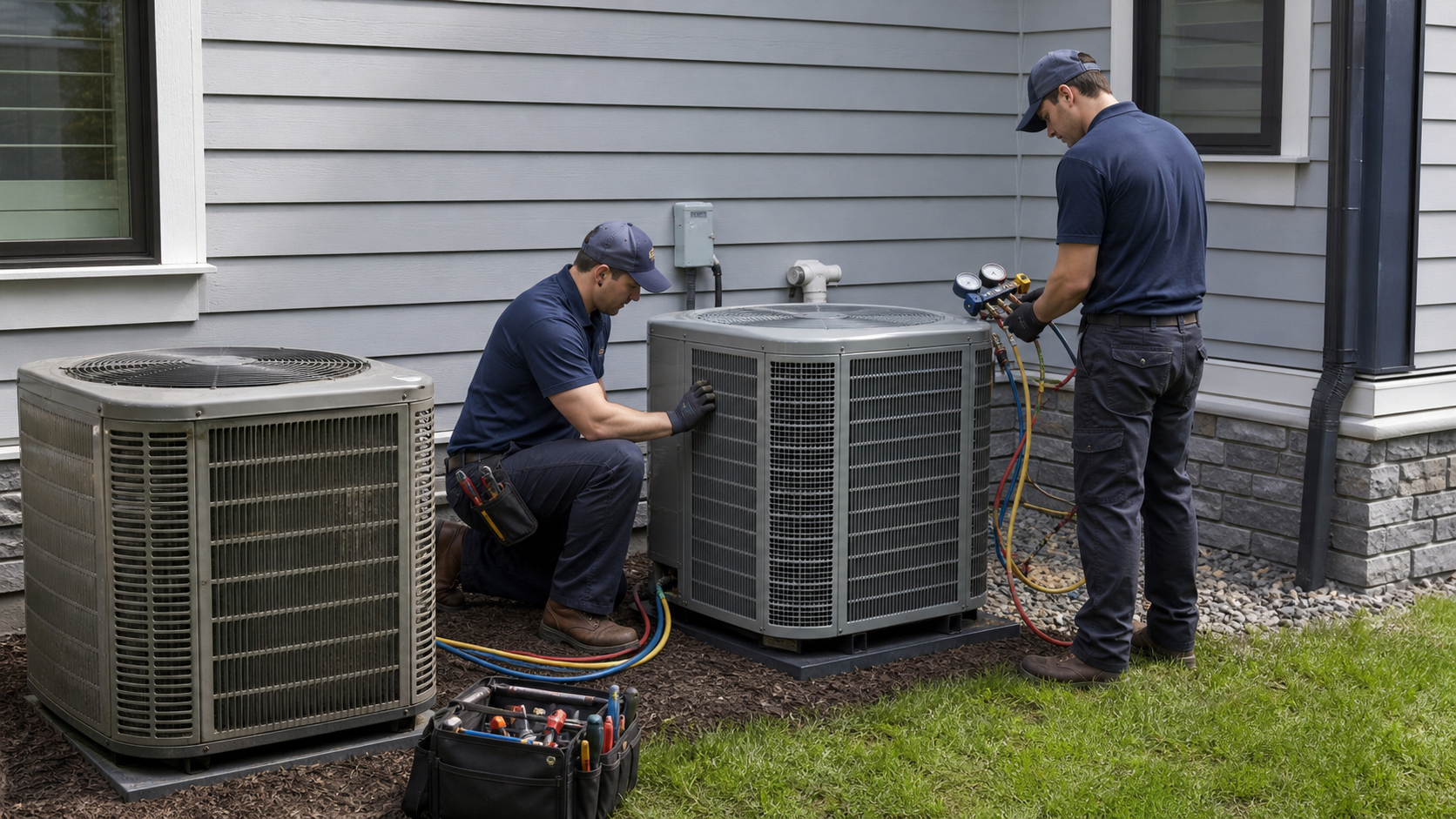
In a typical split central air conditioning system, the major components include an outdoor condenser and compressor assembly plus an indoor evaporator coil. The system also relies on a blower, thermostat, refrigerant lines, condensate drainage, electrical components and ductwork.
Depending on the project, replacing only one component may not be appropriate.
A contractor should assess equipment compatibility before recommending a partial replacement.
AC Replacement Versus AC Repair
Repair involves correcting a specific fault while continuing to use the existing equipment.
Replacement involves installing new equipment because continued repair may no longer provide good value, reliability or suitable performance.
Neither choice is automatically correct.
A relatively new system with an isolated replaceable component may be worth repairing. An older system with a major failure and several other deteriorating components may justify replacement.
What Happens to the Existing Air Conditioner?
During replacement, the contractor disconnects and removes equipment that will no longer be used.
Refrigerant must be handled according to applicable environmental regulations. It should not simply be released into the atmosphere.
Old equipment should also be recycled or disposed of according to local requirements.
Why Professional AC Replacement Matters
Air conditioning installation involves high voltage electricity, refrigerants, drainage and precise mechanical work.
Incorrect refrigerant charge, poor airflow or improper electrical installation can reduce performance and damage equipment.
Requirements vary by location, so homeowners should select professionals holding the licenses and refrigerant credentials required in their jurisdiction.
7 Powerful Benefits of AC Replacement
A properly selected replacement system can offer several advantages when the existing air conditioner has genuinely reached the point where replacement is justified.
1. Improved Cooling Efficiency
Older equipment may have lower rated efficiency than newer qualifying systems.
Efficiency ratings help consumers compare equipment, although regional rating methods and minimum standards differ.
A higher rated air conditioner does not guarantee a particular reduction in electricity bills.
Actual energy use depends on climate, thermostat settings, home insulation, duct losses, equipment sizing, maintenance and installation quality.
2. More Reliable Cooling
Repeated breakdowns can make an older system increasingly difficult to depend on during hot weather.
Replacing deteriorated equipment can reduce exposure to failures associated with aging components.
New equipment can still fail, so warranty quality and correct installation remain important.
3. Better Temperature Control
A correctly sized modern system may provide more consistent temperature control than malfunctioning or poorly matched existing equipment.
Variable speed or multi stage systems can adjust output under different conditions.
This can reduce unnecessary cycling and provide steadier operation when correctly designed.
4. Potentially Better Humidity Management
Air conditioning removes some indoor moisture as air passes over a cold evaporator coil.
Equipment selection and runtime can therefore influence indoor humidity.
An oversized system may cool a house quickly but run for insufficient periods to provide desirable moisture removal in humid climates.
Proper sizing is essential.
5. Quieter Operation
Newer equipment may incorporate improved fan, compressor and cabinet designs that reduce operating noise.
Sound ratings vary significantly between models.
If outdoor or indoor noise is an important concern, compare manufacturer sound data before purchasing rather than assuming every modern unit is quiet.
6. Updated Equipment and Controls
Replacement provides an opportunity to evaluate compatible thermostats, variable speed air handlers, zoning controls and other system features.
Not every feature is necessary for every home.
Controls should be selected for actual comfort requirements and confirmed compatible with the chosen HVAC equipment.
7. New Warranty Coverage
New air conditioners usually include manufacturer warranty coverage subject to specific terms.
Some manufacturers require product registration or impose different coverage conditions depending on ownership and installation.
Contractors may also provide separate labor warranties.
Read both sets of terms rather than assuming all future repairs are fully covered.
Signs You May Need AC Replacement
A single repair does not necessarily justify purchasing a new air conditioner.
The overall pattern of performance is more informative.
Frequent Repairs
Repeated service calls can indicate that multiple components are aging or that an underlying system issue has not been corrected.
Review your recent repair history.
If expensive failures occur repeatedly, ask the technician for both repair and replacement options so you can compare long term costs.
A Major Component Failure
Compressor and coil related repairs can be substantial, depending on equipment design, warranty status and local labor costs.
A major failure does not automatically mean replacement is required.
However, it is a reasonable point to evaluate the condition and remaining expected usefulness of the overall system.
Cooling Performance Has Declined
An air conditioner that previously maintained comfortable temperatures but now struggles deserves professional diagnosis.
Potential explanations include airflow restrictions, refrigerant faults, dirty coils, control problems or building related issues.
Replacement should follow diagnosis, not precede it.
When AC Replacement Is Better Than Another Repair
Replacement becomes more compelling when major repair expense overlaps with advanced equipment age, poor overall condition, repeated failures, limited parts availability or substantial performance concerns.
Ask for an itemized repair estimate and a complete replacement proposal.
Comparing both options provides a stronger basis for deciding than relying on a simple age rule.
How Long Do Air Conditioners Last?
There is no exact lifespan that applies to every cooling system.
Climate, operating hours, installation quality, maintenance, corrosion and equipment design all affect longevity.
A system operating heavily in a hot coastal environment may age differently from the same model used seasonally in a mild inland climate.
Is an Old AC Automatically Inefficient?
Not necessarily.
Age can correlate with older efficiency standards and component wear, but actual performance should be assessed.
Likewise, installing newer equipment does not guarantee excellent efficiency if the duct system leaks badly or installation is incorrect.
The building and HVAC equipment work together as one system.
Age Versus Condition
Condition is usually more useful than a calendar number alone.
A contractor can inspect major components, review operating performance and discuss parts availability.
This allows homeowners to make a decision based on the specific system rather than a universal replacement timeline.
AC Replacement Cost Explained
The total price of replacement can vary substantially.
House size alone cannot provide an accurate estimate because two similar houses may require different equipment and installation work.
What Affects AC Replacement Cost?
Important cost factors include:
• Cooling capacity
• Equipment efficiency
• System type
• Indoor and outdoor equipment
• Installation complexity
• Electrical modifications
• Refrigerant line requirements
• Drainage work
• Duct repairs or modifications
• Local permits
• Labor rates
• Climate specific requirements
• Optional control systems
Quotes should clearly identify the model numbers and scope of work.
Equipment Cost Versus Installation Cost
The outdoor condenser is only one part of the project.
Installation may require indoor coil work, electrical connections, refrigerant piping, condensate drainage and commissioning.
Low quotes that omit necessary work can become expensive if additional charges appear after installation begins.
Hidden Costs to Consider
Ask whether the proposal includes permits, disposal of old equipment, electrical upgrades, line set changes and thermostat work.
Also ask what happens if damaged or inadequate ductwork is discovered.
Getting an Accurate AC Replacement Estimate
The contractor should inspect the home and existing system before giving a final recommendation.
A proposal based entirely on the tonnage of the existing equipment may reproduce previous sizing errors.
Request written estimates showing equipment specifications, warranty details and installation scope.
Correct AC Sizing Is Essential
One of the most important replacement decisions is cooling capacity.
Bigger is not automatically better.
What Is Cooling Load?
Cooling load represents the amount of heat that must be removed to maintain indoor conditions under defined outdoor conditions.
It can be influenced by:
• Building size
• Insulation
• Window area and characteristics
• Air leakage
• Orientation
• Occupancy assumptions
• Climate
• Internal heat sources
A professional load calculation uses these factors to estimate required capacity.
Problems With an Oversized Air Conditioner
An oversized system can satisfy the thermostat quickly and then switch off.
Frequent cycling may affect comfort and, in humid climates, can compromise moisture removal.
Oversizing can also mean paying for capacity the home did not need.
Problems With an Undersized System
A significantly undersized unit may struggle to maintain desired indoor conditions during design weather.
Long operation is not automatically evidence of undersizing because modern systems may be designed for extended runtimes.
Performance should be evaluated against equipment design and actual building load.
AC Replacement and Manual J Calculations
In the United States, ACCA Manual J is a recognized methodology for residential load calculations.
Other countries may use different standards.
Ask the HVAC contractor which accepted sizing methodology applies in your location and how the proposed capacity was determined.
Understanding AC Efficiency Ratings
Energy ratings can help compare air conditioners, but they must be interpreted correctly.
SEER and SEER2
In the United States, seasonal energy efficiency metrics are used for central air conditioning equipment.
SEER2 is part of updated Department of Energy testing and efficiency requirements and should not be casually treated as numerically identical to older SEER ratings.
Applicable minimum efficiencies depend on equipment category, region and effective regulations.
EER and Other Ratings
EER measures performance under defined testing conditions, while other regions use different seasonal or standardized metrics.
Always compare products using the rating system applicable to your market.
Does Higher Efficiency Always Save Money?
Higher efficiency can reduce energy use under suitable conditions, but financial savings depend on several variables.
Climate, electricity prices, system runtime, installation and the efficiency difference between old and new equipment all matter.
Choosing AC Replacement Efficiency Wisely
Instead of automatically purchasing the highest rating, compare initial cost with expected operating requirements.
A qualified contractor or energy professional can help estimate potential consumption using local climate and utility information.
Avoid sales claims promising a fixed percentage reduction without analysis of the existing home and equipment.
Choosing the Right Type of Replacement Air Conditioner
Central split systems are common, but they are not the only option.
Central Air Conditioning
A conventional central system uses ductwork to distribute cooled air throughout the home.
If existing ducts are well designed and in good condition, replacement can be relatively straightforward.
Poor duct systems should be addressed rather than ignored.
Heat Pump Systems
Heat pumps can provide cooling and heating.
Their suitability depends on climate, electricity rates, existing heating equipment and building characteristics.
Modern heat pump technology can operate across a wide range of conditions, but system design should reflect local requirements.
Ductless Mini Split Systems
Mini splits use one or more indoor units connected to outdoor equipment.
They can be useful for homes without existing ducts, additions or areas requiring independent control.
AC Replacement Versus Heat Pump Conversion
Replacing a conventional cooling system with a heat pump may offer the additional benefit of electric heating.
However, the decision should consider local climate, energy prices, electrical capacity and any backup heat requirements.
Do not assume the same solution is economically optimal in every location.
The Professional AC Replacement Process
Understanding installation steps helps homeowners evaluate contractor quality.
Home and System Assessment
The contractor reviews the existing HVAC system, building characteristics and comfort concerns.
Ducts, electrical service and equipment location may also be evaluated.
Equipment Selection
Capacity, efficiency, system type and compatible components are selected.
Matched equipment is important because an outdoor unit, indoor coil and air handler can affect each other’s performance.
Removing Old Equipment
Electrical power is safely isolated, and refrigerant is recovered according to applicable requirements.
Existing components are then disconnected and removed.
Installing New Equipment
The contractor positions the equipment and completes mechanical, electrical, drainage and refrigerant connections.
Installation should follow manufacturer specifications and applicable codes.
Commissioning After AC Replacement
Installation is not complete simply because cold air comes from the vents.
Commissioning may include checking airflow, electrical operation, temperature performance, controls and refrigerant system parameters according to manufacturer procedures.
Ask for documentation of relevant startup measurements where available.
Ductwork and AC Replacement
Replacing equipment while ignoring serious duct problems can limit the value of the project.
Duct Leakage
Leaks can waste conditioned air or draw unwanted air into the system.
Professional assessment can determine whether leakage is substantial enough to justify repair.
Duct Size
Ducts need to accommodate appropriate airflow.
Replacing equipment with a different capacity or airflow requirement without checking ducts can contribute to noise, pressure problems or poor performance.
Insulation
Ducts passing through unconditioned spaces may require suitable insulation according to local codes and climate.
Damaged insulation can increase heat gain and create other performance concerns.
Choosing an AC Replacement Contractor
Installation quality can matter as much as the equipment brand.
Verify Licensing
Confirm that the contractor holds required local or state licenses.
Technicians handling regulated refrigerants should possess the certifications required in the relevant jurisdiction.
Official government or licensing databases are preferable to relying solely on website claims.
Compare Detailed Quotes
Quotes should identify specific equipment rather than simply stating something like premium air conditioner.
Look for:
• Manufacturer and model numbers
• Cooling capacity
• Efficiency rating
• Indoor equipment
• Thermostat or controls
• Installation work
• Duct modifications
• Warranty terms
• Permit responsibilities
Comparable details make competing proposals much easier to evaluate.
Avoid High Pressure Sales Tactics
A contractor should explain why replacement is recommended.
Be cautious when someone declares equipment beyond repair without performing meaningful diagnostic work.
For expensive projects, obtaining another professional opinion can be worthwhile.
AC Replacement Questions to Ask Before Signing
Ask how equipment was sized, which components are being replaced and whether ductwork was evaluated.
Also ask who handles permits, how commissioning is performed and what labor warranty applies.
Clear answers before signing reduce misunderstandings later.
Repair or Replace Your Air Conditioner?
The best decision combines financial and technical information.
Consider the Repair Cost
Obtain a written diagnosis and estimate.
Then compare that expense with replacement while considering the condition of the remaining equipment.
A relatively inexpensive repair on otherwise sound equipment may provide good value.
Consider Reliability
Repeated breakdowns affect more than repair bills.
Loss of cooling during extreme heat can create significant disruption and, for vulnerable people, potential health concerns.
Reliability may therefore carry value beyond simple payback calculations.
Consider Future Serviceability
Replacement parts can become difficult or expensive to obtain as equipment ages.
Refrigerant type can also affect servicing considerations.
A qualified contractor can explain whether the existing system remains practical to support.
Avoiding the Wrong AC Replacement Decision
Do not replace equipment solely because of a generic age threshold, and do not continue repairing indefinitely because each individual bill seems manageable.
Evaluate total condition, recent repair history, likely future costs and replacement benefits together.
That approach produces a more defensible decision.
Maintaining a New Air Conditioner
Correct maintenance protects both performance and the investment.
Maintain the Air Filter
Use a filter compatible with system requirements and replace or clean it as specified.
An excessively restrictive or neglected filter can affect airflow.
Keep Outdoor Equipment Clear
Maintain manufacturer required clearances around outdoor equipment.
Remove leaves and vegetation that could significantly block airflow.
Avoid placing decorative structures around the unit without considering ventilation.
Schedule Suitable Maintenance
Professional maintenance can identify operating problems and verify important system conditions.
Follow manufacturer recommendations regarding service frequency and warranty requirements.
Protecting Your AC Replacement Investment
Keep installation documents, model and serial numbers, warranty information and maintenance records.
Complete any required manufacturer registration within the stated timeframe.
These records can simplify future service and warranty claims.
Frequently Asked Questions
How do I know when AC replacement is necessary?
Repeated failures, major repair costs, declining performance, poor overall condition and limited parts availability can make replacement worth considering after professional diagnosis.
How much does AC replacement cost?
Cost varies according to equipment size, efficiency, system type, installation complexity, ductwork, electrical requirements, permits, labor and location.
Should I repair or replace my old AC?
Compare repair cost with equipment condition, reliability, efficiency, warranty status and future serviceability. Age should be considered but not used as the only criterion.
How long does AC replacement take?
Installation time varies with equipment and project complexity. Straightforward replacements may be quicker than projects requiring ducts, electrical modifications or system redesign.
Does a new AC lower electricity bills?
A more efficient system can use less energy, but actual savings depend on climate, usage, building efficiency, installation quality and the condition of the previous equipment.
What size replacement AC do I need?
Capacity should be based on an accepted cooling load calculation rather than floor area alone or simply copying the size of the existing air conditioner.
Conclusion
AC replacement can improve reliability, comfort and energy performance when existing equipment is no longer economical or practical to maintain. The strongest results come from correct sizing, matched components, appropriate ductwork and careful professional installation rather than choosing equipment by brand or capacity alone. Compare repair and replacement costs using a documented diagnosis, and select a qualified contractor who can explain the proposed system clearly. Proper commissioning and ongoing maintenance can then help your new air conditioner perform as designed for years to come.